As artificial intelligence expands beyond text generation into robotics, autonomous driving, and systems that interact with the physical environment, AI models are becoming increasingly dependent on real world data involving movement, vision, and environmental feedback.
Compared with internet text data, this type of robotics training data is more expensive to obtain and more limited in scale, which makes it a major bottleneck for the embodied AI industry. The sector Caspius operates in sits at an important intersection of AI data infrastructure, DePIN, and Physical AI.
The Origins of Caspius and the Rise of Embodied AI
Embodied AI generally refers to AI systems that can perceive, act, and interact with their surroundings in the real world, such as robots, autonomous driving devices, and intelligent mechanical systems. Unlike traditional large language models, which mainly process textual information, embodied AI must learn spatial relationships, action logic, and physical feedback in the real world. As a result, it requires far more real world behavioral data during training.
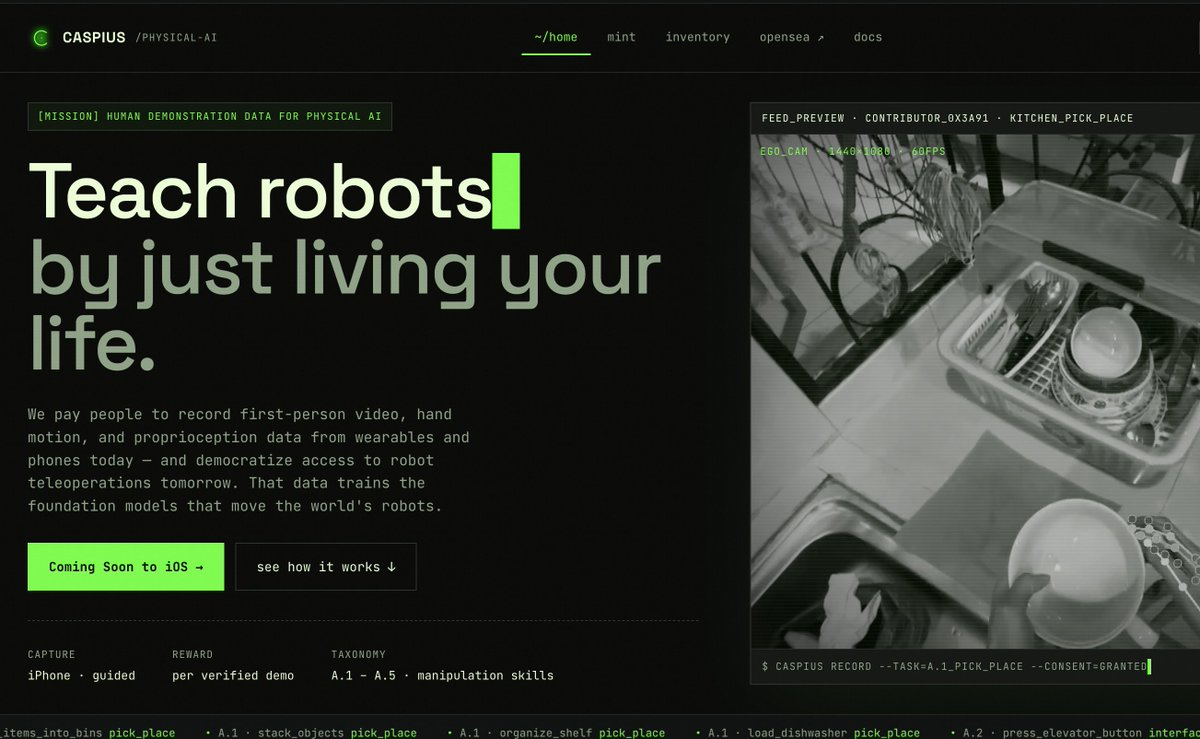
In recent years, the AI industry has increasingly recognized that relying only on internet text data is not enough to support the next stage of robotic intelligence. Robotic models need to understand language, but they also need to learn how to act. For example, when a robot learns the action of “picking up a cup,” it needs large amounts of first person video, motion trajectories, and feedback from the physical environment as training samples.
Caspius aims to address this issue through an open data network. By using blockchain-based incentive mechanisms, the project encourages users to upload data that can be used for robotics training, thereby expanding the scale of data sources available to embodied AI models.
How Does Caspius Work?
The core logic of Caspius is to build an open network for data collection and verification. Users can upload real world behavioral data through the platform, such as first person videos, action demonstrations, environment interaction processes, and sensor data. Once verified, this data can be used to train robotics AI models.
The process generally includes the following steps:
-
Users collect real world behavioral data
-
The data is uploaded to the Caspius network
-
The network verifies the quality and authenticity of the data
-
AI developers or model training platforms access the data
-
Data contributors receive CAS incentives
Compared with traditional AI data platforms, Caspius places greater emphasis on openness and data ownership. Data contributors can take part directly in value distribution, rather than having data revenue captured exclusively by a centralized platform.
Why Does Caspius Emphasize Real World Data?
One of the biggest differences between robotics AI and text generation models is that robotics AI must understand the physical world. Text models mainly learn relationships between words and concepts, while robotic systems need to learn action execution, spatial positioning, and environmental interaction.
For example, when a robot learns to “open a door,” it needs more than just the definition of a door. It also needs to understand:
-
The position of the door handle
-
The trajectory of hand movement
-
Changes in force and angle
-
Spatial feedback after the door opens
This information cannot be obtained through text alone, which is why real world behavioral data has become an important resource for embodied AI.
As automation equipment and AI Agents gradually move into real world use cases, the importance of robotics training data continues to grow. Caspius aims to build a scalable data supply network.
What Is the CAS Token Used For?
CAS is the native token of the Caspius network. It is mainly used for ecosystem incentives and governance.
Its core uses include:
| Function |
Description |
| Data contribution rewards |
Users can receive CAS incentives after uploading valid training data |
| Network governance |
Token holders can participate in protocol governance and parameter adjustments |
| Data verification mechanism |
Some verification processes may require staking or incentive mechanisms |
| Ecosystem collaboration |
Used for value transfer in AI data markets and partnership scenarios |
In decentralized AI infrastructure, tokens usually do more than function as a payment tool. They also help coordinate the interests of different network participants. Through CAS, Caspius aims to establish a long term, sustainable data contribution system.
Traditional AI data platforms are usually controlled by centralized companies, with data collection, distribution, and revenue allocation concentrated in the hands of the platform operator. Caspius, by contrast, places greater emphasis on open networks and community collaboration.
The main differences between traditional AI data platforms and Caspius include:
| Comparison Dimension |
Caspius |
Traditional AI Data Platforms |
| Data ownership |
Greater emphasis on contributor participation |
Centrally controlled by the platform |
| Incentive model |
Blockchain token incentives |
Platform based payment model |
| Data transparency |
On chain verifiable mechanisms |
Black box management |
| Ecosystem structure |
Open network |
Centralized platform |
| Web3 integration |
Supports on chain collaboration |
Usually does not involve blockchain |
This distinction makes Caspius closer to the DePIN and open AI infrastructure model.
What Challenges Does Caspius Face?
Although decentralized AI data networks have growth potential, Caspius still faces several challenges.
The first is authenticity. Robotics training data requires a high level of accuracy. Low quality or falsified data may affect model training results, making verification mechanisms especially important.
The second is privacy and compliance. Real world video and behavioral data may involve personal privacy, environmental information, and regulatory requirements. Legal standards may also vary across regions.
In addition, the AI data market itself is highly competitive. Large technology companies, AI labs, and traditional data platforms are also continuously expanding their own data collection capabilities.
As a crypto asset, CAS may also be affected by market volatility, industry cycles, and changes in ecosystem development.
Conclusion
Caspius (CAS) is a decentralized data infrastructure protocol built for embodied AI and robotics AI. It aims to expand the supply of real world training data through an open network. The project combines AI data networks, DePIN, and Web3 incentive mechanisms in an effort to build a more open robotics training data ecosystem.
As the AI industry gradually expands from text based models to real world interactive systems, the importance of robotics training data continues to rise. Decentralized data networks represented by Caspius are also becoming an important direction in the convergence of AI and blockchain.
FAQs
Is Caspius an AI Project or a DePIN Project?
Caspius has both AI infrastructure and DePIN characteristics. It is a project at the intersection of AI and Web3.
What Is the CAS Token Used For?
CAS is mainly used for data contribution rewards, ecosystem governance, data verification, and network collaboration.
Why Does Robotics AI Need Real World Data?
Robotic systems need to learn actions, space, and physical feedback in real environments. Relying only on text data is usually not enough to train complex behaviors.
Caspius places greater emphasis on open networks, incentives for data contributors, and on chain transparency mechanisms, while traditional AI data platforms usually follow a centralized model.
Does Caspius Involve Risks?
The AI data infrastructure sector in which Caspius operates is still at an early stage. Project development, changes in data demand, and volatility in the crypto market may all create risks.