The blockchain industry is evolving from single-chain structures toward a multichain ecosystem, and data isolation between networks has gradually become a key constraint on application development. Traditional blockchains cannot directly access external data or the state of other chains. As a result, building DeFi products, cross-chain assets, and more complex applications often requires additional oracle or bridging solutions, which increases both system complexity and risk.
Against this backdrop, Flare Network is positioned as a “data layer blockchain.” Its core goal is to make data a verifiable and composable on-chain resource. By embedding data protocols directly into the network’s base layer, Flare occupies an important role in blockchain infrastructure, connecting data with the multichain ecosystem and supporting the development of data-driven Web3 applications.
Definition and Development Background of Flare Network
Flare Network is a Layer 1 blockchain built around data acquisition and cross-chain interoperability. Its design focus is not simply transaction execution, but rather providing smart contracts with trusted data inputs and access to cross-chain states.
As DeFi, NFTs, and multichain applications continue to grow, the lack of a unified data layer between blockchains has become an increasingly visible bottleneck. Flare was created to address this issue, enabling data from different chains to be securely called and supporting more complex financial and application logic.
Core Technical Architecture of Flare Network
Flare uses an EVM-compatible architecture, allowing developers to deploy Ethereum-based smart contracts directly. Its defining feature, however, is its “Enshrined Data Protocols,” which make data protocols part of the network’s core infrastructure.
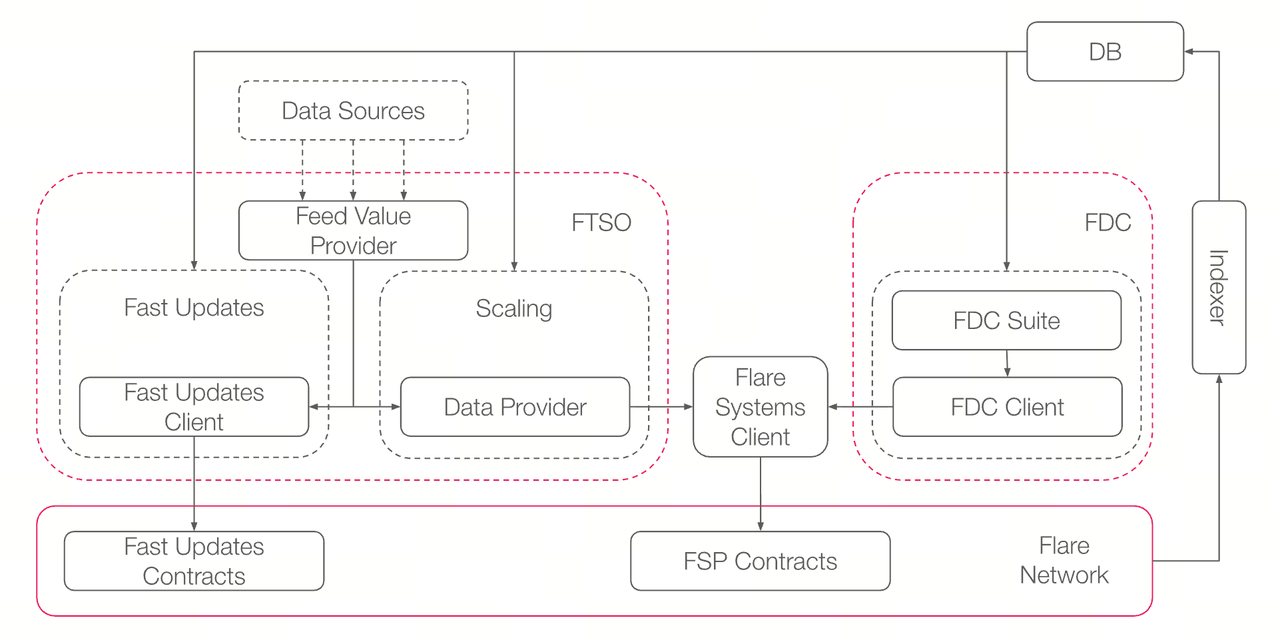
Flare Network data provider system architecture, source: Flare Network
This design avoids reliance on external services and makes data acquisition a native function of the network, reducing trust assumptions and improving system security.
Flare’s Key Protocols: FTSO and State Connector
Flare’s core innovation is reflected in two key protocols: FTSO, or Flare Time Series Oracle, and FDC, or Flare Data Connector.
FTSO, or Flare Time Series Oracle, is a decentralized oracle system. It provides price and time-series data by collecting submissions from network participants and aggregating them through a weighted process.
FDC, or Flare Data Connector, is used to verify the state of other blockchains or external systems, allowing Flare to obtain off-chain information without relying on trusted intermediaries.
Flare’s Cross-Chain Asset Mechanism: FAssets
FAssets is a cross-chain asset solution offered by Flare. It allows non-smart-contract assets such as BTC, XRP, and DOGE to be brought into the Flare network and used in DeFi applications.
Through a collateral and verification model, this mechanism maps native assets into synthetic assets that can be used on Flare, thereby unlocking their liquidity.
The Role and Economic Model of the FLR Token
FLR is the native token of Flare Network and serves multiple functions within the network, including paying transaction fees, helping maintain network security, and participating in governance.
FLR is also used to incentivize data providers to participate in the FTSO system, helping ensure a continuous and accurate supply of data.
Flare Network Use Cases
Flare’s design allows it to support a wide range of data-driven use cases.
In cross-chain DeFi, FAssets allow assets such as BTC to participate in lending, trading, and yield strategies. In data applications, developers can build smart contracts that depend on real-world data. In the multichain ecosystem, Flare can also act as a data bridge connecting different networks.
How Flare Differs from Other Blockchains
The main difference between Flare and traditional blockchains lies in its positioning as a data layer.
Compared with Ethereum, Flare places greater emphasis on data acquisition. Compared with oracle networks such as Chainlink, it embeds data protocols directly into the chain. Compared with Cosmos or Polkadot, its focus is not cross-chain communication itself, but cross-chain data verification.
Advantages and Limitations of Flare Network
Flare’s advantage lies in its native data protocol design, which allows smart contracts to directly access trusted data while reducing reliance on external infrastructure.
At the same time, Flare’s limitations are also clear. Its ecosystem is still developing, the system is relatively complex, and its data mechanism depends heavily on participant incentives.
Conclusion
Flare Network offers a data-centered approach to blockchain design. By embedding oracle and cross-chain verification mechanisms into the network, it enables smart contracts to access a broader range of data sources.
This model provides a new infrastructure option for DeFi, data applications, and asset interoperability in the multichain ecosystem. It also offers an important reference point for the blockchain industry as it moves toward a more data-driven stage.
FAQs
What Is the Core Role of Flare Network?
Flare’s core role is to provide smart contracts with trusted data sources and access to cross-chain states, enabling more complex applications.
How Is FTSO Different from Traditional Oracles?
FTSO is a data protocol embedded within the blockchain, while traditional oracles are usually independent networks that rely on external nodes to provide data.
What Is the FLR Token Used For?
FLR is used to pay transaction fees, participate in governance, and incentivize data providers to help maintain network operations.
Does Flare Support Smart Contracts?
Yes. Flare is EVM-compatible, so developers can deploy Solidity smart contracts directly.
How Does Flare Enable Cross-Chain Functionality?
Flare verifies the state of other chains through the Data Connector and combines this with FAssets to enable cross-chain asset use.







