As the financial sector advances into the digital and intelligent age, Goldman Sachs is accelerating its business transformation by leveraging artificial intelligence (AI), big data analytics, automated trading systems, and digital financial platforms. Evolving from a traditional investment banking model reliant on human resources and relationship networks, the firm now uses technology to boost efficiency, optimize risk management, and expand client service capabilities. Fintech has become a cornerstone of its long-term strategy.
What Is Goldman Sachs (GS)? Company Overview and Development
Goldman Sachs (GS) is a global financial services leader providing investment banking, securities trading, asset management, and wealth management services to corporations, governments, financial institutions, and high-net-worth clients. Founded in 1869 by Marcus Goldman in New York, the firm has grown into one of Wall Street’s most iconic investment banks.
Throughout its 150+ year history, Goldman Sachs has navigated multiple global financial cycles, including economic crises, capital market expansions, regulatory reforms, and digital transformation waves. Renowned for its expertise in large-scale corporate financing, M&A, and capital market activities, Goldman Sachs is widely regarded as a gateway for enterprises accessing global capital markets.
In the latter half of the 20th century, Goldman Sachs expanded its international footprint, establishing operations in all major financial centers. The company went public in 1999, listing on the New York Stock Exchange under the ticker symbol GS.
In the 21st century, Goldman Sachs has faced industry shifts, particularly after the 2008 global financial crisis, which led to stricter regulation and curbed traditional high-leverage, high-risk business models. The firm responded by strengthening its asset management, wealth management, and digital finance offerings to reduce earnings volatility.
Recently, with rapid advancements in AI, cloud computing, and data technologies, Goldman Sachs has deepened its technology-driven transformation, aiming to improve service efficiency and broaden its reach among individual investors and small to mid-sized enterprises.
Core Business Segments of Goldman Sachs
Goldman Sachs operates across four main segments: Global Banking & Markets, Asset & Wealth Management, Platform Solutions, and fintech-related services.
Global Banking & Markets is the firm’s flagship division, encompassing investment banking, equities trading, fixed income, commodities, and currency trading. This segment primarily serves large corporations, institutional investors, and government entities, providing a significant share of total revenue.
Investment banking delivers corporate finance, M&A advisory, equity and debt issuance, and strategic advisory services. Goldman Sachs frequently acts as a financial advisor in IPOs, acquisitions, and strategic realignments.
Asset & Wealth Management has emerged as a key growth engine, serving institutional investors, pension funds, endowments, and high-net-worth individuals. Through portfolio management, fund products, and wealth planning, the firm generates stable, long-term income streams.
Platform Solutions reflects Goldman Sachs’ push into fintech, including payment services, enterprise financial platforms, and digital infrastructure. This segment is more technology- and scale-driven than traditional investment banking.
By diversifying its business lines, Goldman Sachs is reducing its dependence on single capital market cycles and enhancing revenue stability.
How Investment Banking, Asset Management, and Trading Drive Growth
Investment banking remains the core of Goldman Sachs’ brand, with a strong presence in global M&A, equity issuance, and bond markets.
For major M&A deals, investment banks provide valuation, transaction structuring, and financing solutions. Goldman Sachs’ industry expertise and global client base give it a clear edge in executing large transactions.
In sectors like technology, energy, healthcare, and finance, Goldman Sachs often leads major M&A advisory mandates. While these deals are cyclical, individual transactions can generate substantial revenue.
Trading is another major revenue driver, with Goldman Sachs operating a vast institutional network across equities, fixed income, FX, and commodities. The firm serves global investors through market making, risk management, and product design.
Unlike commercial banks that rely on loan interest, investment banks’ earnings are tied to capital market activity. During periods of rate shifts, market rallies, or increased volatility, trading can become a key growth engine.
Asset management offers more stable, recurring income. As institutional assets under management grow globally, demand for professional allocation, alternative investments, and risk management is rising.
Goldman Sachs has expanded its asset management scale through private equity, real estate, credit investments, and traditional fund management, driving higher fee income.
AI is reshaping the global financial landscape, and Goldman Sachs is at the forefront of deploying AI to enhance efficiency.
In investment banking, AI helps analyze massive datasets, market information, and transaction documents, greatly improving research productivity. Generative AI enables analysts to quickly organize financial data, draft reports, and automate repetitive tasks.
In trading, big data and machine learning models are widely used for market analysis, risk forecasting, and strategy optimization. Real-time data analysis enables faster, more informed trading decisions.
Goldman Sachs is also integrating AI tools internally, streamlining workflows with automation. AI-driven document review, compliance checks, and client management help reduce operating costs.
Fintech remains a strategic growth area. In recent years, Goldman Sachs launched Marcus, a digital banking platform, to enter the consumer finance market. While the business has evolved, it underscores the firm’s ambition to expand its client base through digital channels.
Looking ahead, the rise of AI assistants, robo-advisors, and automated finance means investment banks will increasingly blend professional expertise with AI, forming a new model of “financial experience + AI technology.”
Competitive Advantages in Global Capital Markets
Goldman Sachs’ edge lies in its brand, global client network, talent pool, and expertise in complex financial products.
Brand strength is a critical asset; large corporations often choose advisors with proven track records. The firm’s global network—including multinationals, governments, funds, and high-net-worth clients—creates network effects and access to more deal flow.
Talent is another key differentiator. Wall Street competition is driven by top investment bankers, traders, analysts, and risk experts.
Goldman Sachs also leads in complex product design, from derivatives and structured finance to alternatives, creating high barriers to entry.
How Goldman Sachs Differs from JPMorgan, Morgan Stanley, and Bank of America
Goldman Sachs, JPMorgan, Morgan Stanley, and Bank of America are all global leaders, but their models differ.
Goldman Sachs is more focused on investment banking and capital markets. JPMorgan combines a vast commercial banking platform—including retail banking, credit cards, and corporate lending—for more diversified income.
Morgan Stanley is closest to Goldman Sachs, with both excelling in investment banking and wealth management. However, Morgan Stanley has emphasized wealth management in recent years, expanding its retail client base via acquisitions and advisor networks.
Bank of America is more traditional, with a large retail banking footprint, credit cards, and commercial loans, so it is affected differently by interest rate cycles.
In essence, Goldman Sachs is a capital markets specialist, with core strengths in investment banking, trading, and institutional services.
Key Risks for GS Stock Investors
Despite its industry leadership, investing in GS stock carries several risks:
- Capital market cycle risk: Heavy reliance on investment banking and trading means revenue can be impacted by slowdowns in IPOs, M&A, or market activity.
- Regulatory risk: The industry faces strict oversight, including capital requirements, risk controls, and trading restrictions. Regulatory changes can affect profitability.
- Competitive pressure: The global financial sector is fiercely competitive, with JPMorgan, Morgan Stanley, Citigroup, and others all vying for corporate and capital markets business.
- Technology risk: If AI and fintech investments do not translate into business growth, efficiency gains may fall short.
Investors should also monitor macroeconomic conditions—interest rates, economic growth, and corporate financing demand.
How to Access Goldman Sachs (GS) via Gate Stock Trading
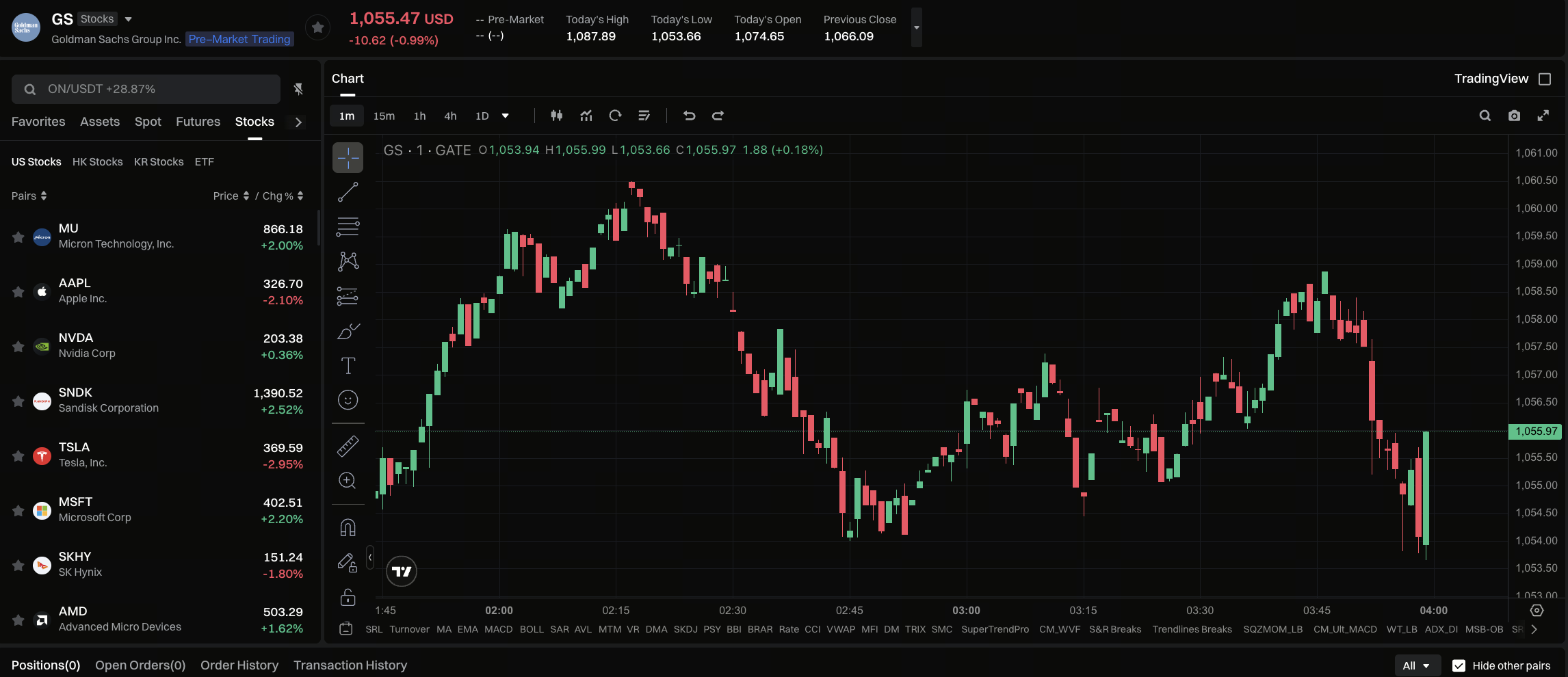
As global asset allocation needs evolve, investors are seeking new ways to access U.S. equities. Gate Stock Trading offers a streamlined channel, allowing users to trade U.S. stocks—including Goldman Sachs (GS)—with USDT, connecting digital asset holders to traditional markets.
Compared to legacy platforms, Gate Stock Trading lowers barriers to global equities. Users can manage digital assets and stocks in a unified account without switching between platforms. The service covers 11,000+ stocks and ETFs, including 10,000+ U.S. and 1,000+ Hong Kong stocks, supporting NYSE, Nasdaq, NYSE Arca, NYSE American, and BATS.
For those interested in Goldman Sachs (GS), Gate Stock Trading enables flexible allocation. Users can buy GS with USDT and trade fractional shares (as little as 0.01 shares), building positions according to their capital. The platform supports 24/7 trading—including pre-market, after-hours, overnight, and weekends—helping investors respond to global market shifts.
Note that stock investments are subject to company performance, macroeconomic trends, market volatility, and regulation. No matter the channel, investors should align allocations with their risk tolerance and monitor industry cycles. Gate Stock Trading is a global access tool, but investment decisions require long-term research and risk management.
Future Outlook and Long-Term Growth Potential
Looking forward, Goldman Sachs’ strategy centers on upgrading its capital markets business, expanding asset management, and integrating fintech.
As global corporate financing needs grow, investment banking remains valuable. In high-growth sectors like AI, energy transition, and biotech, large companies will require more capital and strategic advice.
Asset management is likely to become an even more stable growth driver, as global wealth accumulation fuels demand for professional management.
AI will become foundational for finance, enabling banks to boost research productivity, cut costs, and deliver smarter services.
In digital finance, Goldman Sachs will likely continue innovating in enterprise payments, wealthtech, and platform services, leveraging technology to expand its reach.
Long-term competitiveness will depend not only on traditional financial expertise, but also on adaptability and innovation.
Summary
Goldman Sachs (GS) is a global investment banking powerhouse with over 150 years of history, leading in investment banking, asset management, trading, and fintech services.
With its global network, elite talent, and expertise in complex financial products, Goldman Sachs remains at the forefront of Wall Street. The firm is driving transformation through AI, big data, and digital finance to enhance efficiency and pursue new growth.
Unlike traditional commercial banks, Goldman Sachs relies on capital market opportunities—so investors should monitor economic cycles, regulatory shifts, and competition.
Looking ahead, as AI reshapes finance, capital flows expand, and asset management demand rises, Goldman Sachs’ continued leadership will depend on striking the right balance between traditional strengths and technology-driven innovation.
FAQ
What is Goldman Sachs (GS)?
Goldman Sachs (GS) is a global investment bank and financial services group founded in 1869, with businesses spanning investment banking, asset management, trading, wealth management, and fintech services.
What are Goldman Sachs’ core businesses?
The firm’s main segments are global banking & markets, asset & wealth management, and platform solutions. Investment banking, securities trading, and asset management are its primary revenue drivers.
Why does Goldman Sachs have a competitive advantage?
With more than 150 years of industry experience, a global client network, elite talent, and complex product expertise, Goldman Sachs maintains a leading position in global capital markets.
How does Goldman Sachs approach AI and fintech?
The company uses AI, big data, and automation to optimize trading analysis, risk management, and operations, while developing digital financial platforms and intelligent services to boost efficiency.
How does Goldman Sachs differ from JPMorgan?
Goldman Sachs is more focused on investment banking and capital markets, while JPMorgan has a broader commercial banking platform, including retail banking, credit cards, and corporate lending.