The rapid growth of the artificial intelligence industry is driving a sustained increase in global demand for computing resources. From training large language models to enabling AI Agent to execute tasks autonomously, a wide range of applications depend on stable, scalable computing power.
Traditional cloud computing platforms offer mature infrastructure, but most computing resources remain controlled by a small number of major companies. High access costs, geographic limitations, and concentrated supply have led more developers to explore the potential of decentralized computing networks. Janction builds an open computing power marketplace and collaborative network, allowing personal devices, professional nodes, and enterprise resources to participate in the AI computing ecosystem.
What Is Janction
Unlike platforms that simply provide AI model services, Janction focuses more on connecting and coordinating the computing resource layer. The network integrates distributed GPUs, edge devices, and independent nodes to provide underlying computing support for AI services, while using blockchain mechanisms to manage resource contribution and value distribution.

As the AI Agent economy gradually takes shape, computing power is becoming more than the foundation for model training. It is also becoming an essential productive resource that allows intelligent agents to keep running. Janction aims to serve as an important bridge between computing power providers and demand from AI services.
How Janction Works
Janction’s operating logic can be understood as an open marketplace that connects computing power demand with resource providers.
When an AI developer or application submits a computing task, the network matches it based on resource type, performance requirements, and task priority. Qualified nodes receive permission to execute the task and then complete model training, inference, or data processing work.
After the task is completed, the result is returned to the requester. At the same time, the network distributes rewards and records settlement according to predefined rules.
Several key modules are involved throughout this process:
Computing Resource Discovery
The network continuously identifies available computing nodes and builds a resource directory.
Task Scheduling System
The system automatically allocates computing tasks based on demand.
AI Agent Coordination Layer
AI Agents can independently call on network resources to execute complex tasks.
Blockchain Settlement Layer
Transaction records and incentive distribution are completed through on chain mechanisms.
Core Participants in the Janction Network
The Janction ecosystem is mainly made up of three types of participants.
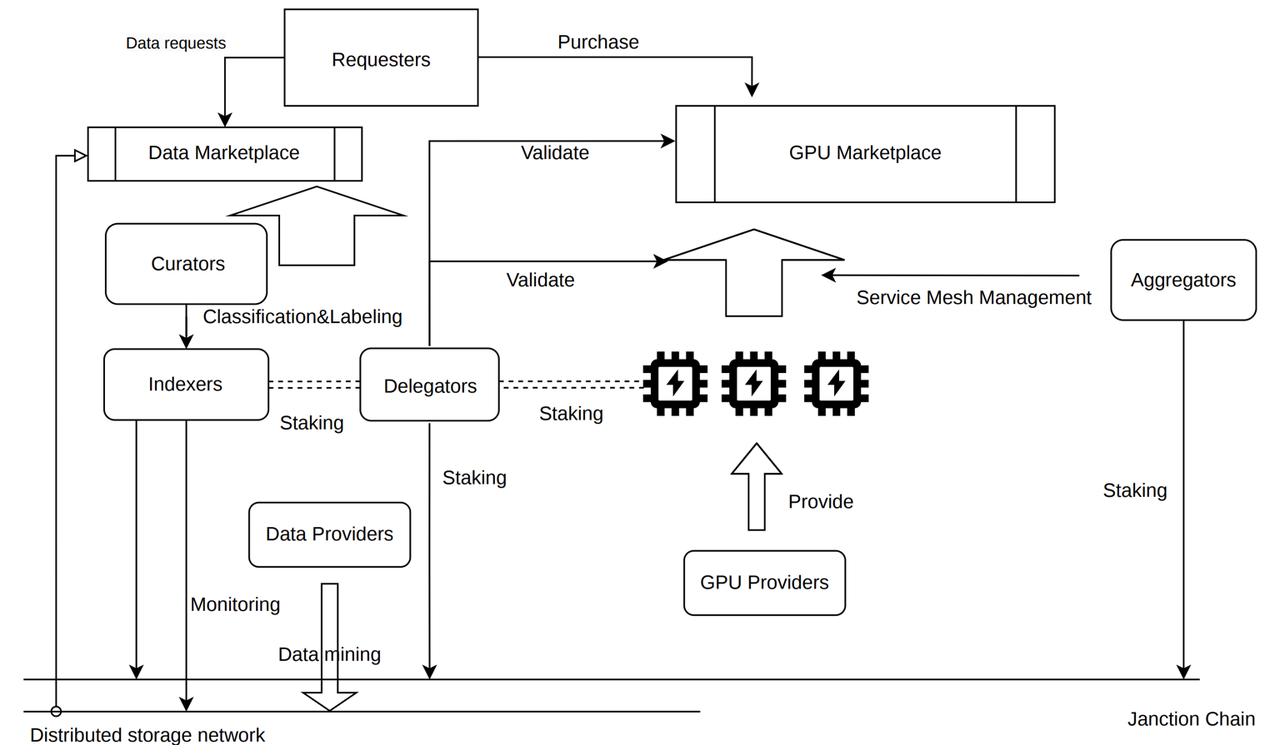
Computing Power Providers
Computing power providers contribute GPUs, servers, or edge device resources, and earn rewards by completing computing tasks.
AI Developers
AI developers use network resources to train models, deploy AI services, or build Agent applications.
AI Agents and the Application Layer
AI Agents can automatically call on computing resources within the network to complete analysis, decision making, and execution tasks.
Together, these participants form both the supply side and demand side of the network, enabling a continuous flow of resources and value.
The Role of the JCT Token in the Ecosystem
JCT is the core medium of value in the Janction network.
JCT is designed not only as a payment tool, but also as a mechanism for network incentives and governance.
Its main uses include:
| Function |
Role |
| Computing power payments |
Pays for model training and inference fees |
| Node rewards |
Incentivizes resource providers to participate in the network |
| Governance voting |
Enables participation in protocol upgrades and parameter adjustments |
| Ecosystem incentives |
Supports developer and application growth |
| Service settlement |
Completes value transfer within the network |
JCT links computing resources with ecosystem value, forming an important economic foundation for the network’s operation.
What Use Cases Does Janction Support
AI Model Training
Development teams can use distributed resources to complete large scale model training tasks.
AI Inference Services
Application developers can dynamically access computing resources to support real time AI service operations.
AI Agent Networks
Intelligent agents can independently call on computing power to execute complex workflows.
Enterprise AI Infrastructure
Enterprises can obtain elastic computing capacity through the network without having to build all hardware infrastructure themselves.
Edge Computing Scenarios
Edge devices can participate in computing tasks, improving resource utilization while reducing latency.
Janction’s Advantages and Potential Challenges
Advantages
Janction connects distributed resources around the world through an open network, helping improve the utilization of idle computing power.
Its decentralized architecture reduces reliance on a single service provider and makes access to computing resources more flexible.
By combining AI Agents with blockchain based incentives, the network can create an ecosystem cycle that continues to expand.
Challenges
Performance differences among distributed nodes may affect task execution efficiency.
The network needs to continuously verify node reliability and result accuracy.
As the number of participants grows, resource scheduling and governance mechanisms will also need ongoing optimization.
The decentralized computing power market is still at an early stage, and industry standards have not yet been fully unified.
| Comparison Dimension |
Janction |
Traditional Cloud Computing Platforms |
| Resource source |
Distributed node network |
Centralized data centers |
| Control model |
Decentralized coordination |
Centralized platform management |
| Resource utilization |
Integrates idle computing power |
Relies on owned resources |
| Incentive mechanism |
Token incentives |
Commercial contract model |
| Openness |
Open participation |
Higher access barriers |
| AI Agent integration |
Native support |
Requires additional development |
The two models are not in complete competition with each other. Instead, they serve different resource needs and application scenarios.
Conclusion
Janction is a decentralized computing power network that combines AI Agents, distributed computing, and Web3 incentive mechanisms. By connecting idle computing resources around the world with intelligent agents and the developer ecosystem, Janction aims to build more open, efficient, and scalable AI infrastructure. The resource sharing, Agent coordination, and value settlement mechanisms explored by Janction offer a new infrastructure path for the future development of the AI Economy.
FAQs
What Is the JCT Token Used For?
JCT is mainly used to pay for computing power services, reward node contributors, participate in network governance, and support ecosystem incentives. It is the core medium of value in the Janction network.
How Does Janction Connect AI Agents with Computing Resources?
Through resource discovery, task scheduling, and value settlement mechanisms, Janction allows AI Agents to automatically call on computing resources in the network to complete complex tasks, with fees settled through JCT.
Traditional cloud computing relies on centralized data centers to provide resources, while Janction uses a distributed node network to share idle computing power and enables resource allocation through open participation and on chain incentives.
What Scenarios Are Suitable for the Janction Network?
Janction can be used for AI model training, inference services, AI Agent workflows, enterprise AI infrastructure development, edge computing, and other scenarios that require support from elastic computing resources.