From an industry standpoint, SK Eternix covers four main verticals — solar, wind, fuel cells, and ESS (energy storage) — while also branching into electricity trading and VPP (virtual power plants). This structure benefits from South Korea’s energy transition momentum but also exposes the company more directly to risks around policy, grid interconnection, financing, and construction timelines. A complete picture of SK Eternix can be built across four dimensions: company definition, business model, trading approach, and risk checklist.
What Is SK Eternix (475150)? Which Listed Company Does It Represent?
SK Eternix Co., Ltd. is a publicly traded company on the Korean stock market under the code 475150. It positions itself as a new energy development and operation platform, stressing "long-term operational capability" over one-off project sales. For users new to Korean equities, the first step is to confirm the ticker and entity: 475150 refers to SK Eternix — not to other SK-group entities.
For information gathering, investors should prioritize three sources: the company’s official website and IR materials, KRX/KIND statutory disclosures, and the stock detail page on the trading platform. Each serves a different purpose: the website and IR highlight the business narrative, statutory disclosures offer a compliance-focused view, and the trading page provides price quotes and order entry.
What Are SK Eternix’s Core Businesses? How Do Solar, Wind, Fuel Cells, and ESS Work Together?
SK Eternix can currently be understood through four major segments:
| Segment |
Core Activity |
Revenue Profile |
| Solar |
Project development, construction, operation, electricity trading |
Relatively stable cycle; dependent on pipeline and grid-connection efficiency |
| Wind |
Onshore/offshore wind project advancement |
Long development cycle; sensitive to approvals and construction progress |
| Fuel Cells |
Distributed clean energy supplement |
Highly correlated with policy mechanisms and electricity consumption patterns |
| ESS |
Peak shaving, storage operation, system optimization |
Significantly influenced by electricity price mechanisms and dispatch rules |
These four lines are not siloed. Solar and wind supply renewable power; ESS boosts grid flexibility; and the trading capability converts generation assets into more stable settlement revenue. As a result, SK Eternix is typically valued from a portfolio operation perspective rather than on a single-project basis.
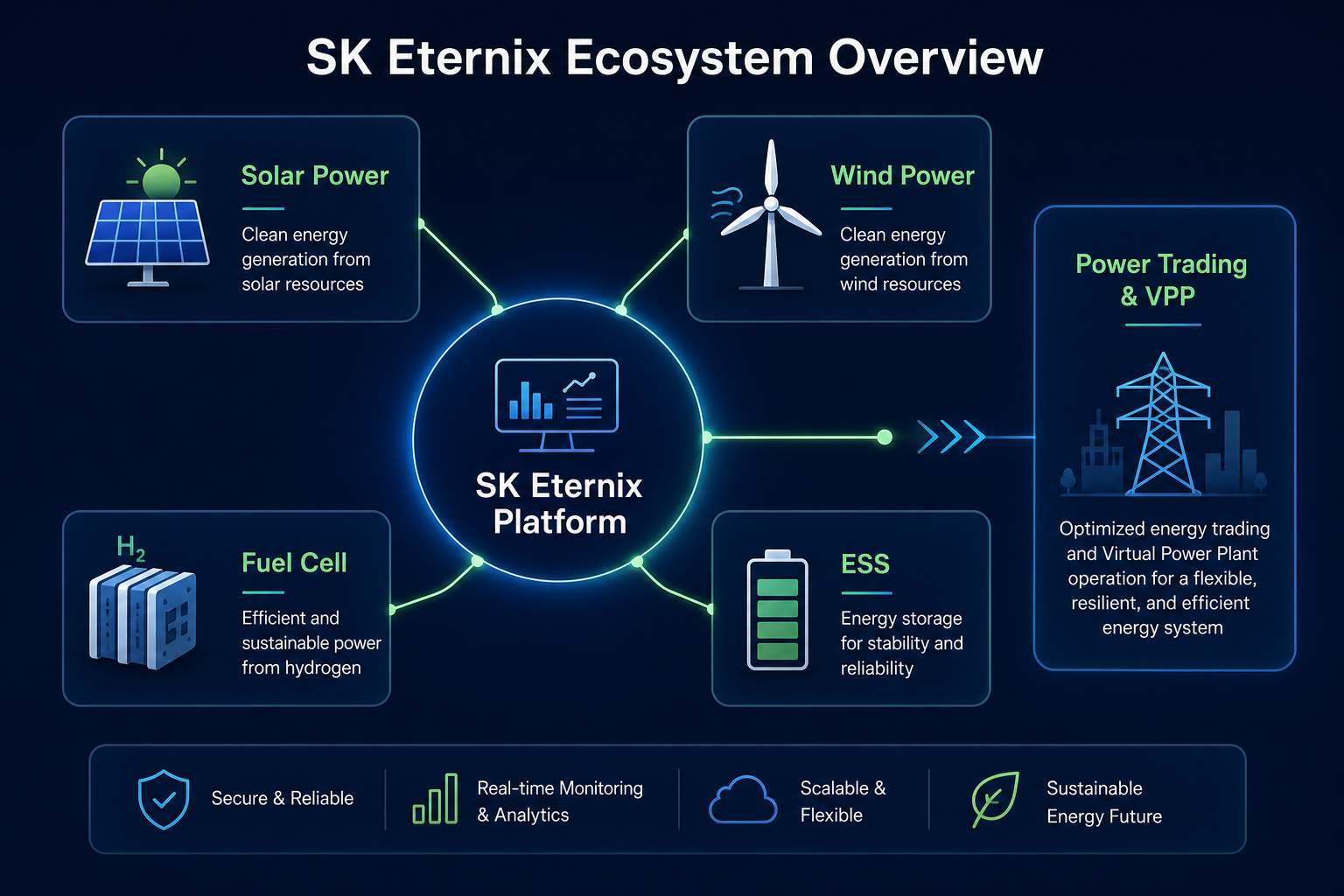 Figure 1. SK Eternix ecosystem overview: Solar, wind, fuel cells, and ESS are connected through electricity trading and VPP capabilities.
A key background factor is SK Eternix’s spin-off and independent listing. After the spin-off, investors should avoid equating the "historical group narrative" with the "current listed entity's performance." The most common mistake is to mix up different legal entities, different tickers, and different asset pools, leading to distorted assessments of business scale and risk exposure.
A simple practical rule: Whenever it involves revenue, profit, debt, projects under construction, or capital expenditure, rely solely on SK Eternix’s own disclosures. Group history or information on sister companies can serve as industry background but cannot substitute for the entity’s financial judgment.
What Is SK Eternix’s Growth Logic? Why the Focus on Build-to-Own and Electricity Trading?
The essence of Build-to-Own is "build, then hold and operate long-term," rather than "build and sell." This creates two key differences: First, short-term profit recognition is smoother but not necessarily explosive; second, asset operation capability and financing ability become far more critical.
For SK Eternix, the growth logic typically follows three paths:
- Project pipeline expansion (adding operational capacity)
- Operational efficiency improvement (generation efficiency, availability, maintenance quality)
- Trading and storage synergy (improving cash flow quality through ESS and trading mechanisms)
This means that when researching the company, you need to look beyond just "how many projects" to also ask: "Can these projects be connected to the grid on time, generate power stably, and settle effectively?"
How to Find and Trade SK Eternix (475150) on Gate? What’s the Full Process?
In the Korean stock section of Gate Stocks, users can search directly by code 475150. The typical process is: Complete account setup and permissions → Transfer available funds → Enter the stock detail page → Select limit or market order → Manage positions and order records.

At the trading level, two things must be clearly distinguished:
- The quote display currency (e.g., KRW)
- The actual account settlement currency (based on platform rules)
Before executing, confirm the trading session, minimum order unit, order types, and fee structure — to avoid "understanding the price but not the rules."
How Does SK Eternix Compare With Other Korean New Energy Companies?
If peer comparison focuses only on market cap or share price, it’s easy to miss differences in business structure. A more effective approach is to compare by business type:
- Is it development-oriented, construction-oriented, or operation-oriented?
- Does revenue rely more on one-time recognition or long-term asset returns?
- Are ESS and trading capabilities ancillary or core?
- What is the geographic distribution of projects and their policy sensitivity?
SK Eternix’s defining characteristic is its "platform-based portfolio combined with an operational focus." Such companies may not show the highest upside in a strong cycle, but they typically offer distinct advantages in asset accumulation and cash flow stability.
What Risks and Limitations Should Investors Consider for SK Eternix?
Key risks can be grouped into five categories:
- Policy Risk: Changes in new energy subsidies and electricity market rules.
- Project Risk: Delays in approvals, construction, and grid connection.
- Financing Risk: Volatility in interest rates and capital costs.
- Operational Risk: Equipment reliability, generation efficiency, and maintenance costs.
- FX Risk: Translation mismatches for cross-border investors.
These risks define the analytical boundary and can be tracked continuously using a combined framework of "project progress + financial quality + rule changes."
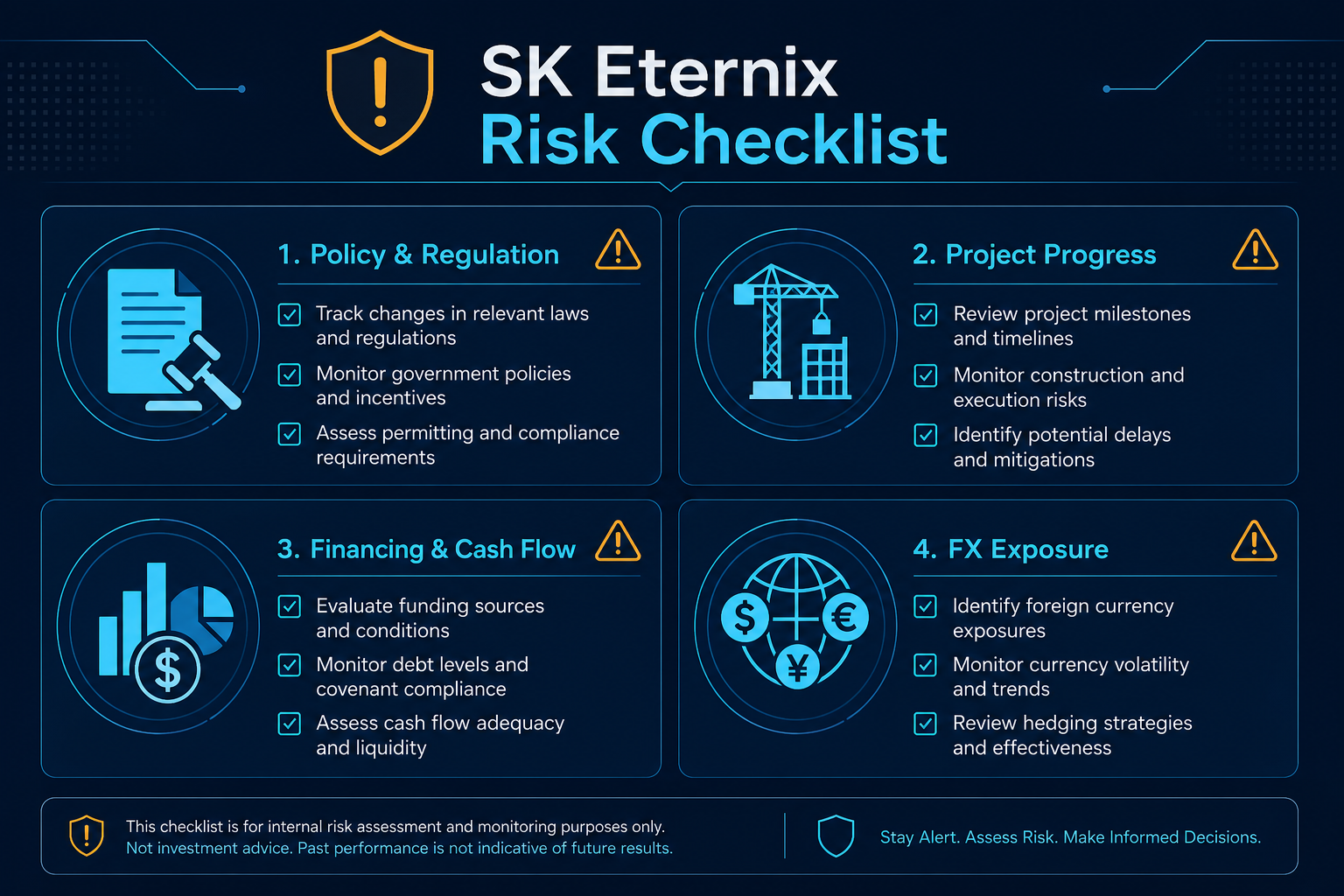 Figure 2. SK Eternix risk checklist: Policy, project progress, financing quality, and FX exposure form the core observation layer.
Risk analysis also requires separating "company operating risk" from "trading execution risk." The former stems from project commissioning, capital costs, policy rules, and cash flow quality; the latter from trading hours, order types, account fund currencies, and cross-border conversion. Both affect your final understanding but should be reviewed independently.
Summary
SK Eternix (475150) is a Korean new energy platform company whose core value lies in its multi-energy asset portfolio and long-term operational capability. For users, the clearest approach is to first build a four-step framework — "entity identification → business layering → trading pathway → risk checklist" — and then verify specific trading rules and risk variables. If trading Korean stocks via Gate, ensure you understand code search, order rules, and fund currencies to align your understanding with execution.
FAQ
What does SK Eternix (475150) do?
It is a Korean new energy platform company focusing on solar, wind, fuel cells, and ESS, extending into electricity trading capabilities.
Is 475150 a KOSPI or KOSDAQ code?
Verify the listing board with KRX/KIND and company disclosures. In practice, you can search the entity on the trading platform using code 475150.
What is the core investment thesis for SK Eternix?
It centers on the Build-to-Own long-term operation model and the synergy between new energy assets and trading capabilities.
How do I find SK Eternix on Gate?
Go to the Korean stock section of Gate Stocks, search for code 475150, open the detail page, and place an order per the trading rules.
Why focus on FX risk separately?
Cross-border investors’ final returns are often affected by the conversion between their base currency and the settlement currency. Exchange rate fluctuations can change the account outcome relative to the asset’s performance.