TeraWulf (WULF) stock represents the equity of a Bitcoin mining company, with its performance primarily driven by hashrate efficiency and electricity costs. WULF stock is influenced not only by Bitcoin price, but also by mining difficulty, capital structure, and expansion pace. Viewing WULF stock through the lens of "hashrate assets + electricity assets + capital constraints" helps clarify the sources of its volatility.
What Is TeraWulf (WULF) Stock?
WULF stock reflects the equity of a company centered on Bitcoin mining infrastructure. The company participates in the Bitcoin network by deploying mining machines, securing electricity, and managing operations, generating revenue from block rewards and related activities. Stock valuation typically focuses on hashrate scale, unit energy consumption, and cash flow stability. To understand this asset, it's helpful to distinguish between "Bitcoin price variables" and "operational variables."
For newcomers, keep in mind three key details: stock code WULF, company name TeraWulf, and the trading fields available for verification on the WULF stock page. Use the code for search and identification, the company name to avoid misselection, and trading fields for accurate order verification. Separating this information makes it easier to follow later sections on business model and risk.
How Does TeraWulf (WULF) Stock's Business Model and Cost Structure Work?
WULF generates revenue by consistently outputting hashrate in exchange for Bitcoin production value. On the cost side, electricity, equipment depreciation, operations, and financing are the main components, with electricity price and mining efficiency having the most direct impact. Analyzing WULF's business model and cost structure typically involves breaking down income, fixed costs, and variable costs.
| Module |
Core Driver |
Impact Direction |
| Mining revenue |
Bitcoin price, global difficulty, block rewards |
Determines unit hashrate output value |
| Electricity cost |
Electricity contracts, energy mix |
Sets the minimum cash cost |
| Equipment operations |
Mining efficiency, depreciation cycle |
Determines unit output cost |
| Capital structure |
Financing costs, debt maturity |
Influences expansion and resilience |
This table shows that WULF's operational flexibility isn't solely determined by Bitcoin price. The quality of electricity procurement and equipment efficiency can create significant differences even at the same Bitcoin price. Financing conditions impact the company's ability to operate during downturns.
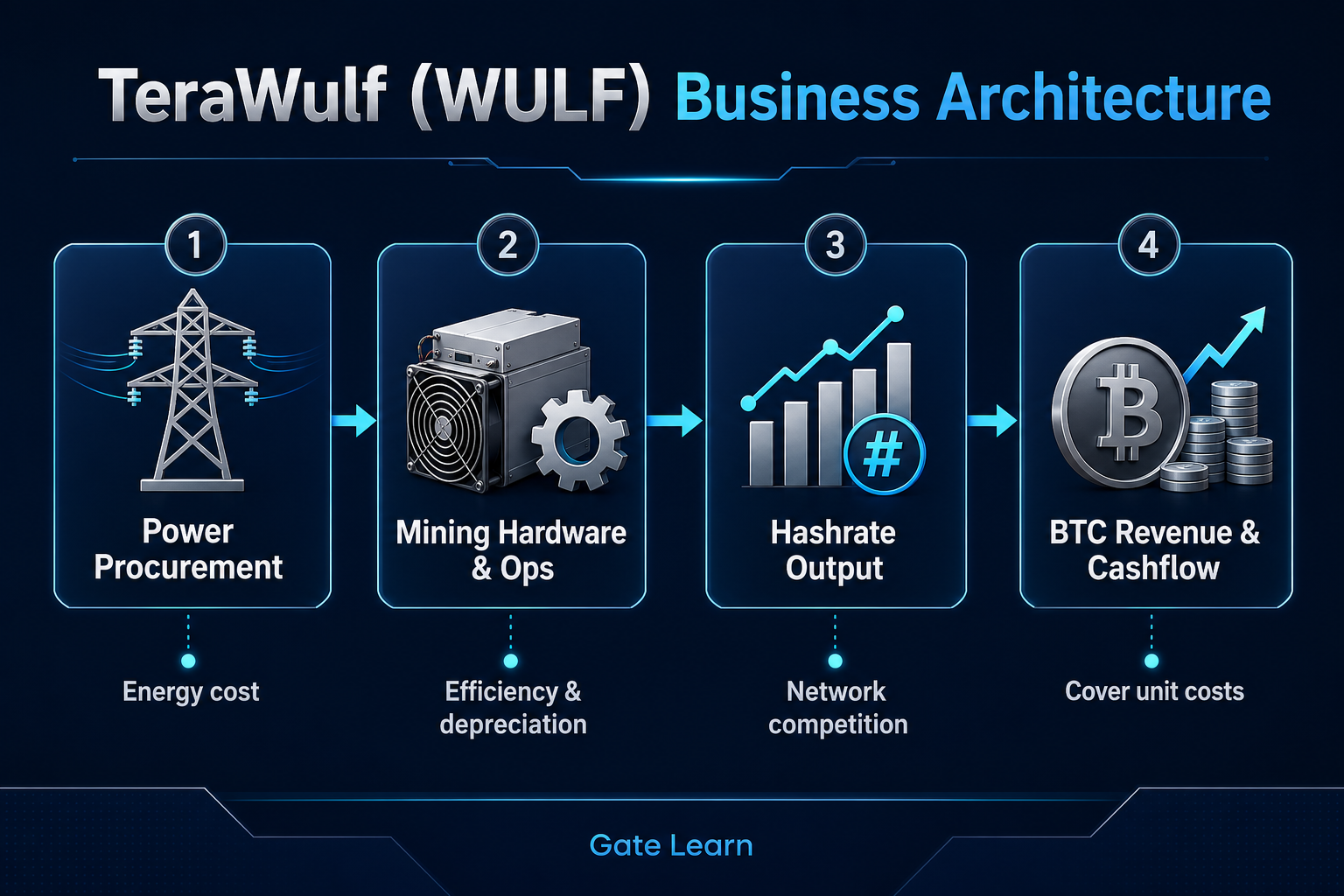
Illustration of TeraWulf (WULF)'s business architecture, from electricity procurement and mining operations to hashrate output and cash flow.
How Does the Bitcoin Cycle Affect WULF Stock?
The Bitcoin cycle impacts WULF stock through four main channels: Bitcoin price, mining difficulty, output, and costs. Rising Bitcoin prices improve revenue expectations, but increasing global hashrate can compress unit output. Halving changes block reward size, requiring miners to focus more on energy and capital efficiency. The analysis of WULF's relationship with the Bitcoin cycle, halving, and hashrate frames the cycle as a process of simultaneous repricing of income and costs.
Transmission isn't always linear. If Bitcoin price rises alongside difficulty and electricity costs, profit improvements may be less than expected; if Bitcoin price falls but the company's unit costs are low, cash flow pressure may be manageable. When analyzing WULF stock, consider both "external cycle variables" and "internal cost curves" together.
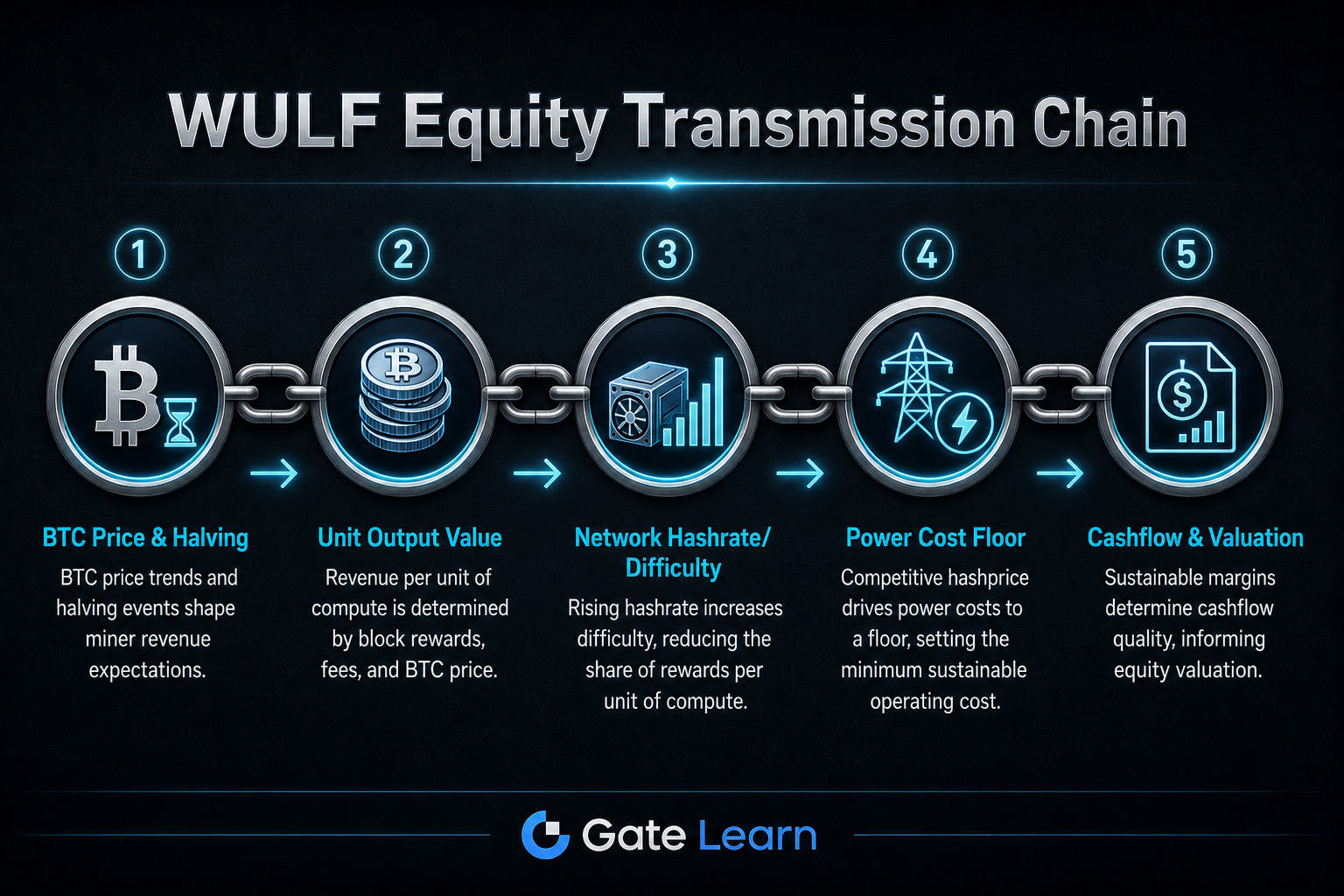
Transmission chain from Bitcoin price, halving, hashrate competition, and electricity cost to WULF stock valuation feedback.
What Are the Key Differences Between WULF, MARA, and RIOT Stocks?
WULF, MARA, and RIOT are all Bitcoin mining stocks, but they differ in electricity strategy, expansion paths, and asset structure. Comparison requires examining three variables: scale, cost, and capital. The comparison of WULF with MARA and RIOT places these differences in a unified framework.
| Dimension |
WULF |
MARA / RIOT (conceptual level) |
| Operational focus |
Electricity efficiency and hashrate synergy |
Different expansion pace and asset allocation paths |
| Cost sensitivity |
Electricity price, equipment efficiency |
Scale, deployment, and financing structure |
| Cycle elasticity |
Unit cost control |
Scale effects and financial strategy |
This comparison is meant to establish a framework, not to judge which is superior. For investors, the key is understanding why different companies have different volatility patterns in the same cycle. Hashrate scale is just the production capacity limit; real differentiation comes from whether unit costs and capital constraints align with expansion speed.
How to Read Gate's WULF Stock Page and Complete USDT Trading?
Gate's WULF stock page provides the asset code and trading verification fields. Review the page in order: code and asset consistency, order parameters, fee rules, and risk reminders. For USDT trading, follow the USDT trading process for WULF stock to prepare funds, search for the asset, place orders, and verify transactions. The priority is field consistency, not transaction speed.
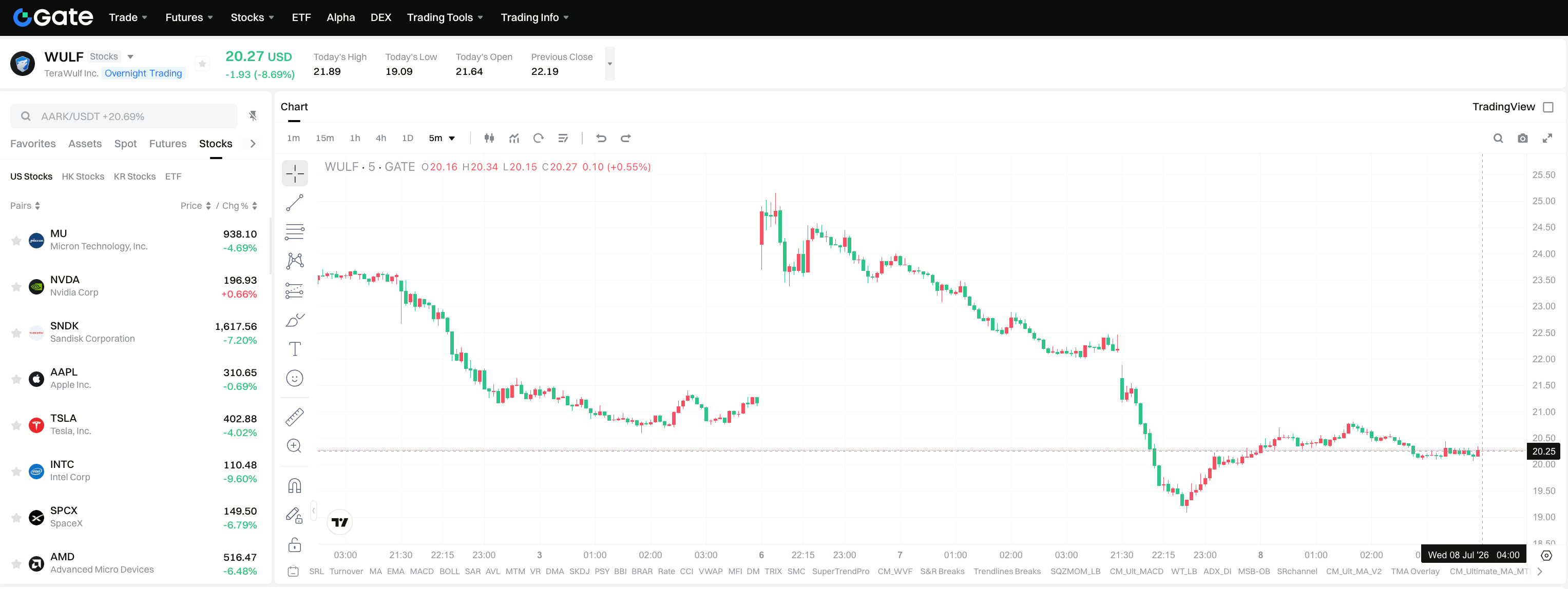
Company analysis and trading execution should be handled separately: first, understand the business model and cycle transmission; then, use page fields for order verification. Mixing these steps can lead to mistaking business judgments for trading decisions. A repeatable checklist is more effective for beginners than relying on memory.
What Are the Advantages, Risks, and Limitations of WULF Stock?
WULF stock's advantages include a clear operating theme, trackable key variables, and a strong connection to Bitcoin infrastructure. Risks stem from Bitcoin price volatility, rising difficulty, electricity price changes, tightening financing, and policy shifts. Limitations arise from sensitivity to external cycles and capital market conditions; stability may be lower than industries with more diversified cash flows. For further analysis, see WULF risks, cycle, and liquidity factors.
Advantages, risks, and limitations should be addressed separately: advantages explain why variables are trackable, risks outline mechanisms impacting profits, and limitations define the boundaries of the industry. None of these constitute buy or sell recommendations—they serve to place information within a verifiable framework.
Summary
The essence of TeraWulf (WULF) stock is how mining companies convert hashrate, electricity, and capital into sustained output. The business model determines long-term viability, the Bitcoin cycle affects short-term flexibility, and the trading process shapes execution quality. Aligning company operations with Gate Stocks page rules in one framework reduces misinterpretation from fragmented information. Start learning with unit cost, cycle transmission, and field verification, then expand to business model, peer comparison, and risk analysis.
FAQ
What is the relationship between TeraWulf (WULF) stock and Bitcoin price?
WULF stock is typically correlated with Bitcoin price, but not in a linear fashion. Bitcoin price influences revenue expectations, while global difficulty and electricity costs impact profit realization. Multiple variables combined may amplify or delay stock volatility relative to Bitcoin price.
What operational variables drive WULF stock's revenue?
Key variables include hashrate output, mining efficiency, uptime, and electricity costs. Block reward-driven income sets the ceiling, while cost structure defines net cash flow. Financing conditions also affect expansion speed and resilience.
Why shouldn't hashrate scale be the only consideration when comparing WULF, MARA, and RIOT stocks?
Hashrate scale only defines production capacity limits, not profitability quality. Electricity contracts, equipment depreciation, and capital structure affect unit costs. Comprehensive comparison requires evaluating scale, cost, and capital constraints together.
What information should be verified before trading WULF stock with USDT on Gate?
Check fund availability, asset code consistency, order type, and fee rules. Before placing an order, review quantity, pricing, and risk reminders. Complete field verification reduces execution errors.
What typical risks does WULF stock face?
Typical risks include Bitcoin downturns, rising global difficulty, higher electricity costs, and tightening financing. Policy and compliance changes may also impact operating costs and expansion pace. These structural factors transmit to stock volatility through profit margins and valuation expectations.
How does halving affect the focus of WULF stock analysis?
Halving reduces block rewards per unit time, making unit income more dependent on energy efficiency and electricity cost control. The focus shifts from "growth rate" to "cost curve supporting cash flow." Cost advantages are more likely to be repriced by the market within the same cycle.