In a landscape where Web3 gaming and NFT ecosystems have long struggled with fragmented gameplay and asset interoperability, no single product can simultaneously handle IP operations, autonomous Agent capabilities, and sustainable tokenomics. Treasure has evolved from an early experiment in on-chain game interconnection into a vertical ecosystem centered on AI Agent infrastructure and interactive entertainment. Using MAGIC as the connective tissue between games, Agents, and governance, it creates a tripartite structure: "IP content + autonomous Agent + community governance."
From a blockchain and digital asset perspective, Treasure Network represents the evolution of NFTs from static collectibles into Agent-based assets that can learn, trade, and act across chains. MAGIC, an ERC-20 token on Arbitrum One, serves dual functions of utility and governance. Holders who stake MAGIC or contribute liquidity receive gMAGIC, enabling them to participate in DAO decisions, thereby creating a closed loop between tokenomics and Agent consumption at the application layer.
What Is Treasure Network? What Role Does MAGIC Play in the Ecosystem?
Treasure Network, a decentralized AI entertainment ecosystem under Treasure DAO, is officially positioned as "an AI-native collectible and interactive IP universe that can grow, learn, and evolve." MAGIC is the ecosystem's native token, currently fulfilling two core functions: paying for computing power and on-chain service fees for AI Agents, and serving as the governance token for Treasure DAO, where the community votes on emission policies and protocol upgrades via gMAGIC.
MAGIC was launched in 2021 via a fair launch (free mint). Early participants earned MAGIC by playing on-chain test games and staked it to participate in governance. The mainnet contract is deployed on Arbitrum One, and all ecosystem products, Agent frameworks, and governance modules revolve around MAGIC for value flow. Below is a comparison of core components:
| Component |
Type |
Core Function |
MAGIC Connection |
| Neurochimp |
AI Agent Framework |
NFT-based autonomous Agents, progressive learning, multi-chain actions |
Agents consume MAGIC to pay for computing power |
| Mastermind |
Backend Orchestration Layer |
Large-scale concurrent Agent scheduling and performance assurance |
Supports Agent economy operation |
| Agent Creator |
User Portal |
One-click conversion of NFTs into playable/tradeable Agents |
Continuously powers Agents |
| Smolworld |
Consumer Application |
AI companion app based on Smol Brains IP |
In-app MAGIC utility |
| Bridgeworld Canopy |
Strategy Game |
4X-lite sandbox showcasing swarm AI capabilities |
In-game MAGIC utility |
| Treasure DAO |
Governance Layer |
TIP proposals, Snapshot voting, treasury management |
gMAGIC-weighted governance |
This structure allows MAGIC to simultaneously serve application-layer consumption and protocol-layer governance, preventing the token from becoming purely speculative without a real ecosystem anchor.
From Chain Game Interconnection to AI Agent Civilization: How Did Treasure Evolve?
Treasure's technical roadmap traces back to 2021, when on-chain game interconnection experiments on Arbitrum linked multiple game economies through Bridgeworld, Legions, and Atlas Mine, with Genesis Mine providing cold-start incentives for long-term stakers. The strategic focus then shifted from general game publishing to proprietary AI products and Agent infrastructure, retaining the Smolverse IP and concentrating on Neurochimp, Mastermind, Agent Creator, Smolworld, and Bridgeworld Canopy. The ecosystem's positioning evolved from a "decentralized game console" to an "AI-native interactive IP and Agent civilization." MAGIC has a maximum supply of 347 million tokens with an annual halving mechanism, and Agent computing power consumption creates new demand-side scenarios.
Neurochimp and Mastermind: How Is AI Agent Infrastructure Divided?
Treasure's AI Agent capabilities are structured into two layers: the framework layer and the orchestration layer. Neurochimp is an AI Agent framework for developers and users that enables the conversion of NFTs into autonomous Agents with progressive learning capabilities, capable of acting across multiple chains such as Ethereum, Abstract, and Ronin to perform on-chain gaming, trading, and social information gathering. Mastermind is a scalable backend technology responsible for orchestrating large-scale concurrent Agents, ensuring stable operation of the Agent network under high load.
Neurochimp Agents possess strategic evolution and memory transfer capabilities, allowing learning outcomes to be bound to the NFT and appreciate in value or be transferred with experience. Agents pay for computing power and on-chain services with MAGIC, and users continuously power them through Agent Creator. Mastermind orchestrates large-scale concurrent Agents; Agents can adapt to on-chain games and engines like Unity and are equipped with independent wallets to participate in market trading. Neurochimp handles individual Agent capabilities, while Mastermind handles network-level orchestration.
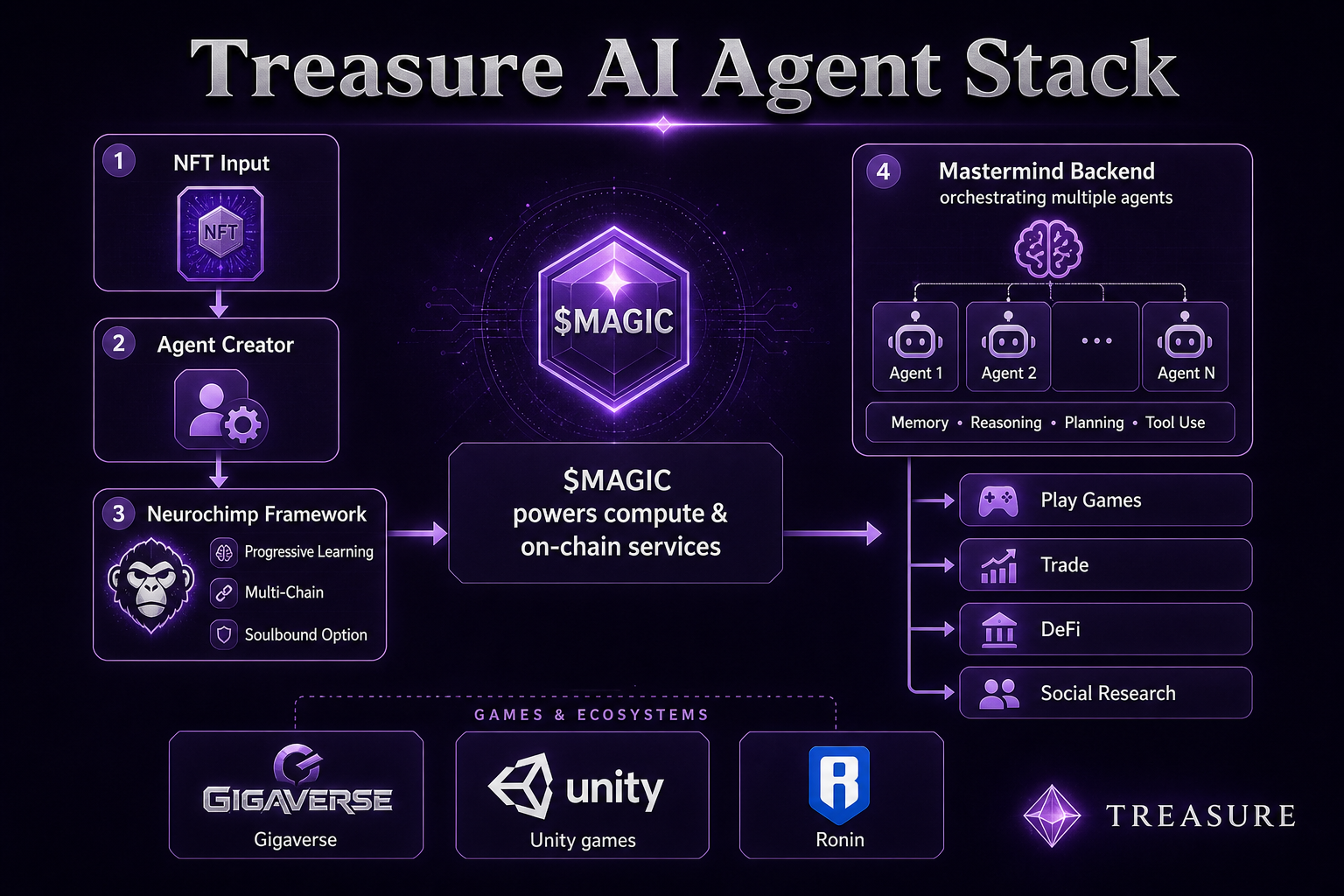 Figure 1. Treasure AI agent stack: Agent Creator, Neurochimp framework, Mastermind orchestration, and MAGIC-powered compute.
What Experiences Do Smolworld and Bridgeworld Canopy Offer, Respectively?
Smolworld is an AI companion app based on the Smol Brains IP, targeting general users. It supports chatting, collecting, trading, and nurturing "Smol" characters, showcasing the application of Neurochimp Agent technology in a consumer-grade scenario. The product is positioned more toward social companionship and IP interaction, lowering the barrier for ordinary users to access AI Agents. MAGIC serves as the medium of ecological value within the app.
Bridgeworld Canopy is a 4X-lite strategy sandbox game that demonstrates Treasure's swarm-AI technology: multiple Agents can collaborate, compete, and evolve in a strategic environment. MAGIC acts as the core token of the game economy, participating in resource management and ecological activities. The Bridgeworld ecosystem also includes on-chain asset systems such as Legions and Harvesters. Harvesters are tools in Bridgeworld for efficiently mining MAGIC, forming part of the MAGIC issuance mechanism together with Atlas Mine.
| Product |
Experience Type |
Target Users |
AI Capability Showcase |
| Smolworld |
AI Companion / Nurturing |
General users, IP fans |
Conversation, collection, character growth |
| Bridgeworld Canopy |
Strategy Sandbox |
Game and strategy players |
Swarm AI, resource game theory |
| Bridgeworld Asset Layer |
On-chain RPG Metaverse |
Long-term ecosystem participants |
Harvester farming, Legions combat |
Smolworld focuses on "one-to-one AI companionship," while Bridgeworld Canopy focuses on "multi-Agent strategic collaboration." Both use MAGIC as a link to transform AI technology into tangible interactive entertainment experiences.
How Does Agent Creator Turn NFTs Into Autonomous Agents?
Agent Creator can convert any NFT into an Agent capable of playing games, trading, and autonomous learning. Treasure Agents start with a "blank slate," accumulating memories and skills from experiences. Users continuously power Agents with MAGIC to maintain computing flow. It also supports non-transferable Soulbound Agents, and a single Agent can operate across networks such as Ethereum, Abstract, and Ronin.
What Can MAGIC Do? How Can I Participate in DAO Governance via gMAGIC?
MAGIC utility covers Agent computing power, in-app economy, and AI Agent Marketplace; governance is implemented through gMAGIC, drawing on the veCRV model to favor long-term stakers. gMAGIC sources are (A) Harvesters/Governance Staking/MAGIC-ETH SLP (1:1) and (B) Magicswap LP or designated treasuries (0.5x), with liquid MAGIC carrying no voting power. TIP proposals are discussed on the forum and voted on Snapshot; approval requires ≥75% in favor and a quorum. TIP-26 mandates quarterly disclosure of treasury and operational reports.
What Are the Advantages and Risks of Adopting the Treasure Ecosystem?
Treasure features a fair-launch token, a complete AI Agent technology stack, and IP interconnection. Limitations include high product concentration, unpredictable Agent behavior, and increasing difficulty for new users to acquire MAGIC under the halving mechanism. Related risks include reliance on smart contracts and cross-chain bridges, concentration of gMAGIC governance, counterfeit contracts, and counterparty risk from autonomous Agent trading. This does not constitute investment advice.
What Are the Most Easily Confused Concepts About Treasure?
Treasure refers to the ecosystem brand, Treasure DAO refers to the governance organization, and Treasure Network is the overall ecosystem name. MAGIC and gMAGIC are not equivalent; Neurochimp is the Agent framework, Mastermind is the backend orchestration. Smolworld is an AI companion, Bridgeworld Canopy is a strategy sandbox, and Legions and Harvesters belong to the Bridgeworld asset layer. MAGIC's mainnet is on Arbitrum One, can be bridged via Treasure Bridge, and is on a different technical layer from Agent multi-chain operations.
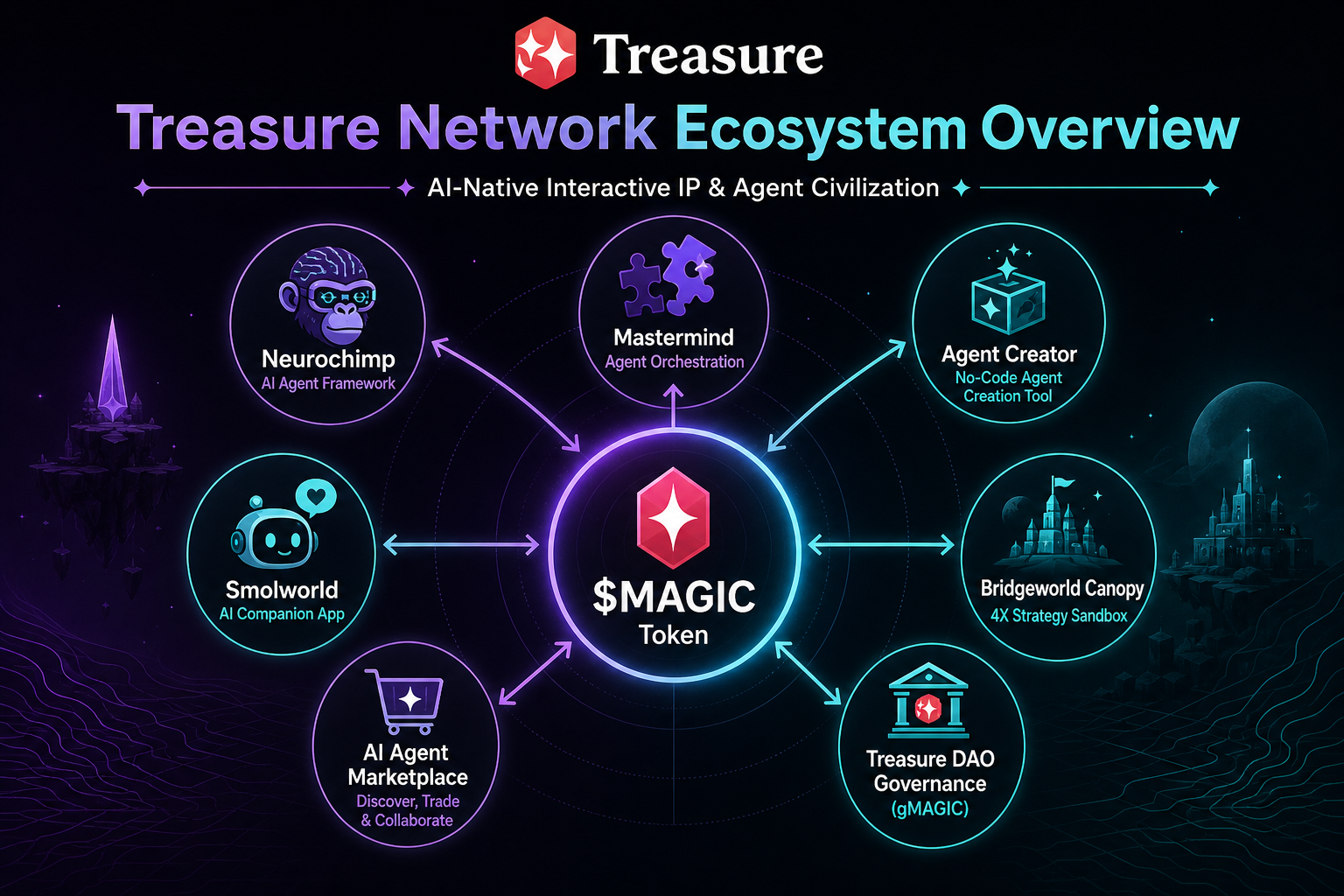 Figure 2. Treasure Network ecosystem: MAGIC token connecting Neurochimp, Mastermind, Agent Creator, Smolworld, Bridgeworld Canopy, and DAO governance.
Summary
Treasure Network is a decentralized AI entertainment ecosystem with MAGIC at its core. It builds Agent infrastructure through Neurochimp and Mastermind, lowers the barrier for users to create Agents via Agent Creator, and delivers interactive IP experiences through Smolworld and Bridgeworld Canopy. MAGIC integrates Agent computing power consumption, gMAGIC governance, and Bridgeworld mining production. Its total supply is capped at 347 million tokens with an annual halving mechanism. Understanding the division of ecosystem components, token roles, and governance pathways is fundamental for reading Treasure technical documentation and product materials.
FAQ
What is Treasure Network?
Treasure Network is a decentralized AI entertainment ecosystem with MAGIC as its native token, governed by Treasure DAO. The ecosystem focuses on AI Agent technology, interactive IP, and proprietary applications, with core components including Neurochimp, Mastermind, Agent Creator, Smolworld, and Bridgeworld Canopy.
What are the use cases of the MAGIC token?
MAGIC is used to pay for AI Agent computing power and on-chain services, participate in applications like Smolworld and Bridgeworld Canopy, and serve as the basis for governance—holders obtain gMAGIC by staking or providing liquidity to vote in DAO proposals. MAGIC is also the medium for production and consumption in Atlas Mine and Harvester mining within Bridgeworld.
What are Neurochimp and Mastermind, respectively?
Neurochimp is Treasure's AI Agent framework responsible for converting NFTs into autonomous Agents capable of learning and cross-chain actions. Mastermind is a scalable backend that orchestrates large-scale concurrent Agents to ensure performance. Their division is "individual Agent capability" versus "network-level orchestration."
How do I participate in Treasure DAO governance?
Users must stake MAGIC in Bridgeworld Harvesters, Governance Staking, or designated LP pools to obtain gMAGIC, then connect their wallet on Snapshot on Arbitrum to vote on TIP proposals. Liquid, unstaked MAGIC does not have voting rights.
What is the difference between Smolworld and Bridgeworld Canopy?
Smolworld is an AI companion app based on Smol Brains IP, focusing on chatting, collecting, and character nurturing. Bridgeworld Canopy is a 4X-lite strategy sandbox that showcases multi-Agent collaboration and resource game theory. Both use MAGIC as the medium of ecological value.
What are the total supply and emission mechanism of MAGIC?
MAGIC has a maximum supply of 347,714,007 tokens. The emission curve mimics Bitcoin's halving logic, but the halving cycle occurs annually on September 1 (UTC). Genesis Mine provided high incentives for early long-term stakers; subsequent emissions are mainly released through Atlas Mine, Harvester, and ecosystem incentive channels.