Amid the rapid expansion of AI applications, enterprises are facing a structural challenge: while model capabilities are advancing quickly, existing business systems are not equipped to support the continuous operation of AI. This disconnect prevents AI from integrating into core production systems, limiting its function to that of a peripheral support tool.
On a broader scale, the competitive landscape of AI infrastructure has shifted away from isolated technical advances to a focus on “how data is interpreted, how models are invoked, and how decisions are executed.” In this structural transformation, Palantir has established itself as a pivotal player.
The Real Bottleneck in Enterprise AI: The Challenge Is Not the Model
At first glance, generative AI appears to have solved the problem of “insufficient intelligence,” yet enterprise adoption remains suboptimal. The core issue is a structural disconnect between the capabilities of AI models and existing enterprise systems.
Enterprise data is distributed across numerous systems—ERP, CRM, supply chain, logging, and external APIs. These data sets differ not only in format but, more critically, in semantics. For instance, terms like “customer,” “order,” and “inventory” may have entirely different definitions across systems.
Furthermore, enterprise processes are complex, human-designed networks not originally intended for AI execution. So, even if a model comprehends natural language, it cannot directly translate that understanding into executable business actions.
Palantir Technologies has addressed this by moving beyond “model optimization” to tackle the “system reconstruction” problem. By unifying the semantic and execution layers, Palantir enables AI to be seamlessly integrated into business operations.
Foundry: Evolving from Data Warehouse to “Business Semantic System”
Foundry’s core value lies in its role not as a traditional data warehouse, but as a “business semantic operating system.”
Traditional data architectures store data in tables, requiring engineers to clean, transform, and model the data for analysis. Foundry abstracts data into an “object network,” where, for example, an order is more than a record—it forms a relational graph with customers, logistics, and inventory.
This approach changes how AI receives inputs: models now engage with “business entities” rather than raw “data fields.” As a result, AI can directly grasp business logic without retraining for new data structures. Foundry also offers data version control and lineage tracking, enabling enterprises to trace the origin and evolution of every metric—a capability especially vital in finance, manufacturing, and government.
Fundamentally, Palantir Technologies, through Foundry, elevates the “data problem” to a “semantic problem”—the first critical barrier to enterprise AI deployment.
Apollo: The Imperative of Continuous AI Delivery
Unlike traditional software, AI systems are not static products—they are dynamic capability systems.
While traditional software is deployed once, AI models, rules, and data environments are in constant flux, making “continuous delivery” a baseline requirement.
Apollo addresses this need by enabling AI applications to be continuously updated across cloud, on-premises, and edge environments, all while maintaining version consistency and robust security controls.
This is crucial in complex enterprise environments. For example, the same AI system may run on production lines, in data centers, and within government security networks—any version inconsistency can lead to decision-making errors.
With Apollo, Palantir Technologies transforms AI from a “deployed software” model into a “continuously operating system,” giving AI the characteristics of infrastructure rather than just applications.
Multi-Model AI: From Model Capability to Execution Chain
Enterprise AI has entered the era of “multi-model collaboration,” where no single model can address all complex business requirements. Real-world business processes typically involve multiple steps: a large model generates a plan, a predictive model assesses risk, a rules system checks compliance, and an execution system implements the action.
The challenge is not the existence of models, but whether they can operate collaboratively within a unified execution chain.
Palantir Technologies’ key strength lies in building a unified execution framework that allows diverse models to work together at the same semantic layer, eliminating “model silos.”
This transforms AI from a collection of disparate tools into an orchestrated decision-making system.
Data Governance: The Critical Barrier for AI in Core Business
As AI becomes embedded in core enterprise systems, data governance emerges as a decisive constraint.
Key concerns for enterprises adopting AI include:
-
Whether AI accesses unauthorized data
-
Whether AI decisions are fully traceable
-
Whether AI complies with all relevant regulations
-
Whether AI actions are auditable
These considerations are especially critical in high-sensitivity sectors like finance, healthcare, and defense. Palantir Technologies addresses these concerns with fine-grained permission controls and auditing mechanisms, bringing all AI actions within a controlled, enterprise-grade “trusted execution” framework. At this level, competitive advantage shifts from model performance to system governance capability.
Palantir vs Snowflake vs Databricks: A Layered Competitive Structure
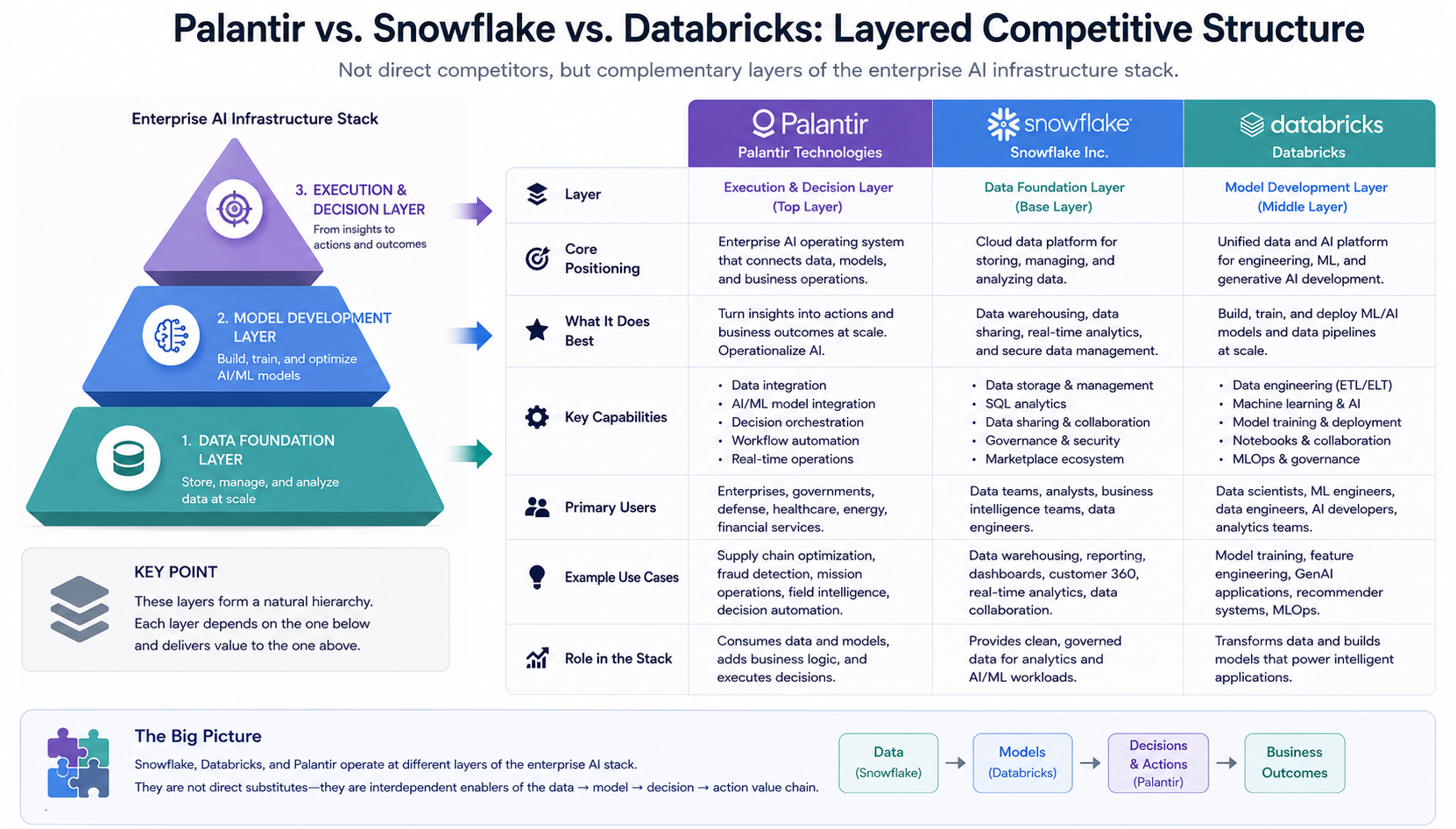
From an enterprise AI infrastructure perspective, these three companies are not direct competitors but instead operate at distinct layers of the technology stack. Snowflake focuses on data storage and analytics as a “cloud data warehouse platform.” Databricks specializes in data engineering and machine learning development as “AI development infrastructure.”
Palantir Technologies operates at a higher level, connecting data, models, and business execution into a closed-loop system.
This layered structure means the competition is not about replacement but about integration across tiers:
-
Snowflake: Data foundation
-
Databricks: Model development layer
-
Palantir: Execution and decision layer
Systemic Challenges in Enterprise AI Infrastructure
The obstacles to enterprise AI adoption are fundamentally systemic—not isolated technical issues.
Data heterogeneity means systems cannot integrate seamlessly.
Organizational complexity requires cross-departmental collaboration, yet enterprises are often siloed.
Security and compliance demands require AI behavior to meet rigorous regulatory standards.
Cost and maintenance concerns mandate that AI systems operate continuously, not as one-off deployments.
These challenges make clear that enterprise AI success depends on infrastructure transformation, not just the adoption of individual tools.
Palantir’s Next Phase: Toward an AI Operating System
Palantir Technologies’ long-term vision is to evolve from a data platform into an “AI operating system.” This transformation is evident on three fronts: AI shifts from an assistive analytics tool to an execution engine directly involved in business operations; data shifts from static assets to real-time semantic networks supporting dynamic decision-making; and enterprises shift from process-driven to model-driven systems, with AI at the core of orchestration. Once achieved, this transformation will fundamentally alter enterprise software architecture, making the data platform the enterprise’s operational backbone.
Conclusion
Palantir Technologies’ significance in AI infrastructure stems not from superior model performance, but from its resolution of the three core challenges of enterprise AI deployment: semantic structure, execution systems, and continuous delivery.
As AI infrastructure evolves from “model competition” to “system competition,” the dual-layer architecture of Foundry and Apollo positions Palantir as the foundational operating system for enterprise AI—transcending the role of mere tool or platform.