Gate TradFi: A Multi-Market Trading Platform Connecting Traditional Finance and Digital Assets
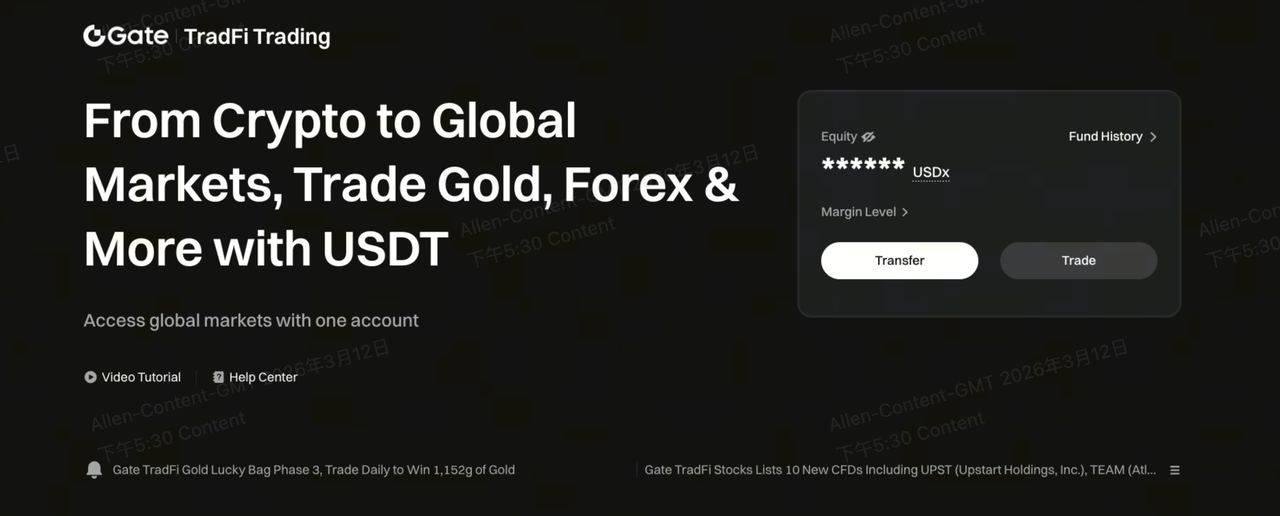
As trading demands grow more complex, single-asset platforms can no longer meet investors’ needs for global allocation. Gate TradFi is a multi-asset trading module launched in response to this trend, designed to offer users a one-stop trading experience that covers both traditional financial markets and digital asset markets.
Unlike traditional platforms that only support crypto assets, Gate TradFi integrates metals, energy, stock indices, forex, and commodities into a unified trading framework. This enables users to conduct cross-market trading and manage funds within a single account system, and flexibly participate in both long and short positions through the CFD (Contract for Difference) mechanism.
From a product positioning perspective, Gate TradFi is not just an additional trading entry point—it marks the platform’s evolution from a single crypto exchange to a comprehensive global asset trading platform. This structural change reflects the future direction of trading infrastructure—allowing users to carry out cross-market asset allocation and trading decisions within a unified system.
Multi-Asset Allocation: Reducing Portfolio Risk Through Diversification
In investment management, diversification has always been a core principle for reducing risk. The essence lies in the fact that different assets typically display distinct price behaviors under various macro environments. By allocating reasonably, the impact of single-market volatility on the overall portfolio can be minimized.
Gate TradFi’s multi-market coverage allows investors to more conveniently build cross-asset portfolios. Common allocation strategies include:
- Hedging risk assets with precious metals
Safe-haven assets like gold and silver often perform strongly when market risks rise, helping to offset losses in high-risk assets.
- Allocating energy assets based on inflation expectations
Energy commodities such as crude oil are often closely linked to inflation cycles and serve as important tools for macro trading.
- Combining stock indices and forex
Capturing growth and monetary policy differences across economies through index and currency combinations.
Reducing systemic risk from any single region or market and enhancing overall portfolio stability.
Through cross-market allocation, investors are no longer simply betting on one direction but building more resilient overall investment portfolios.
Leverage and Risk Management: Key Skills for Enhancing Capital Efficiency
In a multi-asset trading environment, leverage is an important tool for improving capital efficiency, but it also amplifies risk. Therefore, seasoned traders do not blindly pursue high leverage; instead, they dynamically adjust risk exposure based on the volatility of different assets, market structure, and strategic needs.
For example, with assets like gold or major stock indices that have relatively controllable volatility, investors usually apply lower leverage for trend allocation. In more volatile markets like crude oil or forex, leverage may be moderately increased according to market momentum to enhance capital efficiency.
Meanwhile, stop-loss, take-profit, and position management mechanisms are essential risk control tools in leveraged trading. By setting exit conditions in advance, traders can effectively limit the maximum loss per trade and lock in profits when targets are reached.
Leverage itself does not generate returns—it only amplifies outcomes. Ultimately, long-term profitability is determined by risk control and position management skills.
Trend Trading and Capturing Cross-Market Opportunities
The interconnectedness of global asset markets is constantly strengthening; different assets are often driven by similar macro factors. As a result, modern traders face not isolated markets but a highly interlinked global asset network.
For example, when risk-off sentiment rises in the market, funds typically flow into safe-haven assets like gold. When geopolitical or supply chain issues arise, energy commodities like crude oil may experience rapid volatility. Changes in monetary policy directly affect the forex market and the pricing of global risk assets.
For multi-asset traders, real advantage does not come from continuously trading a single market but from understanding the macro logic behind different assets and dynamically switching trading opportunities as trends develop. Gate TradFi’s multi-market coverage enables investors to quickly respond to changing market conditions on a single platform, improving their ability to capture trends and switch assets across markets.
Multi-Strategy Portfolios: Building a More Comprehensive Trading System
As market complexity increases, single strategies can no longer adapt to all market conditions. More professional investors are adopting multi-strategy portfolio approaches to enhance return stability and reduce drawdowns.
In a multi-asset trading environment, investors can build more flexible trading systems based on the characteristics of different markets, such as:
- Trend-following strategies
Capturing directional trends and building positions accordingly.
Establishing offsetting positions between related assets to reduce net risk exposure.
Exploiting price differences across markets or assets for low-risk returns.
- High-frequency and short-term strategies
Leveraging short-term volatility to improve capital turnover efficiency.
By combining multiple strategies, investors can reduce reliance on any single market environment and make their overall trading systems more adaptive and stable.
Start trading now on Gate TradFi: https://www.gate.com/tradfi
Multi-Asset Trading Is Reshaping the Future Investment Framework
As global markets continue to converge, future investors’ competitiveness will no longer depend on mastering a single market but on having comprehensive allocation capabilities across assets, markets, and cycles.
Gate TradFi is more than just a new trading product module—it represents the future development direction of trading platforms: evolving from single-asset platforms to comprehensive asset platforms, from single-point trading tools to complete portfolio management solutions.
For traders, mastering multi-asset allocation logic, risk management methods, and cross-market trading skills will become key competitive advantages in future financial markets. Only by building a systematic and globalized trading perspective can one continuously gain an edge in ever-evolving market structures.