In traditional financial analysis, price is often described as a “reflection of information.” However, in the crypto market, “information” is not a single dimension—it is often disseminated in the form of narrative, amplified by emotion, and realized through trading behavior.
This means that price is not always first driven by data and then by market reaction; more often, narrative focuses attention, emotion drives position reshuffling, and only then do observable results appear on-chain and in transactions.
1. Narrative is not noise, but a mechanism for market attention allocation
The market generates massive amounts of information every day, but only a small portion is converted into trading behavior.
The key to “which information gets traded” is not just the facts themselves, but the narrative framework. Narrative organizes scattered events into a logical structure that can be communicated, believed, and acted upon—for example, “a sector enters a policy-friendly period” or “a technological route will become the next main theme.”
Once a narrative forms, capital will preferentially flow to assets highly relevant to it, leading to periodic valuation repricing.
2. Emotion is an amplifier for the speed of narrative diffusion
Whether a narrative translates into price depends on the emotional state.
- During periods of rising risk appetite, the same bullish narrative more easily triggers buying behavior;
- During periods of declining risk appetite, even neutral news may be interpreted as bearish.
Emotion essentially changes the “market interpretation function,” not the event itself. Therefore, narrative research without considering emotional states often leads to directional bias.
3. Why is the crypto market more influenced by narrative than traditional markets?
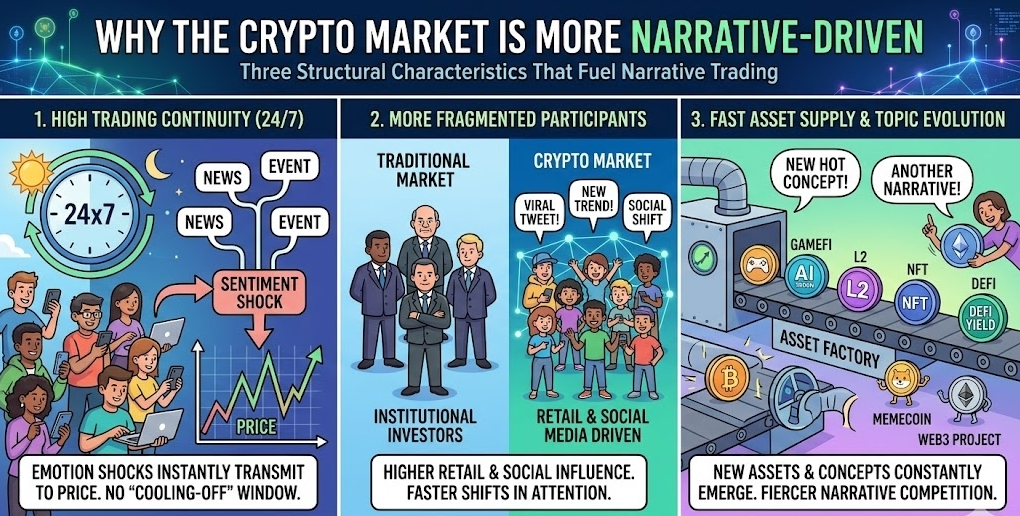
Three structural features of the crypto market make narrative-driven trading stronger:
- High trading continuity (7x24): Emotional shocks can be instantly transmitted to prices, with no obvious “cooling window.”
- More decentralized participant structure: Retail and social media-driven participation is higher, and attention shifts faster.
- Fast asset supply and theme evolution: New assets and concepts continuously emerge, making narrative competition more intense.
These three factors mean that narrative in the crypto market is not only the “language for explaining prices,” but also the “mechanism for triggering trades.”
4. The Four-Stage Transmission Chain from “Information” to “Price”
For subsequent quantifiable modeling, this course adopts a four-stage chain:
- Event occurrence: news, policy, on-chain anomalies, project dynamics
- Narrative packaging: events organized into communicable stories by media/community
- Emotion diffusion: social media discussion, KOL reposts, strengthened capital expectations
- Trade realization: increased trading volume, changes in derivative positions, on-chain capital migration
The value of this chain lies in breaking down “subjective perception” into observable nodes. Later lessons will build data indicators and scoring methods around these four stages.
5. Why “only reading news headlines” fails
The most common practical mistake is mapping news events directly to buy/sell signals.
The same news can produce opposite results in different market conditions for reasons such as:
- The market has already traded on expectations (good news causes prices to fall after it materializes);
- Narrative crowding is too high (new buying is insufficient to drive further gains);
- Capital focuses more on liquidity conditions than the event itself.
Therefore, single-point information cannot be traded directly; it must be judged together with “emotional temperature + on-chain verification + position structure.”
6. The core of narrative trading is not predicting news, but judging “tradability”
The goal of narrative research is not to answer “is this story true,” but “can this story be converted into sustainable capital behavior.”
Tradable narratives usually have three characteristics:
- Consistency: Different information sources provide explanations in the same direction;
- Persistence: Heat is not just a single-day spike—it continues across time periods;
- Verifiability: On-chain flows, transaction structures, and position data are in alignment.
Missing any one of these significantly reduces the trading value of a narrative.
7. Lesson Summary
This lesson accomplished three basic tasks:
- Defined the boundaries of emotion and narrative’s role in the crypto market;
- Explained why narrative has stronger price influence in the crypto market;
- Established the main analysis chain of “event—narrative—emotion—trade.”
The next lesson will move into the data layer to systematically break down the signal value and noise characteristics of news, social media, and on-chain behavior, forming a data foundation for subsequent scoring models.