Global central banks resumed net gold purchases in April, acquiring 17 tons according to World Gold Council data. This marked a sharp reversal from March, when nearly 30 tons were net sold due to factors including significant selling by Turkey. The turnaround comes as gold's share of global official reserves reached a historic 27% by the end of 2025, surpassing US Treasuries at 22%, according to a European Central Bank report released June 2. The shift reflects sustained buying by emerging market central banks in Eastern Europe and Asia, even as gold prices remain volatile after hitting a record $5,598.75 per ounce in January before falling roughly $1,000 following the outbreak of the US-Iran war.
Central Banks Net Purchased 17 Tons in April
Marissa Salim, senior research lead for Asia-Pacific at the World Gold Council, noted that global central banks formally resumed net gold purchases in April with 17 tons added, representing a strong V-shaped rebound compared to the sizable net sales reported in March. Eastern European and Asian central banks drove the buying, with Eastern Europe averaging 12 tons per month and Asia averaging 11 tons per month over the past 36 months, against a global monthly average of 29 tons.
Poland's central bank led with 14 tons purchased in April, bringing its year-to-date total to 45 tons and raising gold's share of its reserves to 30%. The People's Bank of China increased holdings by approximately 8 tons (260,000 ounces) in April, marking the 18th consecutive month of purchases and lifting total reserves to approximately 2,322 tons as of the end of April. According to World Gold Council monthly data, this was China's second-largest monthly purchase since resuming buying in November 2024, exceeded only by approximately 10 tons in December 2024. The Czech central bank added 2 tons in April, its 38th consecutive month of increases.
Russia's central bank continued selling, offloading 6 tons in April for the fourth consecutive month. Turkey's reserves stabilized in April after clearing short-term swap contracts, following earlier large-scale sales.
Gold Surpasses US Treasuries as Top Official Reserve Asset
A European Central Bank report released June 2 stated that as of the end of 2025, gold's share of total global official reserve assets rose to 27%, while the US Treasury share fell to 22%. ECB President Christine Lagarde wrote in the report that persistent geopolitical tensions continue to drive central banks to allocate heavily to gold. The ECB noted that sustained gold purchases by emerging economies including China, Poland, Turkey, and India have reshaped global reserve allocation structures, and combined with significant gold price increases, jointly pushed up gold's weight in total reserve assets.
This shift represents the culmination of a long-term trend. Since the 2008 global financial crisis, global central banks have transitioned from net sellers to net buyers of gold, with cumulative net purchases exceeding 8,000 tons. Particularly after 2010, as emerging market economies grew and foreign exchange reserve scales expanded, demand for diversified reserve allocation intensified, with gold increasingly favored as a reserve asset with no sovereign credit risk and intrinsic value.
Xia Yingying, head of the precious metals and new energy research group at Nanhua Futures, said rising gold prices were a key factor. According to IMF data, since global central banks resumed net gold purchases in 2009, the market value of official gold reserves increased from $850 billion at the end of 2008 to $5.074 trillion at the end of 2025, a gain of 473%, with gold prices up 370% and gold reserve quantities up 22%. Over the same period, global central bank foreign exchange reserves increased 83%.
US Treasuries faced a dual blow: rising yields during the Federal Reserve's prior rate-hiking cycle reduced the market value of existing bonds, while US debt exceeding $39 trillion and massive fiscal interest burdens diminished the credit appeal of Treasuries. Geopolitical factors and de-dollarization trends also played key roles.
The ECB also noted that compared to mainstream fiat currencies, gold as an official reserve has limitations: severe price volatility, no interest income, and high storage costs for physical gold. More critically, gold supply elasticity is insufficient to flexibly adjust to changes in global international liquidity demand.
Gold Price Volatility in 2025
Gold prices have experienced sharp swings in 2025. After reaching a historical high of $5,598.75 per ounce in January, gold fell approximately $1,000 following the outbreak of the US-Iran war and has fluctuated around $4,500 per ounce over the recent month.
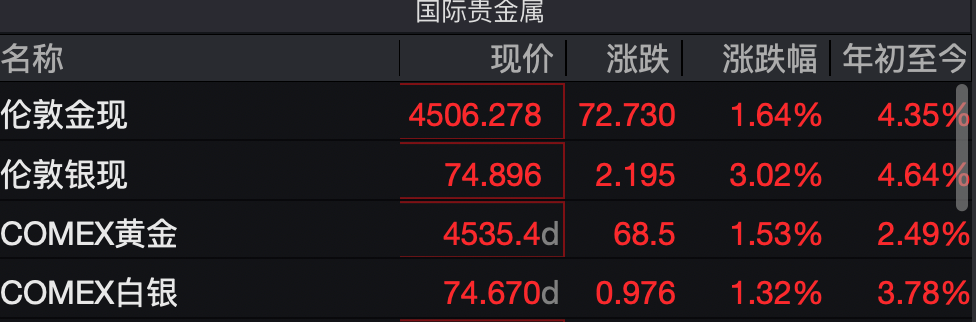
As of publication, spot gold was quoted at $4,506.278 per ounce, up 1.64%, and COMEX gold was at $4,535.4 per ounce, up 1.53%.
Analyst Forecasts on Gold's Trajectory
Xia Yingying stated that central bank gold purchases help smooth gold price volatility because they exhibit a phased negative correlation with prices. However, if purchase scale growth is driven by non-price factors such as rising gold allocation preferences, this will weaken the market supply's ability to adjust to demand growth and increase upward price elasticity. Xia noted that gold price movements are primarily driven by investment demand, and the second half of the year requires close attention to the impact of international crude oil prices and the AI economy on Federal Reserve monetary policy expectations, as well as shocks to investment demand from market risk-aversion sentiment fluctuations.
Goldman Sachs maintains its bullish view on gold, forecasting that gold will resume its upward trend by the end of 2026. Analysts Lina Thomas and Daan Struyven wrote in a report that gold's medium-term outlook remains solid, with prices potentially reaching $5,400 per ounce due to continued central bank purchases and an expected two rate cuts by the US this year.
Wells Fargo strategists stated that four out of five economic scenarios point to further currency depreciation, which could push gold prices to $8,000 per ounce by 2027. However, in a pessimistic scenario where currency depreciation momentum falls short of expectations, gold prices could fall to $4,000 per ounce by the end of 2027.
Natasha Kaneva, head of global commodities research at J.P. Morgan, said in a recent interview that in a baseline scenario where the Strait of Hormuz reopens in June, market expectations regarding the Federal Reserve's policy path may also change. "The Fed is more likely to stand pat. After real interest rates decline, gold prices will rise because central banks will also resume gold purchases," she said. She forecasts gold could reach $6,000 per ounce by year-end and $6,300 per ounce by the end of 2027. However, if the strait remains closed, another scenario may emerge: "Oil prices continue to rise, gold continues to fall."
Multiple institutions including Morgan Stanley, ANZ, and Citigroup have expressed bearish views on gold and lowered price forecasts. For example, Morgan Stanley revised its second-half 2026 gold target to $5,200 per ounce, well below its previous forecast of $5,700, citing rising real interest rates due to geopolitical friction and delayed Federal Reserve rate cuts, which have restored gold's classic negative correlation with real interest rates.
FAQ
What did global central banks do in April regarding gold?
Global central banks resumed net gold purchases in April, acquiring 17 tons according to World Gold Council data. This reversed March's nearly 30-ton net sale, with Poland leading at 14 tons, China adding approximately 8 tons for its 18th consecutive month of purchases, and the Czech Republic adding 2 tons for its 38th consecutive month.
Why did gold surpass US Treasuries as the top official reserve asset?
According to a European Central Bank report released June 2, gold's share of global official reserves reached 27% by the end of 2025, exceeding US Treasuries at 22%. This resulted from sustained central bank purchases by emerging economies, a 370% increase in gold prices since 2009, and declining appeal of US Treasuries due to rising yields and fiscal pressures.
How did gold prices perform in 2025?
Gold hit a historical high of $5,598.75 per ounce in January 2025, then fell approximately $1,000 following the outbreak of the US-Iran war. Over the recent month, gold has fluctuated around $4,500 per ounce.


