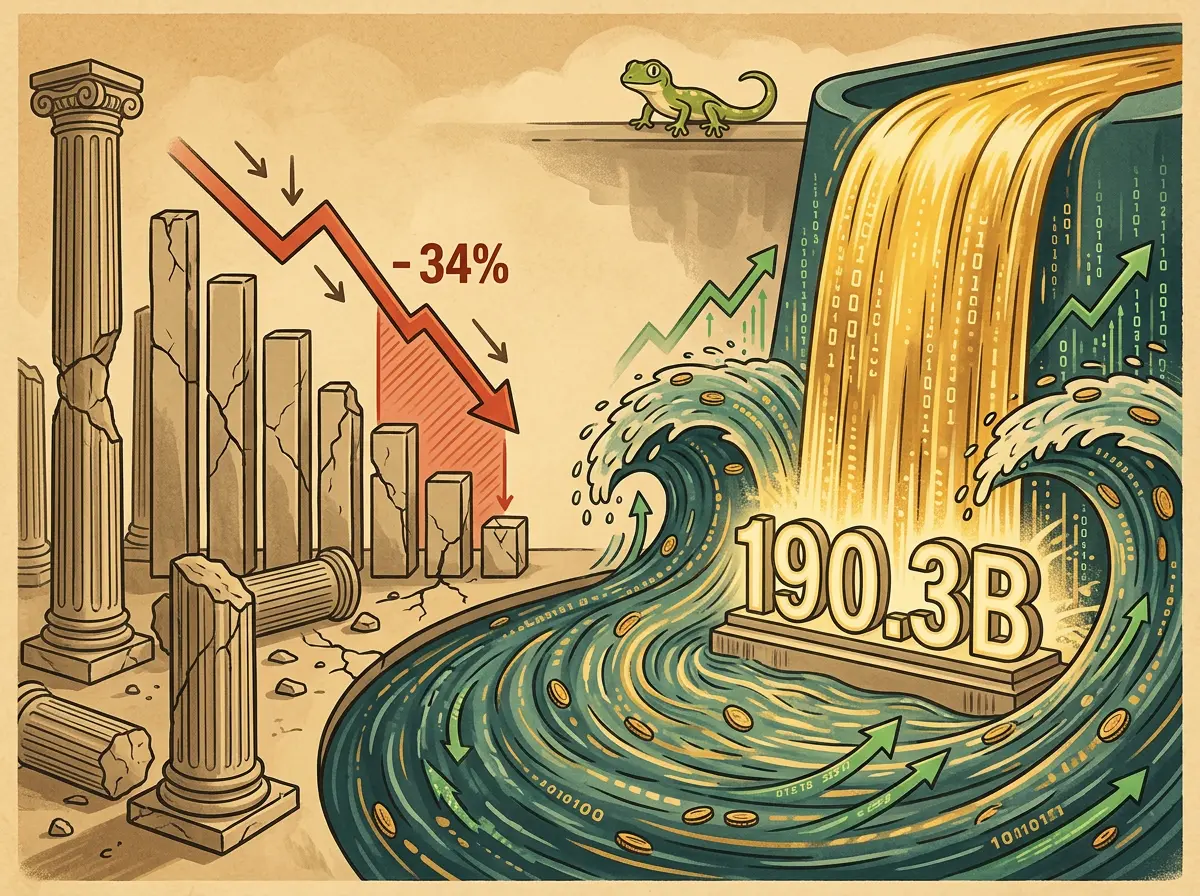
CoinGecko released its “2026 Cryptocurrency Perpetual Contract Status Report” on May 22, confirming that total crypto Open Interest in April fell to $99.09 billion, down more than 50% from the peak; the top 11 Perp CEXs’ average monthly trading volume for the first four months was $4.69 trillion, a drop of 34%. Hyperliquid’s single-month trading volume in April reached $190.28 billion.
10/10 Liquidation Event: Confirmed Scale of the Largest Single-Day Liquidation in Crypto History
 (Source: CoinGecko)
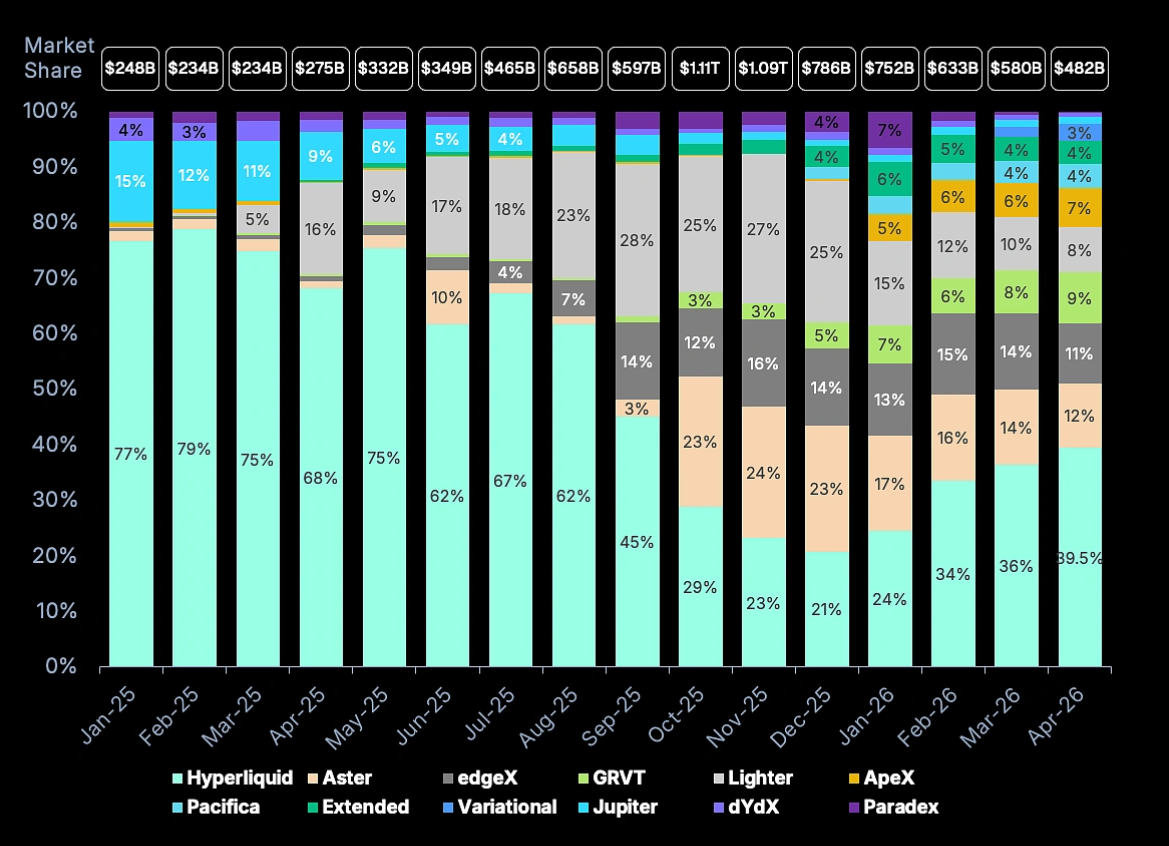
The liquidation event on October 10, 2025 has been confirmed by CoinGecko as the largest single-day liquidation in the crypto market to date, with a scale of about nine times that of any prior single-day liquidation event. Confirmed figures are as follows: leveraged positions of nearly $19 billion were forcibly liquidated within 24 hours; 1.6 million trader accounts were zeroed out; and BTC fell from its historical high of $122,574 to about $105,000 in the event. The trigger was a 100% China tariff announcement, but record-high leverage levels and the recursive USDe lending cycle on Binance substantially amplified the liquidation scale.
The event’s impact on market structure has continued to this day: total Open Interest, from the $210 billion peak three days before the event (October 7), had only recovered to $99.09 billion after seven months (-53%), indicating that traders’ pace of rebuilding leverage has clearly slowed. BTC’s Open Interest alone is down by about 31% versus the October 2025 peak, but the latest incremental BTC Open Interest since 2026 has already exceeded the same metric during the period when 2025 ATH was formed, suggesting partial recovery signals.
Perp CEX vs Perp DEX: Confirmed Market Share Data from 2024 to 2026
 (Source: CoinGecko)
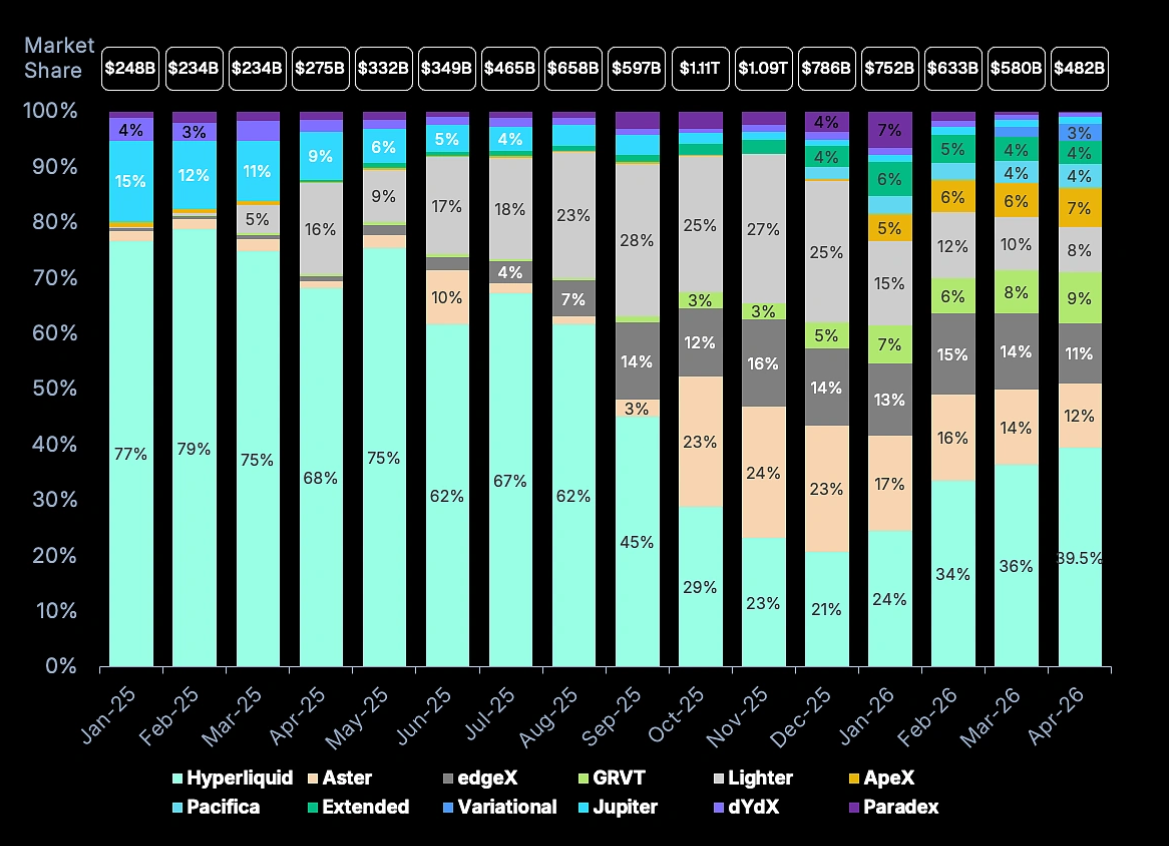
Confirmed figures on the Perp CEX layer: the top 11 CEXs’ average monthly trading volume was $7.11 trillion in 2025, and fell to $4.69 trillion in the first four months of 2026 (-34%); Binance holds 33% share, and OKX holds 15%. Between January 2025 and April 2026, MEXC added 879 perpetual contract products, while BingX added 565; both adopted aggressive listing strategies to respond to competition.
Confirmed figures on the Perp DEX layer: perpetual DEX average monthly trading volume increased from $531.65 billion in 2025 to $611.57 billion in 2026 (+15%); total trading volume was $1.5 trillion in 2024 and rose to $6.38 trillion in 2025; OI market share rose from 3.6% at the beginning of 2025 to 13.5% at the end of April 2026, while CEX’s OI share in the same period fell from 96.4% to 86.5%.
Hyperliquid’s growth is the most representative case of Perp DEX share expansion. Its commodity perpetual contracts (including commodities like crude oil) have accounted for about 30% of Hyperliquid’s total Open Interest; tradeXYZ’s crude oil perpetual contract even temporarily surpassed the bitcoin perpetual contract in single-day trading volume on April 9, 2026.
FAQ
What is the “recursive USDe lending cycle” mechanism of the 10/10 liquidation event in October 2025, and why did it magnify the liquidation size?
The recursive lending cycle refers to: traders use USDe (Ethena’s synthetic dollar stablecoin) as collateral to borrow on Binance; the borrowed funds are used to buy more crypto assets; then the newly acquired assets are used as collateral to carry out a second round of borrowing, forming a layered leverage loop structure. When the price of assets like BTC falls, the collateral value shrinks, triggering forced liquidation; the assets that are forcibly sold further push down market prices, leading to a new round of collateral devaluation and closing positions, forming a self-reinforcing downward spiral. The initial drop triggered by the 100% China tariff announcement was amplified through this structure into a $19 billion single-day liquidation.
Does the Perp DEX Open Interest market share rising from 3.6% to 13.5% reflect real user migration, or is it mainly driven by point rewards?
CoinGecko’s report confirms the existence of two driver sources. Hyperliquid achieved organic growth through its sustainable business model and technical infrastructure based on fee buybacks, validated by its 42% share of on-chain fees; the growth of emerging Perp DEXs such as Pacifica, Extended, and Variational relies primarily on point and airdrop incentive mechanisms. This kind of growth has a structural characteristic of “airdrop-driven traders,” and retention rates after the completion of an airdrop are typically lower than those of organic users. The report states that the points mechanism “might be able to maintain” activity, but it does not provide a definitive conclusion.
If the incremental BTC Open Interest in 2026 exceeds the level during the 2025 ATH period, does it mean leverage rebuilding is complete?
Not entirely. CoinGecko confirms two sets of data pointing in different directions: the incremental BTC Open Interest in 2026 has hit a new high (a positive signal), but the absolute level of BTC Open Interest is still about 31% lower than the October 2025 peak, while total crypto market Open Interest is still more than 50% below the peak. The former reflects the strength of marginal capital inflows, while the latter reflects the accumulated depth of existing leverage. By absolute levels, leverage rebuilding has not been completed; by the speed of flows, acceleration signals have already appeared.


