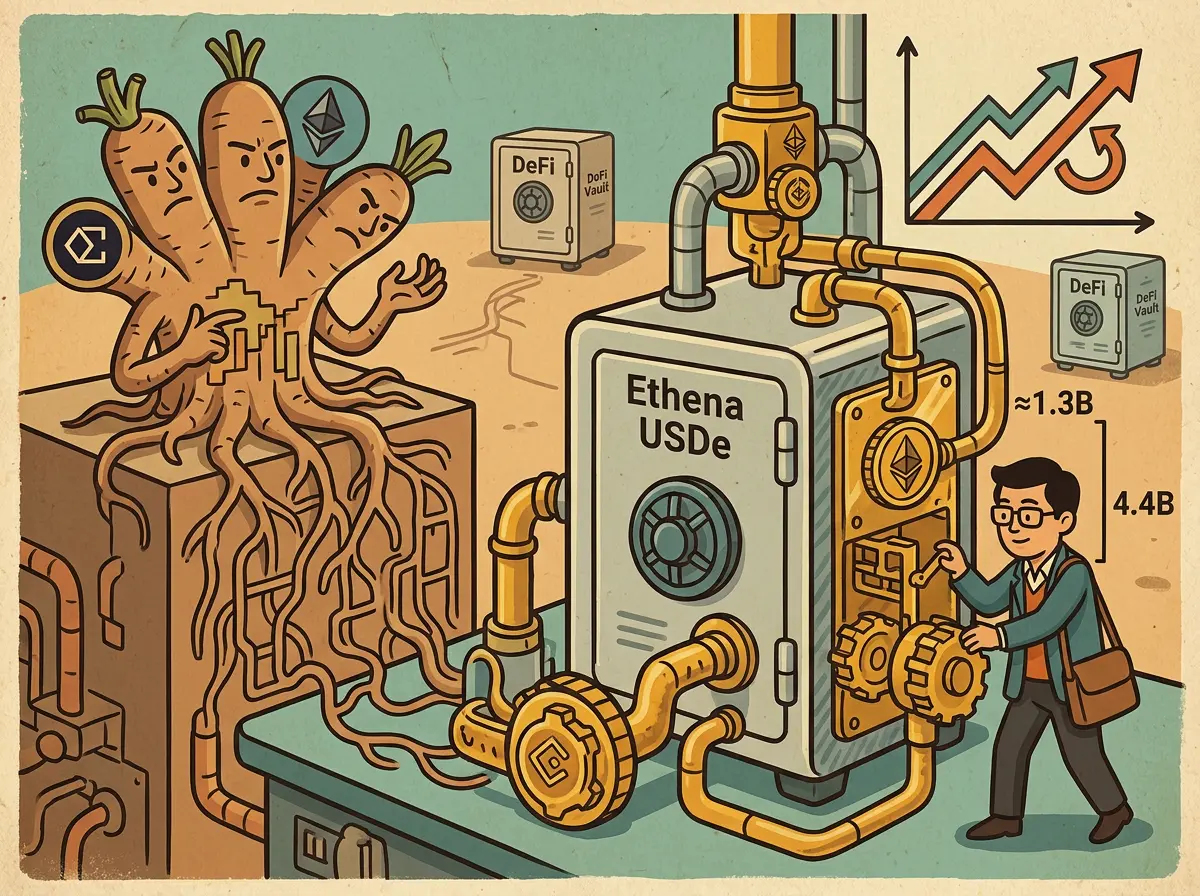
DeFi organization YAM said in an X post on May 21 that, using proportional allocation, about $1.33 billion of Ethena’s USDe—out of its $4.4 billion in collateral funds—falls under “self-loans,” meaning Ethena indirectly provides funding for loans backed by USDe or sUSDe by using its liquidity share across various DeFi lending pools.
YAM Calculation Results: Three Core Figures Under Proportional Allocation
According to the calculation results listed in YAM’s post:
Ethena self-loan estimate: about $1.33 billion (about 30% of $4.4 billion total collateral funds)
Total borrowing amount backed by Ethena assets: about $1.67 billion
The difference vs. proportional allocation: about $336 million
YAM emphasized that Ethena is not the sole lender in each lending pool, so it used proportional allocation rather than counting the full amount. Using a specific example: if a lending pool borrows $556 million using USDe or sUSDe as collateral, and Ethena provides 47.4% of the liquidity, YAM estimates that about $263 million of that is “self-borrowed” funding supported by Ethena. YAM said the figures above are estimates, and as of the time of the post, Ethena’s official side had not issued a formal response to the statement.
Ethena reserve structure: publicly available dashboard data as of May 20
Based on data from Ethena’s transparency dashboard as of May 20, DeFi lending makes up 47.7% of supporting assets (about $2 billion), liquid-stable cryptocurrencies make up 52.7%, and institutional lending and crypto basis exposure account for only a small portion of reserves. Ethena reports an overall collateralization rate of 101.55%, with total supporting funds and reserves of about $4.51 billion, USDe supply of about $4.45 billion, and the token currently trades near a $1 peg. sUSDe’s annualized yield is about 4%, the average funding rate is about 6.8%, and Ethena’s share in total open interest in crypto is 0.05%. Ethena’s dashboard confirms that it has completed integration and certification with institutions including Chainlink, Chaos Labs, LlamaRisk, Copper.co, Kraken, and Anchorage Digital.
Stablecoin market: total marketcap breaks $300 billion, but net growth is only $900 million
According to BlockchainReporter data, over the past month the stablecoin market’s nominal value broke $300 billion, but while USDT increased by more than $5 billion, the combined marketcap of USDC, USDe, and PYUSD fell by $4.2 billion, bringing overall net growth to only $900 million (+0.3%). USDe supply dropped 28% over the past month, with a cumulative decline of nearly 34% year-to-date. The main reason is that compressed perpetual contract financing rates substantially reduced returns for USDe holders, prompting depositors to withdraw; PYUSD fell 13% in the same period. The $5 billion increase in USDT aligns closely with the $4.2 billion outflows from other stablecoins, indicating that recent nominal growth mainly reflects capital rotating among stablecoins rather than new capital inflows.
FAQ
What specific behavior does “self-loans” referred to by YAM mean?
YAM defines “self-loans” as: Ethena provides capital as a liquidity provider in DeFi lending pools, and those same lending pools take out loans using USDe or sUSDe as collateral. Therefore, Ethena effectively provides funding indirectly for part of the loans via its liquidity share. YAM uses proportional allocation rather than full inclusion, and it clearly states that the results are estimates.
As of May 20, what are Ethena’s reserve support rate and peg status?
Based on publicly available data from Ethena’s dashboard, as of May 20, USDe’s reserve support rate is 101.55%, total supporting funds and reserves are about $4.51 billion, USDe supply is about $4.45 billion, and the token trades near a $1 peg price. The dashboard confirms that the redemption mechanism is operating normally.
Does the 28% drop in USDe supply indicate a problem with the peg mechanism?
Based on Ethena’s dashboard support rate of 101.55% and the current trading price near $1, there is no record of peg failure. The shrinking supply reflects holders withdrawing funds under compressed financing-rate conditions. Ethena’s May 20 data did not report any redemption anomalies.


