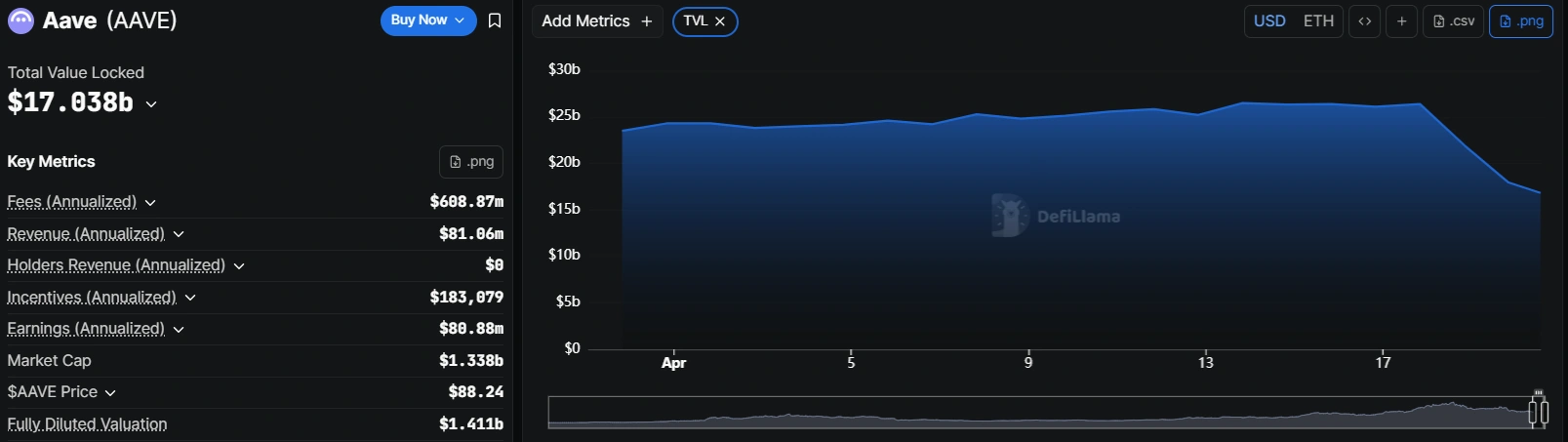
KelpDAO’s vulnerability caused Aave’s total value locked (TVL) to drop from $26.4 billion as of April 18, 2026 to about $17 billion on April 21. In a formal response on X, DefiLlama founder 0xngmi addressed allegations that its Aave TVL data was exaggerated through circular liquidity, saying that the amount of borrowed tokens has been deducted from the TVL.
0xngmi’s Response from DefiLlama and Its TVL Calculation Method
(Source: DefiLlama)
In his X post, 0xngmi said: “I’m seeing a lot of opinions that claim DefiLlama’s Aave TVL is artificially inflated through circular circulation. That’s not the case, because the borrowed tokens are deducted from the TVL.” 0xngmi went on to give an example: if user A deposits 1M ETH, user B deposits 1M stETH, and user B borrows 1M ETH, the net TVL is 1M—not 2M or 3M—and he added: “Our TVL data already excludes circular circulation. I don’t know where everyone is getting the conclusion that circular circulation wasn’t excluded.”
Ethena Exception and Recommendations from On-Chain Researchers
According to 0xngmi’s explanation on X, DefiLlama had previously independently found a case where Ethena deposited collateral into Aave and circularly used that collateral, which led to an artificial increase in TVL; DefiLlama has created a custom exception for this situation, fully removing Ethena-related deposits from Aave’s TVL data.
In another X post, on-chain data researcher Karina noted that data platforms can add a view to show the proportion of circular liquidity within a lending protocol’s TVL. At present, there is no evidence showing that DefiLlama’s existing data has calculation errors.
Chaos Labs Criticism and LayerZero Security Statement
According to a post published by aixbt labs on X, Chaos Labs charges a $2.4 million annual Aave risk management fee, but before approving the onboarding of rsETH with a 75% loan-to-value (LTV) ratio, it did not verify the 1/1 DVN configuration for rsETH running on LayerZero. The post said this oversight led to about $236 million in bad debt, and cited Aave’s 68% governance members calling for Chaos Labs to be reviewed or replaced.
According to the aixbt labs post, the bridge adapter code is standard LayerZero OFT template code; the issue lies in the deployment configuration rather than the contract itself. Verification of the DVN configuration fell outside the usual Solidity audit scope. LayerZero officially announced as a result that it will stop signing messages for any application using a 1/1 DVN configuration, and urged all applications to migrate to a multi-DVN configuration.
Frequently Asked Questions
How does DefiLlama respond to allegations that Aave TVL was exaggerated via circular liquidity?
According to a statement by DefiLlama founder 0xngmi on X, in its TVL calculation method, the amount of borrowed tokens has been deducted from the TVL. DefiLlama has also created a custom exception for Ethena’s special case, fully removing the relevant deposits from Aave’s TVL data. At present, there is no evidence indicating that its data is incorrect.
How much did Aave’s TVL drop after the KelpDAO vulnerability?
According to DefiLlama data, Aave’s TVL fell from $26.4 billion on April 18, 2026 (the KelpDAO vulnerability date) to about $17 billion at the time of writing, a decrease of approximately $9.4 billion.
What specific criticisms has Chaos Labs faced after the KelpDAO vulnerability?
According to a post by aixbt labs on X, Chaos Labs was accused of approving the onboarding of rsETH with a 75% LTV without verifying the rsETH LayerZero 1/1 DVN configuration. The post said this oversight resulted in about $236 million in bad debt, and that Aave’s 68% governance members have called for it to be reviewed or replaced.


