
The token sat1, which uses the Uniswap v4 Hook mechanism on the Ethereum mainnet, appeared on May 8. According to GMGN market data, as of the time of this article’s publication, sat1’s market cap is $8.4 million and its 24-hour trading volume is $2.2 million. In the same mechanism track, sato launched about four days ago, and its market cap briefly approached $40 million.
Third-generation token market data
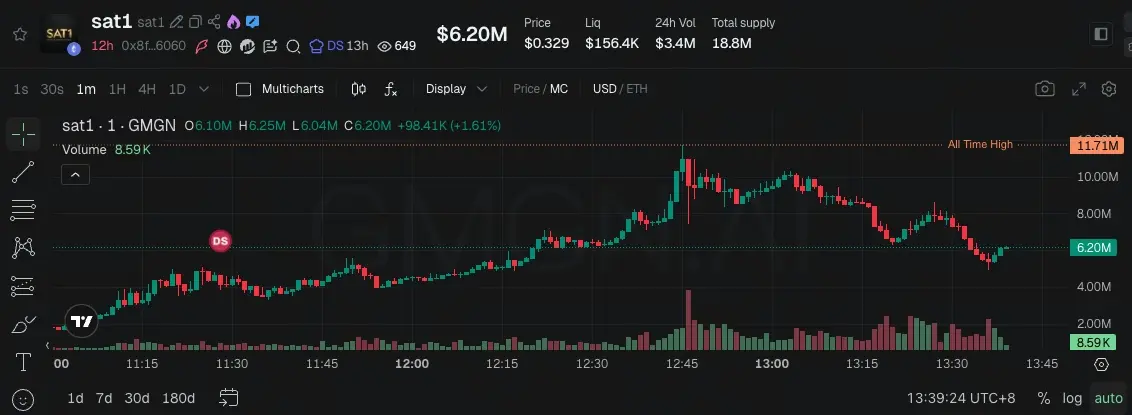
(Source: GMGN)
According to GMGN’s market data as of May 8, 2026, at the time this article was published:
sat1: market cap $8.4 million, 24-hour trading volume $2.2 million
sato: market cap $14.75 million, 24-hour trading volume $17.6 million, peak market cap $37.56 million
uPEG: market cap $8.9 million, 24-hour trading volume $4.3 million, peak market cap $34.44 million
sato mechanism design
According to an Odaily report, sato is an ERC-20 token deployed on the Ethereum mainnet, built based on the Uniswap v4 Hook architecture. It has no pre-mining, no team allocation, no administrator privileges, and also no upgrade or pause functions; the system operates automatically through on-chain contracts.
sato uses a Bonding Curve issuance mechanism. After users pay ETH to the Hook contract, the system automatically mints tokens according to a fixed mathematical formula. ETH is permanently stored in the Hook contract as system reserves. sato’s theoretical maximum supply is 21 million tokens. When the supply reaches 99% (8B minus 8B, i.e., 20.79 million), the system stops further minting. After that, users can still sell sato back to the system to receive ETH, and the sold-back sato is directly burned. The system charges a 0.3% fee on buy and sell transactions; the fee is permanently stored in the Hook contract and cannot be withdrawn.
According to a BlockBeats report on May 8, 2026, sat1 is described as an improved version of the sato mechanism, and it also uses the Uniswap v4 Hook architecture.
BlockBeats: On-chain rotation trend and liquidity constraints
According to a BlockBeats report on May 8, 2026, uPEG, sato, and sat1 have appeared one after another on the Ethereum mainnet. BlockBeats noted that the rapid rotation of these third-generation tokens makes it difficult for the market cap of any single token to continuously expand. Ethereum mainnet gas fees and the scale of on-chain liquidity, therefore, impose constraints on the market-cap ceiling for tokens of this type.
Common questions
When did sat1 launch on the Ethereum mainnet, and what is its current market cap?
According to GMGN market data, sat1 appeared on May 8, 2026. As of the time of publication, its market cap is $8.4 million and its 24-hour trading volume is $2.2 million.
What are the core design features of the sato mechanism?
According to an Odaily report, sato is an Ethereum ERC-20 token that operates based on the Uniswap v4 Hook and Bonding Curve mechanisms. It has no pre-mining, no team allocation, no administrator privileges. Its theoretical maximum supply is 21 million tokens; after reaching 99%, minting stops, and the system’s ETH reserves are permanently locked in the Hook contract.
What are the peak market caps of uPEG and sato, respectively?
According to GMGN data, uPEG’s peak market cap is $34.44 million and sato’s peak market cap is $37.56 million. As of the time this article was published, both have fallen to $8.9 million and $14.75 million, respectively.


