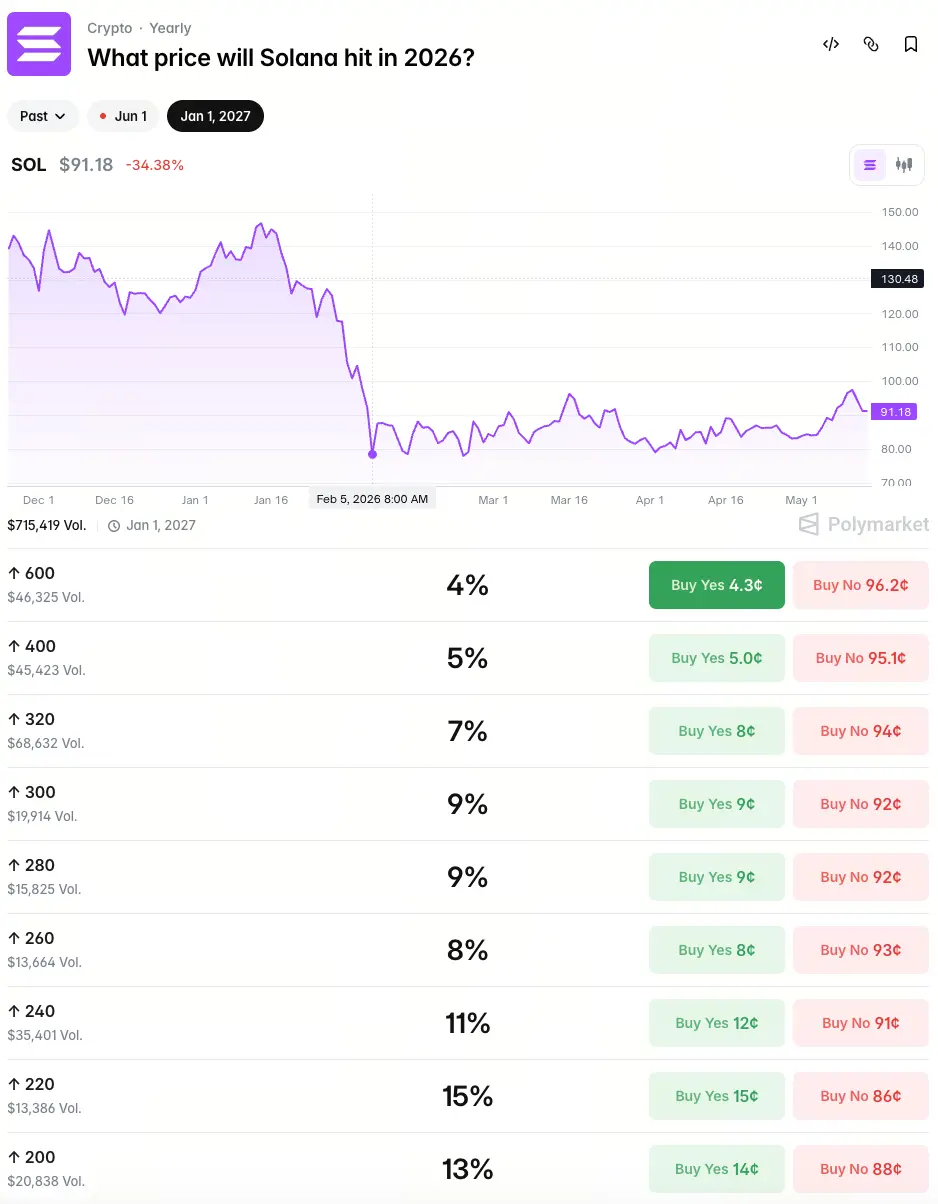
As of May 14, 2026, according to Gate market data, SOL is trading at $91, down 4.3% over the past 24 hours. In the same time window, the cumulative trading volume on Polymarket—the prediction market event “What price will SOL reach in 2026?”—has already exceeded $715k, making it one of the hottest prediction events in the current crypto space. The pricing divergence from $20 to $600 is not just a game of odds—it reflects the market’s core disagreement over expectations for Solana’s fundamentals, the pace of technical evolution, and where the macro environment is headed.
How prediction markets reflect the pricing disagreement around SOL
Prediction markets convert the group’s collective judgment about event probabilities into quantifiable price signals through share trading.
Source: Polymarket
On Polymarket, current data shows that market bets on the probability of SOL falling to $60 during 2026 are at 59%, falling to $40 at 32%, and falling to $20 at 10%. On the upside, the probability of rising to $160 is 30%, $180 is 21%, $200 is 13%, $220 is 15%, $240 is 11%, $260 is 8%, $280 is 9%, $300 is 9%, $320 is 7%, $400 is 5%, and $600 is 4%.点击参与预测
This distribution shows a typical “bimodal bias” structure: the downside probability concentrates in the $60 to $40 range, while upside probability is broadly distributed across the $160 to $300 range. The pricing “centers of gravity” for bulls and bears are roughly the current price around $91 and the $170 to $180 range, respectively—both disagreements exceed the market’s usual volatility band.
How structural contradictions in the fundamentals affect price
From the fundamentals perspective, in 2026 Solana is in a special structural contradiction. On one hand, real network usage data keeps strengthening: SOL-denominated TVL surpassed the historical high of 80 million SOL in February 2026—this implies that even in an environment where dollar prices face pressure, capital continues to be deployed into the Solana ecosystem.
Solana’s stablecoin supply exceeds $13 billion, and in February 2026 stablecoin trading volume surpassed $650 billion. Mainstream payment institutions such as Visa, PayPal, and Stripe are running Solana as a production-grade payment rail. On the other hand, SOL’s dollar-denominated price has fallen by about 48% over the past half year. This “divergence between on-chain activity and price action” is one of the core sources of today’s market disagreement: some participants believe fundamentals will eventually be reflected in price, while others think tighter macro liquidity will overpower fundamental signals.
Can technical upgrades reshape the network’s value support?
Firedancer and Alpenglow are the two most important infrastructure upgrades in Solana’s history. Firedancer went live on the mainnet in December 2025. It is a standalone validator client built from scratch by Jump Crypto. During the testing phase, the client has run continuously for more than 100 days, producing over 50,000 blocks without major incidents. By early 2026, more than 20% of network staked value has migrated to Firedancer. Its core value lies in eliminating single-client failure risk: if the Agave client has a vulnerability, Firedancer can independently keep the network running. Lab tests show Firedancer’s theoretical throughput could reach 1 million transactions per second.
The Alpenglow upgrade compresses block finality time from about 12.8 seconds to 150 to 200 milliseconds. The upgrade began phased deployment in the first quarter of 2026. The combined effect of these two upgrades is: on one side, it sharply reduces Solana’s operational risk as a financial infrastructure—crucial for institutional adoption; on the other, it pushes network performance to a scale that traditional financial systems cannot match. However, there is a time lag in technical evolution: from upgrade deployment to large-scale migration of ecosystem applications, and then to a significant expansion of on-chain economic activity, it usually takes 12 to 24 months. This means the direct catalytic impact of technical upgrades on prices during 2026 may be limited, but they determine the medium- to long-term value ceiling.
The real extent of institutional adoption
Institutional adoption is one of the most weighty logic lines in the Solana narrative in recent years. By the end of 2025, 19 listed companies had cumulatively held 15.4 million SOL, worth about $3 billion, with total capital commitments exceeding $4.3 billion. Visa’s stablecoin settlement annualized processing volume has reached $3.5 billion. Circle has designated Solana as one of the main settlement networks for USDC. WisdomTree deployed its full suite of regulated tokenized funds on Solana, covering money market, equities, and fixed-income products.
Solana’s developer platform went live on March 24, 2026, providing unified tokenized assets, stablecoin payment, and trading APIs for enterprises such as Mastercard, Worldpay, and Western Union. At the developer level, Solana attracted more than 4,100 new developers in 2025, exceeding Ethereum’s incremental figure by more than 3,700 in the same period.
However, the real price impact of institutional adoption depends on how deeply capital shifts from “holding” to “using”: only when institutions move from holding SOL as a reserve asset to continuously generating transaction fees on-chain will the demand structure for SOL change materially. This transition is still at an early stage.
How DePIN and stablecoins drive real demand
In the 2026 Solana ecosystem, the most substantive demand drivers come from two directions: stablecoin payments and DePIN.
On the stablecoin side, Solana currently processes about 35% of global on-chain stablecoin transfer transaction volume, leading any Ethereum L2 when measured by number of transactions. USDC holds about 75% of the supply share, and PayPal’s PYUSD is growing on Solana faster than any other blockchain. Each stablecoin transfer consumes a SOL-denominated base fee and priority fees, creating structural demand that is continuous and independent of speculative sentiment.
On the DePIN side, Solana has become the core settlement layer for this sector. The largest DePIN projects by market cap, such as Helium, Render, and io.net, have deployed on Solana. They generate continuous on-chain activity through mechanisms like network node deployment, bandwidth sharing, and hashrate rental. The characteristics of these two types of demand are that they do not rely on crypto market risk-appetite cycles, but are directly tied to real economic activity. However, it’s also important to note that the main value accumulation for stablecoin transfers happens at the stablecoin issuance end rather than at the public chain token end—although each transfer consumes SOL fees, the per-transaction cost is extremely low, and the upper bound of total fees that large numbers of small transfers can generate still needs to be validated.
How the macro environment shapes SOL’s 2026 price boundaries
Macro liquidity is the most influential external variable in crypto asset pricing. Several key nodes face 2026:
- On May 15, the term of FED Chair Jerome Powell ends, and the policy tilt of the successor will directly affect the timing and cadence of rate cuts. According to predictions from Goldman Sachs and Citibank, the FED may cut rates 2 to 3 times in 2026, taking the interest rate from the current 3.50%–3.75% range down to around 3%–3.25%.
- At the policy level, the market structure bill hearing held by the Senate in January aims to end the regulatory jurisdiction dispute between the SEC and the CFTC; in March, the SEC officially classified SOL as a digital commodity, clearing a key regulatory obstacle for institutional products such as ETFs.
- The U.S. midterm elections are scheduled for November. Historical experience suggests that fiscal and monetary policy typically lean more dovish before and after elections. However, there are two-way macro risks: if inflation rebounds forces the FED to delay rate cuts or even tighten again, the liquidity conditions for crypto assets would deteriorate significantly.
- Additionally, Japan is considering rate hikes to normalize monetary policy. Historically, Bank of Japan rate hikes have often created short-term shocks to crypto markets, with the transmission mechanism primarily through the unwind of yen carry trades that triggers synchronized declines in risk assets.
Reading the market’s final consensus from the probability distribution
By placing Polymarket’s probability distribution into the analytical framework above for cross-validation, we can see that current market pricing implies three layers of consensus:
- First layer: tail risk is priced in significantly. The cumulative probability of bets in the below-$60 range exceeds 100%—meaning the market does not see a drop to $60 or lower as a low-probability event in 2026, but as one of the baseline scenarios.
- Second layer: upside potential is widely priced in but not deeply concentrated. While the probability in the $160 to $300 range accumulates to nearly 130%, it does not form significant concentration at any single price point. This suggests the market sees multiple possibilities for the upside, but lacks expectations of a single unified catalyst.
- Third layer: upside volatility beyond expectations is underappreciated. The probability at the $600 price point is only 4%, far below the tail-up distribution typically seen in mainstream crypto bull-market cycles. This indicates the market is cautious about how much improvement it expects in Solana’s fundamentals.
Overall, the consensus reflected in current prediction data is: downside risk is well understood and even over-priced; upside potential is broadly acknowledged but not concentrated in betting. The market is in a state of “defensive disagreement.”
FAQ
Q: How much reference value do Polymarket’s prediction probabilities have?
The probabilities in prediction markets reflect participants’ collective judgment about the likelihood of an event occurring, not the actual probability. The composition of participants, their capital sizes, and their information advantages all affect pricing efficiency. Therefore, prediction probabilities should be treated as reference indicators for market sentiment and consensus rather than certain forecasts.
Q: With the current SOL price at $91 and the Polymarket probability of betting on SOL falling to $60 at as high as 59%, what does that mean?
It means market participants believe the likelihood of SOL falling to $60 during 2026 is higher than the likelihood of maintaining the current level. Given that $91 is still about 34% above $60, this probability distribution reflects the market’s cautious stance toward near-term macro pressure and negative impacts from the meme-coin ecosystem.
Q: After the Firedancer and Alpenglow upgrades are completed, will the SOL price rise?
The technical upgrades themselves do not directly push up the price. Their impact depends on whether, after the upgrades, large-scale migration of ecosystem applications and a significant expansion of on-chain economic activity can occur. Based on historical experience, it typically takes 12 to 24 months for technical upgrades to transmit into price. The long-term value of both upgrades is largely established, but the degree of direct impact on price during 2026 remains uncertain.
Q: What are the most important variables affecting the SOL 2026 price?
The three variables worth focusing on most are: the FED’s monetary policy path (the timing and magnitude of rate cuts directly affect the liquidity environment), the progress of institutional capital shifting from “holding” to “on-chain usage” (which determines the strength of real demand), and the regulatory and fiscal policy direction after the November U.S. midterm elections (which could change the overall risk-appetite landscape for crypto assets).
Q: What are the fundamental differences between SOL and Ethereum in 2026?
Solana’s advantage is that it has already formed differentiated structural demand sources in the stablecoin payments and DePIN fields, and technical upgrades address the core bottlenecks in performance and reliability. Ethereum’s advantage lies in a more mature DeFi ecosystem and a larger scale of asset accumulation. The competitive landscape between the two has not been finalized; in 2026, it is more about differentiated development rather than direct replacement.


