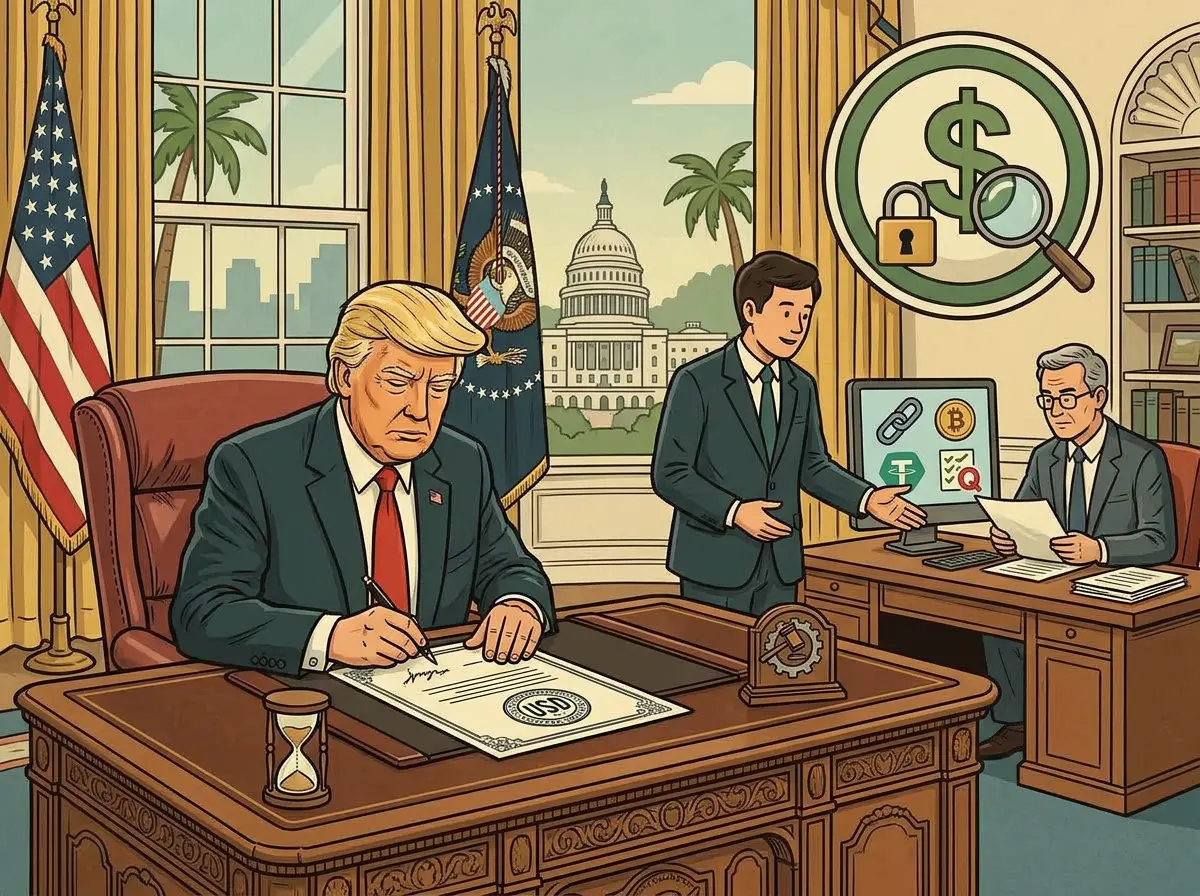
U.S. President Trump signed an executive order on May 19, directing the federal government to update its regulatory framework to “integrate digital assets and innovative technologies into traditional financial services and payment systems.” The executive order instructs heads of relevant financial regulators to review existing rules within 3 months, identify any rules that “improperly hinder financial technology companies from establishing cooperative relationships with federal regulators”; within 6 months, regulators must take measures to encourage innovation.
Three-Month Review and June Action Requirements of the Executive Order
Within three months (confirmed): Financial regulator heads must review existing rules and identify rules or documents that “improperly hinder financial technology companies from establishing cooperative relationships with federal regulators.”
Within six months (confirmed): Regulators must take measures to encourage innovation, including:
· Requiring the FED Board of Governors to review how to allow non-insured depository institutions and non-bank financial companies to obtain payment accounts and services
· Asking whether 12 Federal Reserve Banks can independently grant payment accounts outside of the FED Board of Governors
The executive order’s stated policy objectives: “Streamline regulatory processes, reduce unnecessary entry barriers, and encourage cooperation among fintech companies, federally regulated financial institutions, and federal financial regulators.”
Background on FED Payment Account Access
Confirmed related developments: Earlier this year, the Federal Reserve Bank of Kansas City allowed Kraken’s Wyoming SPDI to use a limited version of its master account; in December last year, the FED released a “streamlined” master account proposal to provide more companies with access pathways. Other companies have also sought similar master account access permissions.
The second executive order signed the same day: Strengthening the Bank Secrecy Act (BSA)
Trump signed a second executive order on Tuesday the same day, directing the Treasury Department and financial regulators to study how to strengthen the Bank Secrecy Act to prevent undocumented immigrants from obtaining bank accounts or payment services. The executive order also requires regulators to assess issues regarding how “peer-to-peer platforms” and “third-party payment processors” could be used to evade BSA reporting thresholds or tax obligations.
FAQs
What is a “non-insured depository institution,” and why is it important to the crypto industry?
A “non-insured depository institution” refers to institutions that do not participate in federal deposit insurance (FDIC), including crypto-friendly bank license holders such as Wyoming SPDI and certain non-bank financial companies. Such institutions currently find it difficult to directly obtain a master account at the FED. This executive order requires the FED to review within six months how to expand their access.
Can 12 regional Federal Reserve Banks independently grant master accounts, and why does it matter?
At present, non-bank institutions applying for a FED master account require approval from the FED Board of Governors, and the process can take years. If the 12 regional reserve banks can approve independently, it would greatly speed up how crypto companies obtain payment accounts. The Federal Reserve Bank of Kansas City has taken the lead in this direction by providing Kraken with limited master account access.
Are these two executive orders moving in opposite directions?
The first executive order expands payment system access for fintech and crypto companies; the second strengthens the BSA to prevent certain groups from using payment services and to monitor peer-to-peer platforms. Although they target different groups and goals, the overall impact on the crypto industry ultimately depends on the detailed implementation rules set by the regulators going forward.


