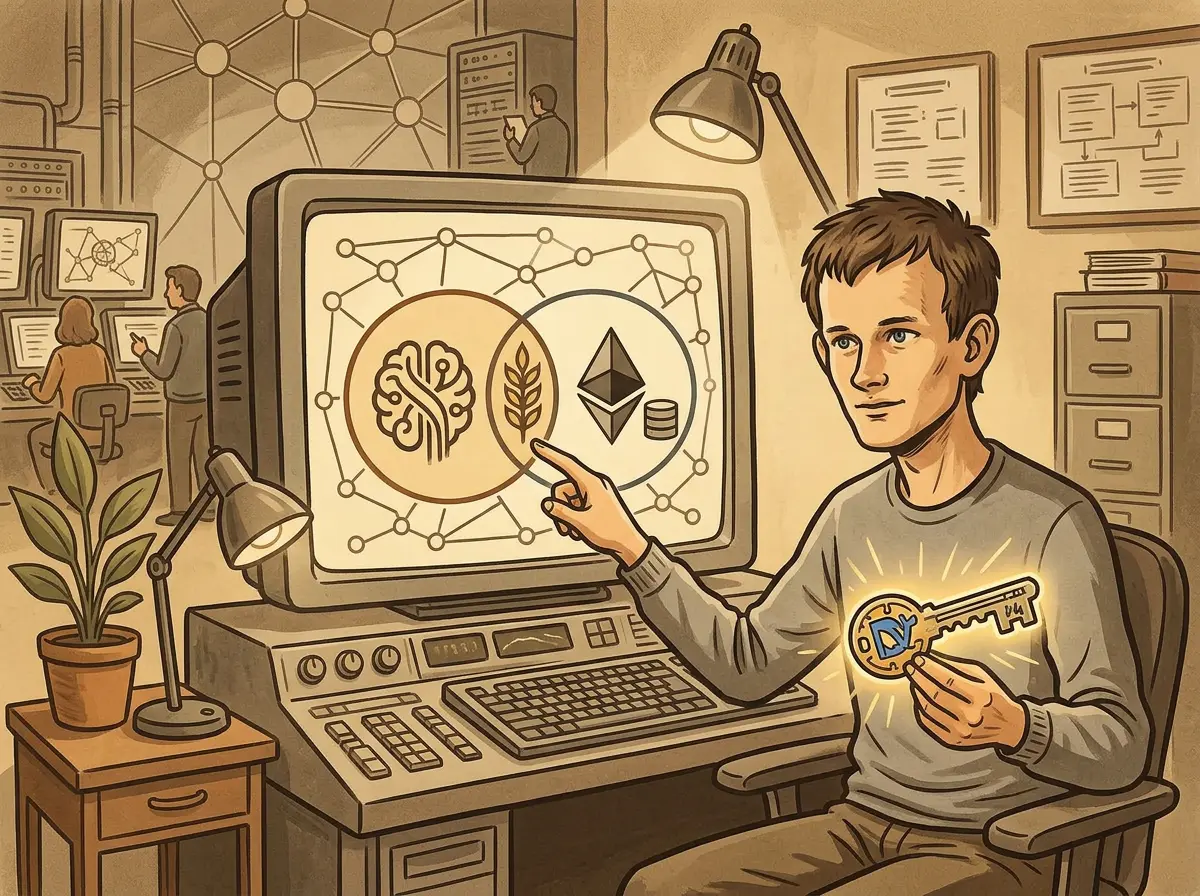
Ethereum co-founder Vitalik Buterin outlined on May 28 a roadmap for integrating local AI models into Ethereum’s access layer, and confirmed that there is substantial overlap between the CROPS Ethereum access layer and CROPS AI. Buterin confirmed that DeepSeek V4 (its 2-bit quantized version running on 90GB of memory) is a key tool for enabling private local transaction processing.
CROPS AI core points confirmed: the technical overlap of ZK remote LLM calls and private RPC
In his explanation, Buterin confirmed the core problem with current local AI tools: most AI models marketed as running locally (such as the Qwen 3.5 series) will call the OpenAI or Anthropic API when they cannot complete tasks on their own, creating exposure risk for users’ metadata, IP addresses, and wallet balances.
Buterin confirmed that the CROPS AI roadmap covers two core functions: zero-knowledge-proof-based paid remote LLM calls, and private Ethereum RPC reads. He confirmed that the same ZK mechanism can solve both problems at the same time. Buterin also confirmed an online security community warning: when local AI gets chaotic, it may send ping requests to OpenAI servers, and the design of the mainstream open-source AI ecosystem prioritizes functionality over security.
Technical characteristics confirmed for DeepSeek V4 and the direction for Ethereum integration
Buterin confirmed that DeepSeek V4 can run in a self-hosted local environment, ensuring users rely on their own infrastructure rather than enterprise cloud servers. Users can use DeepSeek V4 to query Ethereum data without disclosing metadata, IP addresses, or wallet balances to centralized RPC providers.
Buterin suggested combining private local LLM calls with Ethereum zero-knowledge proofs, enabling users to privately process blockchain interactions off-chain. He confirmed that DeepSeek V4’s low hardware requirements are the key condition that makes this vision practical, and urged developers to focus on DeepSeek V4 Flash optimization patches for the AMD platform.
Common questions
What is the concept behind CROPS AI, and where did Buterin first propose it?
According to reports, CROPS AI stands for a design concept of AI that is censorship-resistant (Censorship-Resistant), open-source (Open-source), private (Private), and secure (Secure). Buterin first formally introduced this concept on March 12, 2026 at the ETH Mumbai conference, and discussed why AI becomes a major security risk for cryptocurrencies.
Why don’t most “local AI” tools meet CROPS AI standards?
Based on Buterin’s confirmation, most local AI tools call the OpenAI or Anthropic API when they cannot complete tasks independently, meaning users’ metadata and query content are actually accessed by centralized services. Buterin confirmed that the design of the mainstream open-source AI ecosystem prioritizes functionality over privacy and security.
What hardware configuration is needed to run the 2-bit quantized version of DeepSeek V4?
According to Buterin’s confirmation, the 2-bit quantized version of DeepSeek V4 runs with 90GB of memory; the minimum required is unified memory of 96GB to 128GB on Mac devices or VRAM of 96GB to 128GB on PC devices. Buterin confirmed that DeepSeek V4 Flash optimization patches for the AMD platform are a key improvement direction worth focusing on.


