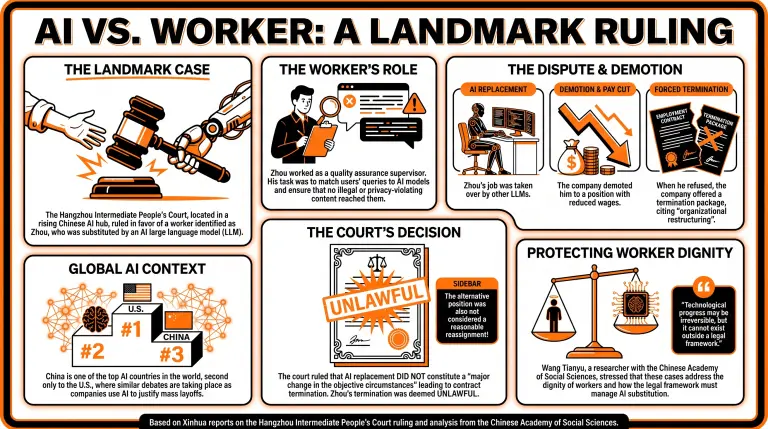
Experts stated that the decision, which sets a precedent for future AI substitution cases, establishes that AI replacement cannot be brandished as a justification to abandon a labor contract. China is the world’s second-largest AI hub.
Key Takeaways:
- The Hangzhou Court ruled that replacing Zhou with an AI model didn’t justify his forced termination.
- This decision sets a vital precedent in China, the 2nd top AI nation, in dealing with AI-driven layoffs.
- Xinhua’s Wang Tianyu noted future laws must prioritize 1 goal: managing AI substitution properly.
Chinese Worker Wins Case Against Company For Terminating Contract Due To AI Substitution
A Chinese court has issued a landmark ruling that could set a legal precedent regarding artificial intelligence (AI) labor substitution disputes.
The Hangzhou Intermediate People’s Court, located in Hangzhou, a rising AI hub in China, ruled in favor of a worker identified as Zhou, who was substituted by an AI large language model (LLM). According to Xinhua, Zhou worked as a quality assurance supervisor, meaning his task was to match users’ queries to AI models and ensure that neither illegal nor privacy-violating content reached them, to allow for accurate outputs.

Nonetheless, Zhou’s role was quickly taken by other LLMs, and the company decided to demote him to a position with a reduced wage. When he refused, the company offered a package to terminate his contracts, citing organizational restructuring and reduced staffing needs.
He refused to receive the sum and took the matter to court. Finally, the court reached this decision, ruling that AI replacement did not constitute a “major change in the objective circumstances” leading to contract termination, according to Chinese laws.
Zhou’s termination was considered unlawful, and the alternative position offered was not deemed a reasonable reassignment proposal due to the relevant pay reduction.
China is one of the top AI countries in the world, second only to the U.S., where similar debates are taking place, as more companies use AI to justify layoffs.
Wang Tianyu, a researcher with the Chinese Academy of Social Sciences, told Xinhua that these cases are relevant, addressing subjects like the dignity of workers as human beings and how the legal framework should manage issues like AI substitution and proper treatment in these cases.
“Technological progress may be irreversible, but it cannot exist outside a legal framework,” he stated.
Disclaimer: The information on this page may come from third parties and does not represent the views or opinions of Gate. The content displayed on this page is for reference only and does not constitute any financial, investment, or legal advice. Gate does not guarantee the accuracy or completeness of the information and shall not be liable for any losses arising from the use of this information. Virtual asset investments carry high risks and are subject to significant price volatility. You may lose all of your invested principal. Please fully understand the relevant risks and make prudent decisions based on your own financial situation and risk tolerance. For details, please refer to
Disclaimer.
Related Articles
Harvard Medical School’s latest study: AI’s diagnostic decision-making in the emergency room is better than that of human doctors
A study published by Harvard Medical School in Science used double-blind testing and clinical reasoning to objectively compare the differences between AI systems and human physicians in interpreting medical records. The results showed that at early emergency-department decision points, AI could be as good as or better than the attending physician, using only the electronic medical record information available at the time. The study also emphasized that AI cannot yet practice medicine autonomously, and physicians remain indispensable; if widely adopted, AI could reduce diagnostic errors and the cost of seeking care.
ChainNewsAbmedia8m ago
South Korea's Top 10 Conglomerates Gain 65% to $2.6 Trillion as AI Chip Stocks Rally
According to The Korea Herald, South Korea's top 10 conglomerates saw their combined market value rise 65% to 3,832.7 trillion won (US$2.6 trillion), driven by a rally in AI-related chip stocks. SK Group posted the largest gain with a 89.6% increase to 1,139.8 trillion won (US$775 billion), led by a
GateNews11m ago
AI Investments Drove 75% of U.S. GDP Growth in Q1, White House Advisor Says
According to David Sacks, White House AI and crypto advisor, commenting on Morgan Stanley data released in early May, AI-related investments contributed approximately 75% of U.S. GDP growth in the first quarter of 2026. Sacks noted that AI investment will drive about 2.5% of GDP growth this year and
GateNews16m ago
AI Talent Earns Up to 25% More in Singapore, NodeFlair Report Shows
According to NodeFlair's 2026 Tech Salary Report released on May 4, software engineers in Singapore with AI skills earned 13% to 25% more than peers without such expertise. The findings were based on more than 230,000 verified salary data points.
Salary increases varied by career level, with
GateNews1h ago
POLITICO Poll: 45% of Americans Say Crypto Investments Too Risky, 50% Trust Banks More
According to a POLITICO survey, 45% of Americans believe cryptocurrency investments are not worth the risk, with approximately 50% stating they trust traditional banks more for protecting their money. The poll also found that 44% of respondents believe artificial intelligence is developing too fast,
GateNews9h ago
Amazon and OpenAI expand their cooperation: models are added to Bedrock, and Microsoft’s exclusive deal ends
OpenAI announced on May 3 that it is expanding its partnership with Amazon Web Services (AWS), with OpenAI models and Codex coding agents being made available to AWS customers through Amazon Bedrock. According to CNBC, this expansion is a key next step after OpenAI and Microsoft ended their cloud exclusive agreement at the end of April—OpenAI shifting from “Microsoft cloud only” to multi-cloud deployment. AWS has also completed initial integration of OpenAI products on the Bedrock platform.
Background: OpenAI–Microsoft exclusive cloud contract ends; IP licensing extended to 2032
At the end of April, OpenAI and Microsoft reached a new agreement: the original structure of “Microsoft’s exclusive access to OpenAI products and IP” ends, Op
ChainNewsAbmedia10h ago