

#GoldTops4200
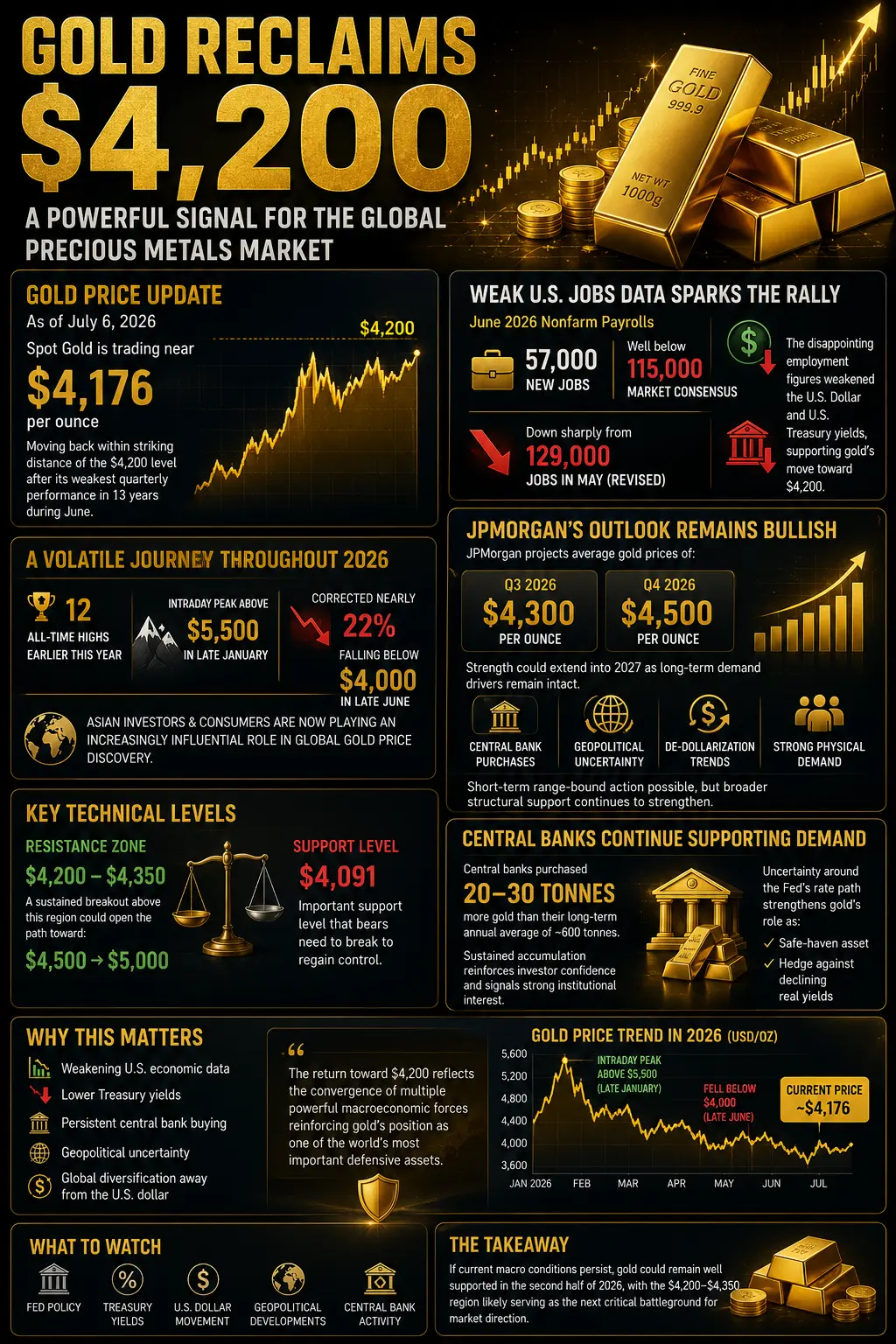
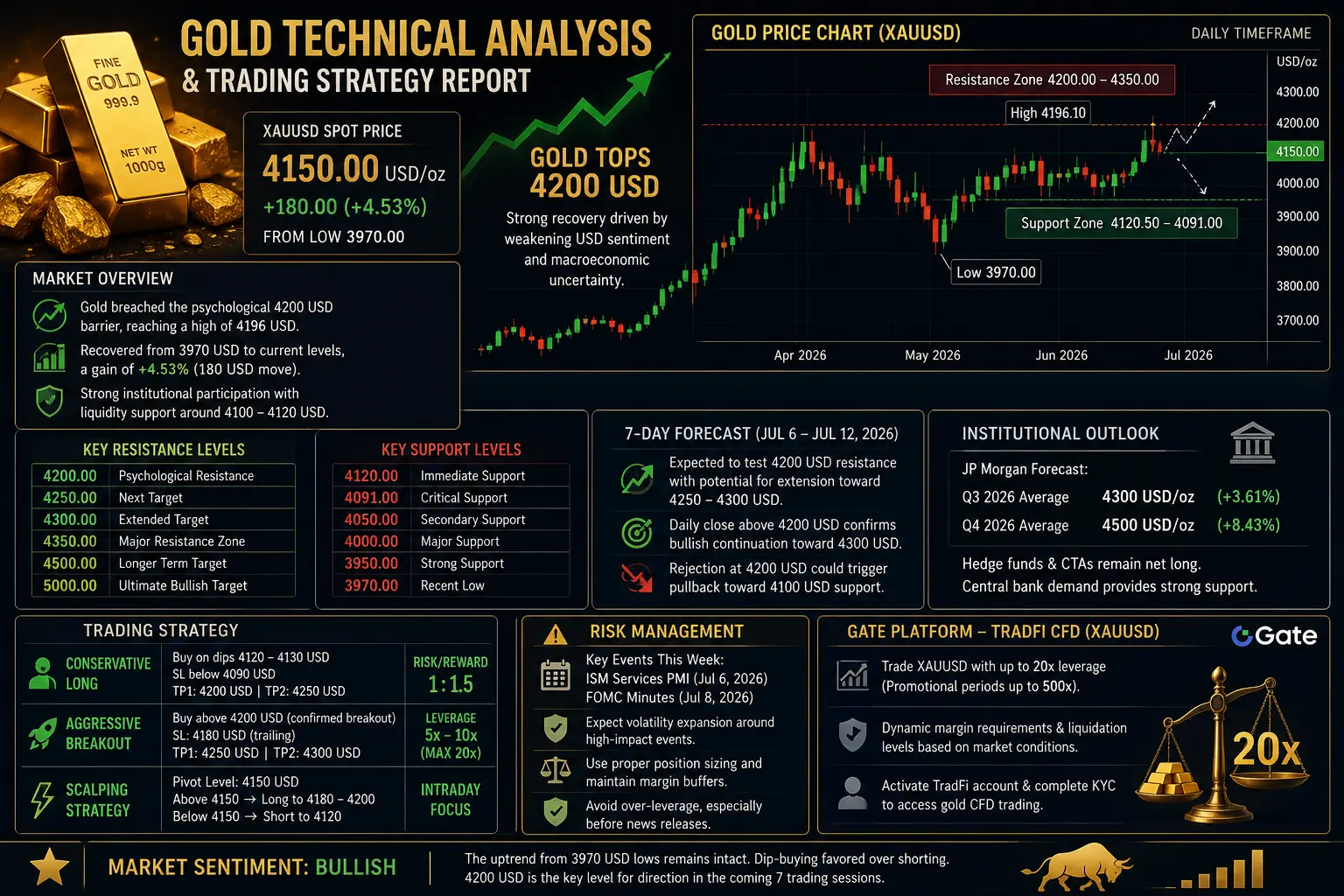
Gold has successfully breached the psychological 4200 USD per ounce barrier, reaching a high of approximately 4196 USD with the current trading level around 4150 USD. This represents a significant recovery from the recent low of 3970 USD, marking a 4.53 percent gain from that trough. The precious metal continues to demonstrate remarkable strength driven by weakening United States dollar sentiment following disappointing Nonfarm Payrolls data and broader macroeconomic uncertainty.
Current Market Structure and Price Action
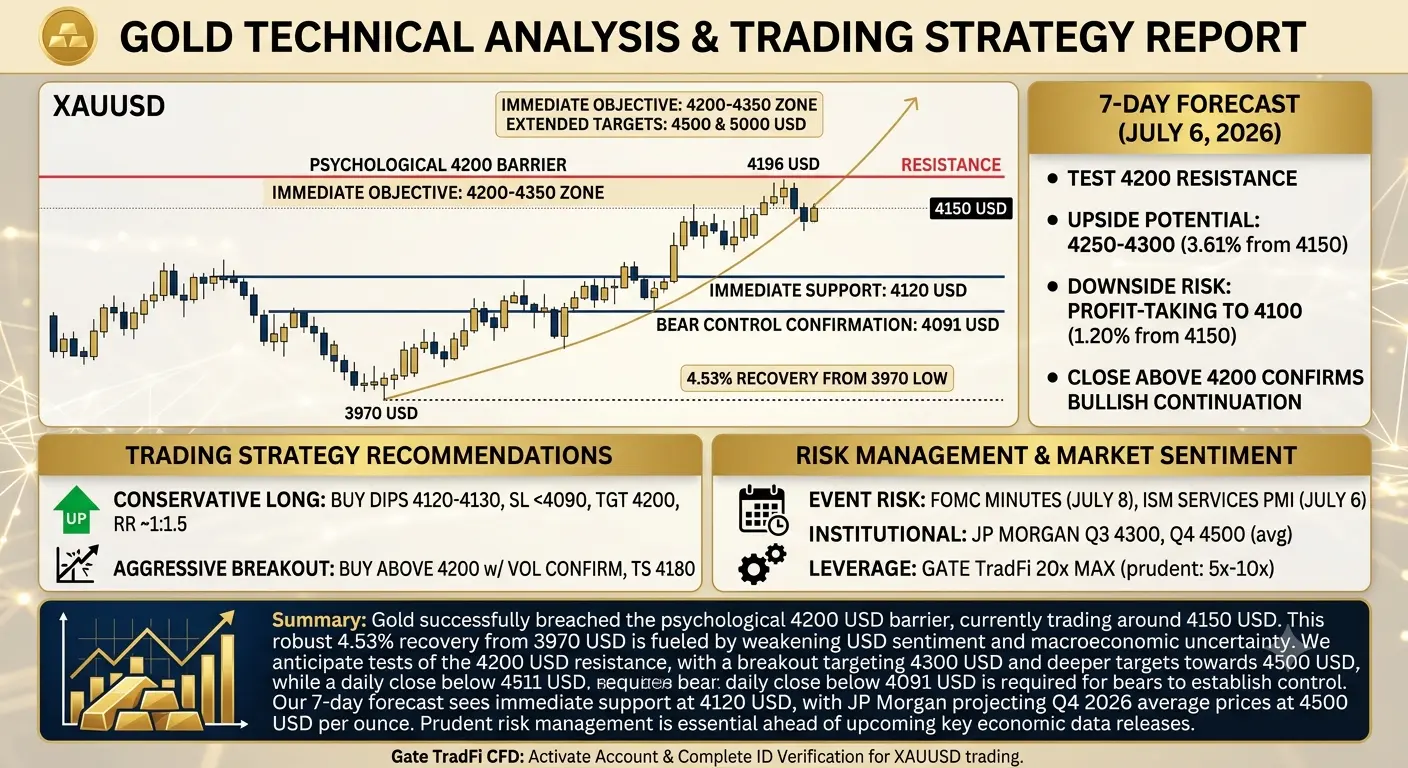
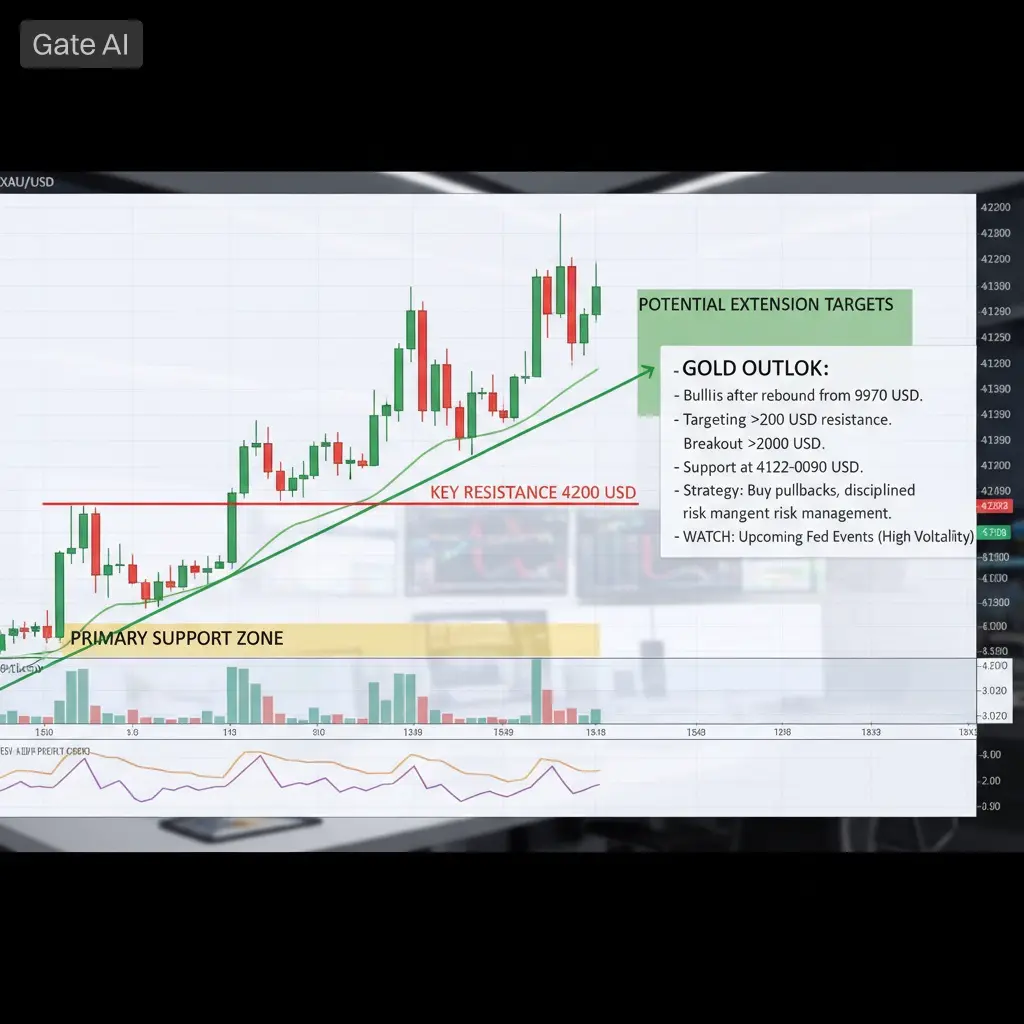
The immediate trading range shows gold consolidating between 4120.50 USD and 4196.10 USD, with the 4200 USD level serving as critical psychological resistance. Technical analysts identify the next upside objective within the 4200.00 USD to 4350.00 USD resistance zone, with sustained momentum potentially targeting 4500.00 USD and subsequently 5000.00 USD. On the downside, bears require a decisive break below 4091.00 USD to establish bearish control, with deeper support targets at 4000.00 USD and 3950.00 USD.
The recovery from 3970 USD to current levels represents a 180 USD move, translating to approximately 4.53 percent appreciation. Volume analysis indicates strong institutional participation during this rally, with liquidity concentration evident around the 4150 USD pivot level. Market depth suggests substantial buying interest emerges between 4100 USD and 4120 USD, providing a defensive buffer for long positions.
Seven-Day Forecast and Key Levels
For the upcoming week commencing July 6, 2026, gold is expected to test the 4200 USD resistance with potential for extension toward 4250 USD to 4300 USD if momentum persists. Critical support levels to monitor include 4120 USD, 4091 USD, and 4050 USD. A daily close above 4200 USD would confirm bullish continuation with measured targets at 4300 USD representing 3.61 percent upside from current levels. Conversely, rejection at 4200 USD could trigger profit-taking toward 4100 USD support, representing 1.20 percent downside.
Institutional positioning data reveals hedge funds and commodity trading advisors maintaining net long positions, with JP Morgan forecasting third quarter 2026 average prices at 4300 USD per ounce and fourth quarter averages reaching 4500 USD per ounce. This implies 3.61 percent and 8.43 percent upside potential respectively from current trading levels.
Trading Strategy Recommendations
Conservative traders should consider establishing long positions on dips toward 4120 USD to 4130 USD with stop-loss protection below 4090 USD, targeting initial profits at 4200 USD and extended targets at 4250 USD. This strategy offers a risk-reward ratio of approximately 1 to 1.5 with defined downside exposure of 1.45 percent against potential upside of 2.41 percent to 4.10 percent.
Aggressive traders may initiate scaled long positions above 4200 USD on confirmed breakout with volume confirmation, utilizing 4180 USD as trailing support. Position sizing should account for maximum leverage of 20x available on Gate platform for gold CFD trading, though prudent risk management suggests utilizing 5x to 10x leverage to accommodate volatility.
For short-term scalping strategies, monitor the 4150 USD pivot for intraday directional bias. Prices holding above this level favor long positions targeting 4180 USD to 4200 USD, while sustained weakness below 4150 USD opens downside toward 4120 USD support.
Risk Management Considerations
The current macroeconomic calendar features significant event risk including Federal Reserve FOMC minutes release on July 8, 2026, and ISM Services PMI data on July 6, 2026. These events could trigger volatility expansion with spreads widening and slippage risk increasing. Traders should reduce position sizes ahead of high-impact releases and maintain adequate margin buffers above liquidation thresholds.
Gate platform offers TradFi CFD trading for XAUUSD with leverage up to 500x during promotional periods, though standard maximum leverage caps at 20x for gold during restriction periods. Margin requirements and liquidation thresholds adjust dynamically based on market conditions. Traders should activate their TradFi account and complete identity verification to access these instruments.
Market Sentiment and Institutional Flow
Geopolitical risk premiums continue supporting gold demand, with central bank accumulation providing structural underpinning. Physical demand from key Asian markets remains robust, though JP Morgan notes near-term demand softness may cap gains temporarily. The correlation between gold and real yields has reasserted, with declining Treasury yields supporting precious metals pricing.
The current market structure favors dip-buying strategies over aggressive shorting given the established uptrend from 3970 USD lows. Traders should await confirmation signals before committing significant capital, utilizing the 4200 USD level as the immediate decision point for directional bias over the coming seven trading sessions.@Gate_Square
Gold has successfully breached the psychological 4200 USD per ounce barrier, reaching a high of approximately 4196 USD with the current trading level around 4150 USD. This represents a significant recovery from the recent low of 3970 USD, marking a 4.53 percent gain from that trough. The precious metal continues to demonstrate remarkable strength driven by weakening United States dollar sentiment following disappointing Nonfarm Payrolls data and broader macroeconomic uncertainty.
Current Market Structure and Price Action
The immediate trading range shows gold consolidating between 4120.50 USD and 4196.10 USD, with the 4200 USD level serving as critical psychological resistance. Technical analysts identify the next upside objective within the 4200.00 USD to 4350.00 USD resistance zone, with sustained momentum potentially targeting 4500.00 USD and subsequently 5000.00 USD. On the downside, bears require a decisive break below 4091.00 USD to establish bearish control, with deeper support targets at 4000.00 USD and 3950.00 USD.
The recovery from 3970 USD to current levels represents a 180 USD move, translating to approximately 4.53 percent appreciation. Volume analysis indicates strong institutional participation during this rally, with liquidity concentration evident around the 4150 USD pivot level. Market depth suggests substantial buying interest emerges between 4100 USD and 4120 USD, providing a defensive buffer for long positions.
Seven-Day Forecast and Key Levels
For the upcoming week commencing July 6, 2026, gold is expected to test the 4200 USD resistance with potential for extension toward 4250 USD to 4300 USD if momentum persists. Critical support levels to monitor include 4120 USD, 4091 USD, and 4050 USD. A daily close above 4200 USD would confirm bullish continuation with measured targets at 4300 USD representing 3.61 percent upside from current levels. Conversely, rejection at 4200 USD could trigger profit-taking toward 4100 USD support, representing 1.20 percent downside.
Institutional positioning data reveals hedge funds and commodity trading advisors maintaining net long positions, with JP Morgan forecasting third quarter 2026 average prices at 4300 USD per ounce and fourth quarter averages reaching 4500 USD per ounce. This implies 3.61 percent and 8.43 percent upside potential respectively from current trading levels.
Trading Strategy Recommendations
Conservative traders should consider establishing long positions on dips toward 4120 USD to 4130 USD with stop-loss protection below 4090 USD, targeting initial profits at 4200 USD and extended targets at 4250 USD. This strategy offers a risk-reward ratio of approximately 1 to 1.5 with defined downside exposure of 1.45 percent against potential upside of 2.41 percent to 4.10 percent.
Aggressive traders may initiate scaled long positions above 4200 USD on confirmed breakout with volume confirmation, utilizing 4180 USD as trailing support. Position sizing should account for maximum leverage of 20x available on Gate platform for gold CFD trading, though prudent risk management suggests utilizing 5x to 10x leverage to accommodate volatility.
For short-term scalping strategies, monitor the 4150 USD pivot for intraday directional bias. Prices holding above this level favor long positions targeting 4180 USD to 4200 USD, while sustained weakness below 4150 USD opens downside toward 4120 USD support.
Risk Management Considerations
The current macroeconomic calendar features significant event risk including Federal Reserve FOMC minutes release on July 8, 2026, and ISM Services PMI data on July 6, 2026. These events could trigger volatility expansion with spreads widening and slippage risk increasing. Traders should reduce position sizes ahead of high-impact releases and maintain adequate margin buffers above liquidation thresholds.
Gate platform offers TradFi CFD trading for XAUUSD with leverage up to 500x during promotional periods, though standard maximum leverage caps at 20x for gold during restriction periods. Margin requirements and liquidation thresholds adjust dynamically based on market conditions. Traders should activate their TradFi account and complete identity verification to access these instruments.
Market Sentiment and Institutional Flow
Geopolitical risk premiums continue supporting gold demand, with central bank accumulation providing structural underpinning. Physical demand from key Asian markets remains robust, though JP Morgan notes near-term demand softness may cap gains temporarily. The correlation between gold and real yields has reasserted, with declining Treasury yields supporting precious metals pricing.
The current market structure favors dip-buying strategies over aggressive shorting given the established uptrend from 3970 USD lows. Traders should await confirmation signals before committing significant capital, utilizing the 4200 USD level as the immediate decision point for directional bias over the coming seven trading sessions.@Gate_Square