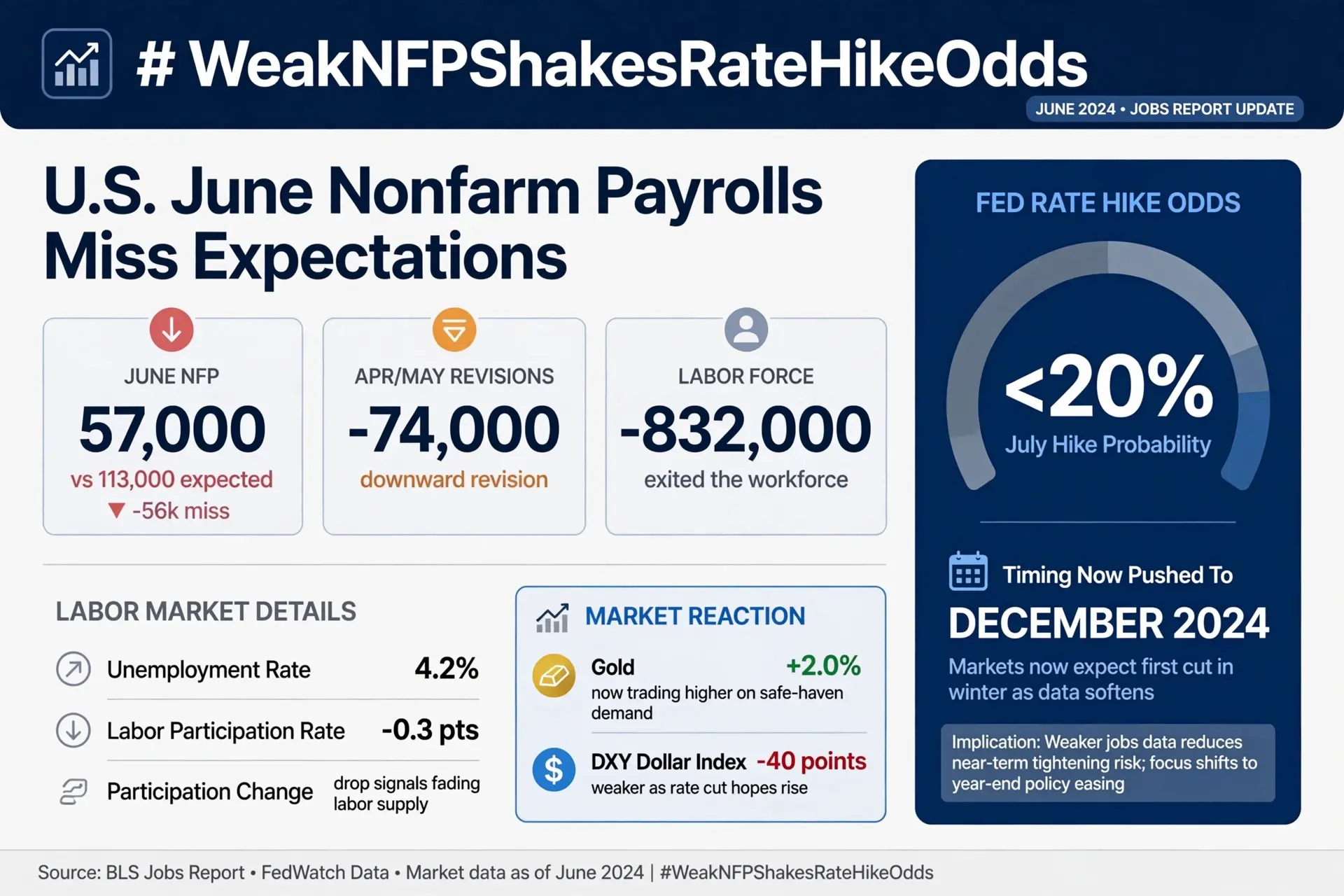
#WeakNFPShakesRateHikeOdds
Weak NFP Report Shakes Rate Hike Odds, Crypto Markets Respond Positively
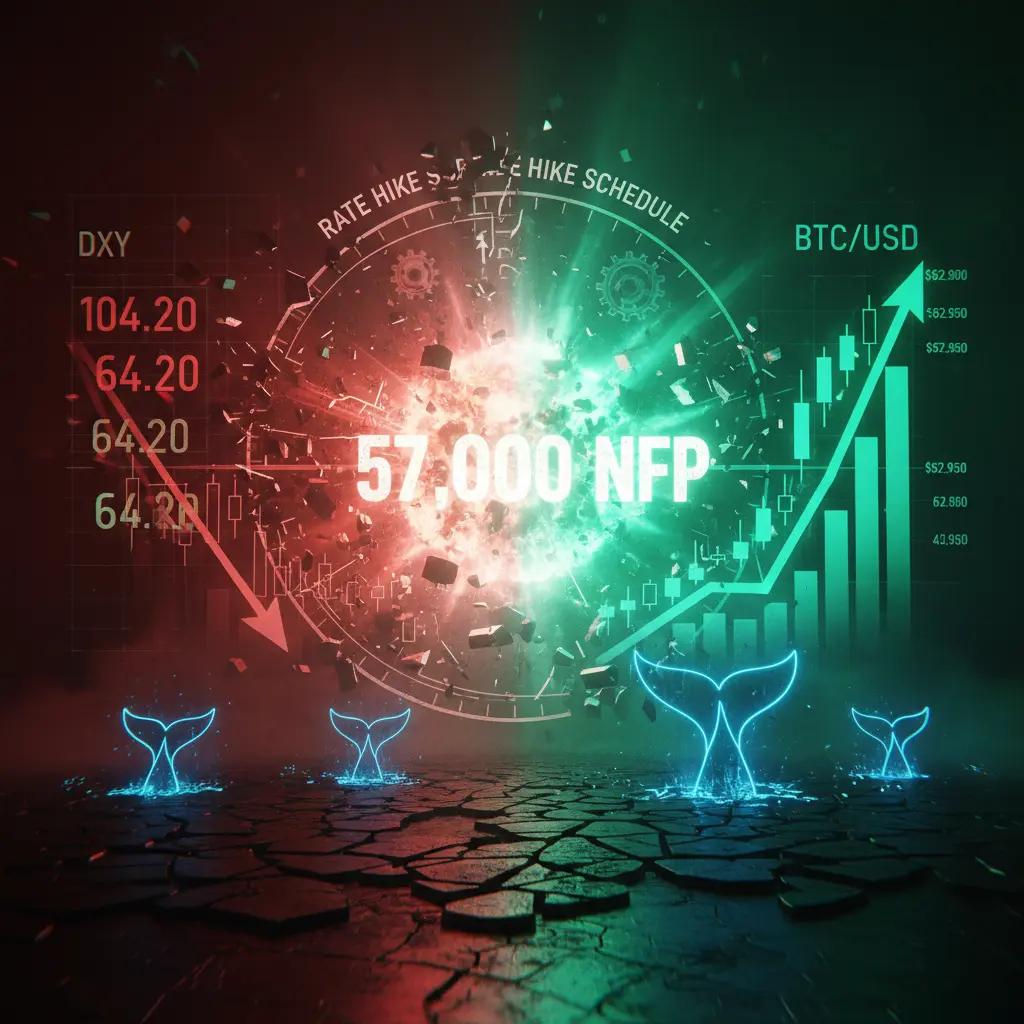
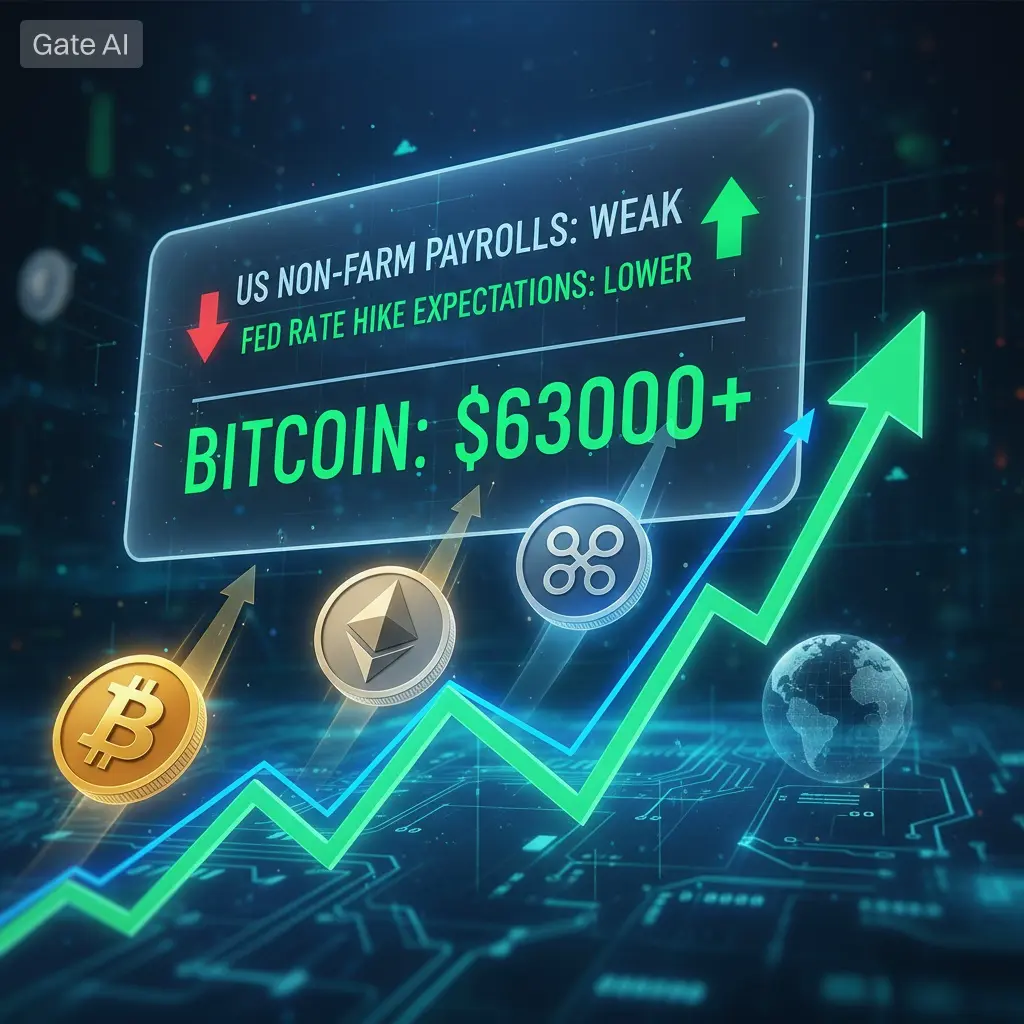
The latest Non-Farm Payrolls (NFP) report from the United States has come in weaker than expected, significantly shaking the odds of a Federal Reserve rate hike and triggering a positive response across cryptocurrency markets. The NFP report, which tracks monthly employment data excluding the agricultural sector, serves as one of the most critical indicators of American economic health. When this report underperforms relative to market expectations, it weakens the probability of the central bank raising interest rates, creating a more favorable environment for risk assets including Bitcoin and other cryptocurrencies.
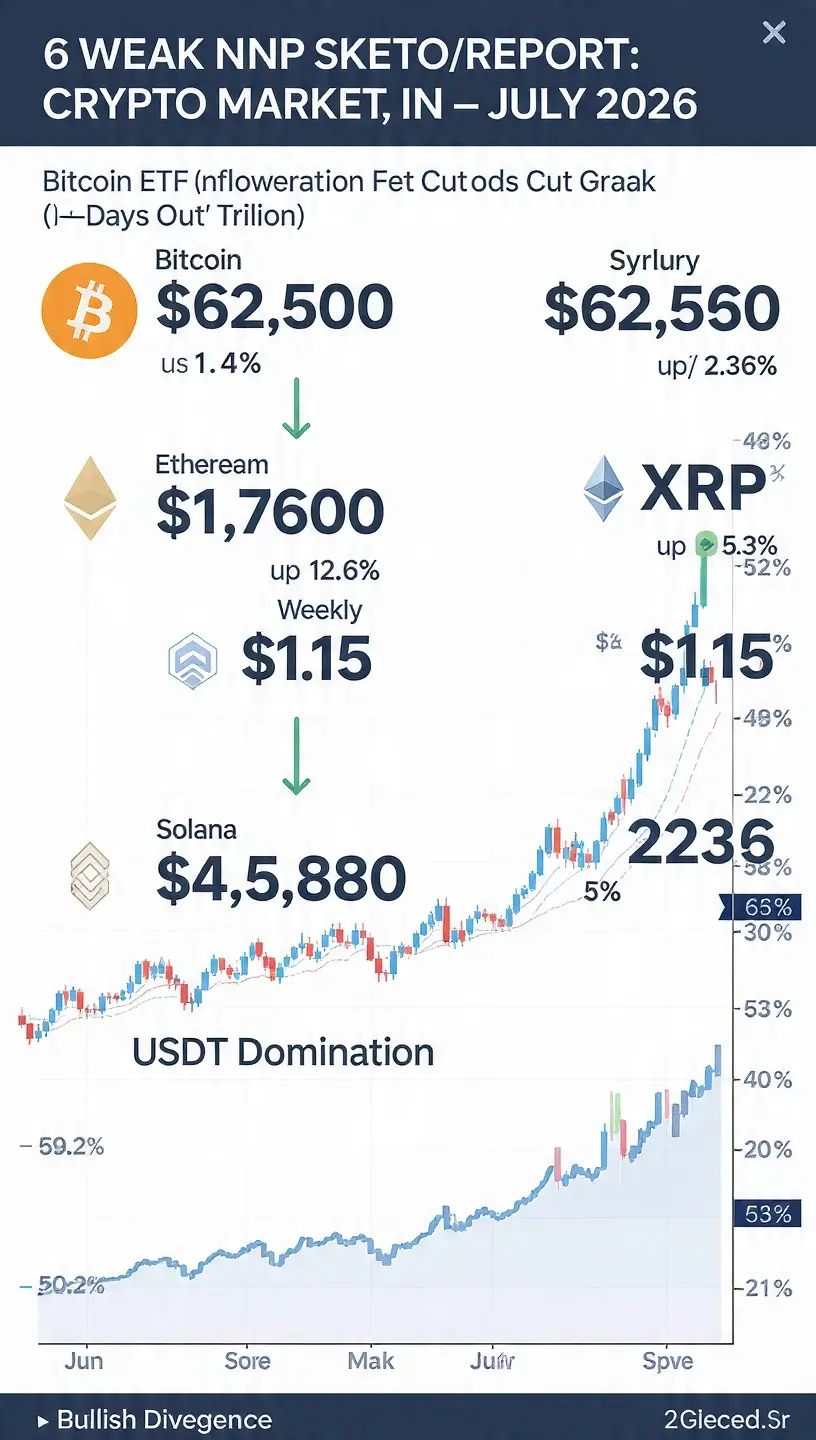
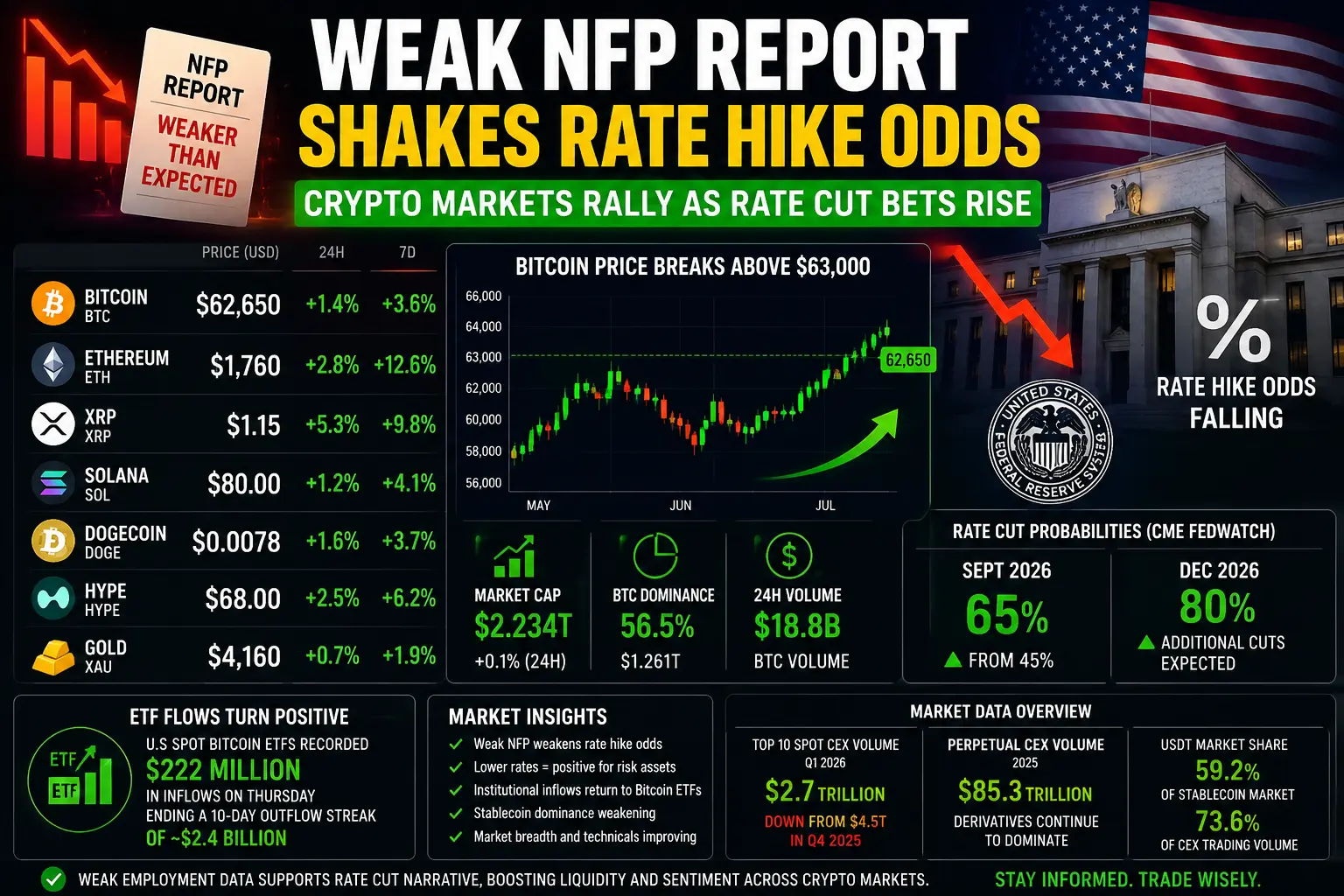
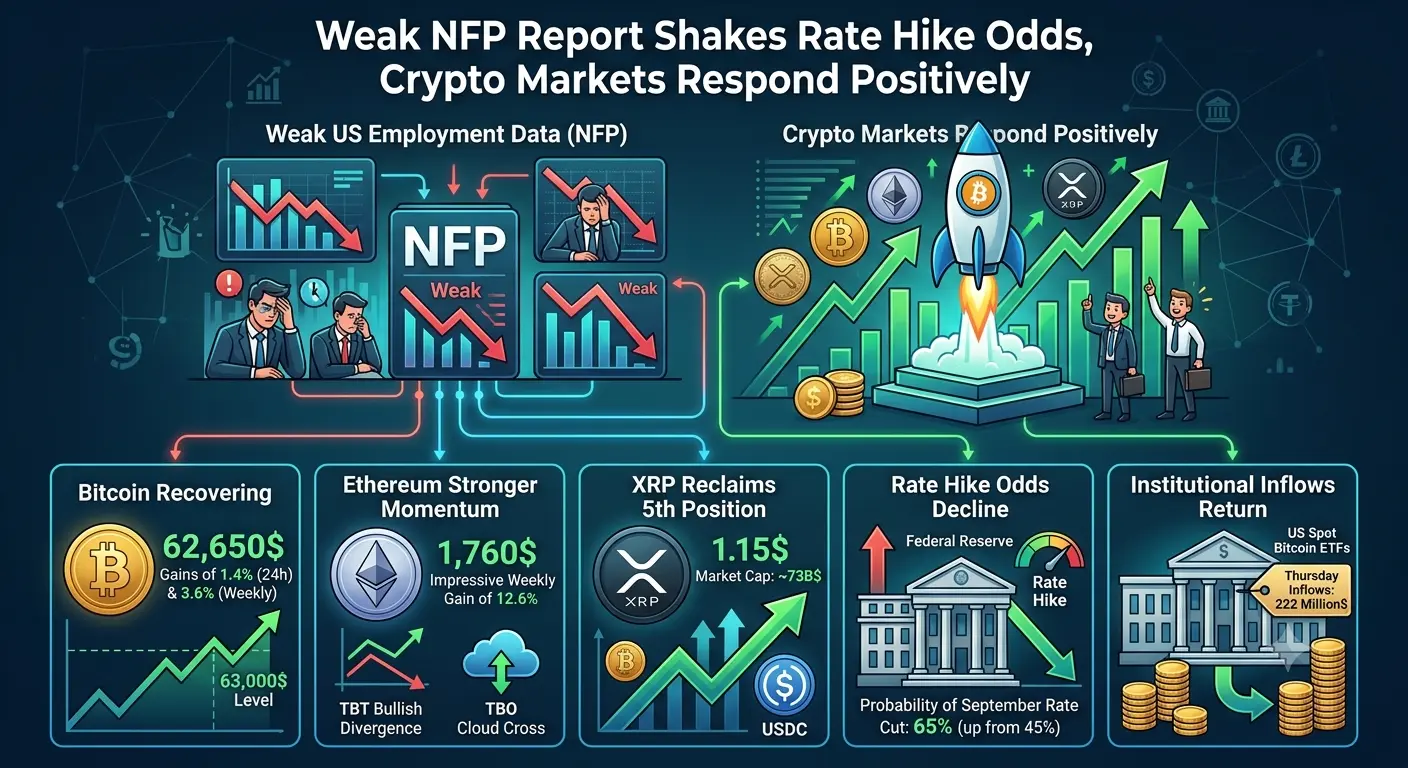
According to recent market data, Bitcoin is currently trading at approximately 62,650 dollars, marking a substantial recovery with gains of 1.4 percent over the past twenty-four hours and 3.6 percent over the week. Bitcoin has successfully breached the 63,000 dollar level, reaching its highest price point in over two weeks and completely reversing the losses that closed out June. This represents a significant technical breakthrough for the leading cryptocurrency, with the price action indicating renewed buying interest from both retail and institutional participants.
Ethereum has demonstrated even stronger momentum, currently trading at 1,760 dollars with an impressive weekly gain of 12.6 percent. The second-largest cryptocurrency by market capitalization has printed a daily TBT Bullish Divergence and closed inside the daily TBO Cloud for the first time since falling below it on May 15, confirming a bullish OBV cross above its moving average line. These technical indicators suggest that Ethereum may be establishing a more sustainable upward trend after weeks of consolidation and downward pressure.
Solana maintains stability around the 80 dollar level, while XRP has emerged as one of the strongest performers among major cryptocurrencies, currently trading at 1.15 dollars with a 5.3 percent daily increase and nearly 10 percent weekly gains. This price appreciation has elevated XRP's market capitalization to approximately 73 billion dollars, allowing it to surpass the USDC stablecoin and reclaim the fifth position by market value. HYPE is trading at 68 dollars, and Dogecoin holds steady at 0.0078 dollars.
Gold prices stand at 4,160 dollars per ounce, reflecting the broader macroeconomic uncertainty and safe-haven demand that often accompanies weak employment data. The relationship between gold and cryptocurrency markets has become increasingly correlated as both asset classes respond to Federal Reserve policy expectations and dollar strength dynamics.
The weak American employment figures have substantially reduced expectations for Federal Reserve rate hikes, with the CME FedWatch Tool indicating that the probability of a rate cut in September 2026 has increased to 65 percent, up from 45 percent before the NFP report release. December 2026 shows an 80 percent probability of additional rate cuts. This shift in monetary policy expectations has weakened the US dollar while providing tailwinds for cryptocurrency valuations.
Institutional flows have responded positively to the changing macroeconomic landscape. United States spot Bitcoin ETFs recorded inflows of 222 million dollars on Thursday, breaking a painful ten-day outflow streak that had seen approximately 2.4 billion dollars in redemptions during June. This return of institutional capital represents an early signal that dip buyers are stepping back into the market, potentially marking the beginning of a more sustained recovery phase.
Market structure data reveals important insights about current trading conditions. The top ten spot centralized exchanges recorded 2.7 trillion dollars in trading volume during the first quarter of 2026, down from 4.5 trillion dollars in the fourth quarter of 2025. However, derivatives volume reached 85.3 trillion dollars traded on perpetual centralized exchanges in 2025, demonstrating that derivatives continue to dominate overall cryptocurrency trading activity. This concentration in derivatives suggests that sophisticated traders remain active despite spot market volume contraction.
USDT maintains its dominance in the stablecoin market with a 59.2 percent market share and accounts for 73.6 percent of centralized exchange trading volume. This concentration of liquidity in a single stablecoin highlights the importance of Tether in maintaining market stability and facilitating price discovery across cryptocurrency markets.
Bitcoin's market capitalization stands at 1.261 trillion dollars, representing 56.5 percent of the total cryptocurrency market capitalization. Ethereum follows with 213 billion dollars, accounting for 9.57 percent of the total market. The overall cryptocurrency market capitalization currently sits at 2.234 trillion dollars, having increased by 0.1 percent over the past twenty-four hours. Bitcoin's twenty-four-hour trading volume reaches 18.8 billion dollars, while Ethereum processes 7.7 billion dollars in daily volume.
Technical analysis suggests improving market conditions across major cryptocurrencies. Bitcoin has printed a daily TBT Bullish Divergence and tagged the daily TBO Fast line near 62,000 dollars, representing meaningful improvement after weeks of pressure. The On-Balance Volume indicator is approaching a bullish cross above its moving average line, which could develop this week if buyers continue following through on current momentum.
Stablecoin dominance is weakening, which typically proves bullish for Bitcoin and alternative cryptocurrencies as capital rotates out of safety and back into risk assets. The total cryptocurrency market breadth is improving, with RSI putting in higher lows while OBV pushes above its moving average line for the first time since May 25. These technical developments suggest that the market may be transitioning from a bearish to a more constructive phase.
The macroeconomic implications of weak NFP data extend beyond immediate price movements. Lower employment growth signals potential economic slowdown, which typically forces central banks to maintain accommodative monetary policy for longer periods. Extended periods of low interest rates reduce the opportunity cost of holding non-yielding assets like Bitcoin and gold, while simultaneously increasing the money supply through quantitative easing measures that historically correlate with cryptocurrency price appreciation.
Market participants should monitor several key factors in the coming weeks. The Federal Reserve's next policy statement will provide crucial guidance about the central bank's reaction function to weakening employment data. Continued ETF inflows would confirm institutional confidence in the recovery narrative. Technical resistance levels for Bitcoin include the 65,000 dollar zone, while Ethereum faces resistance near 1,850 dollars. Support levels for Bitcoin remain intact at 60,000 dollars, with Ethereum finding buyers around 1,650 dollars.
The correlation between cryptocurrency markets and traditional risk assets has remained elevated, meaning that broader equity market movements will likely influence digital asset prices. However, the unique supply dynamics of Bitcoin, including the recent halving event that reduced block rewards to 3.125 BTC, provide fundamental support independent of macroeconomic factors.
Trading volumes across major exchanges suggest that liquidity conditions have improved modestly, though spot volumes remain below the elevated levels seen during the first quarter of 2026. Market depth indicators show adequate support for current price levels, with order book analysis revealing strong buying interest between 60,000 and 62,000 dollars for Bitcoin.
The broader altcoin market has participated in the recovery, with the total altcoin market capitalization excluding Bitcoin and Ethereum showing gains of approximately 3.2 percent over the week. This broadening of the rally suggests improving risk appetite among cryptocurrency investors, who often rotate from large-cap assets into smaller tokens during bullish phases.
Regulatory developments continue to influence market sentiment, with recent clarity around exchange operations and custody solutions providing additional confidence for institutional participants. The European Union's Markets in Crypto-Assets framework and similar regulatory developments in Asia-Pacific regions are creating more standardized operating environments for cryptocurrency businesses.
In conclusion, the weak NFP report has fundamentally altered market expectations for Federal Reserve policy, reducing rate hike odds and creating a more favorable environment for cryptocurrency investments. Bitcoin's recovery above 63,000 dollars, Ethereum's 12.6 percent weekly gain, and XRP's 10 percent appreciation demonstrate broad-based market strength. Institutional flows returning through ETF channels, combined with improving technical indicators and weakening stablecoin dominance, suggest that the cryptocurrency market may be entering a more constructive phase. However, traders should remain vigilant regarding macroeconomic developments, Federal Reserve communications, and technical resistance levels that could determine whether this recovery extends into a more sustained bull market phase or encounters renewed selling pressure near previous highs.@Gate_Square
Weak NFP Report Shakes Rate Hike Odds, Crypto Markets Respond Positively
The latest Non-Farm Payrolls (NFP) report from the United States has come in weaker than expected, significantly shaking the odds of a Federal Reserve rate hike and triggering a positive response across cryptocurrency markets. The NFP report, which tracks monthly employment data excluding the agricultural sector, serves as one of the most critical indicators of American economic health. When this report underperforms relative to market expectations, it weakens the probability of the central bank raising interest rates, creating a more favorable environment for risk assets including Bitcoin and other cryptocurrencies.
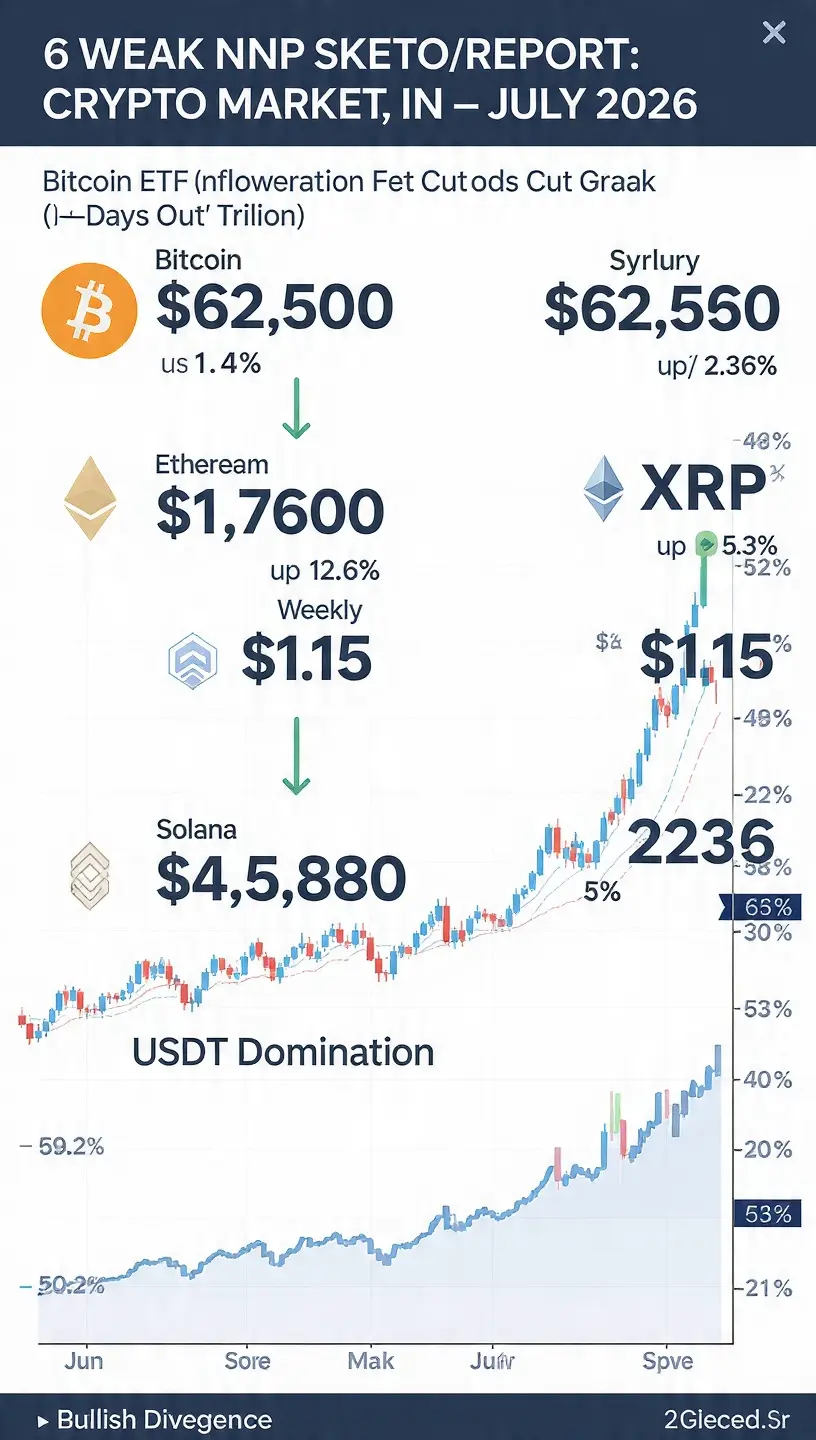
According to recent market data, Bitcoin is currently trading at approximately 62,650 dollars, marking a substantial recovery with gains of 1.4 percent over the past twenty-four hours and 3.6 percent over the week. Bitcoin has successfully breached the 63,000 dollar level, reaching its highest price point in over two weeks and completely reversing the losses that closed out June. This represents a significant technical breakthrough for the leading cryptocurrency, with the price action indicating renewed buying interest from both retail and institutional participants.
Ethereum has demonstrated even stronger momentum, currently trading at 1,760 dollars with an impressive weekly gain of 12.6 percent. The second-largest cryptocurrency by market capitalization has printed a daily TBT Bullish Divergence and closed inside the daily TBO Cloud for the first time since falling below it on May 15, confirming a bullish OBV cross above its moving average line. These technical indicators suggest that Ethereum may be establishing a more sustainable upward trend after weeks of consolidation and downward pressure.
Solana maintains stability around the 80 dollar level, while XRP has emerged as one of the strongest performers among major cryptocurrencies, currently trading at 1.15 dollars with a 5.3 percent daily increase and nearly 10 percent weekly gains. This price appreciation has elevated XRP's market capitalization to approximately 73 billion dollars, allowing it to surpass the USDC stablecoin and reclaim the fifth position by market value. HYPE is trading at 68 dollars, and Dogecoin holds steady at 0.0078 dollars.
Gold prices stand at 4,160 dollars per ounce, reflecting the broader macroeconomic uncertainty and safe-haven demand that often accompanies weak employment data. The relationship between gold and cryptocurrency markets has become increasingly correlated as both asset classes respond to Federal Reserve policy expectations and dollar strength dynamics.
The weak American employment figures have substantially reduced expectations for Federal Reserve rate hikes, with the CME FedWatch Tool indicating that the probability of a rate cut in September 2026 has increased to 65 percent, up from 45 percent before the NFP report release. December 2026 shows an 80 percent probability of additional rate cuts. This shift in monetary policy expectations has weakened the US dollar while providing tailwinds for cryptocurrency valuations.
Institutional flows have responded positively to the changing macroeconomic landscape. United States spot Bitcoin ETFs recorded inflows of 222 million dollars on Thursday, breaking a painful ten-day outflow streak that had seen approximately 2.4 billion dollars in redemptions during June. This return of institutional capital represents an early signal that dip buyers are stepping back into the market, potentially marking the beginning of a more sustained recovery phase.
Market structure data reveals important insights about current trading conditions. The top ten spot centralized exchanges recorded 2.7 trillion dollars in trading volume during the first quarter of 2026, down from 4.5 trillion dollars in the fourth quarter of 2025. However, derivatives volume reached 85.3 trillion dollars traded on perpetual centralized exchanges in 2025, demonstrating that derivatives continue to dominate overall cryptocurrency trading activity. This concentration in derivatives suggests that sophisticated traders remain active despite spot market volume contraction.
USDT maintains its dominance in the stablecoin market with a 59.2 percent market share and accounts for 73.6 percent of centralized exchange trading volume. This concentration of liquidity in a single stablecoin highlights the importance of Tether in maintaining market stability and facilitating price discovery across cryptocurrency markets.
Bitcoin's market capitalization stands at 1.261 trillion dollars, representing 56.5 percent of the total cryptocurrency market capitalization. Ethereum follows with 213 billion dollars, accounting for 9.57 percent of the total market. The overall cryptocurrency market capitalization currently sits at 2.234 trillion dollars, having increased by 0.1 percent over the past twenty-four hours. Bitcoin's twenty-four-hour trading volume reaches 18.8 billion dollars, while Ethereum processes 7.7 billion dollars in daily volume.
Technical analysis suggests improving market conditions across major cryptocurrencies. Bitcoin has printed a daily TBT Bullish Divergence and tagged the daily TBO Fast line near 62,000 dollars, representing meaningful improvement after weeks of pressure. The On-Balance Volume indicator is approaching a bullish cross above its moving average line, which could develop this week if buyers continue following through on current momentum.
Stablecoin dominance is weakening, which typically proves bullish for Bitcoin and alternative cryptocurrencies as capital rotates out of safety and back into risk assets. The total cryptocurrency market breadth is improving, with RSI putting in higher lows while OBV pushes above its moving average line for the first time since May 25. These technical developments suggest that the market may be transitioning from a bearish to a more constructive phase.
The macroeconomic implications of weak NFP data extend beyond immediate price movements. Lower employment growth signals potential economic slowdown, which typically forces central banks to maintain accommodative monetary policy for longer periods. Extended periods of low interest rates reduce the opportunity cost of holding non-yielding assets like Bitcoin and gold, while simultaneously increasing the money supply through quantitative easing measures that historically correlate with cryptocurrency price appreciation.
Market participants should monitor several key factors in the coming weeks. The Federal Reserve's next policy statement will provide crucial guidance about the central bank's reaction function to weakening employment data. Continued ETF inflows would confirm institutional confidence in the recovery narrative. Technical resistance levels for Bitcoin include the 65,000 dollar zone, while Ethereum faces resistance near 1,850 dollars. Support levels for Bitcoin remain intact at 60,000 dollars, with Ethereum finding buyers around 1,650 dollars.
The correlation between cryptocurrency markets and traditional risk assets has remained elevated, meaning that broader equity market movements will likely influence digital asset prices. However, the unique supply dynamics of Bitcoin, including the recent halving event that reduced block rewards to 3.125 BTC, provide fundamental support independent of macroeconomic factors.
Trading volumes across major exchanges suggest that liquidity conditions have improved modestly, though spot volumes remain below the elevated levels seen during the first quarter of 2026. Market depth indicators show adequate support for current price levels, with order book analysis revealing strong buying interest between 60,000 and 62,000 dollars for Bitcoin.
The broader altcoin market has participated in the recovery, with the total altcoin market capitalization excluding Bitcoin and Ethereum showing gains of approximately 3.2 percent over the week. This broadening of the rally suggests improving risk appetite among cryptocurrency investors, who often rotate from large-cap assets into smaller tokens during bullish phases.
Regulatory developments continue to influence market sentiment, with recent clarity around exchange operations and custody solutions providing additional confidence for institutional participants. The European Union's Markets in Crypto-Assets framework and similar regulatory developments in Asia-Pacific regions are creating more standardized operating environments for cryptocurrency businesses.
In conclusion, the weak NFP report has fundamentally altered market expectations for Federal Reserve policy, reducing rate hike odds and creating a more favorable environment for cryptocurrency investments. Bitcoin's recovery above 63,000 dollars, Ethereum's 12.6 percent weekly gain, and XRP's 10 percent appreciation demonstrate broad-based market strength. Institutional flows returning through ETF channels, combined with improving technical indicators and weakening stablecoin dominance, suggest that the cryptocurrency market may be entering a more constructive phase. However, traders should remain vigilant regarding macroeconomic developments, Federal Reserve communications, and technical resistance levels that could determine whether this recovery extends into a more sustained bull market phase or encounters renewed selling pressure near previous highs.@Gate_Square