#30YearTreasuryYieldBreaks5%
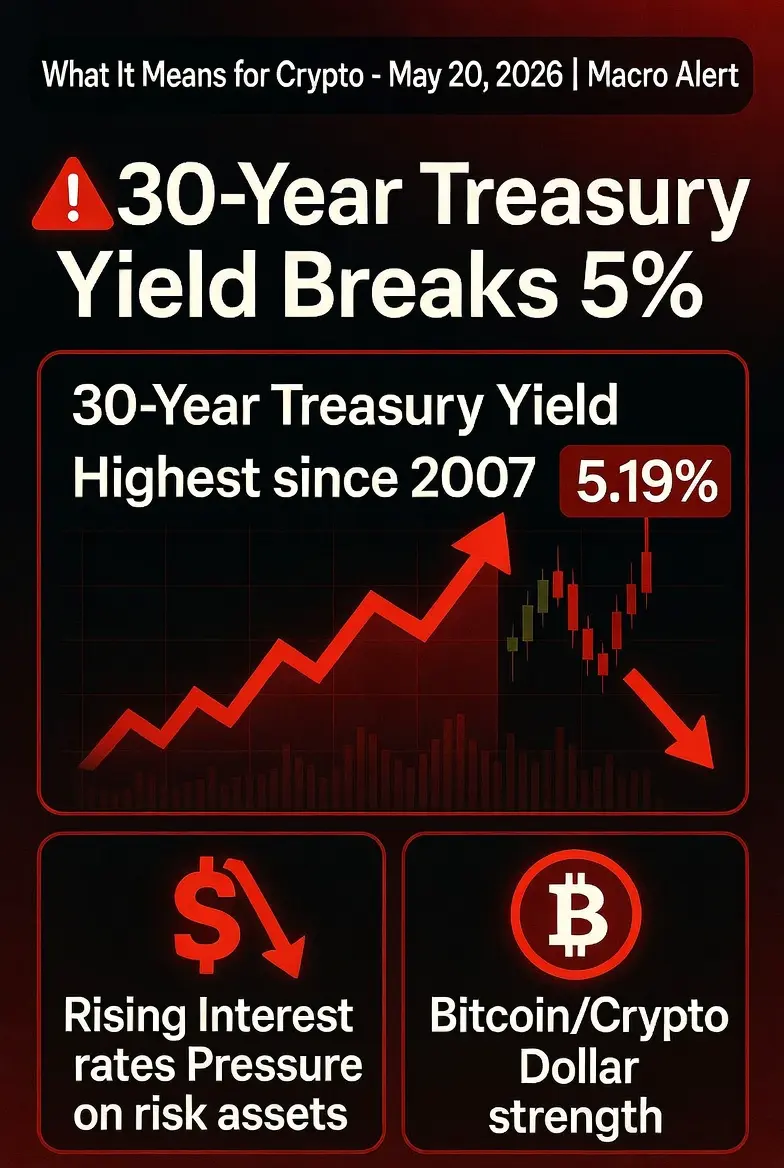
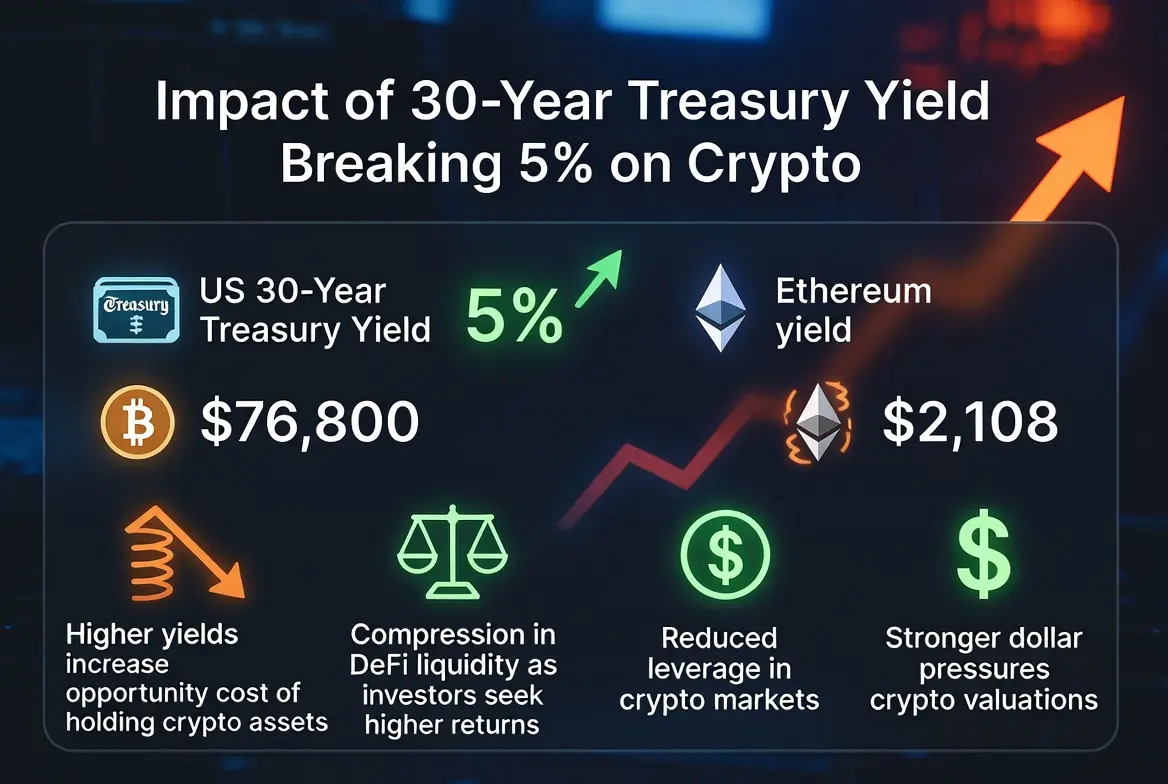
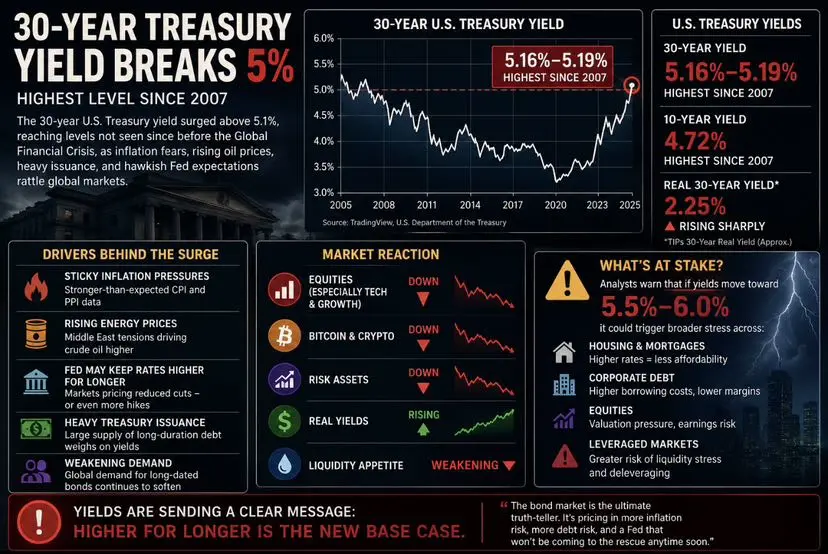
The 30-year US Treasury yield holding above the 5% level marks a major macro regime shift that is reshaping global capital allocation. With Bitcoin trading around $76,800 and Ethereum near $2,108, crypto markets are now operating under tighter liquidity conditions, stronger competition from risk-free yields, and a more defensive institutional stance. This is not just a short-term fluctuation—it is a structural repricing of risk across all asset classes.
1. Macro Shift: Risk-Free Yield Becomes a Strong Competitor
When the 30-year Treasury yield sustains above 5%, it fundamentally alters global capital preferences. Investors are now presented with a rare opportunity: a guaranteed ~5% annual return backed by the US government, something that has not been available in decades.
During the ultra-low interest rate era, capital had almost no choice but to move into risk assets like Bitcoin, Ethereum, equities, and venture capital. Now the situation is reversed—capital has a strong, safe alternative again.
For institutional allocators such as pension funds, insurance companies, and sovereign wealth funds, this shift is critical. The decision is no longer “cash vs risk assets,” but “safe 5% yield vs volatile growth assets.”
2. Opportunity Cost Pressure on Crypto Assets
The opportunity cost of holding crypto rises sharply in this environment.
Bitcoin at $76,800 offers no yield
Ethereum at $2,108 offers staking yield, but still volatile and risk-exposed
Treasury bonds offer ~5% guaranteed return
This creates a direct mathematical disadvantage for crypto in traditional portfolio models.
As a result:
Institutional BTC ETF inflows slow down
Profit-taking increases during rallies
Risk exposure is actively reduced across hedge funds
This does not mean capital exits crypto completely, but it becomes selectively deployed rather than aggressively allocated.
3. Bitcoin Price Behavior Under High-Yield Regime
Bitcoin increasingly behaves like a macro-sensitive risk asset, not an independent hedge instrument.
Current Market Context:
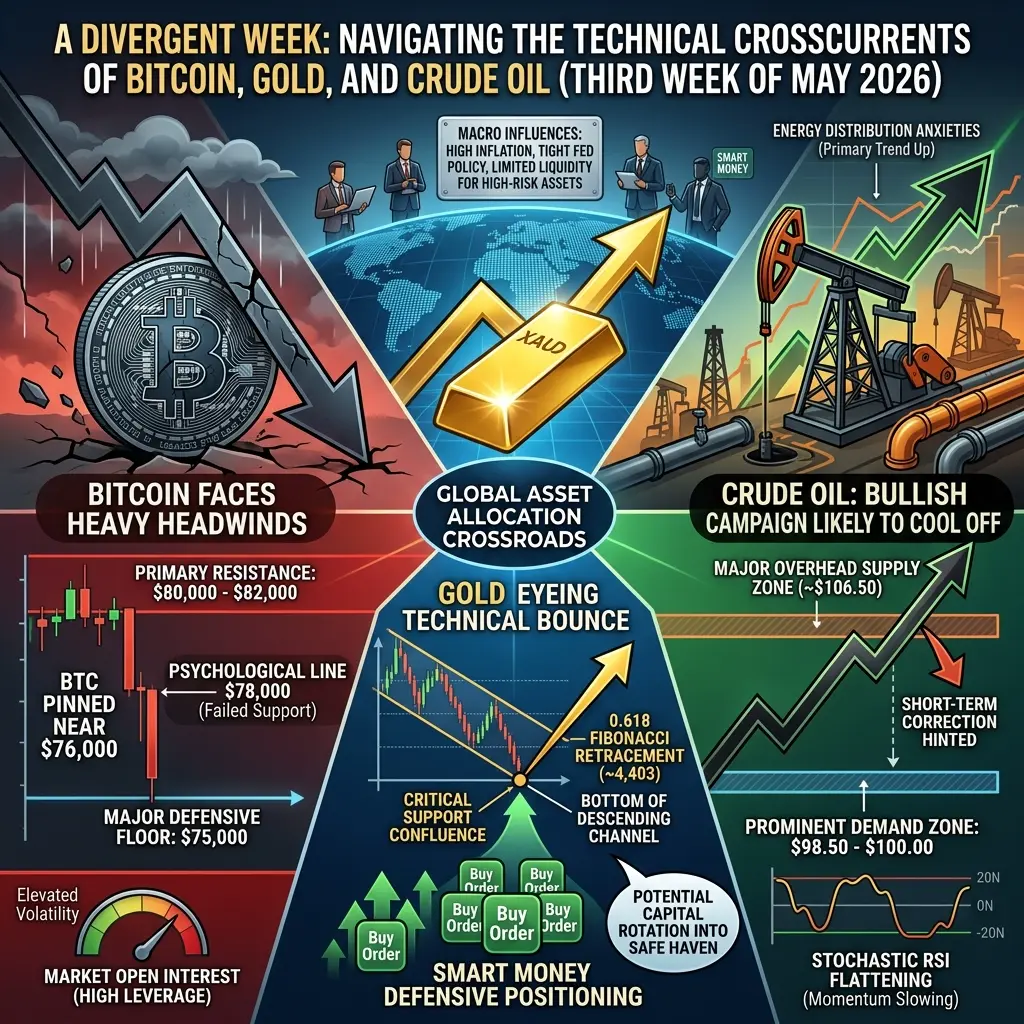
BTC: $76,800
Key psychological range under pressure: $75,000–$80,000
Key Impacts:
Strong resistance to upside expansion
Increased sensitivity to bond yield spikes
Faster corrections during liquidity contractions
Bitcoin’s “digital gold” narrative weakens temporarily when 5% risk-free yield competes directly with long-term store-of-value positioning.
However, Bitcoin still maintains long-term structural demand due to:
Fixed supply
Institutional adoption via ETFs
Sovereign debt concerns
4. Ethereum Under Dual Pressure: Yield Competition + Risk Appetite
Ethereum faces a more complex situation than Bitcoin.
Current ETH Price:
ETH: $2,108
Structural Challenge:
Ethereum staking yields (historically ~3–5%) now compete directly with Treasury yields.
This creates a compressed yield premium scenario where:
Treasuries = safe 5%+
ETH staking = similar yield but with volatility risk
Result:
Reduced attractiveness of staking for conservative capital
Lower DeFi participation
Slower liquidity inflows into ETH-based ecosystems
Ethereum remains fundamentally strong, but capital efficiency advantage temporarily weakens.
5. DeFi Ecosystem Liquidity Compression
Decentralized Finance (DeFi) is one of the most affected sectors.
When risk-free yields rise:
Stablecoin deposits shift toward Treasuries
Borrowing demand decreases
Yield spreads compress
Consequences:
Lower TVL (Total Value Locked)
Higher borrowing costs in lending protocols
Increased liquidation cascades during volatility spikes
DeFi thrives in low-rate environments—5% Treasury yields reverse that advantage.
6. Stablecoin System Stress and Capital Migration
Stablecoins such as USDT and USDC are indirectly impacted because reserves are heavily invested in Treasuries.
Key Dynamic:
Issuers earn high yield from reserves
Users earn zero yield on holdings
This creates a hidden arbitrage pressure:
Capital prefers direct Treasury exposure
Stablecoin circulation growth slows
Result:
Reduced stablecoin liquidity expansion
Lower on-chain trading depth during risk-off periods
7. Leverage Reduction and Market Fragility
Higher Treasury yields increase global borrowing costs, which directly impacts crypto leverage markets.
Effects include:
Higher futures funding rates
Reduced margin appetite
Forced deleveraging events
This leads to:
Faster downside moves
Shorter but sharper volatility cycles
Reduced speculative excess
Leverage contraction is one of the strongest short-term bearish forces in crypto.
8. Correlation Increase Across Risk Assets
A key structural change is rising correlation between:
Crypto
Equities
Tech stocks
When yields rise:
All risk assets move in the same direction
Diversification benefits weaken
Macro becomes dominant driver
This reduces Bitcoin’s independence as a portfolio hedge.
9. Venture Capital and Crypto Innovation Slowdown
High risk-free yields increase discount rates, which reduces startup valuations.
Impact:
Lower crypto VC funding
Reduced token launch valuations
Slower ecosystem expansion
Capital prefers:
Guaranteed 5% returns instead of:
High-risk long-duration crypto startups
This shifts the industry from expansion phase to capital efficiency phase.
10. Dollar Strength and Global Liquidity Drain
Rising yields strengthen the US dollar, which creates:
Capital inflows into USD assets
Pressure on emerging markets
Reduced global crypto purchasing power
Since crypto is globally traded in USD terms, this acts as an additional headwind.
11. Historical Context and Market Cycles
In previous cycles:
2020–2021: near-zero yields → crypto bull run
2022: rising yields → deep crypto bear market
Current conditions resemble a late tightening phase, where liquidity is constrained and speculative appetite weakens.
12. Forward Outlook: Key Scenarios
Bearish Scenario:
Yield moves toward 5.3%+
BTC breaks below $75,000
ETH moves toward $1,900–$2,000 range
Neutral Scenario:
Yields stabilize 4.9%–5.1%
Crypto trades in consolidation range
Low volatility accumulation phase
Bullish Relief Scenario:
Yield retreats below 5%
Liquidity returns gradually
BTC reclaims $80K–$85K zone
ETH recovers toward $2,300+
Final Conclusion
The 30-year Treasury yield above 5% is a structural macro headwind for crypto markets. It does not break the long-term thesis of Bitcoin or Ethereum, but it significantly changes short-to-mid term capital flows.
With BTC at $76,800 and ETH at $2,108, the market is currently in a defensive macro phase, where capital prioritizes safety over speculation.
Crypto is no longer operating in isolation—it is now deeply integrated into global macro liquidity cycles. The next major move will depend less on internal crypto catalysts and more on whether Treasury yields continue rising or begin to stabilize.
The 30-year US Treasury yield holding above the 5% level marks a major macro regime shift that is reshaping global capital allocation. With Bitcoin trading around $76,800 and Ethereum near $2,108, crypto markets are now operating under tighter liquidity conditions, stronger competition from risk-free yields, and a more defensive institutional stance. This is not just a short-term fluctuation—it is a structural repricing of risk across all asset classes.
1. Macro Shift: Risk-Free Yield Becomes a Strong Competitor
When the 30-year Treasury yield sustains above 5%, it fundamentally alters global capital preferences. Investors are now presented with a rare opportunity: a guaranteed ~5% annual return backed by the US government, something that has not been available in decades.
During the ultra-low interest rate era, capital had almost no choice but to move into risk assets like Bitcoin, Ethereum, equities, and venture capital. Now the situation is reversed—capital has a strong, safe alternative again.
For institutional allocators such as pension funds, insurance companies, and sovereign wealth funds, this shift is critical. The decision is no longer “cash vs risk assets,” but “safe 5% yield vs volatile growth assets.”
2. Opportunity Cost Pressure on Crypto Assets
The opportunity cost of holding crypto rises sharply in this environment.
Bitcoin at $76,800 offers no yield
Ethereum at $2,108 offers staking yield, but still volatile and risk-exposed
Treasury bonds offer ~5% guaranteed return
This creates a direct mathematical disadvantage for crypto in traditional portfolio models.
As a result:
Institutional BTC ETF inflows slow down
Profit-taking increases during rallies
Risk exposure is actively reduced across hedge funds
This does not mean capital exits crypto completely, but it becomes selectively deployed rather than aggressively allocated.
3. Bitcoin Price Behavior Under High-Yield Regime
Bitcoin increasingly behaves like a macro-sensitive risk asset, not an independent hedge instrument.
Current Market Context:
BTC: $76,800
Key psychological range under pressure: $75,000–$80,000
Key Impacts:
Strong resistance to upside expansion
Increased sensitivity to bond yield spikes
Faster corrections during liquidity contractions
Bitcoin’s “digital gold” narrative weakens temporarily when 5% risk-free yield competes directly with long-term store-of-value positioning.
However, Bitcoin still maintains long-term structural demand due to:
Fixed supply
Institutional adoption via ETFs
Sovereign debt concerns
4. Ethereum Under Dual Pressure: Yield Competition + Risk Appetite
Ethereum faces a more complex situation than Bitcoin.
Current ETH Price:
ETH: $2,108
Structural Challenge:
Ethereum staking yields (historically ~3–5%) now compete directly with Treasury yields.
This creates a compressed yield premium scenario where:
Treasuries = safe 5%+
ETH staking = similar yield but with volatility risk
Result:
Reduced attractiveness of staking for conservative capital
Lower DeFi participation
Slower liquidity inflows into ETH-based ecosystems
Ethereum remains fundamentally strong, but capital efficiency advantage temporarily weakens.
5. DeFi Ecosystem Liquidity Compression
Decentralized Finance (DeFi) is one of the most affected sectors.
When risk-free yields rise:
Stablecoin deposits shift toward Treasuries
Borrowing demand decreases
Yield spreads compress
Consequences:
Lower TVL (Total Value Locked)
Higher borrowing costs in lending protocols
Increased liquidation cascades during volatility spikes
DeFi thrives in low-rate environments—5% Treasury yields reverse that advantage.
6. Stablecoin System Stress and Capital Migration
Stablecoins such as USDT and USDC are indirectly impacted because reserves are heavily invested in Treasuries.
Key Dynamic:
Issuers earn high yield from reserves
Users earn zero yield on holdings
This creates a hidden arbitrage pressure:
Capital prefers direct Treasury exposure
Stablecoin circulation growth slows
Result:
Reduced stablecoin liquidity expansion
Lower on-chain trading depth during risk-off periods
7. Leverage Reduction and Market Fragility
Higher Treasury yields increase global borrowing costs, which directly impacts crypto leverage markets.
Effects include:
Higher futures funding rates
Reduced margin appetite
Forced deleveraging events
This leads to:
Faster downside moves
Shorter but sharper volatility cycles
Reduced speculative excess
Leverage contraction is one of the strongest short-term bearish forces in crypto.
8. Correlation Increase Across Risk Assets
A key structural change is rising correlation between:
Crypto
Equities
Tech stocks
When yields rise:
All risk assets move in the same direction
Diversification benefits weaken
Macro becomes dominant driver
This reduces Bitcoin’s independence as a portfolio hedge.
9. Venture Capital and Crypto Innovation Slowdown
High risk-free yields increase discount rates, which reduces startup valuations.
Impact:
Lower crypto VC funding
Reduced token launch valuations
Slower ecosystem expansion
Capital prefers:
Guaranteed 5% returns instead of:
High-risk long-duration crypto startups
This shifts the industry from expansion phase to capital efficiency phase.
10. Dollar Strength and Global Liquidity Drain
Rising yields strengthen the US dollar, which creates:
Capital inflows into USD assets
Pressure on emerging markets
Reduced global crypto purchasing power
Since crypto is globally traded in USD terms, this acts as an additional headwind.
11. Historical Context and Market Cycles
In previous cycles:
2020–2021: near-zero yields → crypto bull run
2022: rising yields → deep crypto bear market
Current conditions resemble a late tightening phase, where liquidity is constrained and speculative appetite weakens.
12. Forward Outlook: Key Scenarios
Bearish Scenario:
Yield moves toward 5.3%+
BTC breaks below $75,000
ETH moves toward $1,900–$2,000 range
Neutral Scenario:
Yields stabilize 4.9%–5.1%
Crypto trades in consolidation range
Low volatility accumulation phase
Bullish Relief Scenario:
Yield retreats below 5%
Liquidity returns gradually
BTC reclaims $80K–$85K zone
ETH recovers toward $2,300+
Final Conclusion
The 30-year Treasury yield above 5% is a structural macro headwind for crypto markets. It does not break the long-term thesis of Bitcoin or Ethereum, but it significantly changes short-to-mid term capital flows.
With BTC at $76,800 and ETH at $2,108, the market is currently in a defensive macro phase, where capital prioritizes safety over speculation.
Crypto is no longer operating in isolation—it is now deeply integrated into global macro liquidity cycles. The next major move will depend less on internal crypto catalysts and more on whether Treasury yields continue rising or begin to stabilize.