

#70%OffshoreRMBViaHK
Hong Kong: The World's Largest Offshore RMB Financial Hub
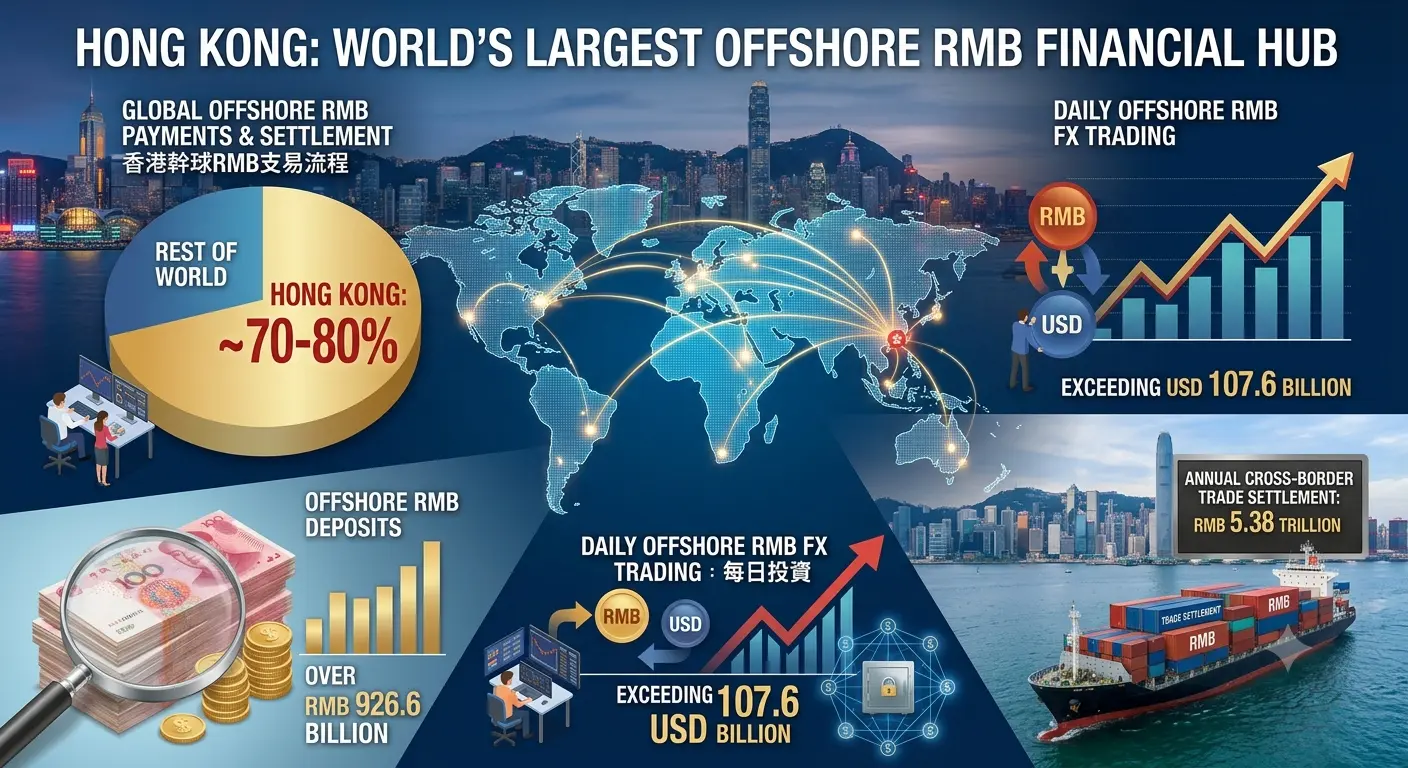
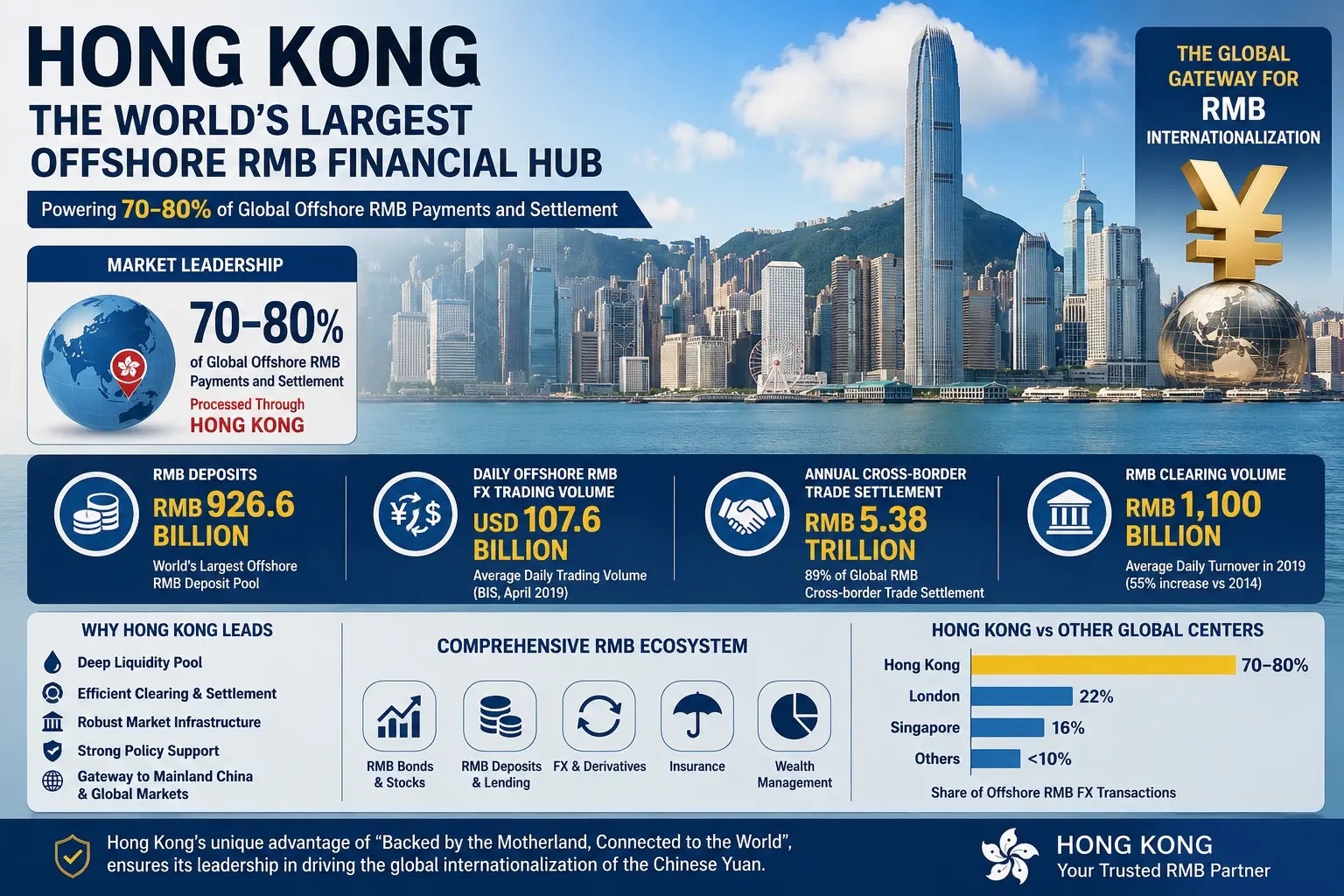
Hong Kong stands as the undisputed global leader in offshore Chinese Yuan (RMB) financial services, handling approximately 70% to 80% of all global offshore RMB payments, clearing, and settlement transactions. This comprehensive analysis examines the critical role Hong Kong plays in the internationalization of China's currency, supported by detailed market data, pricing metrics, volume statistics, and liquidity measurements.
Understanding the Chinese Yuan (RMB) - CNY vs CNH
The Chinese Yuan, officially known as Renminbi (RMB), operates in two distinct markets. The Onshore Yuan (CNY) is China's domestic currency, controlled by the People's Bank of China (PBOC) and used exclusively within mainland China. The Offshore Yuan (CNH) represents RMB traded outside mainland China, primarily in Hong Kong, and is freely convertible in international markets. This dual-track system allows China to maintain capital controls domestically while promoting currency internationalization globally.
Hong Kong serves as the primary hub for CNH trading, offering the deepest offshore RMB liquidity pool worldwide. The distinction between CNY and CNH creates price differentials that fluctuate based on market conditions, with CNH typically trading at a slight premium or discount to CNY depending on capital flow expectations and offshore demand.
Hong Kong's Market Dominance - 70% to 80% Global Share
According to data from the Society for Worldwide Interbank Financial Telecommunication (SWIFT), Hong Kong processes approximately 75% of all RMB activity occurring outside mainland China. HSBC's Global Head of RMB Internationalization, Vina Cheung, reports that Hong Kong clears approximately 80% of global RMB payments, cementing its position as the world's largest offshore renminbi center.
This market share translates to staggering transaction volumes. In 2019 alone, RMB trade settlement handled by Hong Kong banks reached RMB 5.38 trillion, representing 89% of total global RMB cross-border trade settlement. The RMB Real Time Gross Settlement (RTGS) system in Hong Kong recorded an average daily turnover of RMB 1,100 billion in 2019, marking a 55% increase compared to 2014 levels.
RMB Deposits and Liquidity Pool - RMB 926.6 Billion
Hong Kong maintains the world's largest offshore RMB deposit pool. As of 2024, RMB deposits in Hong Kong reached RMB 926.6 billion according to the City of London RMB Business Annual Report. This figure represents a substantial capital base that supports global RMB trading activities. In 2019, Hong Kong's RMB capital pool, including customer deposits and certificates of deposit, stood at RMB 658 billion, accounting for nearly 50% of all offshore RMB deposits worldwide according to the People's Bank of China.
The depth of this liquidity pool enables Hong Kong to offer competitive pricing and efficient settlement for RMB transactions. The substantial deposit base attracts international banks, corporations, and investors seeking RMB exposure, creating a self-reinforcing cycle of liquidity concentration.
Foreign Exchange Trading Volume - USD 107.6 Billion Daily
Hong Kong dominates offshore RMB foreign exchange markets with extraordinary trading volumes. According to the Bank for International Settlements (BIS) Triennial Survey of Foreign Exchange and Derivatives Market Turnover conducted in April 2019, the average daily turnover of RMB foreign exchange transactions in Hong Kong reached USD 107.6 billion. This figure represents a monumental 39.6% increase compared to the previous 2016 survey.
The BIS data further reveals Hong Kong's commanding market share in offshore RMB FX trading. Approximately 41% of all offshore RMB foreign exchange transactions occur in Hong Kong, significantly exceeding London's 22% share and Singapore's 16% share. This concentration of trading activity generates substantial liquidity and price discovery efficiency for global RMB markets.
Interest Rate Derivatives Market - USD 12.7 Billion Daily
Beyond spot foreign exchange, Hong Kong leads in RMB-denominated derivatives trading. The BIS Triennial Survey reported that average daily turnover of RMB over-the-counter interest-rate derivatives in Hong Kong nearly doubled to USD 12.7 billion as of April 2019. This derivatives market provides essential risk management tools for institutions managing RMB interest rate exposure.
The availability of RMB futures, forwards, swaps, and options in Hong Kong enables sophisticated hedging strategies that support the currency's international adoption. Market participants can access RMB-denominated foreign exchange futures, gold futures, and commodity futures including aluminum, zinc, copper, nickel, tin, and lead contracts.
Cross-Border Trade Settlement - RMB 5.38 Trillion Annually
Hong Kong's role in facilitating China-global trade is quantified through massive settlement volumes. In 2019, RMB trade settlement handled by Hong Kong banks totaled RMB 5.38 trillion, accounting for 89% of global RMB cross-border trade settlement. This settlement infrastructure enables Chinese and international businesses to conduct trade in RMB rather than USD, reducing currency conversion costs and settlement risks.
The Stock Connect programs further amplify Hong Kong's role in cross-border investment flows. Since launching the Shanghai-Hong Kong Stock Connect in 2014 and Shenzhen-Hong Kong Stock Connect in 2016, northbound trading accumulated over RMB 21 trillion in transaction value by March 2020. These connectivity schemes channel international investment into Chinese equities while providing Chinese investors access to global markets.
Clearing Volume Statistics - RMB 1,100 Billion Daily Average
Hong Kong's RMB clearing infrastructure processes extraordinary transaction volumes. The RMB Real Time Gross Settlement system recorded average daily turnover of RMB 1,100 billion in 2019, representing a 55% increase from 2014 levels. This clearing capacity ensures efficient settlement for the vast majority of global RMB transactions.
The clearing statistics demonstrate Hong Kong's infrastructure superiority in handling RMB payments. Real-time settlement capabilities reduce counterparty risk and settlement delays that would otherwise impede RMB internationalization. The system's reliability and scale attract global banks to maintain RMB clearing operations in Hong Kong.
Comparative Market Analysis - Hong Kong vs Global Centers
Hong Kong's dominance becomes apparent when comparing global offshore RMB centers. London, the second-largest offshore RMB hub, recorded average daily CNH FX trading volume of GBP 172.7 billion (approximately USD 215 billion) in 2024, representing a 43.20% year-over-year increase. London's RMB deposits reached RMB 155.0 billion by December 2024, up 72.97% year-over-year, while outstanding RMB loans totaled RMB 118.6 billion, up 30.08% year-over-year.
Despite London's growth, Hong Kong maintains overwhelming market share in offshore RMB activities. The UK's total RMB clearing volume reached RMB 31 trillion in 2024 with average daily clearing of RMB 121.6 billion, up 45.15% year-over-year. However, these figures remain substantially smaller than Hong Kong's processing volumes.
RMB Internationalization Progress and Policy Support
China's central bank actively promotes RMB internationalization through policies supporting offshore markets. In 2026, the People's Bank of China announced measures to expand offshore RMB business in Shanghai, authorizing six banks to conduct offshore yuan transactions in the Shanghai free trade zone. Additionally, the PBOC created tools enabling overseas central banks, sovereign wealth funds, and international financial organizations to obtain RMB liquidity more easily.
Hong Kong benefits from these policies while maintaining its first-mover advantage. The city's established infrastructure, legal framework based on English common law, and proximity to mainland China create structural advantages that competing centers cannot easily replicate. The Greater Bay Area integration further strengthens Hong Kong's connectivity with Chinese markets.
Investment Products and Market Infrastructure
Hong Kong offers the most comprehensive range of offshore RMB investment products globally. Available instruments include RMB-denominated stocks, bonds, funds, insurance products, and derivative instruments. The Bond Connect program enables international investors to access China's interbank bond market through Hong Kong, with monthly trading volumes reaching RMB 893.1 billion and average daily turnover of RMB 47.0 billion.
From January to May 2026, Bond Connect trading volume totaled RMB 4.85 trillion with average daily turnover of RMB 48.99 billion. These figures demonstrate the scale of RMB-denominated investment flows channeled through Hong Kong.
Future Outlook and Growth Projections
Hong Kong's offshore RMB market continues expanding despite geopolitical challenges and economic uncertainties. The city's cross-border wealth management business reached USD 2.95 trillion in 2026, surpassing Switzerland as the world's top cross-border wealth hub according to Boston Consulting Group. This wealth concentration supports continued growth in RMB-denominated assets and transactions.
The integration of Hong Kong with China's digital yuan (e-CNY) initiatives presents additional growth opportunities. The PBOC's digital yuan operation center signed agreements with 26 financial institutions in Shanghai to promote cross-border digital currency adoption, with Hong Kong positioned to facilitate these flows.
Conclusion
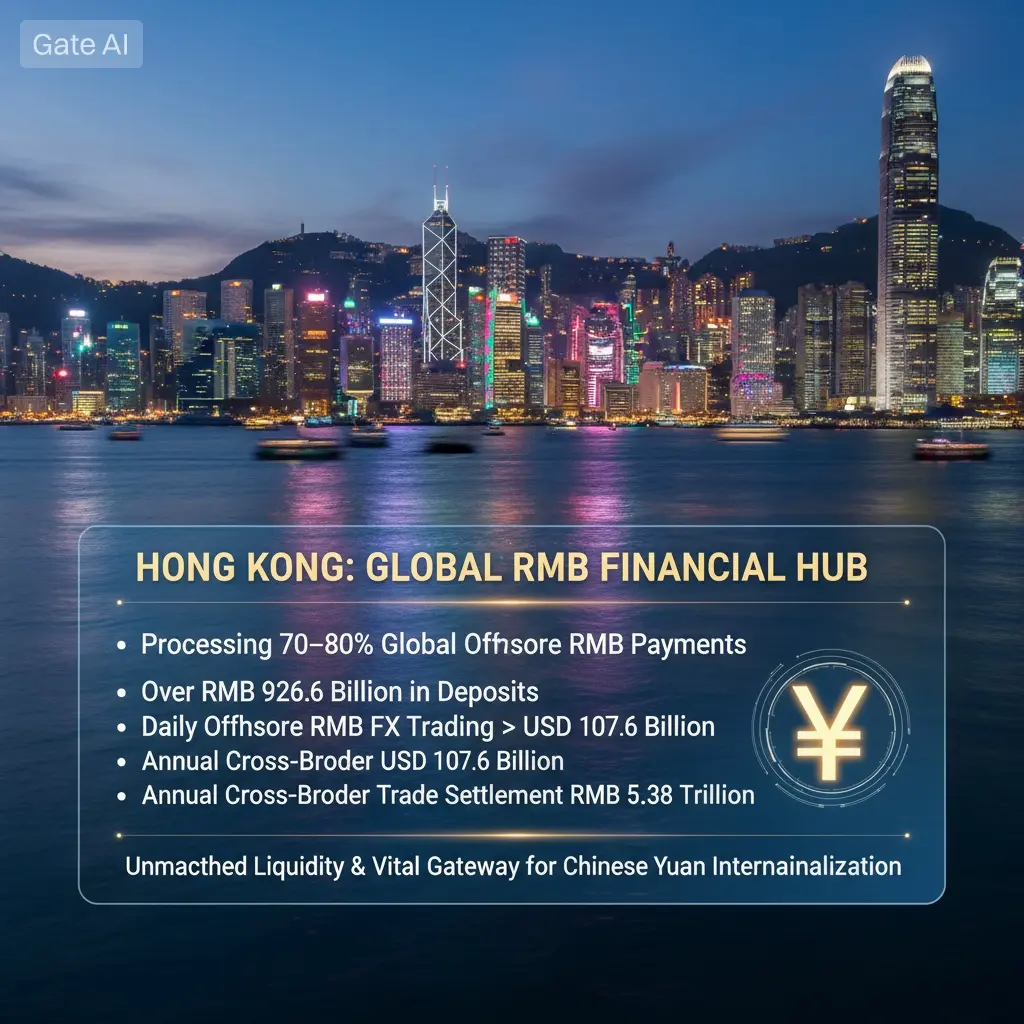
Hong Kong's position as the world's largest offshore RMB financial center is quantified through overwhelming market share statistics: 70% to 80% of global offshore RMB payments, RMB 926.6 billion in deposits, USD 107.6 billion in daily FX trading volume, and RMB 5.38 trillion in annual trade settlement. These figures demonstrate Hong Kong's critical role in China's currency internationalization strategy.
The city's deep liquidity pools, comprehensive market infrastructure, and policy support from Chinese authorities ensure continued dominance in offshore RMB markets. For global businesses, investors, and financial institutions seeking RMB exposure, Hong Kong remains the primary gateway offering price efficiency, settlement reliability, and market depth unavailable elsewhere. As RMB internationalization progresses, Hong Kong's market share, while potentially facing competition from growing centers like London and Singapore, is structurally positioned to maintain leadership through its unique combination of Chinese market access and international financial standards.@Gate_Square
Hong Kong: The World's Largest Offshore RMB Financial Hub
Hong Kong stands as the undisputed global leader in offshore Chinese Yuan (RMB) financial services, handling approximately 70% to 80% of all global offshore RMB payments, clearing, and settlement transactions. This comprehensive analysis examines the critical role Hong Kong plays in the internationalization of China's currency, supported by detailed market data, pricing metrics, volume statistics, and liquidity measurements.
Understanding the Chinese Yuan (RMB) - CNY vs CNH
The Chinese Yuan, officially known as Renminbi (RMB), operates in two distinct markets. The Onshore Yuan (CNY) is China's domestic currency, controlled by the People's Bank of China (PBOC) and used exclusively within mainland China. The Offshore Yuan (CNH) represents RMB traded outside mainland China, primarily in Hong Kong, and is freely convertible in international markets. This dual-track system allows China to maintain capital controls domestically while promoting currency internationalization globally.
Hong Kong serves as the primary hub for CNH trading, offering the deepest offshore RMB liquidity pool worldwide. The distinction between CNY and CNH creates price differentials that fluctuate based on market conditions, with CNH typically trading at a slight premium or discount to CNY depending on capital flow expectations and offshore demand.
Hong Kong's Market Dominance - 70% to 80% Global Share
According to data from the Society for Worldwide Interbank Financial Telecommunication (SWIFT), Hong Kong processes approximately 75% of all RMB activity occurring outside mainland China. HSBC's Global Head of RMB Internationalization, Vina Cheung, reports that Hong Kong clears approximately 80% of global RMB payments, cementing its position as the world's largest offshore renminbi center.
This market share translates to staggering transaction volumes. In 2019 alone, RMB trade settlement handled by Hong Kong banks reached RMB 5.38 trillion, representing 89% of total global RMB cross-border trade settlement. The RMB Real Time Gross Settlement (RTGS) system in Hong Kong recorded an average daily turnover of RMB 1,100 billion in 2019, marking a 55% increase compared to 2014 levels.
RMB Deposits and Liquidity Pool - RMB 926.6 Billion
Hong Kong maintains the world's largest offshore RMB deposit pool. As of 2024, RMB deposits in Hong Kong reached RMB 926.6 billion according to the City of London RMB Business Annual Report. This figure represents a substantial capital base that supports global RMB trading activities. In 2019, Hong Kong's RMB capital pool, including customer deposits and certificates of deposit, stood at RMB 658 billion, accounting for nearly 50% of all offshore RMB deposits worldwide according to the People's Bank of China.
The depth of this liquidity pool enables Hong Kong to offer competitive pricing and efficient settlement for RMB transactions. The substantial deposit base attracts international banks, corporations, and investors seeking RMB exposure, creating a self-reinforcing cycle of liquidity concentration.
Foreign Exchange Trading Volume - USD 107.6 Billion Daily
Hong Kong dominates offshore RMB foreign exchange markets with extraordinary trading volumes. According to the Bank for International Settlements (BIS) Triennial Survey of Foreign Exchange and Derivatives Market Turnover conducted in April 2019, the average daily turnover of RMB foreign exchange transactions in Hong Kong reached USD 107.6 billion. This figure represents a monumental 39.6% increase compared to the previous 2016 survey.
The BIS data further reveals Hong Kong's commanding market share in offshore RMB FX trading. Approximately 41% of all offshore RMB foreign exchange transactions occur in Hong Kong, significantly exceeding London's 22% share and Singapore's 16% share. This concentration of trading activity generates substantial liquidity and price discovery efficiency for global RMB markets.
Interest Rate Derivatives Market - USD 12.7 Billion Daily
Beyond spot foreign exchange, Hong Kong leads in RMB-denominated derivatives trading. The BIS Triennial Survey reported that average daily turnover of RMB over-the-counter interest-rate derivatives in Hong Kong nearly doubled to USD 12.7 billion as of April 2019. This derivatives market provides essential risk management tools for institutions managing RMB interest rate exposure.
The availability of RMB futures, forwards, swaps, and options in Hong Kong enables sophisticated hedging strategies that support the currency's international adoption. Market participants can access RMB-denominated foreign exchange futures, gold futures, and commodity futures including aluminum, zinc, copper, nickel, tin, and lead contracts.
Cross-Border Trade Settlement - RMB 5.38 Trillion Annually
Hong Kong's role in facilitating China-global trade is quantified through massive settlement volumes. In 2019, RMB trade settlement handled by Hong Kong banks totaled RMB 5.38 trillion, accounting for 89% of global RMB cross-border trade settlement. This settlement infrastructure enables Chinese and international businesses to conduct trade in RMB rather than USD, reducing currency conversion costs and settlement risks.
The Stock Connect programs further amplify Hong Kong's role in cross-border investment flows. Since launching the Shanghai-Hong Kong Stock Connect in 2014 and Shenzhen-Hong Kong Stock Connect in 2016, northbound trading accumulated over RMB 21 trillion in transaction value by March 2020. These connectivity schemes channel international investment into Chinese equities while providing Chinese investors access to global markets.
Clearing Volume Statistics - RMB 1,100 Billion Daily Average
Hong Kong's RMB clearing infrastructure processes extraordinary transaction volumes. The RMB Real Time Gross Settlement system recorded average daily turnover of RMB 1,100 billion in 2019, representing a 55% increase from 2014 levels. This clearing capacity ensures efficient settlement for the vast majority of global RMB transactions.
The clearing statistics demonstrate Hong Kong's infrastructure superiority in handling RMB payments. Real-time settlement capabilities reduce counterparty risk and settlement delays that would otherwise impede RMB internationalization. The system's reliability and scale attract global banks to maintain RMB clearing operations in Hong Kong.
Comparative Market Analysis - Hong Kong vs Global Centers
Hong Kong's dominance becomes apparent when comparing global offshore RMB centers. London, the second-largest offshore RMB hub, recorded average daily CNH FX trading volume of GBP 172.7 billion (approximately USD 215 billion) in 2024, representing a 43.20% year-over-year increase. London's RMB deposits reached RMB 155.0 billion by December 2024, up 72.97% year-over-year, while outstanding RMB loans totaled RMB 118.6 billion, up 30.08% year-over-year.
Despite London's growth, Hong Kong maintains overwhelming market share in offshore RMB activities. The UK's total RMB clearing volume reached RMB 31 trillion in 2024 with average daily clearing of RMB 121.6 billion, up 45.15% year-over-year. However, these figures remain substantially smaller than Hong Kong's processing volumes.
RMB Internationalization Progress and Policy Support
China's central bank actively promotes RMB internationalization through policies supporting offshore markets. In 2026, the People's Bank of China announced measures to expand offshore RMB business in Shanghai, authorizing six banks to conduct offshore yuan transactions in the Shanghai free trade zone. Additionally, the PBOC created tools enabling overseas central banks, sovereign wealth funds, and international financial organizations to obtain RMB liquidity more easily.
Hong Kong benefits from these policies while maintaining its first-mover advantage. The city's established infrastructure, legal framework based on English common law, and proximity to mainland China create structural advantages that competing centers cannot easily replicate. The Greater Bay Area integration further strengthens Hong Kong's connectivity with Chinese markets.
Investment Products and Market Infrastructure
Hong Kong offers the most comprehensive range of offshore RMB investment products globally. Available instruments include RMB-denominated stocks, bonds, funds, insurance products, and derivative instruments. The Bond Connect program enables international investors to access China's interbank bond market through Hong Kong, with monthly trading volumes reaching RMB 893.1 billion and average daily turnover of RMB 47.0 billion.
From January to May 2026, Bond Connect trading volume totaled RMB 4.85 trillion with average daily turnover of RMB 48.99 billion. These figures demonstrate the scale of RMB-denominated investment flows channeled through Hong Kong.
Future Outlook and Growth Projections
Hong Kong's offshore RMB market continues expanding despite geopolitical challenges and economic uncertainties. The city's cross-border wealth management business reached USD 2.95 trillion in 2026, surpassing Switzerland as the world's top cross-border wealth hub according to Boston Consulting Group. This wealth concentration supports continued growth in RMB-denominated assets and transactions.
The integration of Hong Kong with China's digital yuan (e-CNY) initiatives presents additional growth opportunities. The PBOC's digital yuan operation center signed agreements with 26 financial institutions in Shanghai to promote cross-border digital currency adoption, with Hong Kong positioned to facilitate these flows.
Conclusion
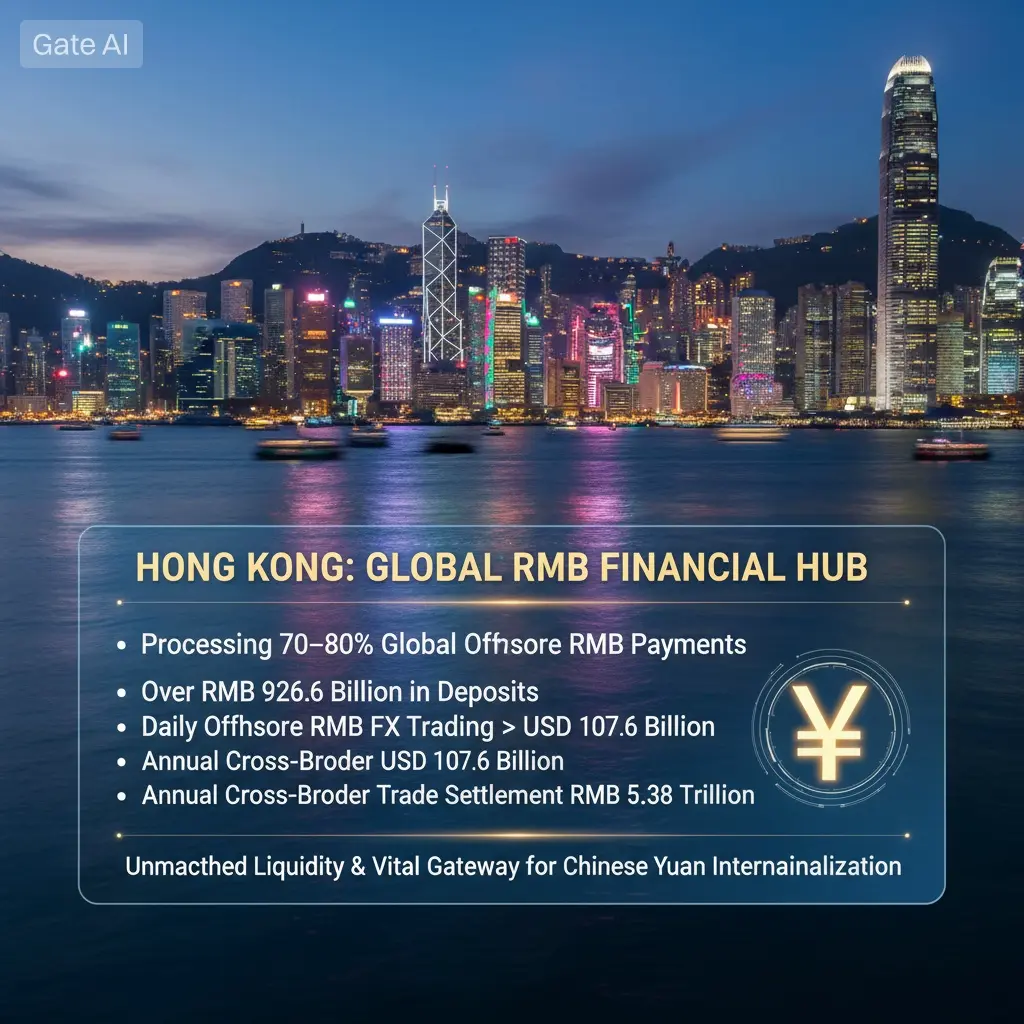
Hong Kong's position as the world's largest offshore RMB financial center is quantified through overwhelming market share statistics: 70% to 80% of global offshore RMB payments, RMB 926.6 billion in deposits, USD 107.6 billion in daily FX trading volume, and RMB 5.38 trillion in annual trade settlement. These figures demonstrate Hong Kong's critical role in China's currency internationalization strategy.
The city's deep liquidity pools, comprehensive market infrastructure, and policy support from Chinese authorities ensure continued dominance in offshore RMB markets. For global businesses, investors, and financial institutions seeking RMB exposure, Hong Kong remains the primary gateway offering price efficiency, settlement reliability, and market depth unavailable elsewhere. As RMB internationalization progresses, Hong Kong's market share, while potentially facing competition from growing centers like London and Singapore, is structurally positioned to maintain leadership through its unique combination of Chinese market access and international financial standards.@Gate_Square