#MARAReports1.3BQ1NetLoss
𝐌𝐀𝐑𝐀 𝐅𝐀𝐂𝐄𝐒 𝐌𝐀𝐒𝐒𝐈𝐕𝐄 𝐐𝟏 𝐋𝐎𝐒𝐒 𝐀𝐒 𝐁𝐈𝐓𝐂𝐎𝐈𝐍 𝐌𝐈𝐍𝐈𝐍𝐆 𝐄𝐕𝐎𝐋𝐕𝐄𝐒 𝐈𝐍𝐓𝐎 𝐀𝐈 𝐀𝐍𝐃 𝐄𝐍𝐄𝐑𝐆𝐘 𝐈𝐍𝐅𝐑𝐀𝐒𝐓𝐑𝐔𝐂𝐓𝐔𝐑𝐄
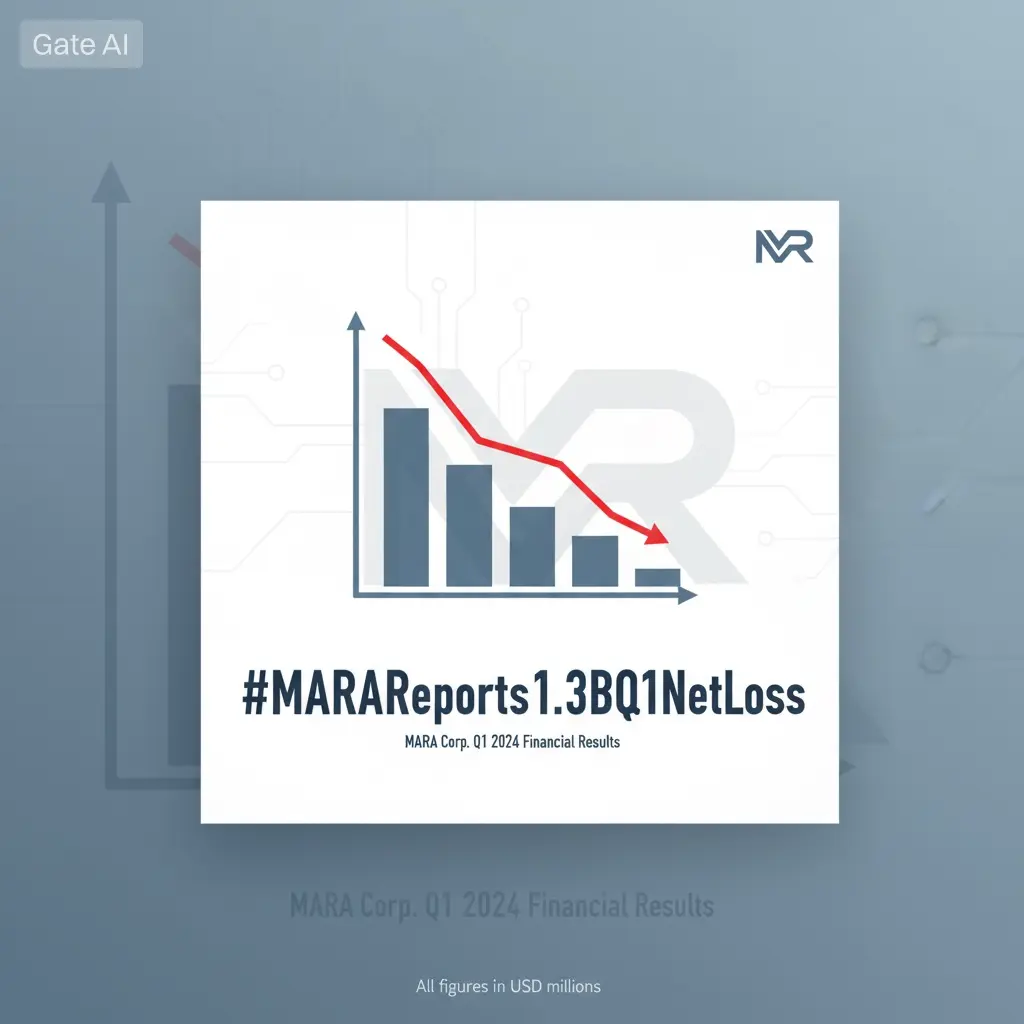
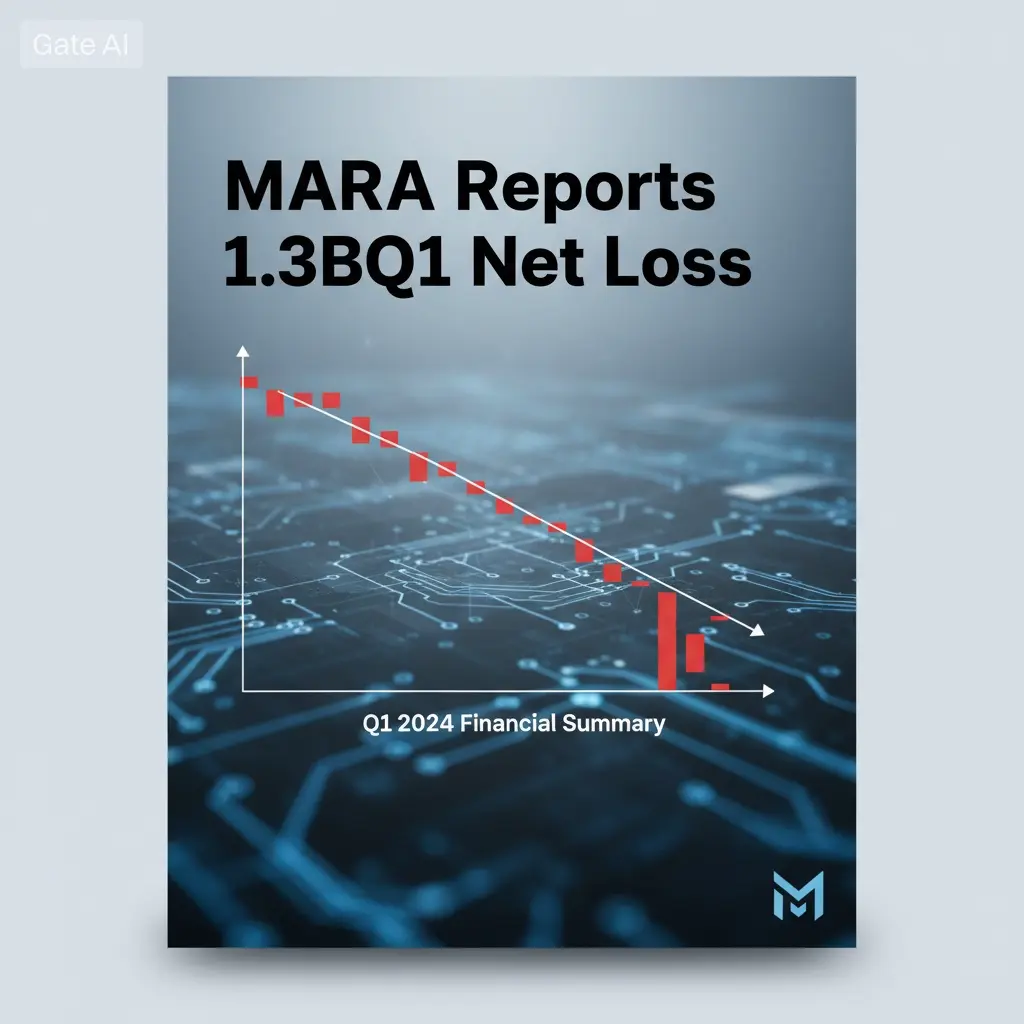
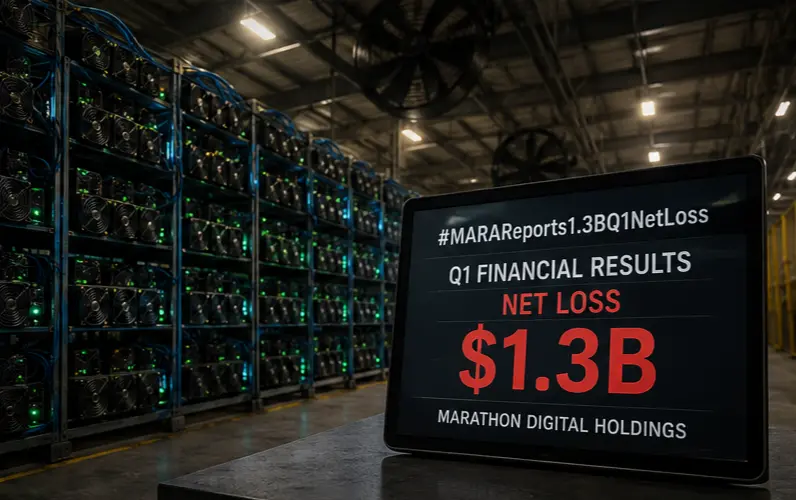
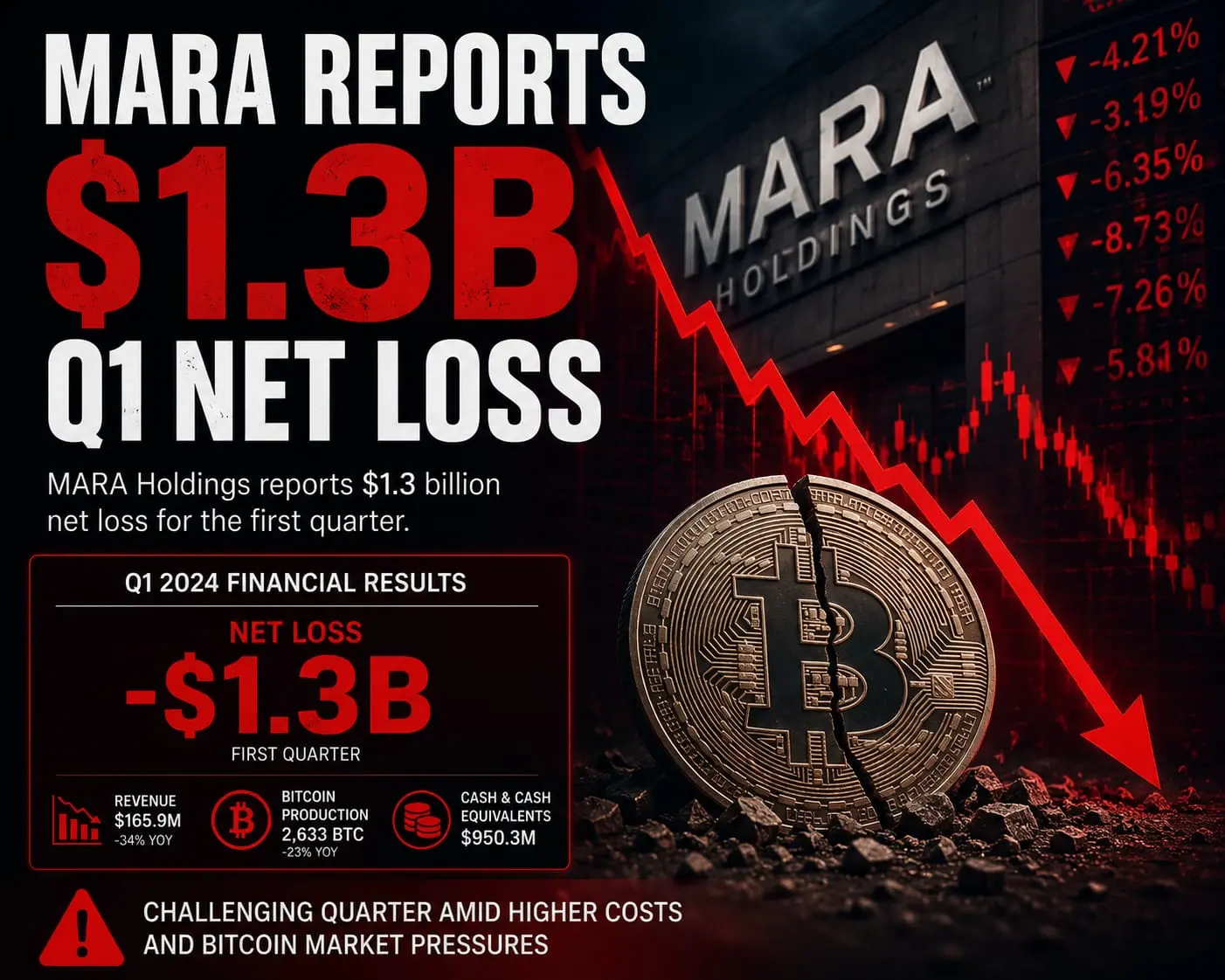
MARA Holdings posted one of the most financially turbulent quarters in recent Bitcoin mining history, revealing how deeply the sector is being reshaped by Bitcoin volatility, rising operational costs, and the growing convergence between digital mining infrastructure and artificial intelligence computing. While the company generated 174.6 million dollars in quarterly revenue, it simultaneously reported a staggering net loss of 1.3 billion dollars, exposing the extreme pressure currently facing large-scale mining firms as they attempt to adapt to a rapidly evolving market environment.
The majority of the loss came from a massive fair-value adjustment tied to the company’s Bitcoin reserves. During the quarter, Bitcoin experienced a significant price decline, forcing MARA to record approximately 1 billion dollars in unrealized losses on its digital asset holdings. Because the company maintains one of the largest Bitcoin treasuries among public miners, fluctuations in BTC price directly impact reported earnings even when no coins are sold. This accounting reality has become one of the defining financial risks for publicly traded mining companies, where balance sheet exposure can often outweigh operational mining performance.
Operational metrics also reflected mounting industry-wide challenges. MARA mined 2,247 Bitcoin during the quarter, but production costs climbed to roughly 76,000 dollars per BTC, highlighting how difficult it has become to maintain profitability after the most recent Bitcoin halving cycle. Higher global hash rate competition, increasing mining difficulty, energy inflation, and continuous hardware upgrade requirements are squeezing margins across the sector. As mining economics tighten, even large operators are being forced to rethink traditional business models centered purely on Bitcoin accumulation.
At the same time, the company actively adjusted its treasury strategy by selling over 20,000 BTC during the quarter. The move signals that liquidity preservation and operational funding are becoming increasingly important priorities for mining firms operating in volatile conditions. Instead of relying solely on long-term Bitcoin appreciation, miners are now balancing reserve management with immediate capital needs, infrastructure expansion, and debt servicing obligations. This shift reflects a broader trend across the industry where treasury holdings are transitioning from passive reserves into actively managed financial instruments.
Despite heavy losses, MARA still controls a substantial Bitcoin treasury worth billions of dollars at current market prices. This reserve continues to provide long-term upside exposure if Bitcoin enters another major bull cycle, but it also creates ongoing earnings instability during market corrections. The company’s financial structure demonstrates how miners effectively operate as leveraged Bitcoin proxies, where even moderate price swings can dramatically affect profitability and shareholder sentiment.
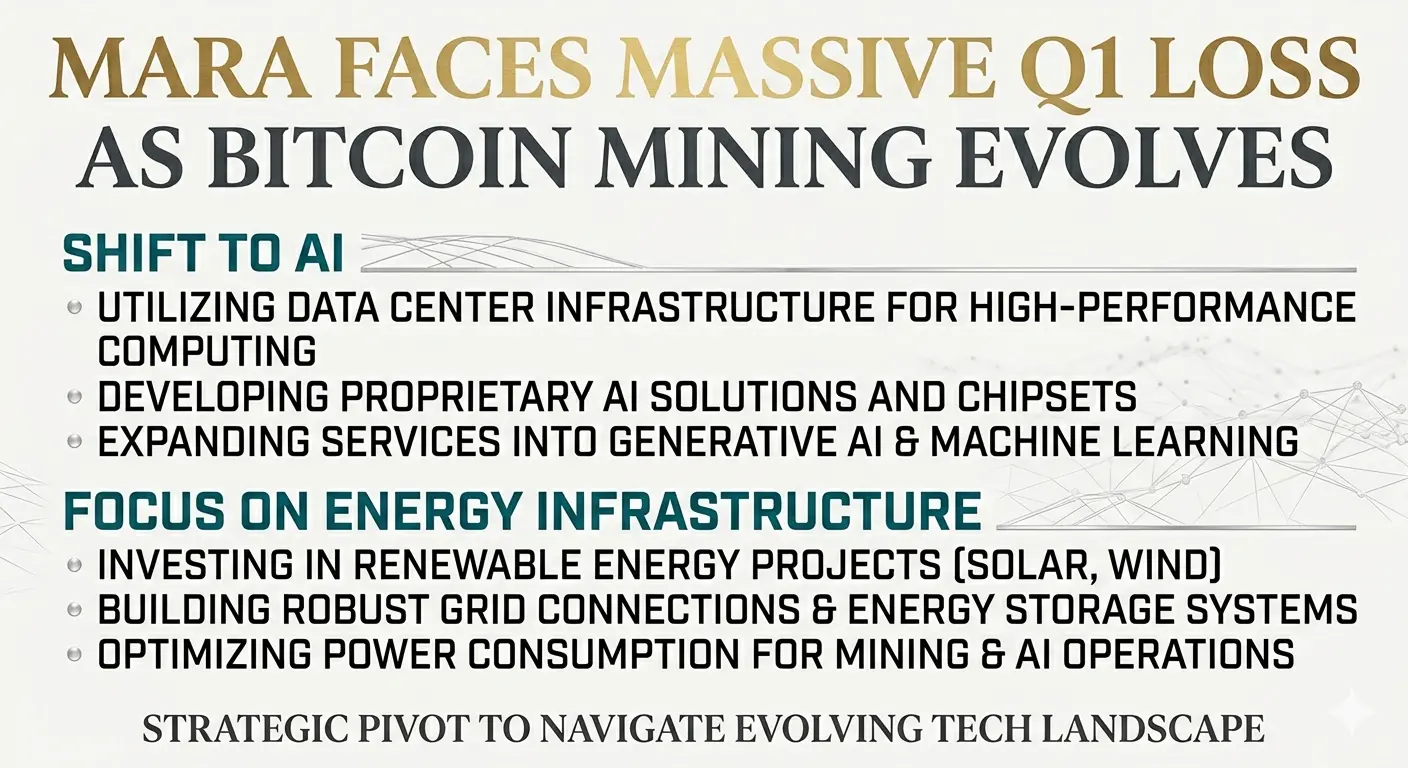
More importantly, MARA’s quarterly report revealed a major strategic transformation that may define the future of the Bitcoin mining industry itself. The company is increasingly repositioning away from being solely a crypto miner and toward becoming a broader energy and digital infrastructure operator. Management emphasized a long-term “energy monetization” strategy, signaling that access to power generation and compute infrastructure may become more valuable than mining alone.
A critical component of this transition is MARA’s growing control over energy assets, including power generation infrastructure. By owning or directly managing electricity production, the company aims to stabilize operational costs while gaining flexibility in how energy resources are deployed. Instead of treating electricity simply as an expense, MARA is attempting to transform energy into a core monetizable asset capable of supporting multiple business models simultaneously.
The company is also accelerating its expansion into AI-focused data center infrastructure, aligning itself with the explosive global demand for high-performance computing capacity. Artificial intelligence systems require enormous amounts of electricity, advanced cooling systems, and scalable data center operations—areas where Bitcoin miners already possess significant expertise and infrastructure overlap. This creates a natural bridge between crypto mining facilities and AI compute centers, allowing companies like MARA to potentially shift resources between industries depending on profitability conditions.
This evolution represents a much larger structural change occurring across the mining sector. Bitcoin mining is no longer functioning as an isolated crypto-native business. Instead, it is increasingly merging with the broader global competition for energy access, compute power, and digital infrastructure dominance. Mining companies are now positioning themselves as participants in the future of industrial-scale computing, where AI processing, cloud infrastructure, and blockchain validation may coexist within the same operational ecosystem.
The transition is also being driven by necessity. As Bitcoin block rewards continue declining over time and mining difficulty rises, companies that depend exclusively on mining revenue face growing long-term sustainability risks. Diversifying into AI computing, energy markets, and data center services provides an opportunity to stabilize cash flow during periods when Bitcoin mining profitability weakens. For many firms, this is becoming less of an expansion strategy and more of a survival mechanism.
MARA’s latest financial results ultimately illustrate both the fragility and adaptability of the modern mining industry. The sector is entering a new era where success will depend not only on hash rate and Bitcoin reserves, but also on energy ownership, infrastructure efficiency, and the ability to participate in the rapidly expanding global AI economy. Companies capable of integrating mining, power management, and high-performance computing may emerge as the dominant players in the next phase of digital infrastructure development.
The broader implication is clear: Bitcoin mining companies are evolving into hybrid energy and technology enterprises. This transformation could fundamentally reshape how investors value the sector, shifting focus away from pure Bitcoin exposure and toward diversified infrastructure capabilities. The miners that successfully execute this transition may become some of the most strategically important infrastructure operators in the digital economy of the future.
#GateSquareMayTradingShare
𝐌𝐀𝐑𝐀 𝐅𝐀𝐂𝐄𝐒 𝐌𝐀𝐒𝐒𝐈𝐕𝐄 𝐐𝟏 𝐋𝐎𝐒𝐒 𝐀𝐒 𝐁𝐈𝐓𝐂𝐎𝐈𝐍 𝐌𝐈𝐍𝐈𝐍𝐆 𝐄𝐕𝐎𝐋𝐕𝐄𝐒 𝐈𝐍𝐓𝐎 𝐀𝐈 𝐀𝐍𝐃 𝐄𝐍𝐄𝐑𝐆𝐘 𝐈𝐍𝐅𝐑𝐀𝐒𝐓𝐑𝐔𝐂𝐓𝐔𝐑𝐄
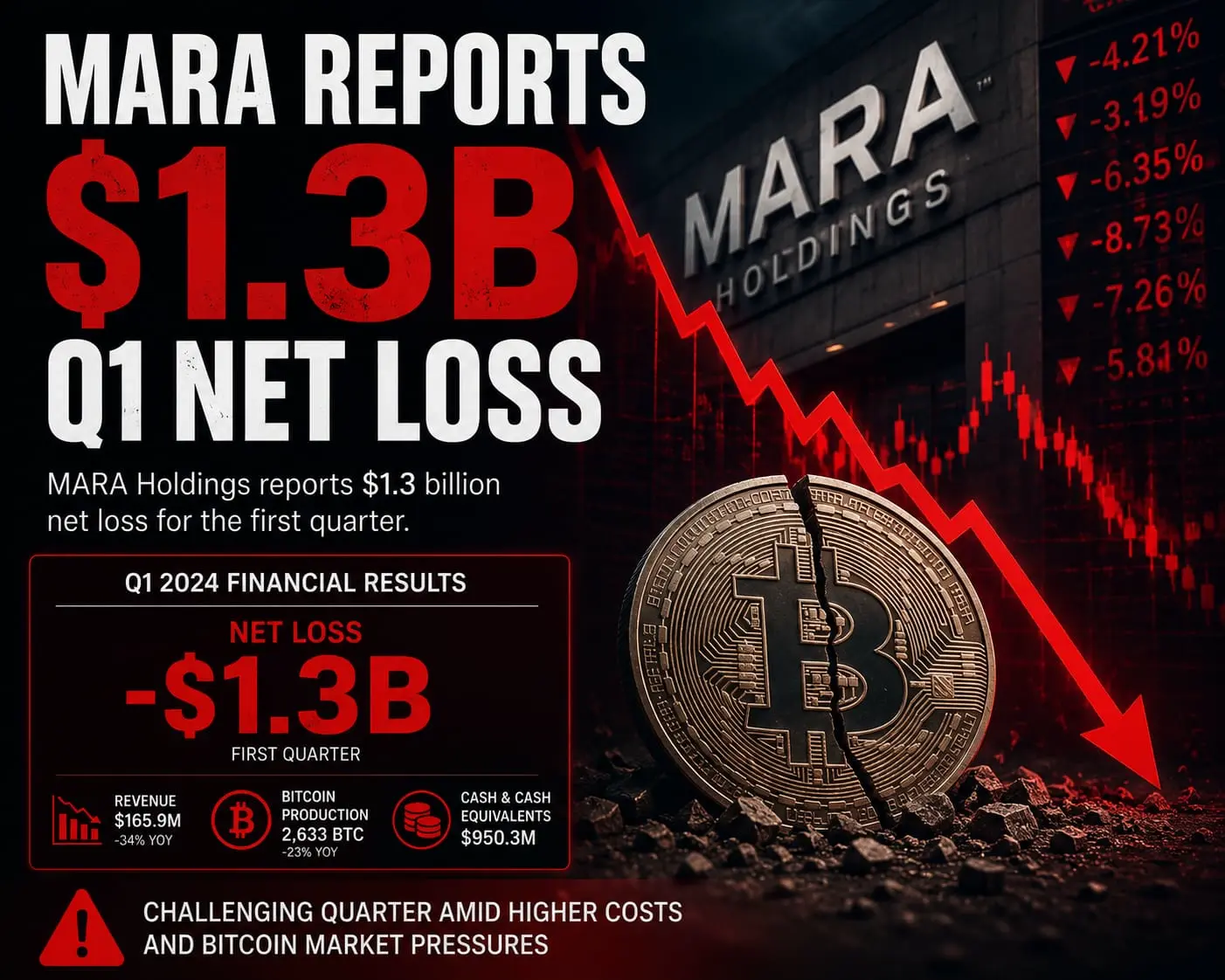
MARA Holdings posted one of the most financially turbulent quarters in recent Bitcoin mining history, revealing how deeply the sector is being reshaped by Bitcoin volatility, rising operational costs, and the growing convergence between digital mining infrastructure and artificial intelligence computing. While the company generated 174.6 million dollars in quarterly revenue, it simultaneously reported a staggering net loss of 1.3 billion dollars, exposing the extreme pressure currently facing large-scale mining firms as they attempt to adapt to a rapidly evolving market environment.
The majority of the loss came from a massive fair-value adjustment tied to the company’s Bitcoin reserves. During the quarter, Bitcoin experienced a significant price decline, forcing MARA to record approximately 1 billion dollars in unrealized losses on its digital asset holdings. Because the company maintains one of the largest Bitcoin treasuries among public miners, fluctuations in BTC price directly impact reported earnings even when no coins are sold. This accounting reality has become one of the defining financial risks for publicly traded mining companies, where balance sheet exposure can often outweigh operational mining performance.
Operational metrics also reflected mounting industry-wide challenges. MARA mined 2,247 Bitcoin during the quarter, but production costs climbed to roughly 76,000 dollars per BTC, highlighting how difficult it has become to maintain profitability after the most recent Bitcoin halving cycle. Higher global hash rate competition, increasing mining difficulty, energy inflation, and continuous hardware upgrade requirements are squeezing margins across the sector. As mining economics tighten, even large operators are being forced to rethink traditional business models centered purely on Bitcoin accumulation.
At the same time, the company actively adjusted its treasury strategy by selling over 20,000 BTC during the quarter. The move signals that liquidity preservation and operational funding are becoming increasingly important priorities for mining firms operating in volatile conditions. Instead of relying solely on long-term Bitcoin appreciation, miners are now balancing reserve management with immediate capital needs, infrastructure expansion, and debt servicing obligations. This shift reflects a broader trend across the industry where treasury holdings are transitioning from passive reserves into actively managed financial instruments.
Despite heavy losses, MARA still controls a substantial Bitcoin treasury worth billions of dollars at current market prices. This reserve continues to provide long-term upside exposure if Bitcoin enters another major bull cycle, but it also creates ongoing earnings instability during market corrections. The company’s financial structure demonstrates how miners effectively operate as leveraged Bitcoin proxies, where even moderate price swings can dramatically affect profitability and shareholder sentiment.
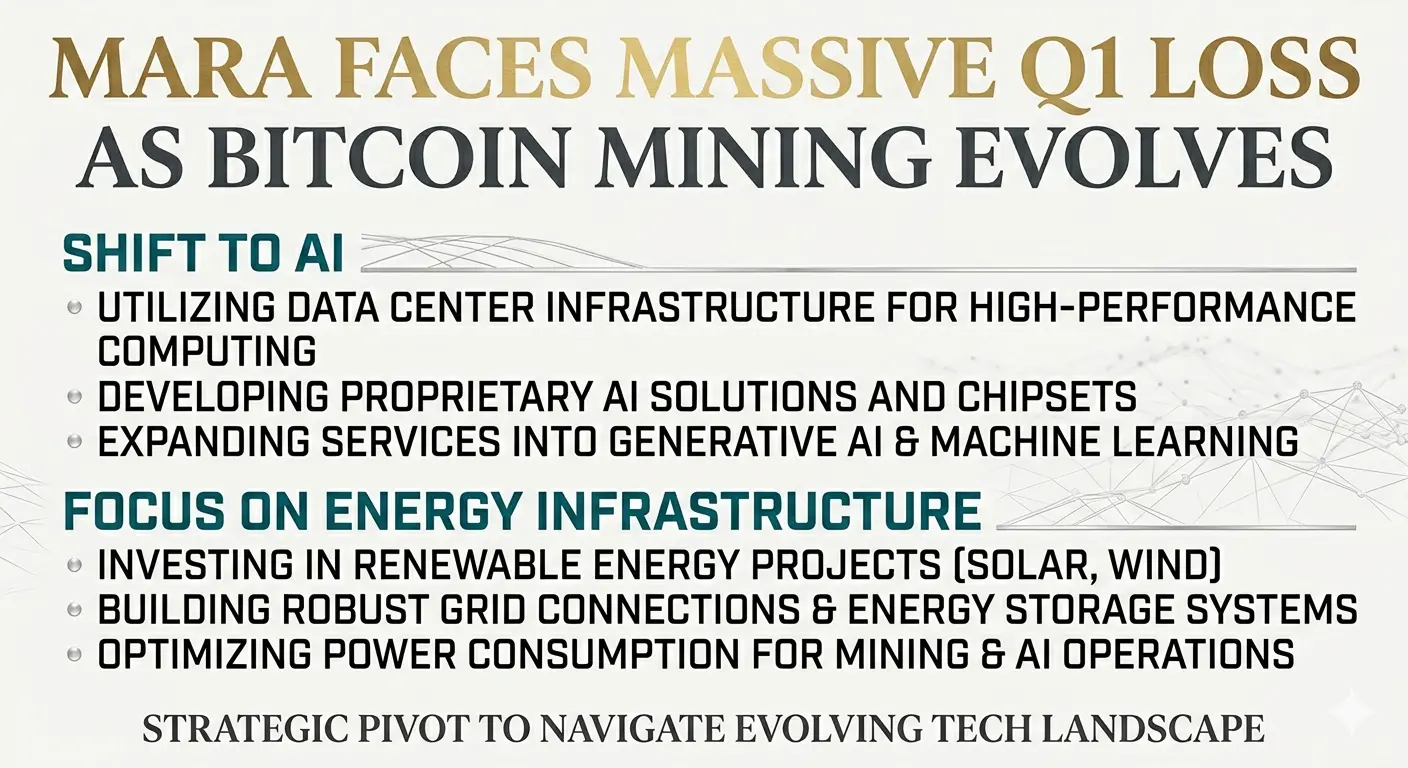
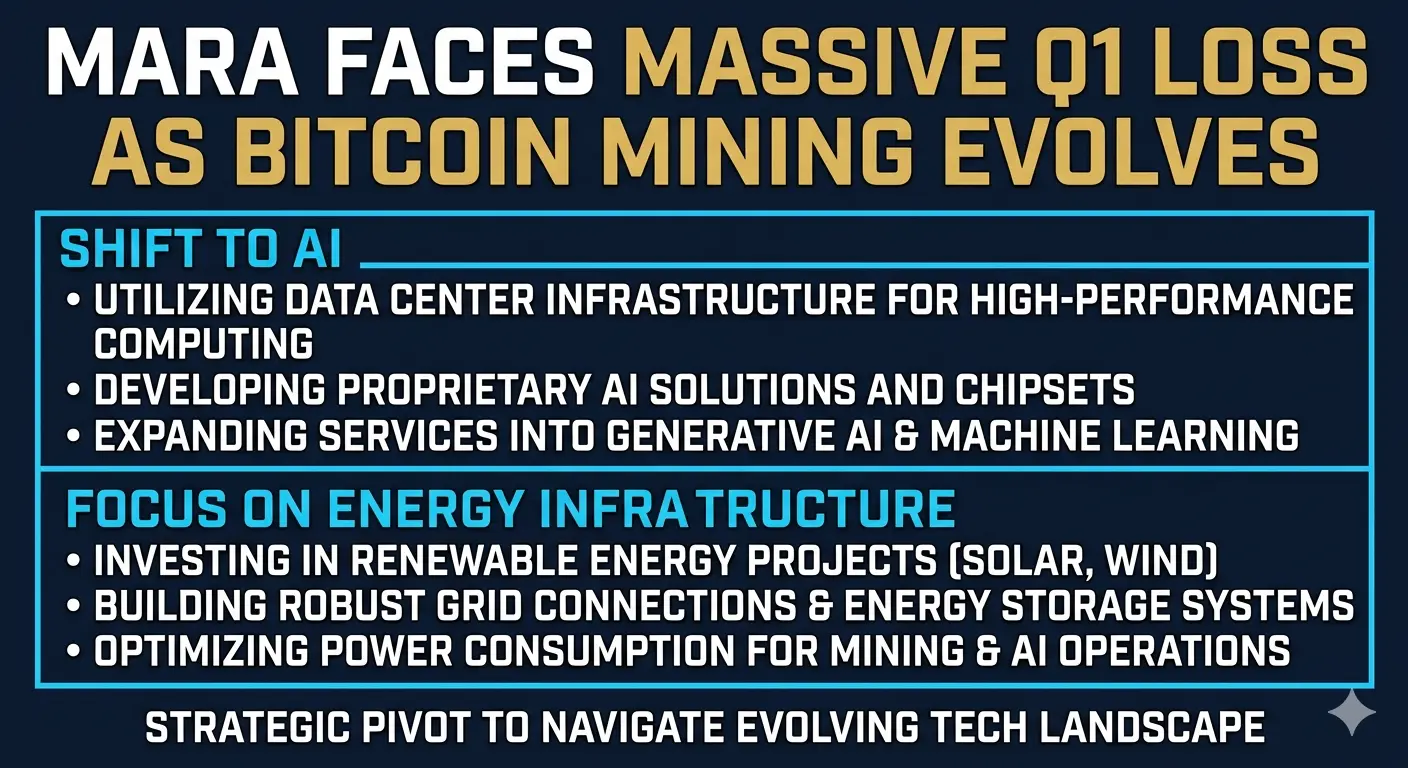
More importantly, MARA’s quarterly report revealed a major strategic transformation that may define the future of the Bitcoin mining industry itself. The company is increasingly repositioning away from being solely a crypto miner and toward becoming a broader energy and digital infrastructure operator. Management emphasized a long-term “energy monetization” strategy, signaling that access to power generation and compute infrastructure may become more valuable than mining alone.
A critical component of this transition is MARA’s growing control over energy assets, including power generation infrastructure. By owning or directly managing electricity production, the company aims to stabilize operational costs while gaining flexibility in how energy resources are deployed. Instead of treating electricity simply as an expense, MARA is attempting to transform energy into a core monetizable asset capable of supporting multiple business models simultaneously.
The company is also accelerating its expansion into AI-focused data center infrastructure, aligning itself with the explosive global demand for high-performance computing capacity. Artificial intelligence systems require enormous amounts of electricity, advanced cooling systems, and scalable data center operations—areas where Bitcoin miners already possess significant expertise and infrastructure overlap. This creates a natural bridge between crypto mining facilities and AI compute centers, allowing companies like MARA to potentially shift resources between industries depending on profitability conditions.
This evolution represents a much larger structural change occurring across the mining sector. Bitcoin mining is no longer functioning as an isolated crypto-native business. Instead, it is increasingly merging with the broader global competition for energy access, compute power, and digital infrastructure dominance. Mining companies are now positioning themselves as participants in the future of industrial-scale computing, where AI processing, cloud infrastructure, and blockchain validation may coexist within the same operational ecosystem.
The transition is also being driven by necessity. As Bitcoin block rewards continue declining over time and mining difficulty rises, companies that depend exclusively on mining revenue face growing long-term sustainability risks. Diversifying into AI computing, energy markets, and data center services provides an opportunity to stabilize cash flow during periods when Bitcoin mining profitability weakens. For many firms, this is becoming less of an expansion strategy and more of a survival mechanism.
MARA’s latest financial results ultimately illustrate both the fragility and adaptability of the modern mining industry. The sector is entering a new era where success will depend not only on hash rate and Bitcoin reserves, but also on energy ownership, infrastructure efficiency, and the ability to participate in the rapidly expanding global AI economy. Companies capable of integrating mining, power management, and high-performance computing may emerge as the dominant players in the next phase of digital infrastructure development.
The broader implication is clear: Bitcoin mining companies are evolving into hybrid energy and technology enterprises. This transformation could fundamentally reshape how investors value the sector, shifting focus away from pure Bitcoin exposure and toward diversified infrastructure capabilities. The miners that successfully execute this transition may become some of the most strategically important infrastructure operators in the digital economy of the future.
#GateSquareMayTradingShare