LiuYang

vip
Age 0.5 Year
Peak Tier 0
No content yet
#PredictWorldCupWin40000U 🇳🇱 Netherlands vs Tunisia 🔥 | World Cup Group F Prediction
The Netherlands are marching into this crucial Group F clash as overwhelming favorites! After collecting 4 points from two matches — a thrilling 2-2 draw against Japan followed by a dominant 5-1 demolition of Sweden — the Dutch side is firing on all cylinders.
Tunisia, unfortunately, have been in freefall. They suffered a humiliating 5-1 loss to Sweden and a shocking 4-0 defeat against Japan, conceding a staggering 9 goals in just two games while scoring only 1. Their defense has completely collapsed, and w
CryptoDiscovery
#PredictWorldCupWin40000U 🇳🇱 Netherlands vs Tunisia 🔥 | World Cup Group F Prediction
The Netherlands are marching into this crucial Group F clash as overwhelming favorites! After collecting 4 points from two matches — a thrilling 2-2 draw against Japan followed by a dominant 5-1 demolition of Sweden — the Dutch side is firing on all cylinders.
Tunisia, unfortunately, have been in freefall. They suffered a humiliating 5-1 loss to Sweden and a shocking 4-0 defeat against Japan, conceding a staggering 9 goals in just two games while scoring only 1. Their defense has completely collapsed, and with elimination already confirmed, they are playing only for pride.
My Strong Prediction:
Netherlands Win Probability: 75%
Draw Probability: 17%
Tunisia Win Probability: 8%
Predicted Score: Netherlands 3-0 Tunisia
Alternative Scores: 2-0, 4-1 (or 1-1 if heavy rotation happens)
Why Netherlands Dominate This Match:
Explosive attack led by Cody Gakpo and other stars — 7 goals scored in two matches.
Perfect balance between attack and defense.
Unbeaten in the group stage with massive motivation to finish 1st in Group F for a better knockout path.
Superior squad quality, transition play, possession, and finishing.
Tunisia’s defensive organization is in ruins compared to their qualification campaign. Coach Herve Renard wants dignity in their final game, but facing a confident, high-momentum Dutch team makes it an uphill battle.
Expected Scenario: Netherlands will control possession from minute one, create wave after wave of attacks, and likely score early. Tunisia may park the bus and look for counters, but their leaky defense will struggle badly against Oranje quality.
The Dutch have shown they can punish any mistake ruthlessly. This should be a comfortable victory that seals top spot in the group.
Final Verdict: Netherlands are the clear strongest pick. Back them confidently for a solid win! Tunisia can fight with pride, but quality, form, and motivation all point towards a convincing Oranje victory.
#SquarePrediction #世界杯 #Win40000U
repost-content-media
  • Reward
  • Comment
  • Repost
  • Share
#MGXRaises50BForAIIinfrastructure
MGX Raises Nearly $50 Billion: Why This Could Become One of the Most Important AI Investment Stories of the Decade
The artificial intelligence industry is moving at a pace that few people imagined possible just a few years ago. Every month brings new breakthroughs, new partnerships, and new investments that reshape how technology companies compete. While many investors focus only on AI products, chatbots, and software applications, there is another side of the AI revolution that is becoming equally important: infrastructure. Without powerful infrastructure, e
MrFlower_XingChen
#MGXRaises50BForAIIinfrastructure
MGX Raises Nearly $50 Billion: Why This Could Become One of the Most Important AI Investment Stories of the Decade
The artificial intelligence industry is moving at a pace that few people imagined possible just a few years ago. Every month brings new breakthroughs, new partnerships, and new investments that reshape how technology companies compete. While many investors focus only on AI products, chatbots, and software applications, there is another side of the AI revolution that is becoming equally important: infrastructure. Without powerful infrastructure, even the most advanced AI models cannot operate efficiently. This is why the recent announcement that MGX has raised nearly $50 billion for AI infrastructure and technology investments deserves serious attention from investors, technology enthusiasts, and anyone following the future of artificial intelligence.
MGX, an Abu Dhabi-based AI investment firm backed by Mubadala and G42, has quickly emerged as one of the most influential players in the global AI ecosystem. Raising close to $50 billion places MGX among the largest AI-focused investment organizations in the world. This is not just another venture capital fund looking for startup opportunities. Instead, it represents a strategic effort to build and support the entire foundation that future AI innovation will rely upon. When capital of this scale enters a rapidly growing industry, it often creates opportunities that extend far beyond the companies receiving direct investment.
One reason this development stands out is the sheer size of the capital involved. Many technology investment funds manage billions of dollars, but reaching nearly $50 billion places MGX in a different category. Funds of this size have the ability to influence entire industries, support large-scale infrastructure projects, and participate in multiple strategic investments simultaneously. In the AI sector, where demand for computing power, data centers, advanced chips, and cloud infrastructure continues to rise, access to massive capital can become a competitive advantage in itself.
When I look at the broader AI market, one trend becomes increasingly clear. The industry is moving beyond experimentation and entering a phase of industrial-scale deployment. During the early years of AI development, the focus was primarily on research and proof of concept. Today, organizations around the world are integrating AI into business operations, customer service, healthcare systems, financial services, manufacturing, logistics, education, and many other sectors. As adoption increases, the infrastructure required to support these applications grows exponentially. Data centers, specialized processors, energy systems, networking equipment, and cloud services all become essential components of the AI economy.
MGX appears to recognize this shift. Rather than concentrating solely on consumer-facing AI products, the firm is targeting the underlying infrastructure that powers the entire ecosystem. This approach is particularly interesting because infrastructure investments often create long-term value. While individual applications may rise and fall in popularity, the infrastructure supporting them remains necessary regardless of which specific AI model or platform dominates the market. In many ways, investing in AI infrastructure resembles investing in roads, ports, and utilities during periods of industrial expansion. The companies providing essential infrastructure frequently become some of the most valuable participants in the broader economic transformation.
Another factor that makes MGX noteworthy is the quality of its strategic relationships. The firm has already invested in OpenAI, xAI, and Anthropic. These organizations are widely recognized as leading innovators in advanced AI systems. Having exposure to multiple major AI players provides MGX with a unique position within the industry. Rather than betting exclusively on one company or one technology path, the firm appears to be building a diversified portfolio across several influential AI ecosystems.
This diversified strategy may prove particularly valuable because the future of AI remains highly competitive. No one can predict with certainty which company will dominate the next decade. OpenAI, Anthropic, xAI, and other emerging competitors are all pursuing different approaches to model development, safety, scalability, and deployment. By maintaining relationships across multiple leading organizations, MGX gains insight into various parts of the AI landscape while reducing dependence on the success of any single company.
The partnership involving BlackRock and Microsoft further highlights the scale of MGX's ambitions. Both organizations bring significant expertise and resources to infrastructure development. Microsoft has become one of the most important technology companies in the AI era through its cloud business and strategic AI investments. BlackRock, meanwhile, possesses extensive experience managing large-scale investment initiatives across global markets. When companies and institutions of this caliber collaborate on infrastructure projects, it signals a long-term commitment rather than a short-term market trend.
One aspect of AI infrastructure that deserves more attention from investors is data center development. Every major AI model requires enormous computing resources for training and deployment. As AI applications become more sophisticated, demand for processing power continues to increase. This creates opportunities not only for software developers but also for companies involved in data center construction, semiconductor manufacturing, energy generation, cooling systems, networking equipment, and cloud services. In other words, the AI boom extends far beyond the companies creating chatbots and language models.
From an investment perspective, this broader ecosystem is often where some of the most durable opportunities emerge. Many retail investors focus on headline names because they are visible and easy to understand. However, experienced investors frequently look deeper into supply chains and infrastructure providers. During previous technological revolutions, the companies supplying essential tools and infrastructure often achieved remarkable growth. The AI era may follow a similar pattern.
Another interesting observation is the growing role of the Middle East in advanced technology investment. Historically, discussions about cutting-edge technology have focused primarily on Silicon Valley, Europe, and parts of East Asia. Today, countries in the Gulf region are increasingly positioning themselves as important participants in the global technology economy. Through strategic investments, partnerships, and infrastructure development, organizations such as MGX are helping to establish the region as a meaningful contributor to AI innovation.
This geographic diversification may ultimately strengthen the resilience of the AI industry. As demand for AI services expands worldwide, infrastructure and investment activity are becoming more distributed across different regions. This reduces concentration risk and creates opportunities for international collaboration. It also encourages competition, which can accelerate innovation and improve access to technology.
For newcomers to investing, the MGX story provides several valuable lessons. First, major technological revolutions are rarely driven by a single company. Instead, they involve entire ecosystems consisting of developers, infrastructure providers, investors, hardware manufacturers, cloud operators, and service providers. Understanding these interconnected relationships can help investors identify opportunities that may not receive as much media attention.
Second, infrastructure matters. While exciting consumer applications often attract headlines, infrastructure forms the foundation upon which long-term growth depends. Companies that build essential infrastructure can benefit regardless of which specific products ultimately dominate the market.
Third, patience remains important. Large-scale infrastructure projects typically require years to develop and mature. Investors focusing on long-term structural trends rather than short-term market fluctuations may be better positioned to benefit from transformational technologies such as artificial intelligence.
Looking ahead, the next phase of AI growth will likely depend on solving several key challenges. Computing capacity must continue expanding. Energy requirements must be managed efficiently. Data center networks must scale to support increasing workloads. Advanced chips must be produced in sufficient quantities to meet demand. Capital on the scale that MGX has raised can play an important role in addressing these challenges.
The significance of this fundraising effort extends beyond the numbers themselves. It reflects growing confidence that artificial intelligence will remain a central driver of economic and technological development for many years. Large institutional investors typically conduct extensive research before committing substantial capital. Their willingness to support AI infrastructure at this scale suggests strong conviction regarding the long-term potential of the sector.
As someone who follows technology and investment trends closely, I view this development as another indication that the AI industry is entering a new stage of maturity. The conversation is gradually shifting from whether AI will transform industries to how quickly that transformation will occur and what infrastructure will be required to support it. Organizations capable of building and financing that infrastructure may become some of the most influential players in the next decade.
The rise of MGX demonstrates that the AI race is no longer limited to technology companies alone. Investment firms, sovereign wealth funds, infrastructure providers, and global institutions are becoming increasingly involved. This broader participation expands the resources available to the industry and accelerates the development of critical capabilities.
Ultimately, the nearly $50 billion raised by MGX represents more than a fundraising milestone. It symbolizes confidence in the future of artificial intelligence, confidence in the importance of infrastructure, and confidence that the next wave of technological progress will require unprecedented levels of investment. Whether viewed from the perspective of technology, finance, or long-term innovation, this is a story worth following closely because the decisions being made today could shape the global AI landscape for years to come.
#MyGateTradeStory #MyGateTradingMoment #PredictWorldCupWin40000U @Gate_Square @GateSquare
repost-content-media
  • Reward
  • Comment
  • Repost
  • Share
Gate Stocks and the Evolution of Global Investing: One Platform, Three Major Markets, Unlimited Opportunities
MrFlower_XingChen
Gate Stocks and the Evolution of Global Investing: One Platform, Three Major Markets, Unlimited Opportunities
#GateStocks7x24Trading
Global investing is evolving rapidly. Gate Stocks connects U.S., Hong Kong, and Korean markets in one platform, offering access to 12,500+ stocks and ETFs, 24/7 trading, fractional investing, and crypto-stock integration. This article explores how Gate Stocks is shaping the future of borderless investing.
repost-content-media
  • Reward
  • Comment
  • Repost
  • Share
#HoldUSD1EarnYield
#MyGateTradeStory
The Gate USD1 Hold and Earn Yield program represents a growing trend in the cryptocurrency industry where exchanges are no longer limited to trading infrastructure alone, but are increasingly evolving into full-scale financial ecosystems. In this new phase of digital finance, users are not only looking for access to markets, but also for stable income opportunities, capital preservation tools, and simplified wealth-building strategies that do not require constant trading activity or advanced technical knowledge.
At its foundation, the USD1 Hold and Earn Y
MrFlower_XingChen
#HoldUSD1EarnYield
#MyGateTradeStory
The Gate USD1 Hold and Earn Yield program represents a growing trend in the cryptocurrency industry where exchanges are no longer limited to trading infrastructure alone, but are increasingly evolving into full-scale financial ecosystems. In this new phase of digital finance, users are not only looking for access to markets, but also for stable income opportunities, capital preservation tools, and simplified wealth-building strategies that do not require constant trading activity or advanced technical knowledge.
At its foundation, the USD1 Hold and Earn Yield program is built around a simple concept: users hold USD1 stablecoins in their Gate account and earn a predefined annualized yield of up to 15 percent. USD1 is a stablecoin designed to maintain a 1:1 peg with the United States dollar, meaning its primary objective is stability rather than price appreciation. Unlike volatile cryptocurrencies such as Bitcoin or Ethereum, stablecoins are designed to reduce exposure to market fluctuations, making them suitable for users who prefer predictable value storage.
This combination of stability and yield generation creates an interesting financial structure. Traditionally, stable assets such as bank deposits or government bonds provide relatively low returns in exchange for safety. In contrast, crypto-based yield programs attempt to enhance returns while maintaining similar stability characteristics. This is why stablecoin earning programs have become increasingly popular among both retail and institutional participants seeking alternatives to traditional savings products.
The mechanics of the USD1 Earn program are intentionally designed to be simple. Users do not need to actively trade, manage positions, or monitor market charts. Once USD1 is deposited or purchased and held within an eligible Gate account, yield generation begins automatically. Earnings are typically distributed on a regular basis, allowing users to observe continuous growth in their holdings over time. This automation is one of the key reasons such programs appeal to beginners, passive investors, and long-term holders who prefer low-effort financial strategies.
One of the most important aspects of any yield-generating system is compounding. While annual yield rates are often discussed in simple percentage terms, the real impact becomes more visible when returns are reinvested over time. For example, a stable principal earning a consistent yield can gradually increase in size not only through interest payments but also through the reinvestment of those earnings. Over longer time horizons, compounding can significantly enhance total returns, assuming rates remain stable and conditions unchanged.
To better understand the appeal of such a system, it is important to compare it with traditional financial instruments. In conventional banking systems, savings accounts often offer low interest rates due to regulatory structures, monetary policy environments, and risk limitations. Even high-yield savings accounts in many developed economies rarely exceed a few percentage points annually. By contrast, crypto-based yield programs often advertise significantly higher returns, reflecting both the competitive nature of digital asset platforms and the evolving structure of decentralized and centralized financial systems.
However, higher yields also require careful consideration of underlying risks. In stablecoin-based programs, the primary risk is not price volatility of the asset itself, since stablecoins are designed to maintain a fixed value. Instead, risks may be associated with platform operations, reserve management, regulatory changes, and broader market conditions affecting liquidity. This is why experienced investors often evaluate not only the yield percentage but also the credibility, transparency, and security infrastructure of the platform offering the program.
Gate positions itself as a global cryptocurrency exchange with a broad ecosystem that extends beyond simple trading services. Its infrastructure includes spot trading, futures markets, investment products, and various earning mechanisms designed to serve different types of users. The USD1 Hold and Earn Yield program fits into this broader strategy by offering a passive income product that complements active trading tools.
From a user experience perspective, simplicity is a major advantage. Many individuals entering the cryptocurrency market are overwhelmed by the complexity of trading strategies, market timing, and technical analysis. A structured yield program removes these barriers by offering a straightforward alternative: hold a stable asset and earn predictable returns. This allows users to participate in the crypto ecosystem without needing deep technical expertise or constant market engagement.
Another important feature of such programs is liquidity flexibility. Unlike traditional fixed-term financial products that require locking funds for specific durations, many crypto yield products are designed with flexible withdrawal options. This means users can access their capital when needed, while still benefiting from ongoing yield generation during the holding period. This balance between liquidity and income generation is one of the key innovations in modern digital finance.
The broader significance of stablecoin yield programs extends beyond individual investors. They represent a shift in how capital is stored and utilized within the digital economy. Stablecoins are increasingly being used as settlement layers for transactions, as hedging instruments during volatile periods, and as base assets for earning strategies. This multi-functional role reflects their growing importance in the overall crypto financial system.
Institutional interest in stable yield products has also increased in recent years. Larger investors often require predictable income streams and low-volatility exposure for cash management purposes. Stablecoin-based earning programs can serve as an alternative to traditional money market instruments, especially in environments where digital asset adoption is expanding. This institutional participation further contributes to liquidity and stability within the ecosystem.
It is also important to consider the psychological aspect of yield-generating products. In financial markets, consistent returns often create a sense of stability and confidence among investors. Unlike speculative trading, where outcomes are uncertain and highly variable, yield programs offer a more structured and predictable experience. This can be particularly appealing during periods of market uncertainty when investors prefer capital preservation over aggressive growth strategies.
At the same time, it is essential to maintain a realistic perspective on risk and return. No financial product is completely risk-free, and yield rates are not guaranteed indefinitely. Market conditions, platform policies, and broader economic factors can influence the sustainability of returns over time. Responsible participation requires understanding these dynamics and aligning investment decisions with individual risk tolerance and financial goals.
From a technological standpoint, stablecoin yield systems rely on robust blockchain infrastructure and secure asset management frameworks. Transparency in reserve management, auditing processes, and operational security are key components that influence user trust. As the crypto industry matures, regulatory oversight and compliance frameworks are also expected to play a larger role in shaping how such products operate.
Looking at the broader evolution of cryptocurrency exchanges, there is a clear trend toward financial product diversification. Early exchanges primarily functioned as trading platforms. Today, they increasingly resemble full-service financial ecosystems offering lending, staking, savings, and structured yield products. This transformation reflects growing user demand for integrated financial solutions within a single platform environment.
The USD1 Hold and Earn Yield program can be viewed as part of this transition. It bridges the gap between traditional savings mechanisms and modern digital asset infrastructure, offering users a familiar financial concept—earning interest on deposits—within a blockchain-based system. This hybrid structure is one of the key reasons stablecoin yield products have gained widespread attention.
In terms of user strategy, such programs are often used as part of broader portfolio management approaches. Investors may allocate a portion of their holdings to stable yield products while maintaining exposure to higher-risk assets such as cryptocurrencies or emerging blockchain projects. This allows for a balance between stability and growth potential, depending on individual investment preferences.
Education also plays an important role in adoption. Many users entering the crypto space for the first time may not fully understand the differences between trading, staking, lending, and yield programs. Clear communication and educational resources help users make informed decisions and better understand how their capital is being utilized within the platform.
In conclusion, the USD1 Hold and Earn Yield program represents a significant development in the evolution of digital finance. It combines the stability of a dollar-pegged asset with the earning potential of modern crypto infrastructure, creating a product that appeals to a wide range of users from beginners to experienced investors. While offering attractive yield opportunities, it also highlights the importance of understanding risk, platform structure, and long-term sustainability.
As the cryptocurrency industry continues to mature, products like USD1 Earn are likely to play an increasingly important role in shaping how users interact with digital assets. They reflect a broader shift toward financial systems that prioritize accessibility, flexibility, and integrated earning opportunities. Ultimately, the success of such programs depends not only on yield rates but also on trust, transparency, and the continued evolution of the underlying digital financial ecosystem.
#PredictWorldCupWin40000U #PredictWorldCupShare20000U Gate_Square @GateSquare
repost-content-media
  • Reward
  • Comment
  • Repost
  • Share
#TradFiCFDGoldMasters
Financial markets rarely move in a straight line, and even more rarely do they turn when the crowd expects them to. In fact, some of the most important transitions in market cycles tend to occur precisely when sentiment feels most one-sided, uncertain, or exhausted. This disconnect between perception and underlying positioning is what often creates the early foundation for the next major move. In the current environment, Bitcoin and broader digital assets appear to be operating within this kind of transitional phase.
Over the past several months, market conditions have r
BTC-2.87%
MrFlower_XingChen
#TradFiCFDGoldMasters
Financial markets rarely move in a straight line, and even more rarely do they turn when the crowd expects them to. In fact, some of the most important transitions in market cycles tend to occur precisely when sentiment feels most one-sided, uncertain, or exhausted. This disconnect between perception and underlying positioning is what often creates the early foundation for the next major move. In the current environment, Bitcoin and broader digital assets appear to be operating within this kind of transitional phase.
Over the past several months, market conditions have reflected a clear shift toward caution. Persistent inflation concerns, elevated interest rates across major economies, and tighter global liquidity conditions have collectively reduced risk appetite among both retail and institutional participants. As borrowing costs rise, speculative capital tends to contract, and assets that depend on liquidity expansion often experience slower momentum. Bitcoin, despite its growing institutional presence, has not been immune to this macroeconomic pressure.
At the same time, geopolitical uncertainty and uneven global growth have contributed to a more defensive positioning across financial markets. Investors are increasingly selective, prioritizing capital preservation over aggressive risk-taking. This environment naturally creates headwinds for high-volatility assets, where price movement is heavily influenced by changes in sentiment and liquidity conditions.
However, beneath the surface of price action, market structure often tells a more nuanced story. While Bitcoin has been trading within a broader consolidation range, downside momentum has gradually slowed compared to earlier phases of correction. This type of behavior is important because market reversals rarely occur through sudden V-shaped movements. Instead, they typically develop through a process of declining volatility, reduced selling pressure, and gradual accumulation by longer-term participants who are less reactive to short-term price fluctuations.
One of the key elements being observed in this phase is the behavior of long-term holders. On-chain patterns suggest that a significant portion of experienced market participants continue to maintain their positions rather than exiting during periods of weakness. Historically, this type of behavior often signals that conviction remains intact beneath surface-level volatility. At the same time, exchange balances have not shown the kind of sharp inflows typically associated with panic-driven selling cycles, suggesting that large-scale capitulation may be less pronounced than in previous downturns.
Macroeconomic conditions continue to play a central role in shaping sentiment. Central banks remain focused on balancing inflation control with economic stability, maintaining a restrictive stance that limits excess liquidity in the financial system. Higher interest rates tend to reduce the attractiveness of non-yielding or speculative assets, which helps explain the cautious tone across risk markets. However, monetary policy operates in cycles, and markets consistently begin to reprice expectations well before policy direction actually changes.
Another important factor is investor positioning. Sentiment indicators across digital asset markets continue to reflect a generally cautious outlook, with many participants expecting either prolonged consolidation or further downside before a sustained recovery can take hold. From a contrarian perspective, this type of positioning often becomes most interesting when pessimism is widespread but selling pressure begins to weaken. When expectations are already heavily negative, even relatively small positive catalysts can have an outsized impact on price behavior and sentiment reversal.
Institutional participation remains one of the most structurally significant developments in this cycle. Traditional financial institutions are continuing to expand their presence in digital assets through regulated investment products, custody solutions, and blockchain infrastructure initiatives. This gradual integration into the traditional financial system suggests that digital assets are increasingly being viewed not as isolated speculative instruments, but as components of a broader financial architecture that is still evolving.
Parallel to this, the development of tokenized real-world assets, stablecoin settlement systems, and blockchain-based financial infrastructure continues to progress at a steady pace. While these developments do not always immediately influence price action, they contribute to long-term adoption trends that shape the underlying demand profile for digital assets. This creates a divergence that is often observed in emerging technologies: short-term price volatility driven by macro and sentiment cycles, alongside consistent long-term structural growth.
From a market psychology standpoint, periods like the current one are defined by uncertainty rather than clarity. Participants are often divided between expectations of further downside and anticipation of eventual recovery, resulting in range-bound conditions and inconsistent directional conviction. It is precisely within these environments that smart capital tends to position itself gradually rather than aggressively, accumulating exposure while broader sentiment remains hesitant.
Volatility is likely to remain a defining feature of the market in the near term. Economic data releases, central bank policy decisions, and geopolitical developments will continue to influence short-term price behavior. However, successful long-term positioning often depends less on reacting to each individual event and more on understanding the broader cycle in which these events are occurring.
The current phase may not yet represent a confirmed transition into a new bullish cycle, but it does reflect characteristics commonly associated with early-stage accumulation environments. Reduced downside momentum, steady institutional engagement, and persistent long-term holder conviction all contribute to a foundation that can support future market expansion if macro conditions begin to stabilize.
Ultimately, financial markets tend to reward patience during periods when certainty is low and punish emotional decision-making when volatility is high. The challenge for most participants is not identifying trends after they have fully formed, but recognizing the structural shifts that begin long before those trends become obvious to the broader market.
In that sense, the current environment is less about immediate direction and more about positioning for what comes next when sentiment eventually realigns with underlying market structure.
#MyGateTradeStory
#PredictWorldCupWin40000U #PredictWorldCupShare20000U Gate_Square @GateSquare.
repost-content-media
  • Reward
  • Comment
  • Repost
  • Share
#MyGateTradeStory
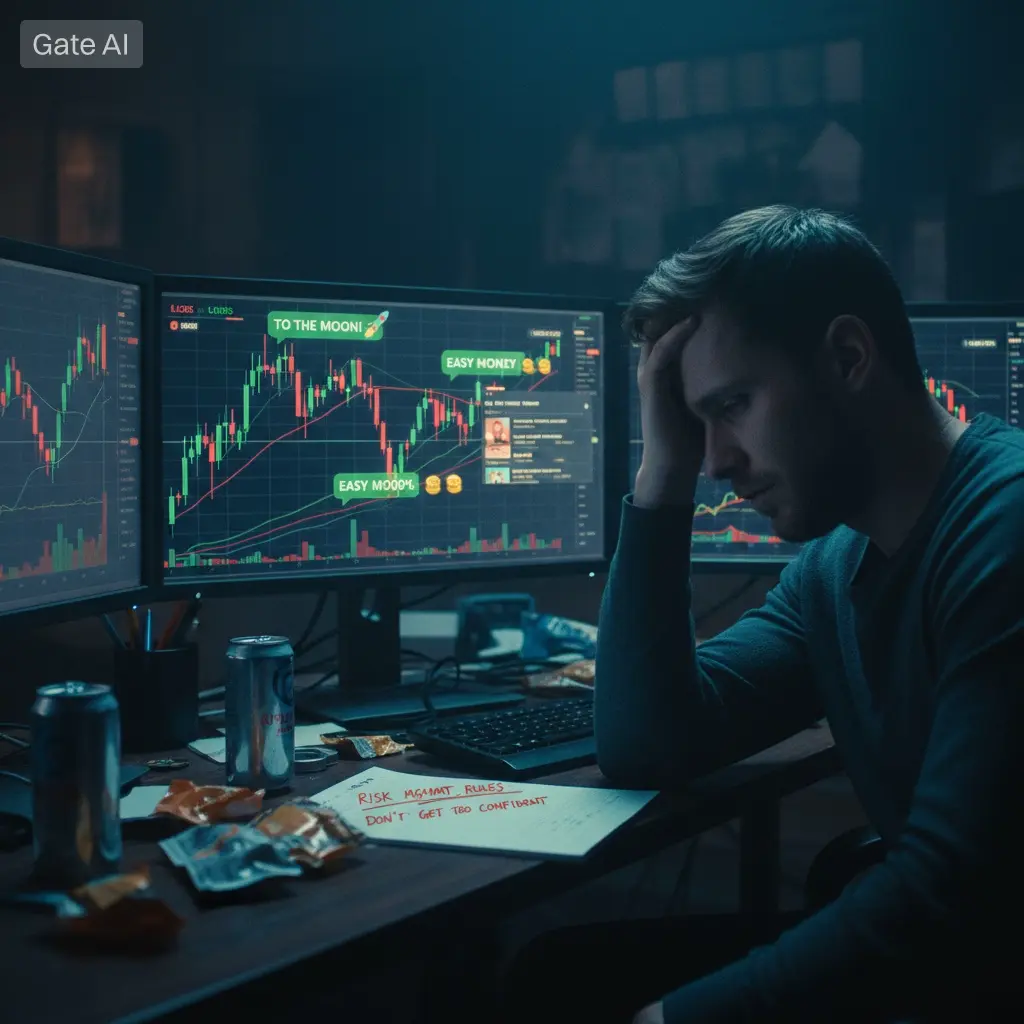
One of the biggest lessons I learned in crypto came from a trade that resulted in a painful loss. Looking back, the loss was not caused by bad luck, market manipulation, or unexpected news. It was caused by a single mistake that many beginners make: I ignored my risk management rules because I became too confident.
At the time, the market was extremely bullish. Every chart seemed to be moving higher, social media was filled with profit screenshots, and many traders were claiming that prices would continue rising indefinitely. After several successful trades, I started believ
MrFlower_XingChen
#MyGateTradeStory
One of the biggest lessons I learned in crypto came from a trade that resulted in a painful loss. Looking back, the loss was not caused by bad luck, market manipulation, or unexpected news. It was caused by a single mistake that many beginners make: I ignored my risk management rules because I became too confident.
At the time, the market was extremely bullish. Every chart seemed to be moving higher, social media was filled with profit screenshots, and many traders were claiming that prices would continue rising indefinitely. After several successful trades, I started believing that I had finally mastered the market. Instead of following my normal strategy, I began increasing position sizes and taking larger risks.
The opportunity looked perfect. The project had strong momentum, trading volume was increasing, and the community sentiment was overwhelmingly positive. I convinced myself that this trade was different from all the others. Rather than waiting for proper confirmation and setting a strict stop-loss, I entered aggressively because I was afraid of missing further gains.
Initially, everything seemed to go exactly as planned. The position moved into profit, and I watched my unrealized gains grow rapidly. Instead of taking partial profits or protecting my capital, greed started influencing my decisions. I kept telling myself that the market would continue moving higher and that selling early would be a mistake.
Then the market changed.
A sudden wave of selling pressure appeared. What looked like a small pullback quickly became a sharp correction. At first, I refused to accept that the trend was changing. I told myself it was only temporary. When the price fell further, I still did nothing. Because I had not placed a stop-loss, every percentage drop translated into a larger loss.
The most damaging part was not the market decline itself—it was my refusal to react. I kept hoping the price would recover instead of following a predefined trading plan. Hope replaced discipline, and emotion replaced strategy. The longer I waited, the larger the loss became.
Eventually, I was forced to close the position at a significant loss. Weeks of profits from previous trades disappeared because of one decision. The experience was frustrating, but it taught me a lesson that no trading book or tutorial could fully explain.
I realized that successful trading is not about finding the perfect coin, predicting every market move, or chasing the biggest gains. It is about protecting capital. A trader can be wrong many times and still survive if risk is controlled. But a single uncontrolled loss can erase months of hard work.
Since that experience, my entire approach to trading has changed. I never enter a position without knowing where I will exit if the trade fails. I use stop-loss orders consistently. I avoid risking large portions of my portfolio on a single idea. Most importantly, I no longer let confidence convince me that market rules do not apply to me.
For beginners entering crypto today, the lesson is simple: your first goal is not making money—it is preserving capital. Opportunities will always exist in the market, but lost capital is much harder to recover. Patience, discipline, and risk management may not seem exciting during bull markets, but they become invaluable when volatility returns.
My biggest loss ultimately became my most valuable trading lesson. The market charged an expensive tuition fee, but the knowledge gained from that experience has helped me become a more disciplined and realistic trader.
Sometimes the trade that hurts the most teaches the lesson that matters the most.
#PredictWorldCupWin40000U #PredictWorldCupShare20000U Gate_Square @GateSquare
repost-content-media
  • Reward
  • Comment
  • Repost
  • Share
#MyGateTradeStory
The cryptocurrency market is once again entering a period where patience may become more important than prediction. Over the past several weeks, Bitcoin has remained under pressure as investors navigate a difficult combination of macroeconomic uncertainty, slowing liquidity growth, and changing expectations regarding monetary policy. While many traders continue searching for the next major bullish catalyst, current market conditions suggest that Bitcoin may first need to complete a longer period of consolidation before a sustainable upward trend can emerge.
One of the bigges
BTC-2.87%
MrFlower_XingChen
#MyGateTradeStory
The cryptocurrency market is once again entering a period where patience may become more important than prediction. Over the past several weeks, Bitcoin has remained under pressure as investors navigate a difficult combination of macroeconomic uncertainty, slowing liquidity growth, and changing expectations regarding monetary policy. While many traders continue searching for the next major bullish catalyst, current market conditions suggest that Bitcoin may first need to complete a longer period of consolidation before a sustainable upward trend can emerge.
One of the biggest challenges facing the market today is the Federal Reserve's increasingly hawkish stance. Earlier in the year, many investors expected that monetary policy would gradually shift toward easing as inflation cooled. However, recent comments from Federal Reserve officials, including Chair Kevin Warsh, have reinforced the message that inflation remains a priority and that interest rates may stay elevated longer than markets previously anticipated. This change in expectations has reduced enthusiasm across risk assets and created additional uncertainty for investors seeking direction.
Historically, Bitcoin has performed best during periods when liquidity is expanding throughout the financial system. Lower interest rates encourage borrowing, increase capital flows, and often boost investor appetite for higher-risk assets. The current environment is the opposite. Financial conditions remain relatively tight, borrowing costs are elevated, and global investors are becoming more selective about where they allocate capital. As a result, Bitcoin's ability to generate strong momentum has been limited despite continued long-term adoption growth.
Another important factor is the visible slowdown in market liquidity. During the strongest phase of the previous bull market, daily spot trading volume regularly exceeded hundreds of billions of dollars. Today, trading activity has fallen significantly. Lower trading volume does not automatically mean prices must decline, but it does indicate that fewer participants are actively driving the market. Without strong new capital entering the ecosystem, large upward moves become increasingly difficult to sustain.
Stablecoin growth provides another valuable insight into current conditions. Throughout previous expansion phases, rapid growth in stablecoin supply often acted as a leading indicator of fresh capital entering the crypto ecosystem. Recently, however, the growth rate of major stablecoins has slowed considerably. This suggests that new liquidity entering the market is not expanding at the same pace seen during earlier bullish periods. Since stablecoins often serve as the primary bridge between traditional finance and digital assets, slower growth can limit buying pressure across the broader market.
Institutional participation remains one of the most closely watched factors. Although spot Bitcoin ETF outflows have slowed compared to earlier weeks, they have not yet transformed into a strong wave of net inflows. This distinction is important. A reduction in selling pressure is certainly positive, but a sustainable bull market typically requires active buying rather than merely reduced selling. Investors will continue monitoring ETF flows closely because they remain one of the clearest indicators of institutional sentiment toward Bitcoin.
At the same time, broader geopolitical developments continue influencing market psychology. Ongoing uncertainty surrounding global conflicts, energy markets, and international trade conditions creates an environment where investors often prefer defensive positioning. While these factors do not directly determine Bitcoin's long-term value, they can significantly affect short-term market behavior by influencing risk appetite and capital allocation decisions.
From a technical perspective, Bitcoin is currently trading near a critical area. The support region around $62,500 remains one of the most important levels for bulls to defend. As long as this support holds, the market can continue building a foundation for future recovery. However, a decisive breakdown below this zone could increase selling pressure and potentially trigger a deeper move toward the $60,000 level or below.
On the upside, resistance levels remain clearly defined. Bitcoin must first reclaim and hold above the $65,000 area before attempting a move toward $67,200 and $68,500. Beyond that, the psychologically important $70,000 level remains a major target. However, for a more meaningful trend reversal, Bitcoin would likely need to establish itself above the $73,700 region, where the broader market structure would begin shifting back toward a stronger bullish outlook.
Despite the current challenges, it is important to recognize that today's market differs significantly from the conditions that existed during the 2022 bear market. Institutional adoption is far stronger, spot Bitcoin ETFs now provide regulated access for traditional investors, and long-term holders continue demonstrating remarkable conviction. These structural improvements create a stronger foundation beneath the market than existed during previous cycles.
Because of these differences, the most likely outcome may not be a dramatic collapse but rather a prolonged accumulation phase. Markets often require time to absorb excess speculation, reduce leverage, and rebuild confidence before a new expansion cycle can begin. While this process may feel frustrating for traders seeking immediate gains, it often serves as the foundation for the next major bull market.
In many ways, the current environment resembles a period of preparation rather than conclusion. Selling pressure appears weaker than before, leverage has been reduced, and long-term adoption trends remain intact. Although strong bullish catalysts are currently limited, the ongoing consolidation process may ultimately create the conditions necessary for a healthier and more sustainable rally in the future.
The market may not be ready for explosive growth today, but history has repeatedly shown that some of the most important opportunities emerge during periods when optimism is scarce and patience is tested. If liquidity eventually improves, institutional demand returns, and macroeconomic conditions become more supportive, the foundation being built during this phase could become the starting point of the next major chapter in Bitcoin's long-term growth story.
#PredictWorldCupWin40000U #PredictWorldCupShare20000U Gate_Square @GateSquare
repost-content-media
  • Reward
  • Comment
  • Repost
  • Share
#WarshDebutsAsFedHoldsRatesSteady
Warsh Debuts as Fed Holds Rates Steady — Markets Enter “Higher-for-Longer” Reality
Financial markets were closely watching the Federal Reserve’s latest policy meeting as Kevin Warsh chaired his first session in office. The decision to keep interest rates unchanged in the 3.50%–3.75% range was widely expected, but the real focus was not the rate decision itself — it was the tone, language, and forward-looking signals emerging from the meeting.
This was less about action, and more about direction.
Warsh’s opening stance emphasized clarity, discipline, and a mor
BTC-2.87%
XAUUSD-0.22%
MrFlower_XingChen
#WarshDebutsAsFedHoldsRatesSteady
Warsh Debuts as Fed Holds Rates Steady — Markets Enter “Higher-for-Longer” Reality
Financial markets were closely watching the Federal Reserve’s latest policy meeting as Kevin Warsh chaired his first session in office. The decision to keep interest rates unchanged in the 3.50%–3.75% range was widely expected, but the real focus was not the rate decision itself — it was the tone, language, and forward-looking signals emerging from the meeting.
This was less about action, and more about direction.
Warsh’s opening stance emphasized clarity, discipline, and a more data-driven communication framework. Markets interpreted this as a shift toward reduced ambiguity, where future policy decisions will rely more heavily on incoming economic data rather than strong forward commitments from the Fed. In simple terms, the message was: policy will react, not promise.
Inflation, however, remained at the center of concern.
Despite progress in some areas, policymakers continue to view inflation as persistent enough to justify maintaining a restrictive stance. Updated projections reinforced the idea that rates could remain elevated for longer than previously expected, and in some scenarios, further tightening cannot be ruled out if inflation pressures reaccelerate.
This “higher-for-longer” narrative immediately shaped market behavior.
The U.S. dollar strengthened as investors recalibrated expectations for future rate cuts. A stronger dollar typically creates pressure on risk assets, and that effect was quickly visible across crypto markets. Bitcoin and major altcoins experienced renewed volatility as liquidity expectations tightened and traders reduced exposure to high-beta positions.
At the same time, traditional safe-haven assets saw increased inflows.
Gold and government bonds benefited from the uncertainty, as investors sought stability in an environment where policy direction remains restrictive and highly dependent on incoming macroeconomic data. This rotation reflects a classic risk-off adjustment, where capital temporarily shifts away from speculative assets.
For investors and traders, the implications are direct.
Higher interest rates reduce liquidity, increase borrowing costs, and generally suppress speculative momentum. In such conditions, leverage becomes more dangerous, and position management becomes more important than prediction. Markets tend to move sharply in both directions, often driven by data releases rather than long-term narratives.
However, the same environment also creates selective opportunities.
Yield-based instruments, treasury-style products, and stablecoin earning strategies may continue to attract attention as investors look for returns that do not depend on market direction. In a high-rate regime, capital efficiency becomes just as important as capital growth.
Warsh also signaled a possible evolution in how the Fed communicates policy.
Discussions around simplifying forward guidance tools — including reduced emphasis on mechanisms like the dot plot — suggest a future where markets receive less structured signaling and must rely more on real-time data interpretation. This increases uncertainty in the short term but may reduce policy misinterpretation over longer cycles.
Looking ahead, all eyes will remain on inflation prints, labor market strength, and consumer demand data. These indicators will determine whether the Fed maintains its restrictive stance or eventually shifts toward easing conditions.
For now, one message from the meeting stands out clearly:
The Federal Reserve is not rushing to declare victory over inflation.
And until that changes, markets must operate in a “higher-for-longer” world where liquidity remains constrained, reactions are sharper, and discipline matters more than ever.
#MyGateTradeStory
#PredictWorldCupWin40000U Gate_Square @GateSquare
repost-content-media
  • Reward
  • Comment
  • Repost
  • Share
#GateSpotVolumeLeadsGlobalGrowth
Gate Spot Volume Leads Global Growth — What It Really Signals for the Exchange Cycle
The crypto exchange landscape is no longer driven by hype cycles or short-term incentive programs alone. As the industry matures, traders have become more selective, focusing on deeper fundamentals like security, liquidity, execution quality, and long-term platform reliability. In this environment, growth in spot trading volume is not just a metric — it becomes a reflection of real user trust and sustained market participation.
Gate’s recent achievement of recording the highes
BTC-2.87%
ETH-2.75%
RWA-2.15%
GAFI-1.80%
MrFlower_XingChen
#GateSpotVolumeLeadsGlobalGrowth
Gate Spot Volume Leads Global Growth — What It Really Signals for the Exchange Cycle
The crypto exchange landscape is no longer driven by hype cycles or short-term incentive programs alone. As the industry matures, traders have become more selective, focusing on deeper fundamentals like security, liquidity, execution quality, and long-term platform reliability. In this environment, growth in spot trading volume is not just a metric — it becomes a reflection of real user trust and sustained market participation.
Gate’s recent achievement of recording the highest global growth in spot trading volume therefore stands out as more than a statistical highlight. It suggests a structural shift in user behavior, where traders are actively choosing platforms based on consistency and infrastructure strength rather than temporary promotional effects.
Spot trading volume is one of the cleanest signals of genuine market activity. Unlike leveraged instruments that can inflate numbers through short-term speculation, spot trading reflects direct asset ownership and real capital deployment. When spot volume expands significantly, it usually indicates that users are not just observing the market — they are actively participating in it.
One of the core drivers behind this growth is security perception. In the current market environment, users are far more sensitive to risk than in previous cycles. Exchange history, custody systems, wallet protection, and risk controls now play a central role in decision-making. Gate’s continued focus on strengthening multi-layer security architecture and improving account protection systems contributes directly to this rising confidence.
Another important factor is asset accessibility. Modern crypto investors no longer concentrate only on Bitcoin or Ethereum. They are increasingly searching for early exposure to emerging sectors such as DeFi, AI-related tokens, RWA narratives, DePIN infrastructure, GameFi ecosystems, and Layer-2 scaling solutions. Platforms that provide broader access naturally attract more active traders because they serve as entry points to multiple narratives within a single ecosystem.
Liquidity also plays a critical role in sustaining growth. Deep order books reduce slippage and improve execution quality, which is especially important during volatile market conditions. As more traders join the platform, liquidity improves further, creating a reinforcing cycle where better liquidity attracts more users, and more users strengthen liquidity even further.
This network effect is one of the strongest forces in exchange competition.
On the technical side, trading infrastructure stability is equally important. Crypto markets operate continuously, and even minor delays or execution failures can significantly impact trading outcomes. Platforms that invest in matching engines, latency reduction, and system scalability tend to retain users during both calm and highly volatile market phases.
Gate’s ongoing improvements in trading infrastructure help support consistent performance even when market activity spikes, which is often when reliability matters the most.
Beyond core trading features, the evolution of exchanges into full financial ecosystems is another key trend. Traders now expect more than just buy and sell functionality. Copy trading tools, automated strategies, analytics dashboards, and portfolio tracking systems have become standard expectations rather than optional features.
Platforms that integrate these tools successfully create stronger user retention because they support both beginners and advanced traders within the same ecosystem.
Global expansion is another layer of growth that cannot be ignored. As crypto adoption spreads across different regions, exchanges that offer localized access, multilingual support, and region-specific services naturally capture broader user bases. This diversification of users contributes to deeper liquidity and more stable trading activity across different market conditions.
Ultimately, rapid growth in spot trading volume reflects a combination of structural strengths rather than short-term momentum. It is the result of security confidence, liquidity depth, technological reliability, asset diversity, and ecosystem expansion working together.
In a maturing crypto market, these factors matter far more than promotional cycles or temporary incentives. Exchanges that consistently deliver on these fundamentals are more likely to maintain long-term leadership as the industry evolves.
Gate’s recent performance highlights a simple but important reality: sustainable growth in crypto is no longer accidental — it is engineered through trust, infrastructure, and continuous execution.
#MyGateTradeStory @Gate_Square
repost-content-media
  • Reward
  • Comment
  • Repost
  • Share
#GateSpotVolumeLeadsGlobalGrowth
Gate’s Spot Volume Leadership and What It Reveals About the Next Phase of Crypto Market Structure
When I look at the current evolution of crypto exchanges, I don’t see it as a simple competition between platforms anymore. It has become a structural race where exchanges are gradually transforming into full financial ecosystems. The recent global spot trading volume growth led by Gate is not just a headline metric. It is a signal of how user behavior, liquidity distribution, and market infrastructure are changing at a global scale.
In earlier market cycles, exch
MrFlower_XingChen
#GateSpotVolumeLeadsGlobalGrowth
Gate’s Spot Volume Leadership and What It Reveals About the Next Phase of Crypto Market Structure
When I look at the current evolution of crypto exchanges, I don’t see it as a simple competition between platforms anymore. It has become a structural race where exchanges are gradually transforming into full financial ecosystems. The recent global spot trading volume growth led by Gate is not just a headline metric. It is a signal of how user behavior, liquidity distribution, and market infrastructure are changing at a global scale.
In earlier market cycles, exchange success was mostly driven by marketing incentives, trading competitions, or short-term fee discounts. That era is slowly fading. Today, traders are far more sophisticated. They no longer choose platforms based on temporary rewards. Instead, they evaluate deeper fundamentals such as liquidity depth, execution quality, security architecture, asset availability, and platform reliability during volatility.
This shift is exactly why spot trading volume has become one of the most important indicators in the entire exchange industry. Spot volume reflects real capital flow. It represents actual buying and selling of assets without artificial leverage amplification. When spot activity increases consistently, it usually indicates genuine user participation rather than speculative short-term trading behavior.
One of the most important developments in this cycle is the rise of liquidity concentration around a smaller number of exchanges. As the market matures, liquidity tends to cluster around platforms that can offer the best combination of execution speed, price stability, and asset coverage. Gate’s recent performance in global spot volume growth shows that it is benefiting from this liquidity consolidation phase.
From a structural perspective, liquidity creates a self-reinforcing cycle. Higher liquidity attracts more traders because it reduces slippage and improves execution quality. As more traders join, liquidity increases further, which again attracts institutional participants, market makers, and algorithmic trading systems. Over time, this creates a network effect that becomes increasingly difficult for smaller platforms to replicate.
What makes this development even more interesting is that it is happening alongside a broader shift in market participation. The crypto market is no longer dominated only by retail speculation. Institutional participation, quantitative trading systems, and cross-market arbitrage strategies are now playing a much larger role in shaping volume distribution. These participants are highly sensitive to execution quality and infrastructure reliability, which means they naturally gravitate toward exchanges that can consistently deliver strong performance under pressure.
Another important factor behind Gate’s growth is asset diversification. Modern crypto investors are no longer focused only on Bitcoin and Ethereum. The market has expanded into multiple innovation sectors, each with its own narrative cycle. These include decentralized finance, artificial intelligence integration, real-world asset tokenization, decentralized physical infrastructure networks, gaming economies, and layer-2 scaling solutions.
An exchange that can provide early access to emerging sectors gains a significant advantage. Traders are not just looking for established assets anymore. They are actively searching for early-stage opportunities that can deliver asymmetric returns. Platforms that consistently list and support new categories of digital assets naturally attract higher engagement and increased trading activity.
Security also plays a more important role today than ever before. As the total value of digital assets stored on exchanges increases, the risk profile of the entire industry rises as well. Users are more aware of custodial risk, cyber threats, and operational vulnerabilities. This awareness has shifted user expectations. It is no longer enough for an exchange to simply operate smoothly. It must demonstrate continuous investment in risk control systems, wallet security architecture, and infrastructure resilience.
In this context, Gate has positioned itself by emphasizing multi-layer protection systems, real-time monitoring frameworks, and improved account security mechanisms. While users may not always see these systems directly, they play a critical role in maintaining confidence during both stable and volatile market conditions. Trust in infrastructure is often invisible until something goes wrong, which is why long-term users tend to value security more than short-term incentives.
Technology infrastructure is another critical dimension of exchange competition. Crypto markets operate 24/7 without interruption, unlike traditional financial markets. This means exchanges must be capable of handling extreme traffic spikes during high volatility events. System latency, order matching efficiency, and API stability all become crucial factors for professional traders and institutions.
Gate’s growth in spot volume also reflects improvements in system scalability and trading engine performance. In modern markets, even milliseconds of execution delay can impact profitability for high-frequency traders. As a result, exchanges that invest in backend optimization and infrastructure scaling tend to attract more sophisticated market participants over time.
Another major trend shaping this industry is the integration of trading ecosystems. Exchanges are no longer just order-matching platforms. They are evolving into multi-service financial environments that include copy trading, automated strategies, yield products, portfolio tracking tools, and advanced analytics. This transformation increases user retention because traders can manage multiple aspects of their financial activity within a single ecosystem.
Gate’s expansion into broader financial services reflects this trend. Instead of treating users as one-time traders, modern exchanges aim to create long-term engagement cycles where users interact with multiple layers of the platform. This increases trading activity naturally and contributes to higher overall volume stability.
Global expansion is also playing a key role in driving growth. Crypto adoption is not uniform across regions. Different markets have different trading behaviors, liquidity conditions, and regulatory environments. Exchanges that can successfully localize their services and adapt to regional demand patterns tend to gain stronger global traction. Multilingual support, regional onboarding systems, and localized trading access all contribute to broader participation.
From a macro perspective, Gate’s leadership in spot volume growth reflects a deeper transition in the crypto exchange industry. We are moving away from fragmented liquidity and toward more consolidated global trading hubs. This mirrors the evolution seen in traditional financial markets, where liquidity naturally concentrates in the most efficient and trusted venues over time.
However, it is important to understand that growth in spot volume alone is not the final destination. The next phase of competition will likely focus on cross-market integration, tokenized real-world assets, institutional-grade infrastructure, and seamless interaction between centralized and decentralized systems. Exchanges that can bridge these ecosystems will likely define the next generation of financial infrastructure.
In my view, the most important takeaway from Gate’s recent performance is not just that it leads in growth, but that it reflects a shift in what users value. Traders are becoming more rational, more infrastructure-focused, and more sensitive to execution quality. This is a healthy sign for the market because it indicates maturity.
Ultimately, sustainable exchange leadership is not built on short-term incentives or temporary volume spikes. It is built on trust, liquidity depth, technological reliability, and continuous ecosystem expansion. Gate’s recent spot trading growth highlights how these factors combine to create long-term competitive advantage in an increasingly sophisticated global market.
As the crypto industry continues to evolve, the exchanges that succeed will be those that understand one simple principle: trading volume is not created, it is earned through consistent performance, user trust, and structural strength.
#MyGateTradeStory @Gate_Square @GateSquare
repost-content-media
  • Reward
  • Comment
  • Repost
  • Share
#MyGateTradeStory
Most traders don’t fail because they don’t know analysis. They fail because they don’t know how to behave when the market suddenly stops agreeing with them.
Imagine this situation.
You enter a trade after a clean setup. Everything looks perfect on the chart. Trend is strong, volume looks supportive, and you feel confident this time the market will move in your direction. You even size the position a little bigger than usual because the setup feels “safe.”
At first, everything goes as expected. Price moves slightly in your favor. You relax a bit. Maybe even start thinking ab
MrFlower_XingChen
#MyGateTradeStory
Most traders don’t fail because they don’t know analysis. They fail because they don’t know how to behave when the market suddenly stops agreeing with them.
Imagine this situation.
You enter a trade after a clean setup. Everything looks perfect on the chart. Trend is strong, volume looks supportive, and you feel confident this time the market will move in your direction. You even size the position a little bigger than usual because the setup feels “safe.”
At first, everything goes as expected. Price moves slightly in your favor. You relax a bit. Maybe even start thinking about profit.
Then suddenly, the market changes.
A sharp move appears out of nowhere. Price rejects hard and starts dropping fast. In a few minutes, your small profit disappears… and turns into a loss. This is the moment everything changes.
Now it is no longer about analysis. It becomes emotional.
You start thinking maybe it’s just a pullback. You tell yourself the trade is still valid. You hesitate to close it. You wait.
Then the loss increases.
Now fear enters. You look at the chart again and again. You start hoping it comes back. You think about removing the stop-loss or widening it just a little.
This is where most traders lose control without realizing it.
Because the next step is usually revenge thinking. “If I add more here, I can recover faster.” Or “it will bounce soon, I just need to survive this move.”
But this is not strategy anymore. This is emotional trading.
A disciplined trader does something very different.
They don’t argue with the market. They don’t negotiate with the loss. If the stop-loss is hit, they exit. Simple.
They accept that being wrong is part of trading. They don’t try to prove the trade was right. They move on to the next opportunity.
And this is the real difference in trading.
The market does not destroy accounts because traders are wrong.
It destroys accounts because traders refuse to be wrong.
In the long run, survival matters more than any single trade. Because only traders who survive can improve, adjust, and eventually become consistent.
So the real question is not “how many trades will you win?”
repost-content-media
  • Reward
  • Comment
  • Repost
  • Share
#MyGateTradeStory
My First Major Trading Mistake: A Lesson I Will Never Forget
When I first started trading, I believed that making money in the market was much easier than it actually is. I spent hours watching charts, following social media influencers, and reading predictions from other traders. Like many beginners, I thought that if enough people were talking about a coin, it had to go higher. Unfortunately, that mindset led me to one of my biggest early mistakes.
I still remember the trade clearly. A particular cryptocurrency was gaining attention everywhere. People were posting screensh
MrFlower_XingChen
#MyGateTradeStory
My First Major Trading Mistake: A Lesson I Will Never Forget
When I first started trading, I believed that making money in the market was much easier than it actually is. I spent hours watching charts, following social media influencers, and reading predictions from other traders. Like many beginners, I thought that if enough people were talking about a coin, it had to go higher. Unfortunately, that mindset led me to one of my biggest early mistakes.
I still remember the trade clearly. A particular cryptocurrency was gaining attention everywhere. People were posting screenshots of huge profits, and excitement was spreading rapidly across trading communities. Instead of doing my own research, I allowed FOMO (Fear of Missing Out) to take control. I convinced myself that if I didn't enter immediately, I would miss a life-changing opportunity.
Without creating a proper trading plan, I opened a position much larger than I should have. I did not set a stop loss because I was confident that the market would continue rising. For a short period, everything looked perfect. The price moved up, and I was already imagining how much profit I would make. That small gain made me even more confident and blinded me to the risks.
Then the market suddenly changed direction.
What started as a small pullback quickly turned into a sharp decline. Instead of accepting that I was wrong, I kept telling myself that the price would recover. I watched my profits disappear and my position move into a loss. Every time the market dropped further, I found another excuse to hold. I wasn't following analysis anymore—I was trading based on hope.
Within a few days, the loss became significant. Eventually, I closed the position with far less capital than I had started with. The financial loss hurt, but the emotional impact was even greater. I felt frustrated, disappointed, and angry at myself for ignoring basic risk management principles.
However, that mistake became one of the most valuable lessons of my trading journey.
I learned that successful trading is not about chasing hype or following the crowd. It is about having a clear plan before entering a trade. I learned that every position should have a defined risk level and a stop loss. Most importantly, I learned that protecting capital is more important than chasing quick profits.
Today, before entering any trade, I ask myself several questions: What is my entry reason? Where is my stop loss? How much am I willing to lose if I'm wrong? If I cannot answer these questions clearly, I simply do not take the trade. This habit has saved me from countless unnecessary losses over the years.
Looking back, I no longer see that trade as a failure. I see it as tuition paid to the market. Every experienced trader has stories about mistakes they wish they could avoid. The difference is that successful traders learn from those mistakes and use them to become more disciplined.
For beginners reading this, remember that losses are not what destroy trading accounts. Repeating the same mistakes without learning from them is what causes long-term failure. My first major mistake taught me the importance of patience, risk management, and emotional control—lessons that remain part of my trading strategy today.
#PredictWorldCupWin40000U #PredictWorldCupShare20000U @Gate_Square @GateSquare
repost-content-media
  • Reward
  • Comment
  • Repost
  • Share
#MyGateTradeStory
Stop-Loss Saved My Account , A Lesson in Trading Discipline
One of the most important lessons I learned during my trading journey is that a stop-loss is not just a tool—it is protection for your trading account. Many beginners focus only on finding good entries and profit targets, but very few truly understand the importance of planning for the possibility of being wrong. The market can surprise even the most experienced traders, which is why risk management should always come before profit.
I remember a trade I took during a period when market sentiment was extremely bullis
MrFlower_XingChen
#MyGateTradeStory
Stop-Loss Saved My Account , A Lesson in Trading Discipline
One of the most important lessons I learned during my trading journey is that a stop-loss is not just a tool—it is protection for your trading account. Many beginners focus only on finding good entries and profit targets, but very few truly understand the importance of planning for the possibility of being wrong. The market can surprise even the most experienced traders, which is why risk management should always come before profit.
I remember a trade I took during a period when market sentiment was extremely bullish. Most traders were expecting prices to continue moving higher, and technical indicators also appeared supportive of further upside. After completing my analysis, I entered a long position with confidence. However, unlike many of my earlier trades as a beginner, I had already decided exactly where my stop-loss would be placed before entering the market.
At first, the trade looked promising. The price moved slightly in my favor, and I felt confident that my analysis was correct. But within a few hours, unexpected selling pressure entered the market. What seemed like a normal pullback quickly became a strong downward move. Social media was filled with traders claiming the dip was temporary, and many people continued holding their positions while hoping for a reversal.
At that moment, I faced a decision that every trader eventually encounters. I could ignore my stop-loss and trust my emotions, or I could follow my trading plan and accept a small controlled loss. Fortunately, I chose discipline over hope. My stop-loss was triggered automatically, and I exited the trade exactly as planned.
The interesting part happened afterward. Instead of recovering, the market continued falling much further. Traders who refused to accept a small loss watched their positions suffer major drawdowns. Some added more capital to losing trades, while others held on emotionally, believing the market would eventually come back. What could have been a small loss turned into a devastating account-damaging event for many participants.
That experience reinforced a lesson I will never forget: small losses are business expenses, but uncontrolled losses can destroy months or even years of hard work. Because my stop-loss was in place, I lost only a small percentage of my capital and remained financially and emotionally ready for the next opportunity.
Many beginners view stop-losses as an obstacle because nobody enjoys being stopped out. However, professional traders understand that losing trades are unavoidable. The goal is not to avoid losses completely; the goal is to keep losses small enough that a single mistake cannot seriously damage the account. Trading is a game of probabilities, and even the best setups can fail.
This is why discipline is one of the most valuable skills in trading. Discipline means following your rules when emotions are telling you to do the opposite. It means accepting losses without revenge trading. It means respecting position sizing, following risk management guidelines, and staying patient while waiting for quality setups. Without discipline, even the best strategy will eventually fail.
Today, every trade I take includes a predefined stop-loss and a clear risk management plan. I no longer see stop-losses as signs of failure. Instead, I see them as insurance policies that protect my capital and keep me in the game for the long term. Markets will always provide new opportunities, but only traders who protect their capital will be able to take advantage of them.
My advice to every beginner is simple: Never enter a trade without knowing where you will exit if you are wrong. Profits grow accounts, but risk management and discipline keep accounts alive. The traders who survive and succeed over many years are not necessarily those who win the most trades—they are the ones who consistently protect themselves when the market proves them wrong.
#PredictWorldCupWin40000U #PredictWorldCupShare20000U @Gate_Square @GateSquare
repost-content-media
  • Reward
  • Comment
  • Repost
  • Share
#MyGateTradeStory
How DCA Helped Me During Market Volatility
One of the most useful investment strategies I have ever used is Dollar-Cost Averaging (DCA). I discovered its value during a period when the crypto market was experiencing heavy volatility. Prices were moving sharply in both directions, fear was spreading across the market, and many investors were struggling to decide whether to buy, sell, or simply wait.
At that time, I had strong long-term confidence in a particular cryptocurrency, but I also knew that predicting the exact market bottom was nearly impossible. Instead of investing
MrFlower_XingChen
#MyGateTradeStory
How DCA Helped Me During Market Volatility
One of the most useful investment strategies I have ever used is Dollar-Cost Averaging (DCA). I discovered its value during a period when the crypto market was experiencing heavy volatility. Prices were moving sharply in both directions, fear was spreading across the market, and many investors were struggling to decide whether to buy, sell, or simply wait.
At that time, I had strong long-term confidence in a particular cryptocurrency, but I also knew that predicting the exact market bottom was nearly impossible. Instead of investing all my capital at once, I decided to use a DCA approach. My plan was simple: invest a fixed amount at different price levels over time rather than trying to find the perfect entry point.
For example, let's say a coin was trading at $100 when I first became interested. Instead of investing my entire amount immediately, I allocated only a portion of my capital. A few weeks later, the market declined and the same coin dropped to $85. Rather than panicking, I invested another portion. As volatility continued, the price eventually fell to $70, and I added again according to my plan.
Many traders around me were becoming increasingly emotional. Some sold their holdings out of fear, while others kept waiting for the "perfect bottom" and never entered the market at all. Because I was following a DCA strategy, I didn't need to predict the exact bottom. My focus was on accumulating quality assets at increasingly attractive prices.
As a result, my average entry price became significantly lower than my original purchase price. Instead of owning the asset only at $100, my average cost was reduced to around $85 through disciplined buying. When the market eventually recovered, I reached profitability much sooner than traders who had entered all their capital at the higher price.
The biggest advantage of DCA was not just the improved average entry price—it was the emotional stability it provided. Market volatility creates fear and uncertainty, but having a structured plan removed much of the stress. I no longer felt pressured to make perfect decisions because my strategy already accounted for potential price declines.
Another lesson I learned is that DCA works best when combined with patience and proper risk management. It should not be used blindly on weak projects or assets with poor fundamentals. Before using DCA, I always ensure that I believe in the long-term value of the asset. Averaging into a strong project during temporary market weakness is very different from averaging into a fundamentally weak investment.
Looking back, DCA transformed the way I approach volatile markets. Instead of fearing price drops, I began viewing them as opportunities to improve my overall position. The strategy taught me that successful investing is often about consistency rather than prediction. No one can perfectly time every market bottom, but disciplined investors can still achieve strong results by following a systematic approach.
For beginners, my advice is simple: Don't focus on catching the exact bottom. Focus on building a plan that allows you to participate in the market without being controlled by emotions. DCA can help reduce timing risk, improve your average entry price, and make it easier to stay disciplined during periods of uncertainty.
#PredictWorldCupWin40000U #PredictWorldCupShare20000U @Gate_Square @GateSquare
repost-content-media
  • Reward
  • Comment
  • Repost
  • Share
#MyGateTradeStory
My Risk Management Rules: The Foundation of Every Trade
When I first started trading, I was obsessed with finding winning trades. I spent countless hours studying charts, indicators, and market news. However, I quickly learned that even the best analysis can be wrong. The market does not reward traders for being right all the time—it rewards traders who survive long enough to capitalize on opportunities. That realization completely changed the way I approach trading. Today, risk management is the first thing I think about before entering any position.
One of my most importan
MrFlower_XingChen
#MyGateTradeStory
My Risk Management Rules: The Foundation of Every Trade
When I first started trading, I was obsessed with finding winning trades. I spent countless hours studying charts, indicators, and market news. However, I quickly learned that even the best analysis can be wrong. The market does not reward traders for being right all the time—it rewards traders who survive long enough to capitalize on opportunities. That realization completely changed the way I approach trading. Today, risk management is the first thing I think about before entering any position.
One of my most important rules is that I never risk a large portion of my account on a single trade. Early in my journey, I made the mistake of allocating too much capital to one setup because I felt "certain" about the outcome. The trade went against me, and the loss had a significant impact on my account. Since then, I have learned that certainty does not exist in financial markets. No matter how strong a setup looks, there is always a possibility that it will fail.
My general rule is to risk only a small percentage of my trading capital on any single position. This means that even if several trades fail consecutively, my account remains protected and I can continue trading without emotional pressure. Small losses are manageable; large losses can take weeks or months to recover from.
Position sizing is another area where many beginners make mistakes. Before entering a trade, I calculate my stop-loss level first. Once I know how much I am willing to lose if the trade fails, I determine the appropriate position size. In other words, I never decide position size based on how much profit I want to make. Instead, I decide it based on how much risk I am willing to accept. This simple adjustment completely changed my trading consistency.
For example, imagine two traders have the same account balance. One trader enters a position based purely on confidence and uses excessive leverage. The other trader calculates risk first and adjusts position size accordingly. If the market moves unexpectedly, the first trader may suffer a devastating loss, while the second trader experiences only a small setback and remains ready for the next opportunity. Over time, the disciplined trader usually survives and grows, while the reckless trader struggles to remain consistent.
Another personal rule is that I never move my stop-loss further away simply because I hope the market will reverse. I learned this lesson the hard way. Early in my trading career, I would often widen stop-losses whenever a trade moved against me. Instead of accepting a small loss, I would convince myself that the market would recover. More often than not, the loss became much larger. Today, once a stop-loss is placed, I respect it completely.
I also avoid overtrading. Many beginners believe that more trades automatically mean more profits. In reality, taking too many trades often leads to unnecessary losses and emotional exhaustion. I prefer waiting for high-quality setups that align with my strategy rather than forcing trades out of boredom or impatience. Sometimes the best trade is no trade at all.
One rule that has helped me tremendously is maintaining a favorable risk-to-reward ratio. Before entering any position, I ask myself whether the potential reward justifies the risk. If the potential upside is too small compared to the downside, I simply skip the trade. Over hundreds of trades, this principle can make a significant difference in overall profitability.
Perhaps the most important lesson I can share with beginners is that risk management is not designed to maximize profits—it is designed to ensure survival. Every successful trader experiences losing trades. The difference is that professional traders keep those losses small and controlled. They understand that preserving capital is the first step toward building wealth.
Today, my trading philosophy is simple: Protect capital first, manage risk second, and focus on profits last. Opportunities will always exist in the market, but only traders who protect their accounts will be able to take advantage of them. A good strategy can help you find trades, but strong risk management is what keeps you in the game long enough to succeed.
#PredictWorldCupWin40000U #PredictWorldCupShare20000U @Gate_Square @GateSquare
repost-content-media
  • Reward
  • Comment
  • Repost
  • Share
#MyGateTradeStory
Market Cycles: What Years of Trading Taught Me About Surviving the Market
When I first entered the world of trading, I thought success was all about finding the next big opportunity. Like many beginners, I was focused on quick profits and short-term price movements. However, after spending years in the market, I realized that the biggest lesson is not how to make money during a single rally—it's how to survive through every market cycle. Markets are constantly changing, and every phase teaches a different lesson.
One of the first phases I experienced was a strong bull market
MrFlower_XingChen
#MyGateTradeStory
Market Cycles: What Years of Trading Taught Me About Surviving the Market
When I first entered the world of trading, I thought success was all about finding the next big opportunity. Like many beginners, I was focused on quick profits and short-term price movements. However, after spending years in the market, I realized that the biggest lesson is not how to make money during a single rally—it's how to survive through every market cycle. Markets are constantly changing, and every phase teaches a different lesson.
One of the first phases I experienced was a strong bull market. During this period, almost everything seemed to go up. New traders were making profits, social media was filled with success stories, and confidence was extremely high. It felt as if every trade was a winning trade. Looking back, I understand that bull markets can be dangerous because they create the illusion that trading is easy. Many traders confuse a favorable market environment with personal skill. I made that mistake too. Early profits increased my confidence, but they also made me underestimate risk.
Eventually, the market entered a correction phase. Prices started falling, volatility increased, and many assets that had been rising for months suddenly moved lower. This was the first time I experienced real uncertainty. Some traders remained optimistic, believing the decline was temporary, while others became fearful and sold everything. During this phase, I learned that emotions often become stronger than logic. The traders who survived were usually the ones who followed risk management rules instead of reacting emotionally.
After the correction came a prolonged bear market. This was one of the most challenging periods of my trading journey. Prices continued trending lower, trading volumes declined, and public interest in the market faded significantly. Many traders who had entered during the bull market disappeared completely. Some quit because they had lost too much money, while others lost patience after waiting months for recovery. What I learned during this period was that bear markets are where real discipline is developed. It is easy to stay positive when everything is rising; it is much harder to remain focused when opportunities seem limited.
One thing that surprised me was that bear markets often create the best long-term opportunities. While many people were leaving the market, experienced investors were quietly studying projects, improving strategies, and preparing for the next cycle. The market may have looked weak on the surface, but the foundation for future growth was being built behind the scenes. This taught me the importance of thinking long term rather than reacting to short-term sentiment.
As time passed, I witnessed the market transition into a recovery phase. Confidence slowly returned, strong assets began showing strength again, and opportunities became more visible. Traders who had remained patient during the difficult periods were often in the best position to benefit. This phase reinforced a lesson that I still follow today: markets move in cycles, and no condition lasts forever. Bull markets eventually cool down, and bear markets eventually end.
Perhaps the most valuable realization from all these cycles is that longevity is one of the greatest advantages a trader can have. Many beginners focus on making a large profit quickly, but very few focus on staying in the market for years. In reality, the traders who remain active through multiple cycles gain experience that cannot be learned from books or videos. They learn how fear feels during crashes, how greed feels during rallies, and how patience is rewarded over time.
Whenever beginners ask me for advice, I tell them that the goal should not be to get rich from one trade or one market cycle. The goal should be to build skills, protect capital, and remain active long enough to experience multiple cycles. Every phase—bull markets, corrections, bear markets, and recoveries—offers valuable lessons. Traders who survive these phases become stronger, more disciplined, and more prepared for future opportunities.
Looking back on my journey, I realize that my biggest achievement was not any single profitable trade. My biggest achievement was staying in the market long enough to learn from different environments and continue improving. Markets will always rise and fall, trends will always change, and sentiment will always fluctuate. The traders who succeed are usually not the ones who make the fastest profits—they are the ones who adapt, stay disciplined, and continue learning through every cycle.
For every beginner reading this, remember one thing: The market rewards patience more than excitement. Anyone can participate during a bull run, but true success belongs to those who remain committed through every phase of the cycle. In trading, survival is not just important—it is the foundation of long-term success.
#PredictWorldCupWin40000U #PredictWorldCupShare20000U @Gate_Square @GateSquare
repost-content-media
  • Reward
  • Comment
  • Repost
  • Share
#MyGateTradeStory
How to Avoid “Account Wash” in Trading? (My Personal Experience)
When I first started trading, I genuinely believed I could beat the market anytime. I thought that if my analysis was correct, every trade would naturally turn into profit. At that stage, I had a lot of confidence but very little understanding of risk. I focused more on entries and profits, and almost ignored the fact that losses are a normal and unavoidable part of trading.
Then came a phase that completely changed my mindset. The market became extremely volatile, and my confidence was tested in a way I had ne
MrFlower_XingChen
#MyGateTradeStory
How to Avoid “Account Wash” in Trading? (My Personal Experience)
When I first started trading, I genuinely believed I could beat the market anytime. I thought that if my analysis was correct, every trade would naturally turn into profit. At that stage, I had a lot of confidence but very little understanding of risk. I focused more on entries and profits, and almost ignored the fact that losses are a normal and unavoidable part of trading.
Then came a phase that completely changed my mindset. The market became extremely volatile, and my confidence was tested in a way I had never experienced before. I remember watching my trades move rapidly against me, and instead of following a structured plan, I started reacting emotionally. That was the beginning of my early mistakes, and also the beginning of my real learning process.
Looking back, I can clearly say that most beginners don’t lose money because they don’t know analysis. They lose money because they don’t know how to manage risk, control emotions, and protect their account from unnecessary exposure. This is exactly what leads to what traders call an “account wash”—when losses accumulate to the point where recovery becomes extremely difficult.
In this article, I want to share three of the most important lessons I learned through experience. These are not theories; they are practical rules that every beginner should include in their trading plan if they want to survive long-term in the market.
---
1. The Importance of Stop-Loss (Your Financial Seatbelt)
In my early trading days, I used to avoid stop-losses. I believed that setting a stop-loss would limit my profit potential or cause me to exit trades too early. I thought I could manually manage trades better by watching the market and making decisions in real time.
This was one of the most expensive mistakes I made.
There were many situations where the market suddenly moved against my position. Instead of accepting a small controlled loss, I would hold the trade, hoping for a reversal. Sometimes I even added more to losing positions, believing that the market would eventually come back in my favor. But more often than not, the losses became larger, not smaller.
Eventually, I understood something very important: a stop-loss is not there to reduce your profit—it is there to protect your capital.
A stop-loss acts like a safety system. Just like a seatbelt does not prevent accidents but reduces damage, a stop-loss does not prevent losses but ensures that one bad trade does not destroy your account.
Once I started using stop-losses properly, my trading became more stable. I stopped worrying about every small price movement because I already knew my maximum risk before entering the trade. This mental clarity alone improved my decision-making significantly.
Today, I never enter a trade without defining my stop-loss first. If I cannot define my risk clearly, I do not take the trade at all.
---
2. Emotional Control: The Hidden Enemy of Traders
If there is one thing that destroys trading accounts faster than bad analysis, it is emotional trading.
Markets are designed in a way that triggers emotions constantly. When prices rise quickly, traders feel excitement and greed. When prices fall sharply, fear takes over. These emotional reactions often lead to impulsive decisions that are not based on logic or strategy.
I have personally experienced situations where I was completely calm at the beginning of a trade, but as soon as the market started moving against me, I became emotional. I would check charts repeatedly, overthink every candle, and start doubting my own analysis. In some cases, I exited trades too early due to fear. In other cases, I held losing trades for too long because I didn’t want to accept a loss.
One of the most dangerous emotional patterns I faced was revenge trading. After a loss, I would immediately try to recover it by opening another position without proper analysis. This usually led to even bigger losses, because I was no longer trading based on strategy—I was trading based on frustration.
Over time, I learned a very important rule:
Trading success depends more on emotional discipline than on technical knowledge.
Now, whenever the market becomes highly volatile or emotional pressure increases, I follow a simple approach. I step back, reduce screen time, and focus only on my predefined plan. I remind myself that the market will always create new opportunities, but emotional mistakes can permanently damage my account.
The biggest shift in my mindset was this: I stopped trying to control the market, and started focusing on controlling myself.
---
3. The Power of DCA (Dollar-Cost Averaging) in Uncertain Markets
One of the biggest challenges in trading is timing the market correctly. Many beginners try to find the perfect entry point, believing that buying at the exact bottom will maximize their profits. In reality, this is extremely difficult, even for experienced traders.
I also made this mistake early in my journey. I used to wait for the “perfect dip” or the “perfect breakout.” Sometimes I entered too early and got stuck in losses. Other times I waited too long and missed the entire move.
Later, I discovered the value of Dollar-Cost Averaging (DCA), and it completely changed my approach to volatile markets.
Instead of investing all my capital at once, I started dividing it into multiple parts. When the market was uncertain, I would enter gradually at different price levels instead of trying to predict the exact bottom.
For example, if I planned to invest a total amount in a coin, I would split it into three or four entries. If the price dropped, I would continue adding according to my plan. If the price went up, I would already have a position and not miss the opportunity completely.
This approach helped me in two major ways:
First, it improved my average entry price. Instead of entering at a single risky price point, my cost became more balanced over time. This reduced pressure and improved long-term profitability.
Second, it reduced emotional stress. I no longer felt the need to predict the market perfectly. I stopped worrying about missing the exact bottom or top because my strategy was designed to handle uncertainty.
However, one important lesson I learned is that DCA should only be used with proper risk management and strong assets. It is not a blind strategy. You should only average into positions where you have long-term confidence and clear reasoning.
---
Golden Advice for Beginners: Survival Comes First
If there is one message I want every beginner to understand, it is this:
Trading is not about getting rich quickly. It is about staying in the game long enough to become experienced.
Many beginners focus only on profits, but professionals focus on survival. The reality is simple—if your account is gone, you cannot trade anymore. That is why risk management is more important than any strategy.
There are two key principles that every trader must follow:
1. Risk Management
2. Discipline
Risk management ensures that no single trade can destroy your account. Discipline ensures that you follow your plan even when emotions try to take control.
Every trader will face losses. The difference between success and failure is not avoiding losses, but controlling their size and frequency.
Instead of trying to win every trade, focus on protecting your capital. Instead of chasing fast profits, focus on consistency. Instead of reacting emotionally, focus on following your plan.
---
Final Thoughts
My trading journey taught me that “account wash” does not happen because of one bad trade. It happens because of repeated mistakes—lack of stop-loss, emotional decisions, and poor risk management.
Once I started respecting stop-losses, controlling my emotions, and using structured strategies like DCA, my trading became much more stable. I stopped trying to predict everything and started focusing on controlling what I could manage: risk, discipline, and patience.
Markets will always remain unpredictable. But your survival in the market is completely under your control.
If you are a beginner, remember this:
Your first goal is not profit. Your first goal is to stay alive in the market long enough to learn how to succeed.
Only those who survive long enough eventually win.
#PredictWorldCupWin40000U #PredictWorldCupShare20000U @Gate_Square @GateSquare
repost-content-media
  • Reward
  • Comment
  • Repost
  • Share
#MyGateTradeStory
The Trading Lessons I Learned the Hard Way
When I first started trading, I believed that success was all about finding the perfect entry point. I spent hours studying charts, indicators, and market predictions, thinking that if I could accurately predict the next move, profits would come naturally. What I didn't realize at the time was that trading is much more than predicting price movements. The biggest lessons I learned came not from winning trades, but from the mistakes I made along the way.
One of the first things I ignored was risk management. Whenever I found a setup
MrFlower_XingChen
#MyGateTradeStory
The Trading Lessons I Learned the Hard Way
When I first started trading, I believed that success was all about finding the perfect entry point. I spent hours studying charts, indicators, and market predictions, thinking that if I could accurately predict the next move, profits would come naturally. What I didn't realize at the time was that trading is much more than predicting price movements. The biggest lessons I learned came not from winning trades, but from the mistakes I made along the way.
One of the first things I ignored was risk management. Whenever I found a setup that looked strong, I became overly confident and focused only on the potential profit. I rarely thought about what would happen if the trade went against me. I remember entering a position that looked almost perfect based on my analysis. For a short time, the trade moved in my favor, which made me even more confident. Then the market suddenly reversed. Instead of accepting that I was wrong, I kept holding the position and hoping for a recovery. What could have been a small, manageable loss eventually became one of my largest early losses. That experience taught me that every trade carries risk, no matter how strong the setup appears.
Another lesson came from learning how dangerous emotions can be during a losing trade. Whenever I saw my position moving into the red, fear would begin to take control. Sometimes I would close trades too early because I was afraid of losing more money. Other times, I would refuse to close a losing position because I didn't want to admit that I was wrong. The market taught me that fear and hope are not trading strategies. A trader who makes decisions based on emotions will eventually lose consistency. Learning to stay calm during losses was one of the hardest skills I had to develop.
Interestingly, I discovered that managing profits can be just as difficult as managing losses. In the beginning, whenever a trade moved into profit, greed would often take over. Instead of following my original plan, I would convince myself that the market would continue moving higher. I remember one particular trade where I was already holding a respectable profit. My target had been reached, but I decided not to close the position because I wanted even more. A few hours later, the market reversed sharply and most of my profit disappeared. That experience taught me that taking profits is not a sign of weakness. A profitable trade only becomes a successful trade when the profit is actually secured.
As I gained more experience, I also learned the importance of patience. Early in my journey, I felt that I needed to be in a trade all the time. If the market was moving, I wanted to participate. This led to many unnecessary trades that did not meet my strategy criteria. Most of those trades resulted in losses because they were driven by boredom rather than opportunity. Over time, I realized that professional traders spend far more time waiting than trading. Patience is not inactivity—it is discipline in action.
One of the most valuable lessons I learned is that trading is not about being right all the time. There is no trader in the world who wins every trade. The goal is not perfection; the goal is consistency. Once I accepted that losses are a normal part of trading, my mindset began to change. Instead of focusing on individual outcomes, I started focusing on following my process. If I followed my rules, respected my stop-loss, and managed my risk correctly, I considered the trade successful regardless of the outcome.
Today, whenever I enter a trade, I pay attention to several things that I once ignored. I define my risk before thinking about profit. I set a stop-loss and respect it. I avoid increasing position sizes after losses. I do not chase trades out of fear of missing out. Most importantly, I remind myself that emotions should never make decisions on my behalf.
Looking back, I am grateful for those early mistakes because they taught me lessons that no book or video could teach. The market has a way of exposing weaknesses in a trader's mindset, but it also provides opportunities for growth. Every loss carries a lesson, every mistake carries a warning, and every experience contributes to becoming a better trader.
If I could give one piece of advice to beginners, it would be this: focus on protecting your capital before chasing profits. Learn to control your emotions during both winning and losing trades. Respect risk management, stay patient, and trust your trading plan. Success in trading is not determined by a single trade—it is built through discipline, consistency, and the ability to learn from every stage of the journey.
#PredictWorldCupWin40000U #PredictWorldCupShare20000U @Gate_Square @GateSquare
repost-content-media
  • Reward
  • Comment
  • Repost
  • Share
#MyGateTradeStory
Cristiano Ronaldo and the Final Quest for World Cup Glory
Few athletes in sports history have managed to remain relevant across multiple generations, but Cristiano Ronaldo has built a career that constantly redefines what is possible. As the 2026 FIFA World Cup unfolds, the conversation around Ronaldo is no longer just about goals, records, or trophies. It is about legacy. At an age when most footballers have long retired, Ronaldo continues to compete at the highest level, chasing the one major achievement that has remained just beyond his reach: lifting the FIFA World Cup t
MrFlower_XingChen
#MyGateTradeStory
Cristiano Ronaldo and the Final Quest for World Cup Glory
Few athletes in sports history have managed to remain relevant across multiple generations, but Cristiano Ronaldo has built a career that constantly redefines what is possible. As the 2026 FIFA World Cup unfolds, the conversation around Ronaldo is no longer just about goals, records, or trophies. It is about legacy. At an age when most footballers have long retired, Ronaldo continues to compete at the highest level, chasing the one major achievement that has remained just beyond his reach: lifting the FIFA World Cup trophy.
The Record-Breaking Journey
Ronaldo's World Cup story began in 2006 when a young Portuguese star arrived on the global stage with immense expectations. Since then, he has participated in multiple World Cups, scoring goals in different editions and becoming one of the most recognizable figures in football history. Along the way, he accumulated records that once seemed impossible: international goal-scoring records, appearances for Portugal, Champions League achievements, and countless individual awards.
What separates Ronaldo from many great players is not only talent but also longevity. Every few years, critics predicted that age would finally slow him down. Yet season after season, tournament after tournament, he continued finding ways to adapt his game. The explosive winger of Manchester United evolved into the ruthless goal scorer of Real Madrid and later into the experienced leader guiding younger generations.
Lessons from Previous World Cups
One of the most fascinating aspects of Ronaldo's career is how each World Cup reflected a different stage of his footballing evolution. In his younger years, he relied heavily on pace, athleticism, and direct attacking play. As he matured, his positioning, movement, and finishing became his greatest weapons.
His previous World Cup performances showed both brilliance and frustration. There were unforgettable goals, iconic celebrations, and moments that energized an entire nation. Yet there were also difficult exits and missed opportunities. Unlike many other major trophies he has won, the World Cup remained elusive.
These experiences have shaped Ronaldo into a player who understands tournament football better than almost anyone else. He knows that success is not determined by a single match but by consistency over several weeks. He has experienced the pressure, the criticism, and the expectations that come with carrying a football nation on his shoulders.
The Mentality That Changed Football
Perhaps Ronaldo's greatest contribution to modern football is not a specific goal or trophy but his mentality. Throughout his career, he transformed himself through relentless discipline. His commitment to fitness, preparation, recovery, and self-improvement became a blueprint for athletes around the world.
Many players possess natural talent, but few maintain elite standards for over two decades. Ronaldo's journey proves that success is often built on daily habits rather than occasional moments of brilliance. This mindset is one reason why fans still believe he can influence major matches despite his age.
The 2026 Opportunity
As Portugal enters another World Cup campaign, Ronaldo's role has evolved. He is no longer expected to carry every attack alone. Instead, he serves as the experienced leader surrounded by a talented generation of Portuguese players.
This balance could actually benefit Portugal. Opponents can no longer focus exclusively on Ronaldo because the squad contains multiple attacking threats. That creates space and opportunities for a player whose movement inside the penalty area remains among the best in football.
His experience also becomes more valuable during knockout football, where composure often matters more than physical superiority. Young players may have greater speed, but very few possess Ronaldo's understanding of pressure situations.
What the Football World Is Saying
Social media reactions remain divided between emotion and realism. Supporters view this tournament as one final opportunity for one of football's greatest icons to complete his story. Many fans believe that if Lionel Messi's World Cup triumph in 2022 created the perfect ending for one legend, perhaps football has another unforgettable chapter waiting for Ronaldo.
Others point to the physical realities of age and the increasing competitiveness of international football. They argue that Portugal's success will depend more on squad depth and collective performance than on individual brilliance.
Yet almost everyone agrees on one thing: whenever Ronaldo steps onto a World Cup pitch, history feels close. Every appearance could be another record. Every goal could add another chapter to a career already filled with milestones.
My Prediction
I believe Ronaldo can still play an important role for Portugal during the 2026 World Cup. While he may no longer dominate matches through athleticism alone, his leadership, positioning, and finishing ability remain significant assets. Portugal has enough quality around him to make a deep tournament run, which could create several scoring opportunities.
My prediction is that Ronaldo will continue contributing with crucial goals in key moments rather than overwhelming opponents with volume. Tournament football often rewards experience, and few players possess more experience than Cristiano Ronaldo.
Whether Portugal ultimately lifts the trophy or not, Ronaldo's presence ensures that every match carries added significance. Fans are not simply watching a footballer compete; they are witnessing the final chapters of one of the most extraordinary careers the sport has ever seen.
In the end, the biggest question is not whether Ronaldo can still perform at the highest level. History suggests he can. The real question is whether football has one last fairytale ending reserved for a player who has spent two decades rewriting what greatness looks like.
#PredictWorldCupWin40000U #PredictWorldCupShare20000U @Gate_Square @GateSquare
repost-content-media
  • Reward
  • Comment
  • Repost
  • Share
#MyGateTradeStory
🏆 World Cup 2026 Winner Prediction: France
France looks like the most complete team in the tournament right now. They have world-class players in every position, strong squad depth, tournament experience, and arguably the best player in the world at the moment, Kylian Mbappé. They started their campaign with a convincing 3-1 victory over Senegal and continue to be among the top favorites according to most prediction models and betting markets.
🥈 My Second Favorite: Argentina
You can never count out Lionel Messi and Argentina. They are defending champions, have strong chem
MrFlower_XingChen
#MyGateTradeStory
🏆 World Cup 2026 Winner Prediction: France
France looks like the most complete team in the tournament right now. They have world-class players in every position, strong squad depth, tournament experience, and arguably the best player in the world at the moment, Kylian Mbappé. They started their campaign with a convincing 3-1 victory over Senegal and continue to be among the top favorites according to most prediction models and betting markets.
🥈 My Second Favorite: Argentina
You can never count out Lionel Messi and Argentina. They are defending champions, have strong chemistry, and opened the tournament with a dominant 3-0 win over Algeria. Messi's experience, combined with Argentina's winning mentality, makes them extremely dangerous. However, age and the physical demands of the expanded tournament may become a challenge later in the knockout rounds.
🥉 Dark Horse: Portugal
Portugal has one of the most talented squads in the competition. While Cristiano Ronaldo remains the emotional leader, the team no longer depends solely on him. If Portugal improves after their opening draw against DR Congo, they could surprise many people and make a deep run.
Teams Most Likely to Reach the Semifinals
1. France 🇫🇷
2. Argentina 🇦🇷
3. Spain 🇪🇸
4. Portugal 🇵🇹
Golden Boot Prediction
Lionel Messi 🇦🇷
Kylian Mbappé 🇫🇷
Cristiano Ronaldo 🇵🇹
Messi's early goal-scoring form puts him in a strong position, while Mbappé's pace and France's attacking style make him a constant threat.
My Final Prediction
France 2-1 Argentina (Final)
France has the deepest squad, the best combination of youth and experience, and enough quality to handle the long tournament. Argentina and Messi could absolutely reach the final again, but if I had to choose one team today, I would give France a slight edge.
Champion: France 🇫🇷
Runner-up: Argentina 🇦🇷
Golden Boot: Lionel Messi 🇦🇷
Best Young Player: Lamine Yamal
Of course, World Cups are unpredictable. Spain, England, Brazil, Portugal, and Argentina all have realistic chances, and the gap between favorites and challengers appears smaller than in previous tournaments.
#PredictWorldCupWin40000U #PredictWorldCupShare20000U @Gate_Square @GateSquare
repost-content-media
  • Reward
  • Comment
  • Repost
  • Share
  • Pinned