#VitalikUnveilsLeanEthereum
Ethereum ecosystem is entering a new phase of architectural refinement as Vitalik Buterin introduces the concept of “Lean Ethereum,” a vision focused on simplifying protocol design while improving efficiency, scalability, and long-term sustainability.
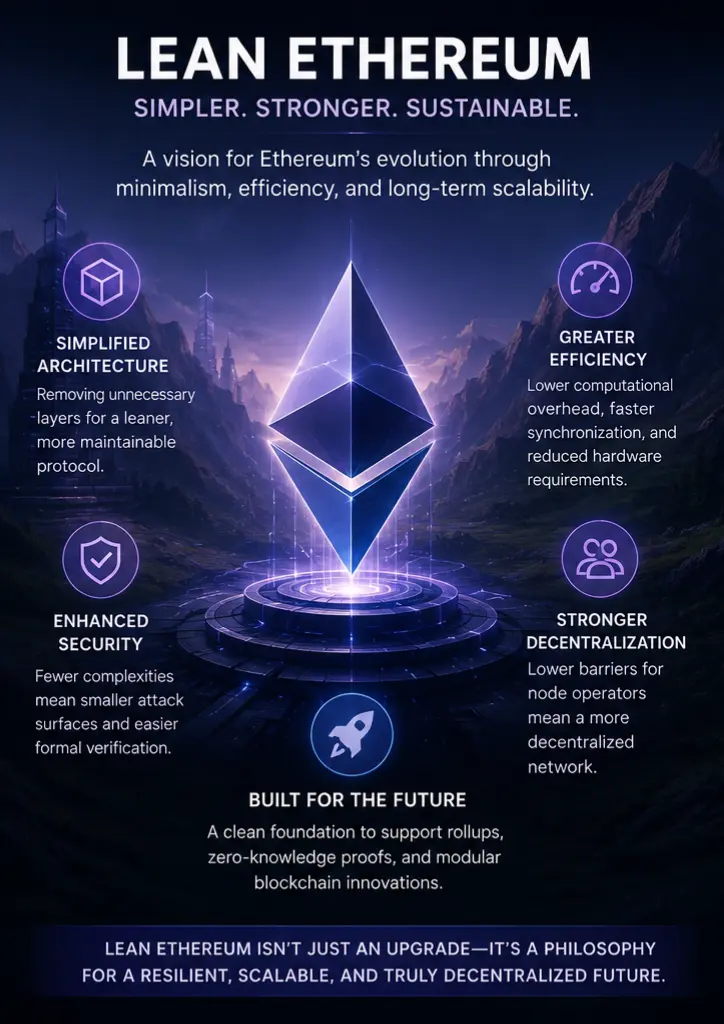
The core idea behind Lean Ethereum is not to add complexity, but to reduce unnecessary layers that have accumulated over years of rapid development. As blockchain networks evolve, they often face the challenge of balancing innovation with maintainability. Lean Ethereum addresses this by prioritizing minimalism in consensus design, execution logic, and infrastructure dependencies.
One of the key goals is to make Ethereum more accessible for developers and node operators. By reducing computational overhead and streamlining protocol rules, the network can potentially achieve faster synchronization, lower hardware requirements, and improved decentralization. This is especially important as global adoption increases and more participants join the ecosystem.
Another important aspect of this vision is long-term scalability. Instead of relying heavily on layered complexity, Lean Ethereum emphasizes clean foundational upgrades that can support future technologies such as advanced rollups, zero-knowledge proofs, and modular blockchain components without compromising core stability.
Security remains a central priority. A simplified protocol reduces attack surfaces and makes formal verification more practical, allowing researchers and developers to reason about the system with greater confidence.
If implemented successfully, Lean Ethereum could represent a shift in how major blockchain networks evolve—from expanding feature sets to refining core efficiency. This approach aligns with the broader philosophy of sustainable decentralization, where performance and simplicity work together rather than compete.
In essence, Lean Ethereum is not just an upgrade path, but a design philosophy aimed at ensuring Ethereum remains resilient, scalable, and truly decentralized in the long run.
Ethereum ecosystem is entering a new phase of architectural refinement as Vitalik Buterin introduces the concept of “Lean Ethereum,” a vision focused on simplifying protocol design while improving efficiency, scalability, and long-term sustainability.
The core idea behind Lean Ethereum is not to add complexity, but to reduce unnecessary layers that have accumulated over years of rapid development. As blockchain networks evolve, they often face the challenge of balancing innovation with maintainability. Lean Ethereum addresses this by prioritizing minimalism in consensus design, execution logic, and infrastructure dependencies.
One of the key goals is to make Ethereum more accessible for developers and node operators. By reducing computational overhead and streamlining protocol rules, the network can potentially achieve faster synchronization, lower hardware requirements, and improved decentralization. This is especially important as global adoption increases and more participants join the ecosystem.
Another important aspect of this vision is long-term scalability. Instead of relying heavily on layered complexity, Lean Ethereum emphasizes clean foundational upgrades that can support future technologies such as advanced rollups, zero-knowledge proofs, and modular blockchain components without compromising core stability.
Security remains a central priority. A simplified protocol reduces attack surfaces and makes formal verification more practical, allowing researchers and developers to reason about the system with greater confidence.
If implemented successfully, Lean Ethereum could represent a shift in how major blockchain networks evolve—from expanding feature sets to refining core efficiency. This approach aligns with the broader philosophy of sustainable decentralization, where performance and simplicity work together rather than compete.
In essence, Lean Ethereum is not just an upgrade path, but a design philosophy aimed at ensuring Ethereum remains resilient, scalable, and truly decentralized in the long run.