Morrisss

vip
Age 2.1 Year
Peak Tier 0
No content yet
Many creators on X are excessively obsessed with tactical optimization, such as mutual follow, algorithms, trending topics, and content hooks. Essentially, this is about increasing the "probability of being seen," yet they rarely think about deeper strategic questions: who they are, what their position in the system is, and what irreplaceable value they should accumulate over the long term. The result is that content becomes more and more "viral-like," but the individual becomes increasingly lacking in structure and distinguishability. The real difference is not about who is better at catering
View Original
  • Reward
  • Comment
  • Repost
  • Share
Many people, when they see good content, don’t react by discussing it at all—they immediately say, “This was written by AI.” What they truly care about is often not whether AI was used, but this: why, when we’re all using AI, do so many people like what you make, while mine gets no love? When they can’t explain this gap, attributing everything to AI is far easier than admitting the differences between people in ability, aesthetics, expression skills, and long-term accumulation. In the future, tools will become increasingly similar, and people’s standing—where they place themselves—will matter
View Original
  • Reward
  • Comment
  • Repost
  • Share
What is the highest quality brainwashing? It’s not making you believe a single sentence, but making you spend the length of your life proving a narrative. Even if there is a huge disconnect between that narrative and reality, you will still attribute the problem to yourself, others, or the times, and never doubt the narrative itself.
View Original
  • Reward
  • Comment
  • Repost
  • Share
Why do many people earn more money in the U.S. by running businesses like cleaning, moving, repairs, and landscaping than they do in China? Because they’re not selling physical labor—they’re selling prices under different system structures. The same work, in China, has long been trapped in low-price competition and an oversupply, so its value is hard to show; whereas in the U.S., labor is scarce, time is expensive, and the credit system is well developed—so people are willing to pay for peace of mind, time savings, and certainty. That means the same capability gets repriced. Of course, at thei
View Original
  • Reward
  • Comment
  • Repost
  • Share
Fitness, diet, sleep, and mindset can extend your lifespan; reading, observing, thinking, reflecting, and practicing can increase your time density. What truly creates the gap between people is not time, but time density.
View Original
  • Reward
  • Comment
  • Repost
  • Share
Youth has never been about age, but a state of mind. It means you still have the capacity to be moved by this world, and the courage to be curious, to love, and to create. When a person's eyes are filled only with interests, gains and losses, efficiency, and results, even at twenty years old, they may have already lost their youth. True aging is not about the body growing old, but the gradual loss of the ability to perceive beauty.
View Original
  • Reward
  • Comment
  • Repost
  • Share
Why do many people in China frequently study wolf nature, hunters, and hunting? Because they instinctively believe the world operates solely on the law of the jungle, that wealth comes from plunder, and success from defeating others. But the real jungle has no winners. Today you are the wolf, tomorrow there will be an even bigger wolf. In the end, it only creates greater injustice. What makes humans a civilization is not becoming better at hunting, but learning division of labor, cooperation, trade, rules, and trust. The vast majority of wealth in modern society is not created through plunder,
View Original
  • Reward
  • Comment
  • Repost
  • Share
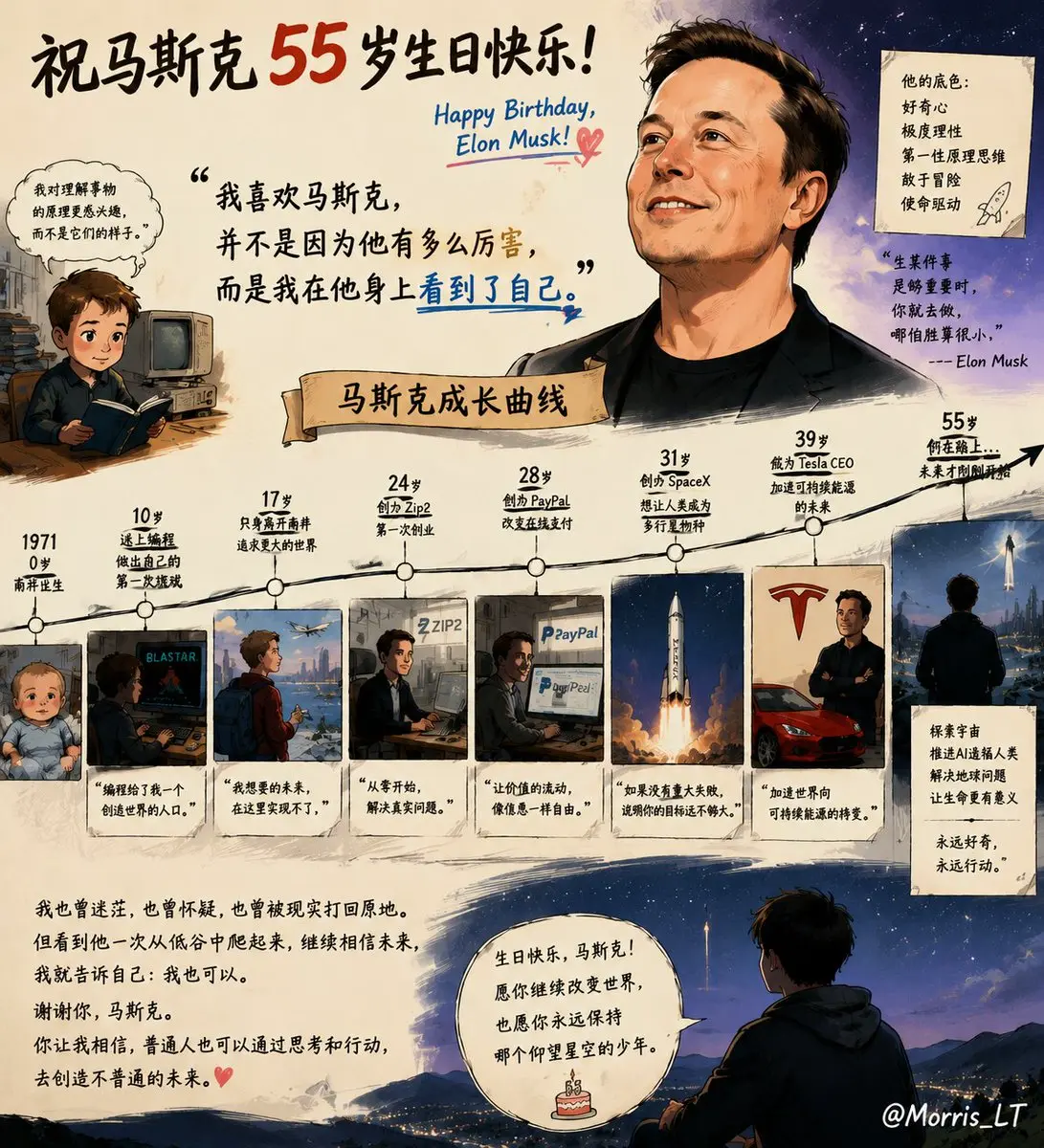
Happy 55th birthday to Musk! Actually, I like Musk not because he is so amazing, but because I see myself in him.
View Original
post-image
  • Reward
  • Comment
  • Repost
  • Share
Why do many people think that overweight people have a better temper, while people with smaller breasts have a stronger temper? Because in real life, these two appearance traits may indeed affect the social feedback a person receives, but that doesn’t mean they determine one’s personality. From a sociological perspective, a person’s appearance affects how others treat him, and also affects how he views himself. From a young age, overweight people are more likely to be expected to be “honest, easygoing, and non-aggressive,” and the long-term social feedback may lead some people to be more incli
View Original
  • Reward
  • Comment
  • Repost
  • Share
Why in some communications do you always want to clarify things, make them clear, and even insist on getting a response from the other person? Many people think this is because they value communication, but it's actually more about seeking psychological certainty. When a relationship experiences silence, avoidance, or vague responses, the brain instinctively treats it as an "unfinished task," constantly driving you to pursue, explain, and verify, hoping to complete the emotional loop through the other person's response. At the same time, people unconsciously use others' feedback to confirm the
View Original
  • Reward
  • Comment
  • Repost
  • Share
Many people think that goals determine results, so they desperately fixate on goals. But what truly determines results has never been goals—it's structure. Goals are only directions, uncontrollable external variables; how many followers you gain today, how much money you earn, how many pounds you lose—none of these are directly within your control. Structure determines whether you consistently take the actions that can influence outcomes every day. When a person's actions are built around uncontrollable results, they easily fall into anxiety, procrastination, and giving up; when actions are bu
View Original
  • Reward
  • Comment
  • Repost
  • Share
We often say that hard work is the most useless thing. In fact, this statement is only meant to break a bigger misconception: that hard work always leads to rewards. For the wealthy, hard work more easily yields returns; for the poor, if this statement is taken as absolute truth, it can become a shackle. This is because the efforts of the wealthy are more likely to receive positive feedback in terms of resources, opportunities, and social circles. Meanwhile, the efforts of the poor must also contend with variables such as background, rules, resources, and the era. Hard work is certainly import
View Original
  • Reward
  • Comment
  • Repost
  • Share
Have you ever noticed that from childhood to now, many of the narrative logics repeatedly instilled in you have later been proven by reality to be incomplete, or even wrong? Why? Many people will tell you it's because those principles were inherently wrong. Actually, a more accurate answer is: these narratives are not designed from your perspective. For ordinary people, they emphasize obedience, stability, submission, and hard work, because a society needs a large number of predictable individuals, not everyone becoming rule-makers. So, what you hear is: "Hard work leads to success," "Good peo
View Original
  • Reward
  • Comment
  • Repost
  • Share
Intuition is not a decision-making tool, but an alarm system. When the cost of error is low and the decision is reversible, you can boldly rely on intuition; when the cost of error is high and the impact is long-term, you should prioritize analysis. When intuition tells you that "something is wrong," don't immediately believe it; instead, ask whether it is reminding you of missing information, or if it is just your bias refusing to accept the answer. Truly excellent decision-makers do not eliminate intuition, but learn to distinguish whether intuition comes from facts or from emotions.
View Original
  • Reward
  • Comment
  • Repost
  • Share
A subscribing member asked me: Teacher, besides the logic of holding Bitcoin for the U.S. government to resolve its debt in the future, and AI applications, are there any other logics? Actually, debt resolution, AI applications, interest rate cuts, liquidity, robots, the energy revolution... the market will never run out of stories. What really drives the market is not stories, but new capital. The core reason for Bitcoin's rise is not "whether you can buy coffee," but that the old order can no longer contain new capital. The new order needs a huge, global, liquid pool of funds. Bitcoin is lik
BTC-0.47%
View Original
  • Reward
  • Comment
  • Repost
  • Share
If you judge first and then seek the truth, the result is no truth.
View Original
  • Reward
  • Comment
  • Repost
  • Share
What topics and content would you like me to write into an analysis?
View Original
  • Reward
  • Comment
  • Repost
  • Share
A stable market reduces volatility and also compresses excess returns;
a chaotic market amplifies risks and also amplifies arbitrage opportunities.
View Original
  • Reward
  • Comment
  • Repost
  • Share