#WarshSaysFedDecidesIfAIInflation Will AI Reshape Inflation? Why Kevin Warsh's Comments Matter for Markets and Monetary Policy
AI Has Entered the Inflation Debate
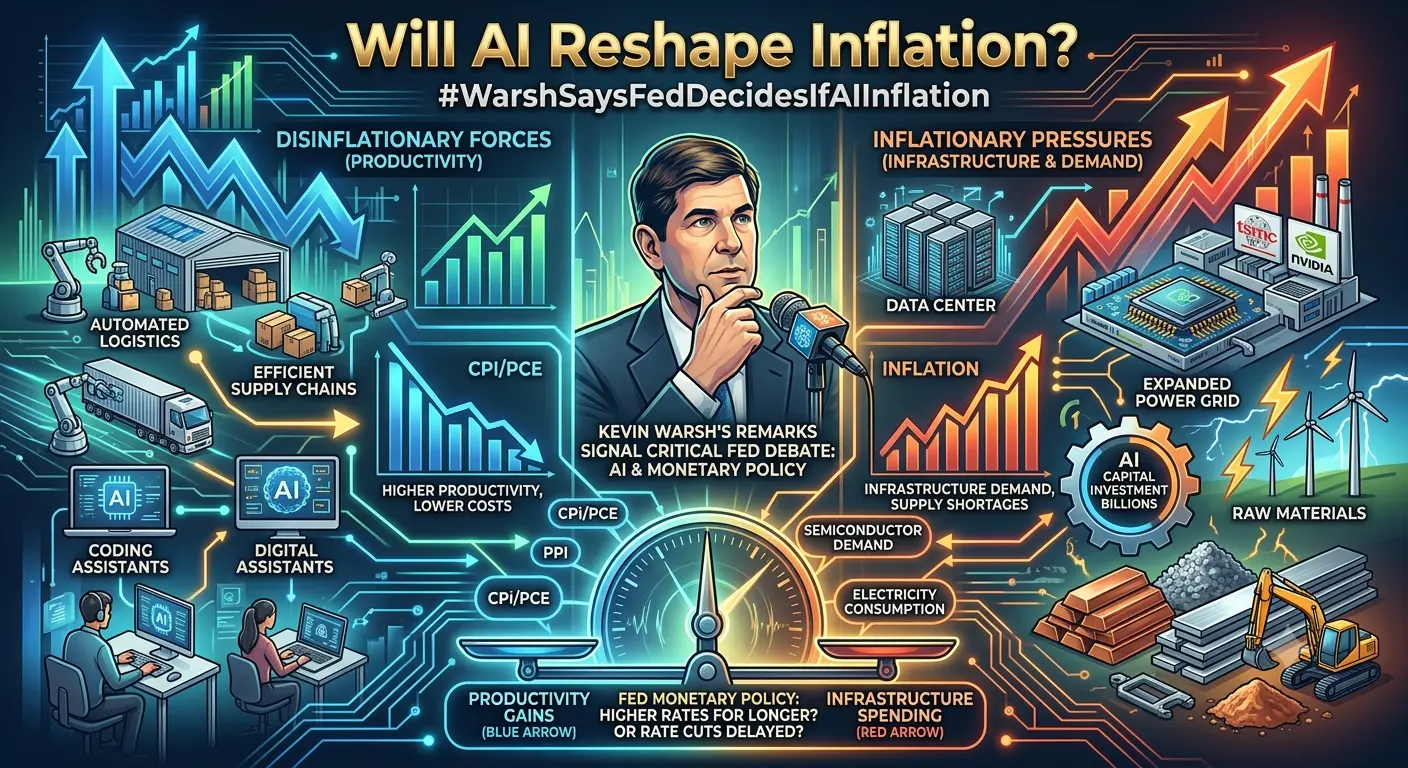
Artificial intelligence is no longer just a technology story it is becoming a major macroeconomic theme. Former Federal Reserve Governor Kevin Warsh recently emphasized that the Federal Reserve must determine how AI will influence inflation and future monetary policy. His remarks highlight an important question for investors: Will AI lower inflation through higher productivity, or will the massive investment required to build AI infrastructure create new inflationary pressures?
The answer could shape interest-rate expectations, financial markets, and investment strategies for years to come.
The Productivity Argument: AI Could Reduce Inflation
One of the strongest arguments in favor of AI is its ability to improve productivity across industries. Businesses are increasingly using AI to automate repetitive tasks, optimize supply chains, improve customer service, accelerate software development, and reduce operational costs.
Higher productivity allows companies to produce more with fewer resources, helping offset labor shortages and limiting cost increases. If these efficiency gains continue to expand across the economy, inflationary pressures may gradually ease over the long term.
For the Federal Reserve, stronger productivity growth could support lower inflation without significantly slowing economic activity.
The Infrastructure Challenge
At the same time, AI requires enormous investment.
Building advanced AI systems depends on high-performance semiconductor manufacturing, powerful GPUs, massive cloud infrastructure, next-generation networking equipment, and expanding electricity generation. Companies around the world continue investing billions of dollars into new data centers and AI computing capacity.
This surge in capital spending increases demand for construction materials, energy, skilled labor, and advanced hardware. If infrastructure expansion cannot keep pace with AI adoption, shortages could emerge and place upward pressure on prices.
This creates a complex situation where AI improves efficiency while simultaneously increasing demand across several sectors of the economy.
Implications for Federal Reserve Policy
The Federal Reserve closely monitors inflation before making interest-rate decisions. If AI-driven productivity becomes the dominant force, inflation could moderate over time, allowing policymakers greater flexibility to reduce rates.
However, if infrastructure investment, rising electricity demand, and continued wage growth keep inflation elevated, the Fed may maintain higher interest rates for longer than markets currently expect.
This balance between productivity gains and investment-driven inflation will become an increasingly important factor in future monetary policy discussions.
Impact Across Financial Markets
Changes in interest-rate expectations influence nearly every asset class.
Technology companies such as NVIDIA, AMD, Microsoft, TSMC, and other AI leaders could continue benefiting from expanding enterprise AI adoption and long-term infrastructure investment.
Meanwhile, higher interest rates generally increase financing costs and may create periods of volatility for growth-oriented technology stocks.
For digital assets, expectations surrounding Federal Reserve policy remain highly important. Bitcoin and Ethereum often respond positively when markets anticipate lower interest rates and greater liquidity. If inflation remains persistent because of AI infrastructure spending, expectations for delayed rate cuts could create short-term pressure across crypto markets.
Key Economic Indicators to Watch
Investors should continue monitoring several macroeconomic indicators that will help determine AI's economic impact:
CPI and PCE inflation trends
Producer Price Index (PPI)
Employment and wage growth
Productivity data
AI infrastructure investment
Semiconductor demand
Data center construction
Electricity consumption and energy prices
Together, these indicators provide valuable insight into whether AI is becoming primarily disinflationary or inflationary.
Risks Investors Should Consider
Rapid AI adoption presents several challenges. Infrastructure expansion may struggle to keep pace with growing demand, creating supply bottlenecks. Rising energy consumption, geopolitical risks affecting semiconductor supply chains, and export restrictions could also contribute to higher costs.
In addition, elevated valuations across parts of the AI sector require continued earnings growth to justify investor expectations.
Final Outlook
Kevin Warsh's comments underscore one of the most important economic questions of this decade. Artificial intelligence has the potential to significantly improve productivity and support lower long-term inflation, but achieving that future requires massive investment in chips, power generation, data centers, and digital infrastructure.
Rather than viewing AI as purely inflationary or disinflationary, investors should recognize that both forces may operate simultaneously. Monitoring inflation data, Federal Reserve policy, semiconductor demand, and AI infrastructure spending will remain essential for understanding how this transformation shapes equities, cryptocurrencies, and the broader global economy.
As the AI revolution continues, monetary policy may increasingly depend not only on traditional economic indicators but also on the pace at which artificial intelligence reshapes productivity, investment, and inflation.
@Gate_Square