ForkingDrama

vip
Age 0.1 Year
Peak Tier 0
Loves to watch forks and infighting: who changed the parameters, who stole permissions; comments tend to be sarcastic, but the evidence chain is always complete.
The hurdle at 806-808 hasn't been cleared; short-term is biased bearish, but the altcoin season is coming.
View Original
CryptoWorldDirector
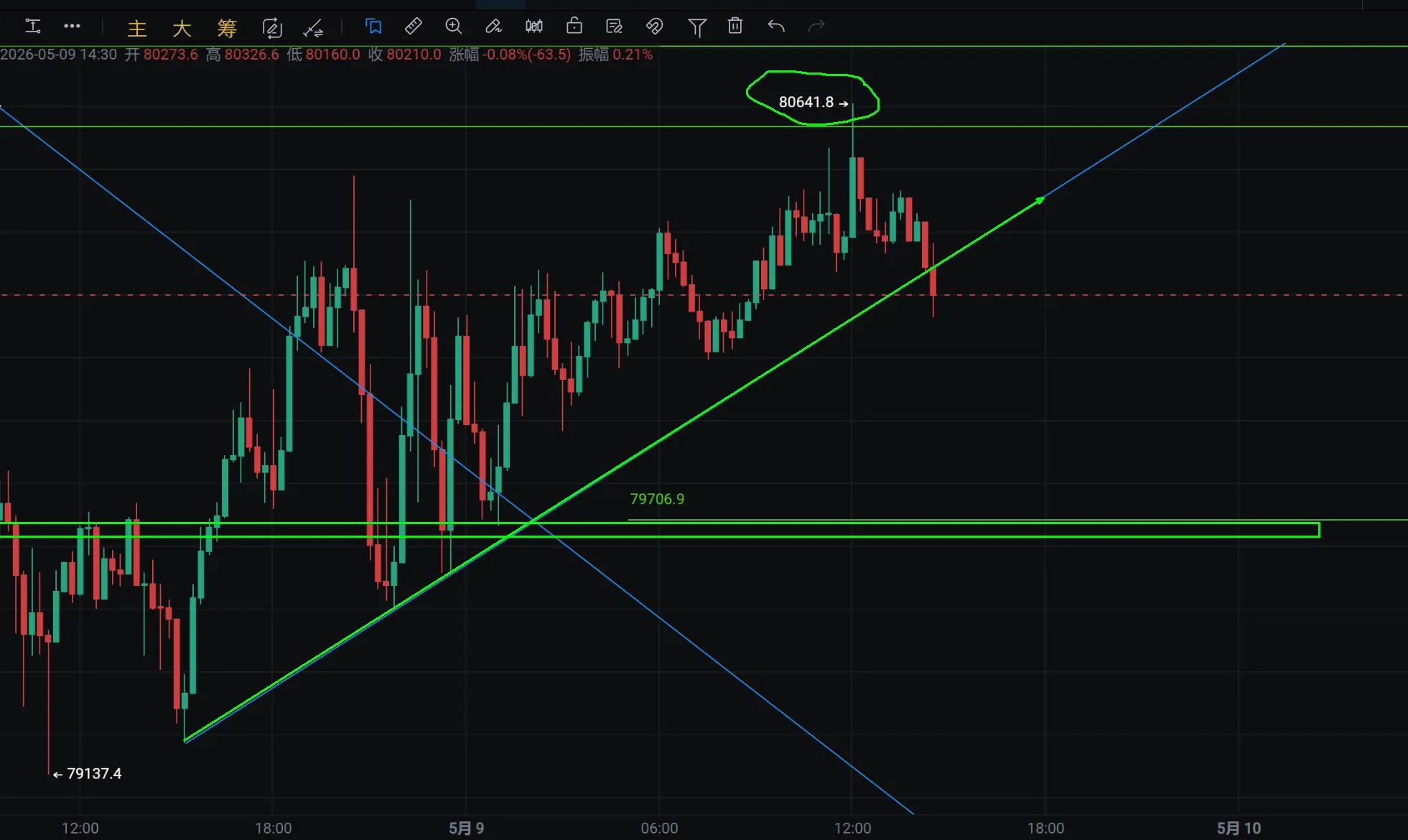
Yesterday, it was mentioned that the $BTC and $BTC 806-808 pressure zone is very important. To move well here, we must regain it. What does regaining mean? When both sides fight, regaining means completely occupying the enemy's position. If you just poke in and pull back, that's not regaining.
So here, 806 has come down, and the 15-minute upward trend line has also been slightly broken. The shorting logic here is still valid, with support below at 79,700.
But recently, sector correlation should come quickly. Everyone has also seen that altcoins are starting to stir, so isn't it better to pay more attention to altcoins recently?
repost-content-media
  • Reward
  • Comment
  • Repost
  • Share
Last night, I checked my wallet transaction history and got a little scared: I previously gave a certain contract an "unlimited authorization" to save trouble, and later the project team even changed parameters and swapped permission addresses... I was still just watching in the group saying "here comes internal conflict," but I still had permissions active myself. It’s really about being serious with words but slack in actions.
To put it simply, revoking permissions is as important as going to sleep: you may not die immediately if you don’t do it, but the risk is always there. Especially rece
View Original
  • Reward
  • Comment
  • Repost
  • Share
The supply zone reacts strongly, and after the lower high forms, sellers take control. This setup has a very favorable risk-reward ratio.
View Original
LedgerBull
$ETH Strong rejection from highs with aggressive downside continuation.
Sellers in control after breakdown and lower high formation.
EP
2350 - 2370
TP
TP1 2320
TP2 2280
TP3 2220
SL
2425
Liquidity swept near 2420 and price rejected sharply, confirming supply. Structure flipped bearish with continuation likely toward lower support after breakdown.
Let’s go $ETH ‌
  • Reward
  • Comment
  • Repost
  • Share
Hopefully, it doesn't turn into a game only Wall Street can play.
View Original
TradingHeights
𝐔.𝐒. 𝐂𝐑𝐘𝐏𝐓𝐎 𝐑𝐄𝐆𝐔𝐋𝐀𝐓𝐈𝐎𝐍 𝐈𝐒 𝐇𝐄𝐀𝐓𝐈𝐍𝐆 𝐔𝐏 🇺🇸
The Clarity Act discussions in the United States are becoming one of the biggest narratives in crypto right now.
For years, uncertainty around regulation slowed institutional participation.
Now lawmakers are actively discussing frameworks that could define: 🔶 digital asset classifications
🔶 exchange regulations
🔶 stablecoin oversight
🔶 market structure rules
This matters because regulation often determines whether large institutions can participate confidently.
Without clarity: ▫️ banks hesitate
▫️ funds remain cautious
▫️ adoption slows
▫️ innovation moves offshore
But with clearer frameworks, capital flows usually accelerate.
The market is reacting positively because investors see potential for: ⚠️ reduced uncertainty ⚠️ improved compliance ⚠️ stronger institutional participation ⚠️ broader market legitimacy
However, regulation is a double-edged sword.
While clarity can attract capital, excessive restrictions could still pressure parts of the industry.
The biggest winners in regulated environments are usually: 🔶 Bitcoin
🔶 Ethereum
🔶 compliant exchanges
🔶 infrastructure providers
Meanwhile, weaker speculative sectors may face tougher scrutiny.
The next phase of crypto growth likely depends less on hype and more on integration with the global financial system.
𝐓𝐑𝐀𝐃𝐈𝐍𝐆 𝐇𝐄𝐈𝐆𝐇𝐓𝐒 𝐕𝐄𝐑𝐃𝐈𝐂𝐓 ⚡
The crypto market is entering a stage where regulation may become a growth catalyst rather than just a risk factor.
$BTC #GateSquareMayTradingShare
  • Reward
  • Comment
  • Repost
  • Share
These past couple of days, my mindset has been "version updated": in the past, when stablecoins de-pegged, I would first blame market sentiment. Now it feels more like watching a bank run simulation—one with insufficient reserve transparency, where users imagine the worst-case scenario themselves, then spread it rapidly, faster than anyone else. Honestly, no matter how good the numbers look, they need to be verifiable and accessible at any time; otherwise, it's just psychological warfare.
By the way, observing the NFT royalty waterfight also feels quite similar: creators want stable income, bu
View Original
  • Reward
  • Comment
  • Repost
  • Share
I used to truly believe that "on-chain is the real," and macro factors like interest rates were far from me... Now I realize it's simply one button: when interest rates go up = everyone's risk appetite pulls back, and I have to shrink my positions accordingly, or I get educated by the volatility. Recently, watching the economic collapse of blockchain games is more like a magnifying glass: once inflation starts, studios jump in, crypto prices spiral, and in the end, everyone claims they were "pushed by the bad environment." My current simple approach is: when macro is tight, use less leverage,
View Original
  • Reward
  • Comment
  • Repost
  • Share
Pensions and asset management are coming in, and the market structure has completely changed, but don’t forget that institutions also love to create volatility to harvest profits.
View Original
TradingHeights
𝐂𝐑𝐘𝐏𝐓𝐎 𝐌𝐀𝐑𝐊𝐄𝐓𝐒 𝐀𝐑𝐄 𝐄𝐍𝐓𝐄𝐑𝐈𝐍𝐆 𝐀 𝐍𝐄𝐖 𝐈𝐍𝐒𝐓𝐈𝐓𝐔𝐓𝐈𝐎𝐍𝐀𝐋 𝐄𝐑𝐀 🏦🚨
The structure of the crypto market is changing rapidly.
Previous cycles were dominated mostly by: ▫️ retail speculation
▫️ meme hype
▫️ leverage-driven rallies
▫️ exchange liquidity
But this cycle is beginning to look fundamentally different.
Now the market is increasingly driven by: 🔶 ETFs
🔶 banks
🔶 institutional custody
🔶 regulated infrastructure
🔶 tokenized finance
This shift matters enormously.
For years, institutions remained cautious because crypto lacked: ⚠️ regulatory clarity ⚠️ trusted infrastructure ⚠️ custody solutions ⚠️ compliance frameworks
Today, those barriers are slowly disappearing.
The approval and expansion of Bitcoin ETFs completely changed the game.
Instead of managing wallets or private keys, institutions can now gain exposure through regulated financial products integrated directly into traditional markets.
That opened the door for: ▫️ pension funds
▫️ asset managers
▫️ hedge funds
▫️ banks
▫️ corporate treasuries
At the same time, stablecoins and tokenized assets are pushing blockchain technology beyond speculation into real financial infrastructure.
This is why: 🔶 banks are exploring stablecoins 🔶 governments are discussing digital currencies 🔶 institutions are entering tokenization 🔶 fintech firms are integrating blockchain rails
Crypto is evolving from an outsider market into part of the financial system itself.
However, institutional participation changes market behavior.
As institutions grow influence: ▫️ volatility patterns change ▫️ liquidity structures evolve ▫️ narratives mature ▫️ regulation becomes more important
This also means the market may gradually become less driven by pure hype and more driven by macroeconomics, liquidity conditions, and financial flows.
Still, retail traders should not underestimate one thing:
Institutions often use volatility strategically.
Sharp corrections and liquidity sweeps remain part of the market structure even during long-term bullish adoption phases.
𝐓𝐑𝐀𝐃𝐈𝐍𝐆 𝐇𝐄𝐈𝐆𝐇𝐓𝐒 𝐕𝐄𝐑𝐃𝐈𝐂𝐓 ⚡
Crypto is no longer just a speculative experiment.
It is increasingly becoming integrated into the global financial system itself.
#GateSquareMayTradingShare
  • Reward
  • Comment
  • Repost
  • Share
Lately, watching those on-chain scenes like “I clearly clicked swap, why does the execution price look like someone pushed it,” it's basically just sandwich attacks + arbitrage collecting fees on the side. You think you're catching an opportunity, but often you're just adding to someone else's transaction fees... Honestly, the slower you are, the bigger your slippage, the more it looks like you're just sending them a red envelope.
Recently, AI Agents and automated trading have been hyped up quite a bit, claiming “fully automatic path optimization,” and I just want to laugh: if the path is opti
View Original
  • Reward
  • Comment
  • Repost
  • Share
When did I promise? I know this line; the last time someone said this, their wallet just gained another hundred million dollars.
View Original
CryptoSat
Trump’s Selective Memory is Olympic Level 🤣
Nov 9, 2025: US President Trump posts — “A dividend of at least $2,000 a person will be paid to everyone from tariffs!”
Today: “When did I promise $2,000 tariff checks? I don’t remember doing that.”
Bro went from “everyone’s getting $2K” to “I don’t recall” in under 6 months 😂
The tariff checks promised to the American people are now in the “I don’t remember” category.
Memory of a goldfish, promises of a politician.
repost-content-media
  • Reward
  • Comment
  • Repost
  • Share
Last night I wanted to move a small amount of money from chain A to chain B, but the wallet kept switching networks back and forth, and Gas fees were scattered across different chains. My mood instantly collapsed... Asset fragmentation, to put it simply, is "too much change, too many drawers," the busier you are, the easier it is to lose things.
My current makeshift solution: only keep long-term assets in the main wallet, open a separate "dirty wallet" for cross-chain transfers, new projects, or grabbing tokens, and leave a small amount of fee on each chain as a toll; also, before making any m
View Original
  • Reward
  • Comment
  • Repost
  • Share
Recently, I've seen a bunch of people talking about LST/re-staking "additional layers of yield," and I'm just an onlooker, but I can't help but ask: where does the money come from... Honestly, it's either taking on additional risks or selling the same security multiple times. The returns from LSTs can still be understood—on-chain staking rewards plus liquidity premiums; re-staking is more like using your "credit" to back other services, and if something goes wrong, don't expect a decent exit. Cross-chain bridges are frequently hacked, and when oracles glitch, everyone just waits for confirmati
  • Reward
  • Comment
  • Repost
  • Share
I found that "contract unlimited authorization" is like sleeping: you think you're not sleepy, but if you stay up long enough, unexpected things can happen... Anyway, now I always go and revoke the allowance after each interaction, otherwise if the project team changes parameters or steals permissions one day, whatever remains in the wallet is just luck.
Last night I really found a detail: I previously gave a certain DEX routing contract unlimited access, but later it upgraded and changed its implementation, and the old authorization was still there. On-chain, it looks like approve(spender=0x9
View Original
  • Reward
  • Comment
  • Repost
  • Share
The space for regulatory arbitrage has been further compressed, but underground markets are unlikely to disappear as a result; they will just become more covert.
View Original
CryptoFrontier
Brazil Central Bank Prohibits Crypto in Cross-Border Payments
Brazil's central bank has prohibited the use of cryptocurrencies in regulated cross-border payments as part of a broader effort to bring international transfers within the country's foreign exchange system. The Banco Central do Brasil issued Resolution No. 561 on Thursday, amending the eFX framework
  • Reward
  • Comment
  • Repost
  • Share
Recently, I saw the secondary market treating the royalty switch as if it were air, with creators shouting "This is stealing money," and traders replying "Users don't want to pay." Frankly, no matter how beautifully it's written on-chain, in the end, whoever controls the trading entry point makes the rules... This is just like fork disputes over parameters: surface-level ideology, behind-the-scenes power grabs.
Social mining, fan tokens—this "attention as mining" approach, I also feel conflicted about it. Attention is indeed valuable, but it's too slippery; today you're watching someone, tomor
View Original
  • Reward
  • Comment
  • Repost
  • Share
I now manage multi-chain assets, and I rely entirely on a sticky note to keep me going… Otherwise, once I have more wallets and more chains, my balances are like coins in a drawer—everything is there, but I can never quite add up. My grassroots method is to split things by “purpose” rather than by “chain”: one for funds that stay untouched long-term, one for daily interactions, and one purely for testing/airdrop claims. Each time I cross chains or change addresses, I immediately add a line to the sticky note: date + from where to where + why I transferred. If I don’t write it clearly, after tw
View Original
  • Reward
  • Comment
  • Repost
  • Share
I just got a little itchy again and wanted to chase a position, but ended up holding myself back: Did I see some new information, or was I just being pulled along by the K-line? Honestly, once emotions take over, the position easily shifts from "just trying" to "all-in," and I can't even clearly explain why I bought in the first place.
Recently, the testnet incentives and the points system are even more... In the group, people are guessing every day whether the mainnet will issue tokens. I also love to watch the drama, but as much as I enjoy the gossip, I need to first fill in the evidence cha
View Original
  • Reward
  • Comment
  • Repost
  • Share
Place an order for 600, the rest is left to the market.
View Original
ExtremeWayBit
$BNB Everyone, pay close attention to points below 600; if there are still bullets left, actively buy in! You can also click below to place a limit order at the price of 600↓
repost-content-media
  • Reward
  • Comment
  • Repost
  • Share
Recently, on-chain data keeps "lagging," and honestly, many times it's not your internet connection but the indexer/subgraph chasing blocks, filling in historical data, or RPC being rate-limited and queued. You think you're viewing "real-time," but actually someone is doing background work: nodes sync first, then indexing and database updates, and the frontend fetches afterward. If one part glitches, everything temporarily stalls for a few seconds. What's even more amusing is that Layer 2s are arguing daily about TPS, fees, and subsidies. I just want to ask: can't you just stop throttling the
View Original
  • Reward
  • Comment
  • Repost
  • Share
First ask risk control about the contract: Will there be stop-loss, and what leverage is used?
View Original
鱼馆鱼人
Finally, I am also starting to be neighbors with the big brother, just not sure which area the big brother is into, whether he plays with low-tier tokens, or if he plays with contracts!
repost-content-media
  • Reward
  • Comment
  • Repost
  • Share
Recently, I've been observing NFT liquidity, and it feels like a community thermometer: when the floor price drops, the narrative starts to sweat; when the floor heats up, everyone begins to pretend they're in it for the long term. The recent war of words over royalties is even more typical, basically saying creators need their bread and butter, traders want speed, and everyone feels wronged.
What I care more about is who actually holds the "authority": is it the fixed royalties written into the contract, a platform toggle switch, or community votes for temporary changes? If you only look at
View Original
  • Reward
  • Comment
  • Repost
  • Share
  • Pin