As networks such as Ethereum, Arbitrum, Base, BNB Chain, and Solana continue to expand, the multichain paradigm has become a defining trend in blockchain development. This growth brings more options, but it also fragments the user experience. Heima addresses this by using chain abstraction technology to conceal underlying complexity, allowing users to interact with the multichain ecosystem as seamlessly as they would with a single chain. This makes Heima a leading project in the chain abstraction space.
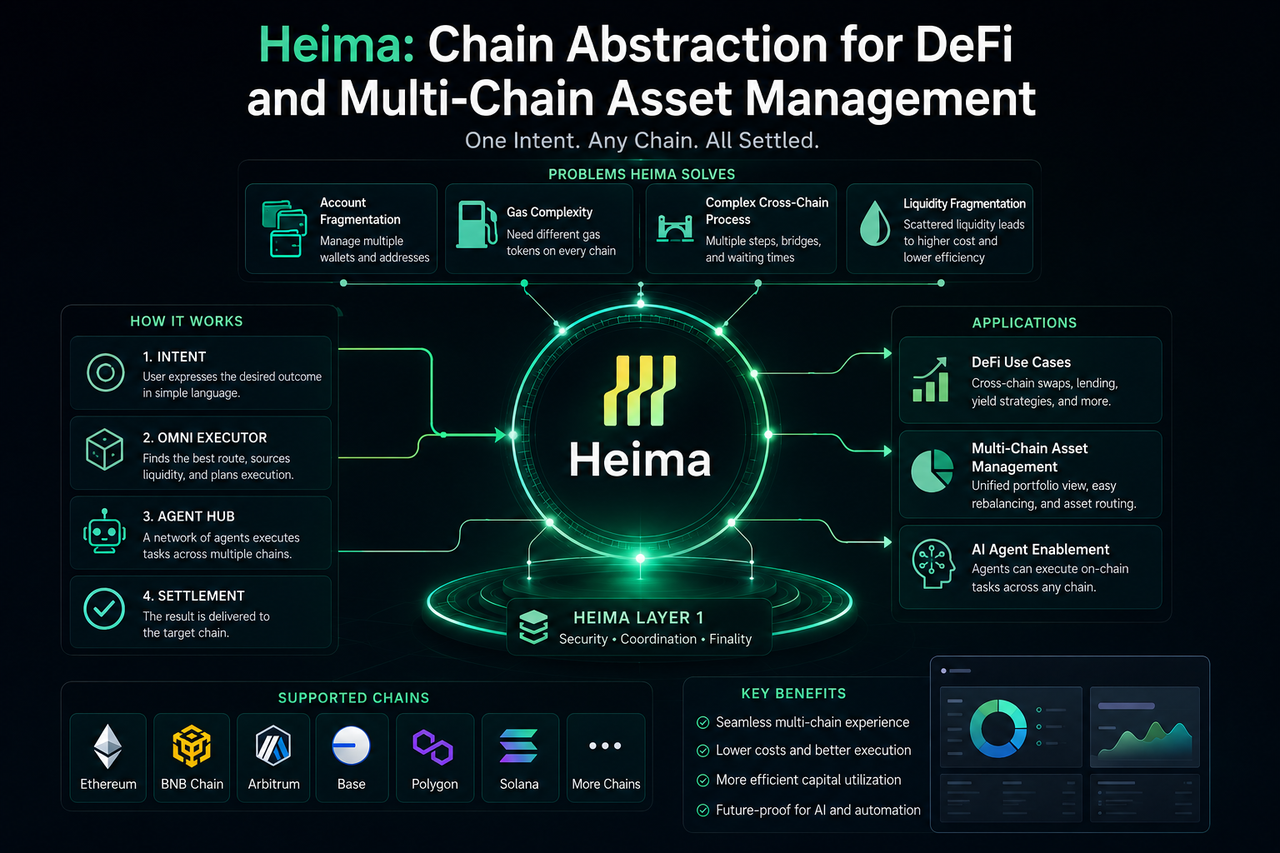
The First Problem Heima Solves: Account Fragmentation
Account fragmentation ranks among the most common issues in a multichain ecosystem.
When users simultaneously operate on Ethereum, Base, Arbitrum, and BNB Chain, they typically need to juggle multiple addresses, balances, and transaction histories across different chains. Although the assets belong to the same user, they are scattered across disparate networks.
Heima's Omni Account provides a unified account system that consolidates identities and asset states from various blockchains into a single interface. Users no longer need to switch wallets or track asset distribution across chains to perform cross-chain operations.
The Second Problem Heima Solves: Complex Gas Token Management
Managing Gas tokens has long been a major hurdle in the cross-chain experience.
Under the traditional model, users must hold ETH, BNB, MATIC, or other native tokens individually to pay fees. When assets move cross-chain and the target chain lacks the required Gas token, users may find themselves unable to proceed. This situation frequently frustrates new users trying Layer 2 networks or cross-chain bridges for the first time.
Heima's Gas Abstraction mechanism eliminates the need to pre-purchase Gas on the destination chain. The system automatically handles fee payment and settlement, resulting in a smoother cross-chain transaction flow.
How Does Gas Abstraction Improve the User Experience?
Gas Abstraction moves on-chain fee management from the user to the protocol layer. Users concentrate on completing their transactions, while the system manages the details of Gas payment. This model mirrors how traditional internet applications abstract away backend server costs.
The Third Problem Heima Solves: Cumbersome Cross-Chain Workflows
Conventional cross-chain transactions often demand multiple steps.
For example, to convert USDC on Ethereum into ETH on Base, a user typically must first bridge assets, wait for confirmations, switch networks, and then execute the swap.
The whole process may involve several protocols, multiple signatures, and significant waiting time.
Heima's Intent-Centric approach flips this: users simply state their goal—such as "swap USDC for ETH on Base"—and the system takes care of the rest automatically.
Why Is Intent a Key Building Block of Chain Abstraction?
Intent shifts interactions from being "action-oriented" to "outcome-oriented." Users no longer need to understand cross-chain paths, bridging protocols, or liquidity sources. They simply communicate the desired result, and the system plans and executes the necessary steps.
The Fourth Problem Heima Solves: Liquidity Dispersion
Liquidity fragmentation is a persistent challenge in multichain environments.
The same asset can exist on multiple networks, each with different levels of trading depth and market efficiency. This often leads to higher transaction costs and lower capital utilization.
Heima's Omni Executor automatically identifies the best liquidity source based on the user's intent and dynamically calculates the optimal execution path. This design spares users from manually comparing liquidity across networks and protocols—the system handles resource coordination autonomously.
Why Is Liquidity Coordination Important?
Unified liquidity boosts asset efficiency. When the system can aggregate liquidity across chains, users are more likely to achieve lower slippage and higher execution efficiency.
How Does Heima Apply in DeFi?
DeFi is one of the most critical use cases for chain abstraction.
Many DeFi users today deploy lending, trading, and yield strategies across multiple chains, requiring constant asset transfers and network switches.
Heima integrates these complex workflows into a single execution framework. For instance, a user can submit a single intent that covers cross-chain transfers, token swaps, and liquidity provision. The system then orchestrates the entire process automatically.
Cross-Chain Transaction Aggregation
Heima aggregates liquidity from different chains. A single request triggers the system to find the best swap path and execute the cross-chain transaction.
Multichain Yield Strategy Execution
DeFi yield opportunities are often scattered across networks. Heima coordinates resources across protocols, enabling users to execute sophisticated multichain strategies through one entry point.
Automated Asset Allocation
As AI Agents and automated financial tools evolve, chain abstraction infrastructure can handle asset allocation and rebalancing autonomously. Heima's Agent Hub architecture is purpose-built to power these automation scenarios.
Heima in Multichain Asset Management
Multichain asset management is another key application of chain abstraction. Long-time Web3 participants typically hold assets across multiple wallets and multiple blockchains, and as the number of chains grows, management complexity increases.
Heima offers a unified account view and a single execution interface, centralizing asset management. Users can view and interact with assets across different networks from one account, eliminating the need to switch wallets or access multiple dApps.
Unified Asset View
A unified asset view reduces administrative overhead. Users no longer need to log into separate networks to check balances; the system consolidates all asset information into a single dashboard.
Cross-Chain Asset Rebalancing
When users need to rebalance their portfolios, Heima handles the cross-chain transfers and swaps automatically. This capability is especially valuable for those who frequently adjust their asset allocation.
Summary of Problems Heima Solves
| User Pain Point |
Traditional Multichain Model |
Heima Solution |
| Managing multiple accounts |
Juggling multiple chains and addresses |
Omni Account |
| Gas fragmentation |
Preparing separate Gas for each chain |
Gas Abstraction |
| Complex cross-chain operations |
Multiple protocols and manual steps |
Intent-Driven Execution |
| Liquidity dispersion |
Manually searching for best routes |
Omni Executor |
| Lack of automation |
User must perform all steps |
Agent Hub |
| Difficult multichain asset management |
Assets scattered across networks |
Unified Asset View |
Conclusion
Heima's core value is not in creating a new blockchain, but in building a unified coordination layer on top of the existing multichain ecosystem. Through Omni Account, Intent, Omni Executor, and Agent Hub, Heima integrates account management, Gas payment, cross-chain execution, and liquidity coordination into a single framework.
For DeFi users, Heima reduces the complexity of cross-chain transactions and multichain strategy execution. For asset management, it offers a unified account and asset view. For emerging applications like AI Agents, Heima provides the automated execution infrastructure needed to operate across chains.
FAQs
What is the primary problem Heima solves?
Heima tackles account fragmentation, complex Gas management, cumbersome cross-chain workflows, and liquidity dispersion in the multichain ecosystem by applying chain abstraction to deliver a unified user experience.
Why does Heima need chain abstraction?
Chain abstraction hides the technical differences between blockchains, allowing users to perform cross-chain operations without understanding the underlying network details—lowering the barrier to entry for Web3.
How does Heima improve the DeFi experience?
Heima uses Intent-driven execution and automated cross-chain coordination to merge cross-chain trades, asset swaps, and multichain strategy execution into a single workflow, minimizing manual intervention.
Can Heima manage assets on multiple blockchains?
Yes. Heima's Omni Account provides a unified account system that helps users manage assets spread across different blockchain networks.
How is Heima different from a cross-chain bridge?
A cross-chain bridge primarily facilitates asset transfers, whereas Heima goes further by managing execution path planning, Gas handling, and automated task coordination—offering a much broader scope of functionality.







