The evolution of blockchain applications has made on-chain data access a central requirement in the Web3 ecosystem. Whether it’s checking wallet balances, reading NFT metadata, broadcasting transactions, or updating DeFi protocol statuses, applications need constant communication with blockchain nodes. In the early days, developers often had to run full nodes themselves and maintain databases, servers, and indexing systems—adding significant overhead in both cost and complexity.
Within the current Web3 infrastructure landscape, Alchemy stands out by providing developers with a unified API to access multiple blockchain networks, while boosting on-chain data retrieval efficiency through data indexing, caching, and enhanced interfaces.
What is the Alchemy API?
The Alchemy API is a set of blockchain development tools offered by Alchemy. It allows applications to read on-chain data, send transactions, and listen to blockchain events.
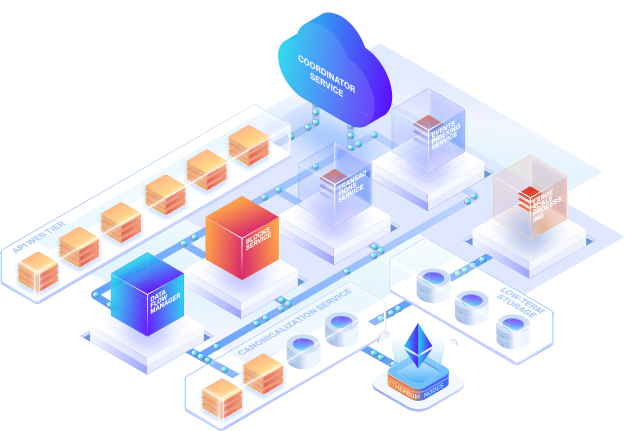
Architecturally, the Alchemy API serves as a middleware layer between DApps and blockchain nodes. Instead of maintaining their own Ethereum, Polygon, or Solana nodes, developers interact with these blockchains through Alchemy’s API endpoints.
Key features include:
- Checking wallet balances
- Fetching NFT data
- Verifying transaction status
- Broadcasting on-chain transactions
- Listening to on-chain events
- Retrieving block and log data
The Alchemy API goes beyond simple "node access" by structuring on-chain data, making it easier for developers to build Web3 applications.
What is an RPC Request?
Remote Procedure Call (RPC) is the standard method for Web3 applications to communicate with blockchain nodes.
When a user opens a wallet or DApp, the frontend sends an RPC request to a node. For example:
- Query a wallet balance
- Get the latest block height
- Call a smart contract
- Submit a transaction
Common Ethereum RPC methods include:
| RPC Method |
Function |
| eth_blockNumber |
Get the latest block height |
| eth_getBalance |
Query Account Balance |
| eth_call |
Call a smart contract |
| eth_sendRawTransaction |
Broadcast a transaction |
| eth_getLogs |
Retrieve on-chain logs |
One of Alchemy’s core roles is to receive these RPC requests and route them to the appropriate blockchain network.
How Do User Requests Reach Alchemy?
When a user opens a DApp, the request typically follows this path:
- The user interacts with the frontend
- The frontend sends an RPC request via SDK or API
- The request enters the Alchemy API Gateway
- The system identifies the target blockchain
- The request is routed to the relevant node cluster
- The node reads on-chain data
- The data is returned to the frontend
This is analogous to the traditional "client → cloud server → database" model.
In the middle, Alchemy handles request management, node load balancing, and data processing.
How Does Alchemy’s Node System Work?
Alchemy runs a large distributed network of nodes to connect to various blockchains.
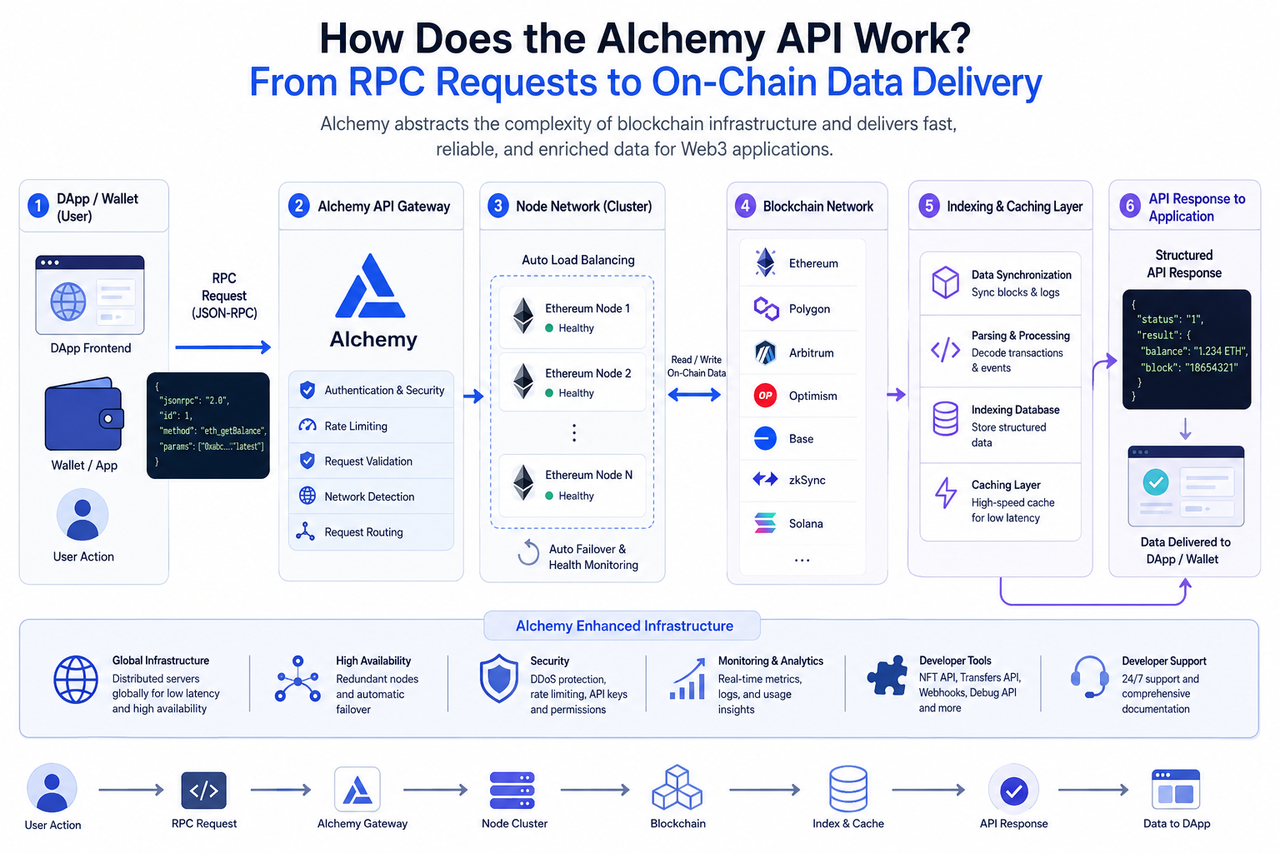
Unlike developers running a single node, Alchemy employs:
- Node clusters
- Automatic load balancing
- Data caching
- Failure recovery mechanisms
- Global server deployment
This setup minimizes the risk of node downtime and improves API response times.
For instance, if an Ethereum node encounters a sync issue, the system automatically switches to another healthy node, preventing API service disruption. This is a key reason large Web3 applications rely on professional infrastructure platforms.
How On-Chain Data Indexing and Caching Work?
Raw blockchain data is often not optimized for direct queries.
For example, an NFT marketplace scanning the chain block by block for transfer data would be highly inefficient. Alchemy solves this by pre-indexing and caching on-chain data.
The core process:
- Nodes synchronize on-chain data
- The system parses blocks and logs
- Data is stored in an index database
- The API reads from the index layer
- Structured results are returned
This resembles how search engines index web pages.
By indexing data, Alchemy offers higher-level APIs, such as:
- NFT holdings queries
- Token transfer history
- Wallet asset aggregation
- Smart contract event filtering
Compared to raw RPC queries, this approach is far more efficient and better suited for commercial Web3 applications.
How the NFT API and Transfers API Work
Alchemy’s enhanced APIs are a key differentiator from traditional RPC providers.
NFT API
The NFT API pre-indexes NFT contracts and metadata, enabling quick access to:
- NFT images
- NFT attributes
- Holder addresses
- NFT rarity
- Collection details
Traditional nodes generally cannot return such structured data directly.
Transfers API
The Transfers API tracks token and NFT transfer history.
For example, when a user checks their wallet history, Alchemy will:
- Scan on-chain Transfer events
- Parse token types
- Organize timeline data
- Return structured transaction records
These APIs are widely used in wallets, block explorers, and asset management platforms.
How Webhooks Enable Real-Time Notifications
Webhooks are Alchemy’s system for on-chain event notifications.
Traditional apps that need to monitor on-chain events often resort to constant node polling, which consumes excessive resources.
Alchemy’s Webhook workflow:
- The developer defines listening conditions
- The system continuously monitors on-chain data
- Specific events trigger notifications
- Data is automatically pushed to the server
Supported monitoring scenarios include:
- Wallet incoming payments
- NFT transfers
- Smart contract events
- Transaction confirmations
- Large-value transfer alerts
This mechanism allows applications to stay updated in real time.
Alchemy API vs. Traditional Nodes
Alchemy is more than just an RPC node provider; its strength lies in its enhanced development infrastructure.
| Dimension |
Traditional Nodes |
Alchemy API |
| Data Access |
Raw on-chain data |
Structured API |
| NFT Support |
Limited |
Comprehensive |
| Data Indexing |
Requires self-setup |
Provided by platform |
| Real-Time Notifications |
Custom development needed |
Webhooks support |
| Multi-Chain Compatibility |
Manual maintenance |
Unified interface |
| Operational Cost |
High |
Low |
Thus, Alchemy is better described as a "Web3 development platform" than a mere node service.
Summary
As a foundational piece of modern Web3 infrastructure, the Alchemy API helps DApps, wallets, and on-chain applications access blockchain data and send transactions.
From routing RPC requests through the API Gateway, to node data retrieval, indexing, and returning structured results via enhanced APIs, Alchemy handles extensive backend infrastructure. Compared to traditional node access, it improves data retrieval efficiency and developer experience through caching, indexing, and purpose-built APIs.
FAQs
What is the Alchemy API?
The Alchemy API is a development interface that enables Web3 applications to access blockchain data and send transactions.
What does an RPC request mean?
An RPC request is a data call from an application to a blockchain node to read on-chain data or broadcast a transaction.
Why do DApps need Alchemy?
Alchemy allows DApps to avoid running their own nodes, reducing development and operational complexity.
Which blockchains does the Alchemy API support?
Alchemy supports multiple networks, including Ethereum, Polygon, Arbitrum, Optimism, Base, zkSync, and Solana.
What’s the difference between the NFT API and regular RPC?
The NFT API pre-indexes NFT data, providing more complete and structured information compared to raw RPC queries.
What role do Webhooks play?
Webhooks automatically send real-time notifications when on-chain events occur, such as NFT transfers or transaction confirmations.