Prediction markets and sports betting both center on future events, leading many users to believe they are fundamentally the same. In both cases, users assess whether an event will occur and earn returns based on the outcome.
This overlap is especially visible in sports scenarios. Whether predicting a team's win or trading a match result, users are essentially making judgments about future events. However, in terms of market structure, pricing methodology, regulatory logic, and trading mechanics, prediction markets and traditional sports betting belong to entirely different systems.
What Is a Prediction Market?
The core logic of a prediction market is to form a probability for a future event through Marketplace trading.
On platforms like Kalshi and Polymarket, users can buy YES or NO contracts. YES indicates the event will happen, and NO indicates it will not.
The price always ranges between $0 and $1, naturally corresponding to the event's probability.
For example:
A YES contract price of $0.72 typically means the market estimates roughly a 72% probability of the event occurring.
This mechanism is essentially "probability trading," so prediction markets emphasize information aggregation, probability formation, and market consensus rather than pure entertainment gambling.
What Is Sports Betting?
Sports betting belongs to the traditional gambling industry.
On most sports betting platforms, odds are set by the bookmaker, and users place bets based on those odds. The bookmaker adjusts odds dynamically based on team strength, betting volume, and Risk Control requirements.
Therefore, the core logic of sports betting leans toward:
The "house model."
Users are essentially betting against the platform, rather than freely trading with other market participants.
What Is the Core Difference Between Kalshi and Sports Betting?
Though both revolve around future events, their underlying structures are completely different.
The key difference is: Sports betting trades "odds," while Kalshi trades "probability."
On gambling platforms, odds are set by the house, whereas Kalshi's prices are determined collectively by market participants.
Thus: Gambling leans toward a centralized odds system, while prediction markets are closer to an open market trading structure.
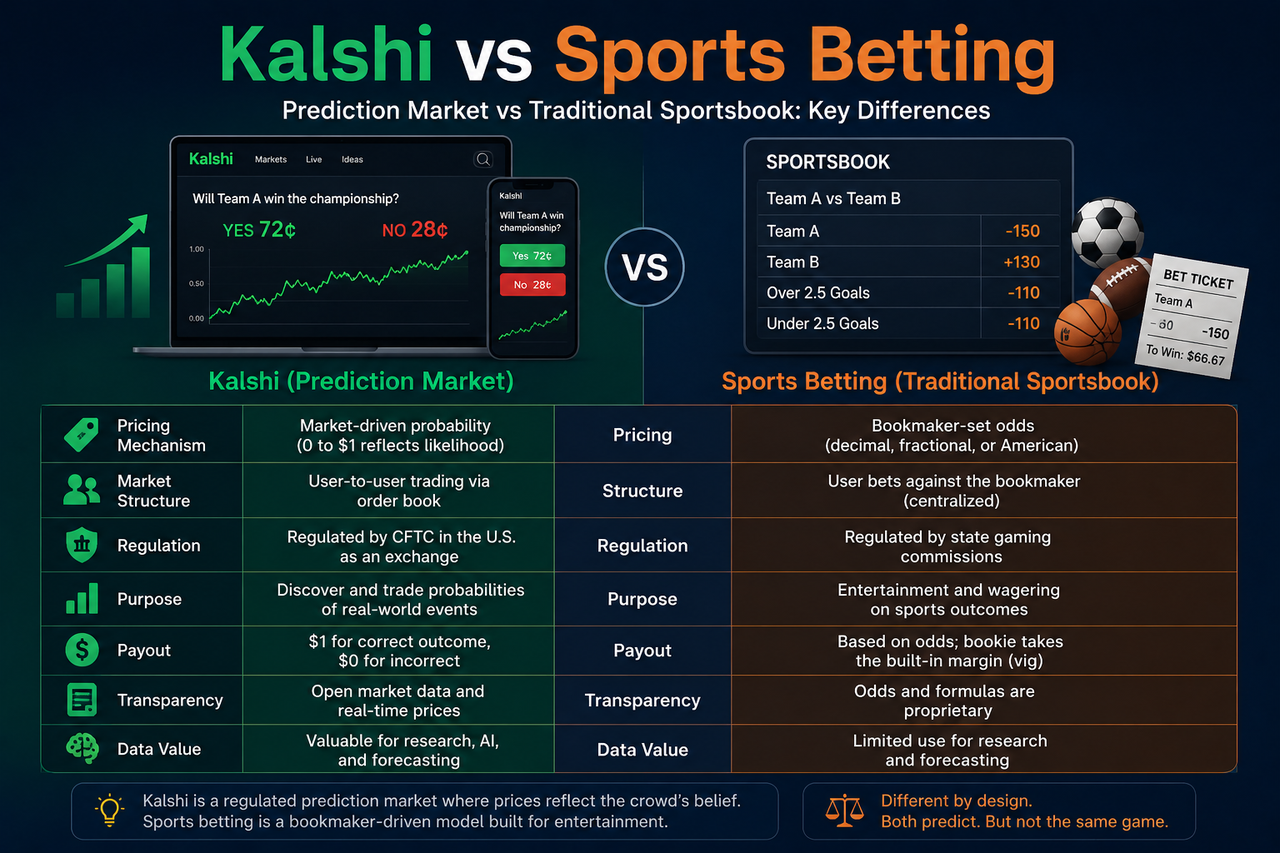
How Do the Pricing Mechanisms of Kalshi and Sports Betting Differ?
In sports betting, odds are set uniformly by the bookmaker.
The bookmaker dynamically adjusts odds based on team strength, betting volume, and risk exposure to maintain profitability.
On Kalshi, prices come from trading activity among users.
If more and more people believe a particular team will win, the YES contract price may rise from 45¢ to 70¢.
Therefore, price changes on Kalshi reflect shifts in market expectations, not adjustments by a house.
What Are the Market Structure Differences Between Kalshi and Sports Betting?
Sports betting typically follows a:
"User vs. platform" structure.
Prediction markets, on the other hand, are more like:
A "user vs. user" trading market.
Kalshi uses an Order Book system where users freely place Maker orders and execute trades with each other. The platform itself is primarily responsible for matching trades, enforcing rules, and settling contracts.
This structure is more akin to stock and futures markets, so prediction markets emphasize liquidity and price discovery.
Why Are the Regulatory Frameworks of Kalshi and Sports Betting Different?
One of the biggest differences between prediction markets and the gambling industry is the regulatory framework.
Sports betting is typically regulated by state gambling authorities, while Kalshi is an event contract trading platform under the U.S. CFTC regulatory framework.
This means:
Kalshi is closer to financial Derivative markets in regulatory logic, rather than the entertainment gambling industry.
As a result, Kalshi has long been regarded as a "financialized prediction market."
Will Prediction Markets Replace Sports Betting?
For now, the target audiences of the two remain clearly distinct.
Sports betting emphasizes entertainment experience and sports culture, while prediction markets focus on information efficiency, probability judgment, and financial trading attributes.
The two may continue to converge in the future. For instance, more prediction markets are beginning to cover sports events, and some gambling platforms are starting to introduce market-based trading mechanisms.
However, in the long run, prediction markets are more likely to evolve toward financial markets, while sports betting will retain its gambling industry characteristics.
Summary
Although Kalshi and sports betting both revolve around future events, there are clear differences in their underlying logic.
Sports betting mainly uses a house odds model and is essentially part of the gambling industry. Kalshi, as a prediction market, forms real-time probabilities through market trading, making it closer to a financial derivatives market.
FAQs
Is Kalshi a form of sports betting?
No. Kalshi is a prediction market and is regulated by the U.S. CFTC.
What is the biggest difference between prediction markets and sports betting?
Prediction markets trade event probabilities, while sports betting revolves around odds set by bookmakers.
Why does Kalshi's price change?
Because prices are formed through trading among market participants, they fluctuate as market expectations shift.
Why is sports betting more like gambling?
Because most sports betting platforms use a house model, where users are essentially betting against the platform.
Why is Kalshi more like a financial market?
Kalshi uses an order book mechanism and market-based pricing, making its structure more similar to stock and futures exchanges.







