This comprehensive analysis compares CHIRP and ETH investment potential through 2031, examining two distinctly different blockchain assets. CHIRP, launched January 2025 on Sui blockchain, focuses on DePIN and IoT connectivity solutions with current market cap of $974,459 and extreme volatility. ETH, the established smart contract platform since 2014, maintains #2 market position with $276.69 billion market cap and institutional adoption. The article evaluates historical price trends, tokenomics mechanisms, ecosystem development, liquidity conditions, and risk factors affecting both tokens. Long-term price forecasts project CHIRP at $0.0113-$0.0232 by 2031 versus ETH at $2,639-$5,799. Investment strategies vary by risk profile: conservative investors favor ETH (90-95% allocation), while aggressive investors may diversify with 15-25% CHIRP exposure. Comprehensive risk analysis addresses market volatility, regulatory uncertainty, and liquidity constraints, guiding investors toward aligned portfolio decisions bas
Introduction: CHIRP vs ETH Investment Comparison
In the cryptocurrency market, the comparison between CHIRP vs ETH continues to be a topic of interest for investors. The two differ notably in market cap ranking, application scenarios, and price performance, representing distinct positioning within the crypto asset landscape.
CHIRP (CHIRP): Launched in January 2025, this token has gained attention for its focus on IoT ecosystem development and decentralized physical infrastructure networks (DePIN). Built on the Sui blockchain, CHIRP aims to provide connectivity solutions for IoT devices while rewarding community participants.
ETH (ETH): Since its launch in July 2014, Ethereum has been recognized as a leading smart contract platform and the foundation for decentralized applications (DApps). It remains one of the cryptocurrencies with significant global trading volume and market capitalization.
This article will examine historical price trends, supply mechanisms, institutional adoption, technological ecosystems, and future outlook to provide a comprehensive analysis of CHIRP vs ETH investment value comparison, addressing the question many investors consider:
"Which option may align better with different investment strategies?"
Note: Market data is as of February 3, 2026. CHIRP is ranked #2525 with a market cap of approximately $974,459, while ETH holds the #2 position with a market cap of approximately $276.69 billion. Price performance, market conditions, and technological developments are subject to change.
I. Historical Price Comparison and Current Market Conditions
CHIRP (Coin A) and ETH (Coin B) Historical Price Trends
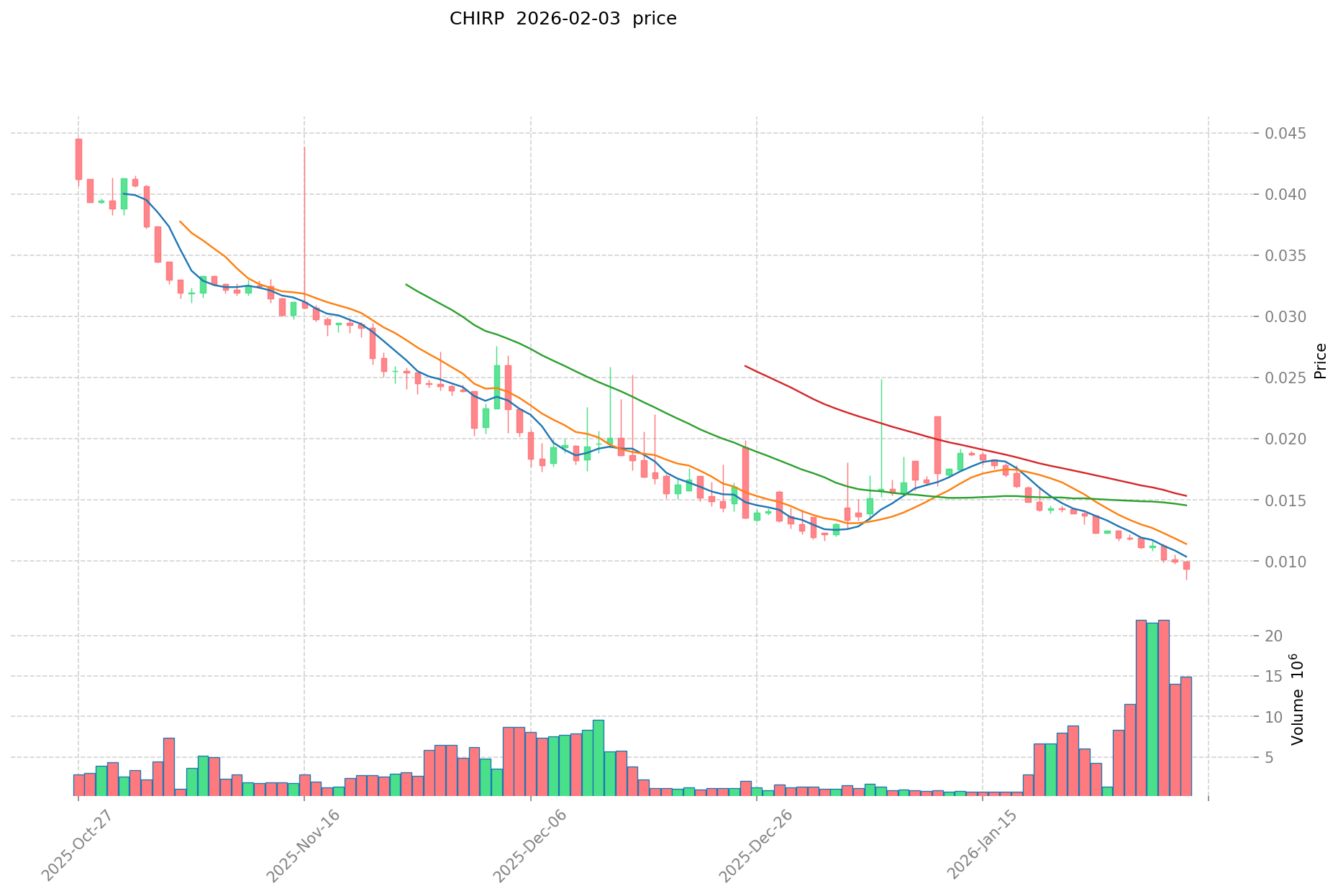
- 2025: CHIRP experienced notable volatility following its market listing in January 2025, with the price reaching an all-time high of $0.7308 on January 20, 2025.
- 2015-2025: ETH underwent multiple market cycles, with significant growth from its 2015 launch price of approximately $0.31 to an all-time high of $4,946.05 recorded on August 25, 2025.
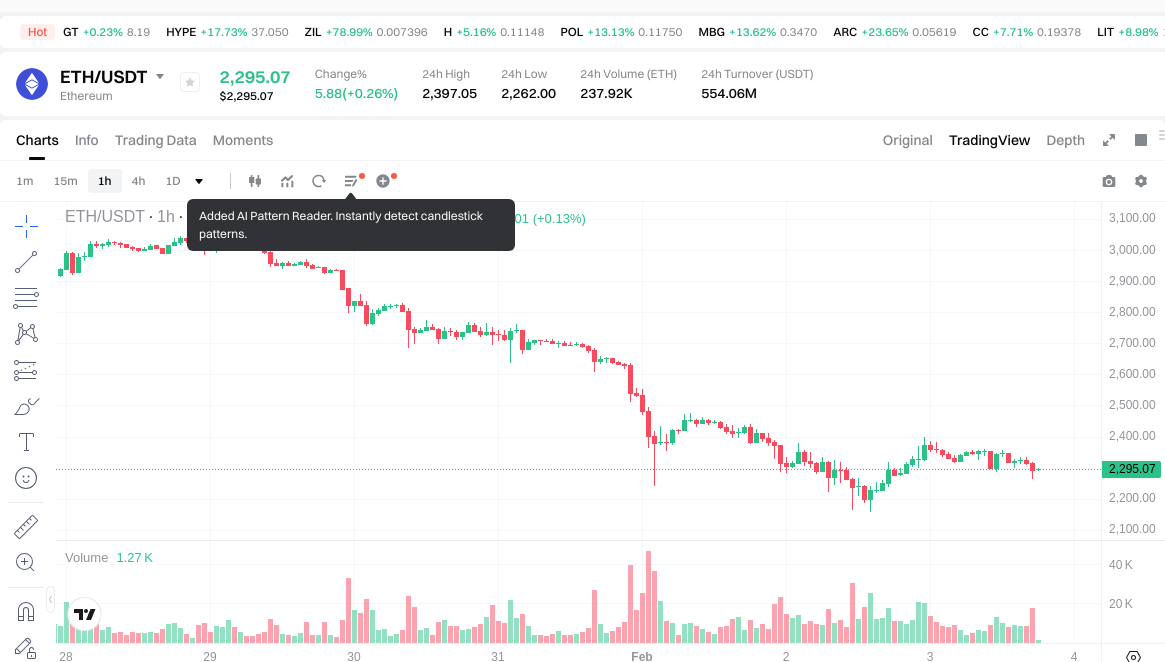
- Comparative Analysis: During recent market cycles, CHIRP declined from its peak of $0.7308 to a low of $0.008488 recorded on February 2, 2026, representing a substantial correction. In contrast, ETH demonstrated relatively more established market behavior, declining from its peak of $4,946.05 to the current price level of $2,292.5, reflecting broader market conditions.
Current Market Status (2026-02-03)
- CHIRP current price: $0.00917
- ETH current price: $2,292.5
- 24-hour trading volume: CHIRP $126,126.77 vs ETH $558,991,744.44
- Market Sentiment Index (Fear & Greed Index): 17 (Extreme Fear)
View real-time prices:
- View CHIRP current price Market Price
- View ETH current price Market Price
II. Core Factors Influencing CHIRP vs ETH Investment Value
Tokenomics Comparison
- CHIRP: The economic model includes total supply, circulating supply, and allocation proportions distributed among teams, investors, and communities, which collectively influence its market dynamics.
- ETH: Ethereum employs a deflationary mechanism following its transition to Proof of Stake, where a portion of transaction fees is burned, potentially reducing supply over time.
- 📌 Historical Pattern: Supply mechanisms can shape price cycles by affecting scarcity perception and market liquidity conditions.
Institutional Adoption and Market Applications
- Institutional Holdings: Ethereum has attracted substantial institutional interest, with various investment funds and enterprises incorporating ETH into their portfolios.
- Enterprise Adoption: ETH serves as infrastructure for DeFi applications, smart contracts, and NFT platforms. CHIRP operates within the DePIN framework, targeting IoT device connectivity through decentralized infrastructure networks.
- Regulatory Landscape: Different jurisdictions maintain varying approaches toward blockchain assets, with regulatory clarity potentially influencing adoption trajectories.
Technical Development and Ecosystem Construction
- CHIRP Technical Position: As a token on the Sui blockchain, CHIRP focuses on providing connectivity solutions for IoT devices through decentralized physical infrastructure networks (DePIN).
- ETH Technical Evolution: Ethereum continues development across Layer 2 scaling solutions and ecosystem enhancements, supporting diverse applications including DeFi protocols, NFT platforms, and smart contract implementations.
- Ecosystem Comparison: Ethereum maintains a substantial presence in DeFi with applications like Uniswap, Aave, and Lido. DePIN projects, including those similar to CHIRP, represent an emerging sector focusing on physical infrastructure decentralization.
Macroeconomic Environment and Market Cycles
- Inflationary Context Performance: Digital assets with supply constraints may exhibit different characteristics in varying inflation scenarios.
- Macroeconomic Policy Influence: Interest rate adjustments, monetary policy shifts, and currency dynamics can affect capital flows within digital asset markets.
- Geopolitical Considerations: Policy regulations and technological innovation developments across multiple dimensions may influence market trends and price fluctuations.
III. 2026-2031 Price Forecast: CHIRP vs ETH
Short-term Forecast (2026)
- CHIRP: Conservative $0.0051-$0.0092 | Optimistic $0.0092-$0.0101
- ETH: Conservative $1,399.76-$2,294.69 | Optimistic $2,294.69-$3,051.94
Mid-term Forecast (2028-2029)
- CHIRP may enter a consolidation phase with projected price range of $0.0071-$0.0155
- ETH may enter an expansion phase with projected price range of $1,891.64-$4,631.25
- Key drivers: institutional capital inflows, ETF developments, ecosystem growth
Long-term Forecast (2030-2031)
- CHIRP: Baseline scenario $0.0113-$0.0163 | Optimistic scenario $0.0163-$0.0232
- ETH: Baseline scenario $2,639.32-$4,639.42 | Optimistic scenario $4,639.42-$5,799.28
View detailed price predictions for CHIRP and ETH
Disclaimer
CHIRP:
| Year |
Predicted High Price |
Predicted Average Price |
Predicted Low Price |
Price Change |
| 2026 |
0.0100903 |
0.009173 |
0.00513688 |
0 |
| 2027 |
0.014254842 |
0.00963165 |
0.008668485 |
5 |
| 2028 |
0.01230154338 |
0.011943246 |
0.01039062402 |
30 |
| 2029 |
0.0155166652032 |
0.01212239469 |
0.0071522128671 |
32 |
| 2030 |
0.018794560727376 |
0.0138195299466 |
0.011332014556212 |
50 |
| 2031 |
0.023156004378522 |
0.016307045336988 |
0.011251861282521 |
77 |
ETH:
| Year |
Predicted High Price |
Predicted Average Price |
Predicted Low Price |
Price Change |
| 2026 |
3051.9377 |
2294.69 |
1399.7609 |
0 |
| 2027 |
3849.571944 |
2673.31385 |
2299.049911 |
16 |
| 2028 |
4631.24891374 |
3261.442897 |
1891.63688026 |
42 |
| 2029 |
4301.5170368533 |
3946.34590537 |
3630.6382329404 |
72 |
| 2030 |
5154.9143388895625 |
4123.93147111165 |
2639.316141511456 |
79 |
| 2031 |
5799.278631250757812 |
4639.42290500060625 |
4268.26907260055775 |
102 |
IV. Investment Strategy Comparison: CHIRP vs ETH
Long-term vs Short-term Investment Strategies
- CHIRP: May align with investors focused on emerging DePIN sector opportunities and IoT infrastructure development, though with considerations for higher volatility characteristics
- ETH: May align with investors seeking exposure to established smart contract platforms with substantial ecosystem presence and institutional participation
Risk Management and Asset Allocation
- Conservative Investors: CHIRP 5-10% vs ETH 90-95%
- Aggressive Investors: CHIRP 15-25% vs ETH 75-85%
- Hedging Tools: Stablecoin allocation, options strategies, cross-asset portfolio diversification
V. Potential Risk Comparison
Market Risk
- CHIRP: Limited liquidity conditions with 24-hour trading volume of $126,126.77, price volatility following recent launch, and ranking at #2525 with market cap of approximately $974,459
- ETH: Market cycles influenced by broader crypto market conditions, regulatory developments, and macroeconomic factors, with 24-hour trading volume of $558,991,744.44 and market cap of approximately $276.69 billion
Technical Risk
- CHIRP: Network stability considerations as a token on the Sui blockchain, ecosystem development stage, and adoption trajectory within DePIN sector
- ETH: Layer 2 scaling implementation progress, network congestion during high activity periods, and ongoing development requirements
Regulatory Risk
- Varying regulatory frameworks across jurisdictions may affect both assets differently, with established assets like ETH potentially facing different regulatory scrutiny compared to emerging tokens like CHIRP
VI. Conclusion: Which Is the Better Buy?
📌 Investment Value Summary:
- CHIRP Characteristics: Focus on emerging DePIN sector and IoT connectivity solutions, token on Sui blockchain, positioned within specialized infrastructure niche
- ETH Characteristics: Established smart contract platform, substantial DeFi ecosystem presence, institutional participation, ongoing technical development
✅ Investment Considerations:
- New Investors: May consider beginning with established assets like ETH to gain familiarity with crypto markets before exploring specialized tokens
- Experienced Investors: May evaluate diversified portfolio approaches incorporating both established platforms and emerging sector exposure based on individual risk tolerance
- Institutional Investors: May assess allocation strategies aligned with investment mandates, considering liquidity requirements, regulatory frameworks, and portfolio objectives
⚠️ Risk Disclosure: Cryptocurrency markets demonstrate significant volatility. This content does not constitute investment advice. Market conditions, prices, and technological developments are subject to change.
VII. FAQ
Q1: What are the main differences between CHIRP and ETH in terms of market positioning?
CHIRP is an emerging token focused on IoT connectivity through DePIN infrastructure on the Sui blockchain, while ETH is an established smart contract platform with substantial DeFi ecosystem presence. CHIRP ranks #2525 with a market cap of approximately $974,459 and launched in January 2025, positioning it as a specialized infrastructure project in early development stages. ETH holds the #2 position with a market cap of approximately $276.69 billion since its 2014 launch, serving as foundational infrastructure for decentralized applications, DeFi protocols, and NFT platforms with significant institutional adoption.
Q2: How do the liquidity levels of CHIRP and ETH compare?
ETH demonstrates substantially higher liquidity with approximately 4,431 times greater trading volume than CHIRP. As of February 3, 2026, ETH records 24-hour trading volume of $558,991,744.44, while CHIRP shows $126,126.77. This liquidity difference reflects ETH's established market presence and widespread exchange availability, potentially allowing for larger position entries and exits with minimal price impact. CHIRP's limited liquidity may result in wider bid-ask spreads and increased price volatility during trading activities.
Q3: What are the key risk factors investors should consider for each asset?
CHIRP presents risks associated with early-stage projects including limited liquidity, ecosystem development uncertainty, and substantial price volatility—having declined from an all-time high of $0.7308 to $0.00917 within one year. ETH faces risks related to regulatory developments across jurisdictions, Layer 2 scaling implementation progress, network congestion during high activity periods, and broader market cycle influences. Both assets demonstrate correlation with macroeconomic conditions, though CHIRP's smaller market cap may amplify volatility during market downturns.
Q4: How do the supply mechanisms of CHIRP and ETH differ?
ETH employs a deflationary mechanism following its transition to Proof of Stake, where transaction fees are partially burned, potentially reducing circulating supply over time and creating scarcity dynamics. CHIRP's economic model includes defined total supply and circulating supply allocations distributed among teams, investors, and communities, though specific burning or inflation mechanisms are not detailed in available information. These differing approaches to supply management may influence long-term price dynamics and scarcity perception within their respective market segments.
Q5: What investment allocation strategies might suit different investor profiles?
Conservative investors may consider allocating 5-10% to CHIRP and 90-95% to ETH, prioritizing established platforms with substantial liquidity and institutional participation. Aggressive investors with higher risk tolerance might allocate 15-25% to CHIRP and 75-85% to ETH, seeking exposure to emerging DePIN sector opportunities while maintaining core holdings in proven infrastructure. New investors may benefit from beginning with ETH to gain familiarity with crypto markets before exploring specialized tokens, while experienced investors can evaluate diversified approaches based on individual risk tolerance and portfolio objectives.
Q6: What are the projected price ranges for CHIRP and ETH through 2031?
Short-term forecasts for 2026 project CHIRP within conservative range of $0.0051-$0.0092 and optimistic range of $0.0092-$0.0101, while ETH is projected within conservative range of $1,399.76-$2,294.69 and optimistic range of $2,294.69-$3,051.94. Long-term forecasts for 2031 suggest CHIRP baseline scenario of $0.0113-$0.0163 and optimistic scenario of $0.0163-$0.0232, whereas ETH baseline scenario projects $2,639.32-$4,639.42 and optimistic scenario projects $4,639.42-$5,799.28. These projections assume various factors including institutional capital inflows, ecosystem growth, and technological development progress.
Q7: How do the technical ecosystems of CHIRP and ETH differ in practical applications?
ETH serves as infrastructure for diverse applications including DeFi protocols like Uniswap and Aave, NFT platforms, and smart contract implementations across multiple sectors, demonstrating established utility with substantial developer activity. CHIRP operates within the DePIN framework, specifically targeting IoT device connectivity through decentralized physical infrastructure networks on the Sui blockchain, representing an emerging sector focused on physical infrastructure decentralization. While ETH provides broad-spectrum platform functionality with proven use cases, CHIRP addresses specialized infrastructure requirements within the IoT connectivity niche.
Q8: What role does institutional adoption play in the comparison between CHIRP and ETH?
Institutional adoption significantly differentiates the two assets, with ETH attracting substantial institutional interest through investment funds, enterprise portfolios, and potential ETF developments, contributing to market depth and price stability. CHIRP, as a recently launched token in an emerging sector, has not yet demonstrated comparable institutional participation, with adoption trajectory dependent on DePIN sector maturation and IoT infrastructure demand validation. Institutional involvement typically correlates with enhanced liquidity, regulatory clarity, and market confidence, factors that currently favor ETH's investment profile compared to CHIRP's early-stage positioning.
* The information is not intended to be and does not constitute financial advice or any other recommendation of any sort offered or endorsed by Gate.