This comprehensive analysis compares DIN and HBAR, two rising blockchain cryptocurrencies with distinct positioning in the crypto market. DIN, launched in February 2025 as the first AI Agent Blockchain, focuses on AI-powered decentralized applications, while HBAR, operational since February 2020, emphasizes fast transaction speeds and distributed ledger technology. The article examines historical price trends, market fundamentals, tokenomics, institutional adoption, and technology ecosystems to evaluate investment value. Through detailed price predictions spanning 2026-2031, risk assessments, and portfolio allocation strategies, the comparison addresses critical questions for both novice and experienced investors on Gate. Ultimately, HBAR demonstrates greater stability and liquidity, while DIN presents emerging growth opportunities in AI-blockchain convergence, requiring investors to align selections with their risk tolerance and investment horizons.
Introduction: Investment Comparison Between DIN and HBAR
In the cryptocurrency market, the comparison between DIN vs HBAR has become a topic of growing interest among investors. These two assets differ significantly in market cap rankings, application scenarios, and price performance, representing distinct positioning within the crypto asset landscape.
DIN (DIN): Launched in February 2025, this project has gained attention as the first AI Agent Blockchain, built on the Data Intelligence Network foundation. It aims to provide comprehensive solutions and infrastructure for AI agents and decentralized AI applications (dAI-Apps).
HBAR (HBAR): Since its launch in February 2020, Hedera has been recognized for its fast transaction speeds (>10,000+ TPS), security features utilizing hashgraph consensus, and fair transaction ordering. HBAR serves as the native cryptocurrency of the Hedera public network, supporting decentralized applications and payment models.
This article will provide a comprehensive analysis of DIN vs HBAR investment value comparison, covering historical price trends, supply mechanisms, institutional adoption, technological ecosystems, and future predictions, attempting to address investors' most pressing question:
"Which is the better buy right now?"
I. Historical Price Comparison and Current Market Status
DIN and HBAR Historical Price Trends
- 2025: DIN experienced significant volatility following its launch in February 2025, with an initial price of $0.8 before declining substantially. The token reached a peak of $3.6641 in February 2025.
- 2021: HBAR was influenced by broader crypto market momentum, reaching its peak price of $0.569229 in September 2021 during the bull market cycle.
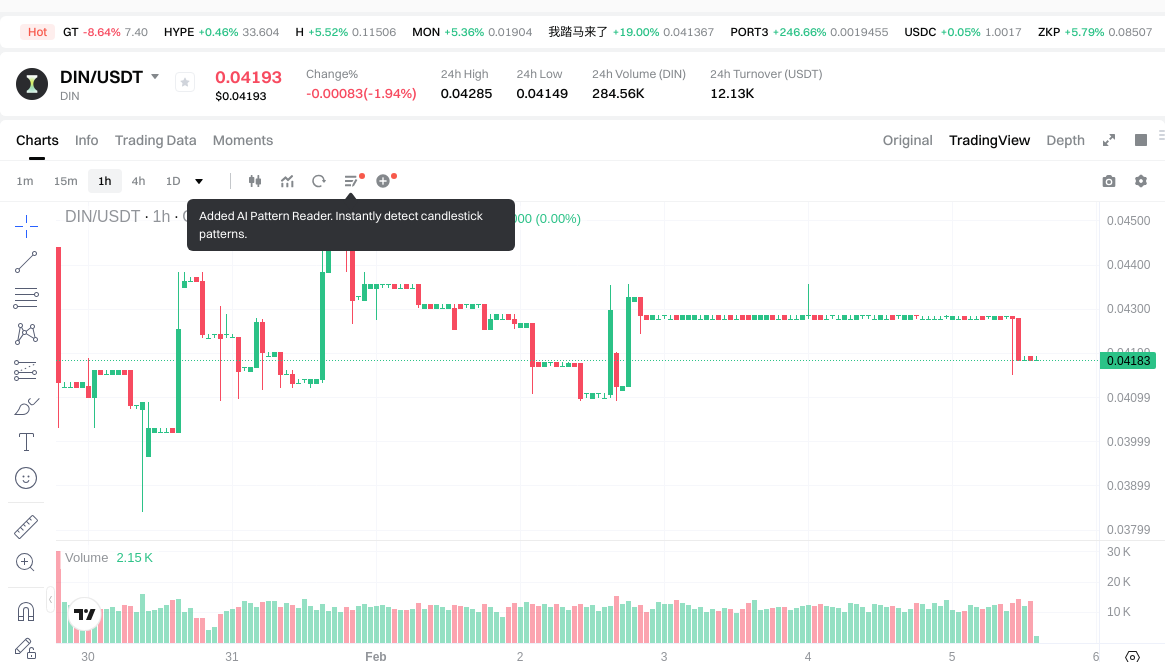
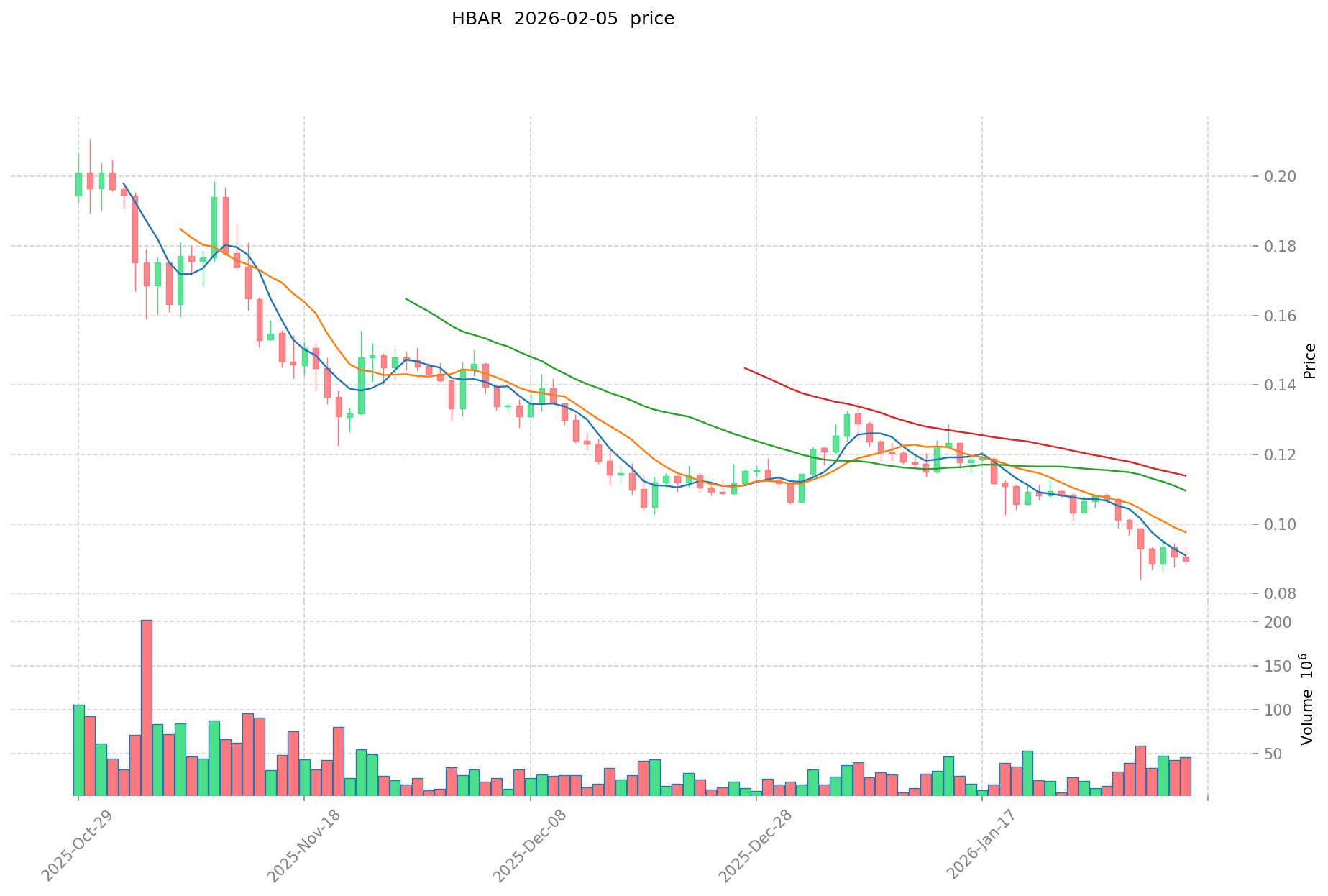
- Comparative Analysis: During the 2025-2026 market cycle, DIN declined from its high of $3.6641 to approximately $0.04183, representing a decline of over 98%, while HBAR decreased from its 2021 peak of $0.569229 to around $0.08788, reflecting a decline of approximately 84%.
Current Market Status (2026-02-05)
- DIN current price: $0.04183
- HBAR current price: $0.08788
- 24-hour trading volume: DIN $12,103.28 vs HBAR $4,786,459.81
- Market Sentiment Index (Fear & Greed Index): 12 (Extreme Fear)
View real-time prices:
- View DIN current price Market Price
- View HBAR current price Market Price
II. Core Factors Influencing DIN vs HBAR Investment Value
Supply Mechanism Comparison (Tokenomics)
- DIN: The reference materials do not contain specific information regarding DIN's supply mechanism or tokenomics model.
- HBAR: The reference materials do not contain specific information regarding HBAR's supply mechanism or tokenomics model.
- 📌 Historical Pattern: Supply mechanisms can influence price cycles through factors such as scarcity dynamics and emission schedules, though specific historical data for these assets is not covered in the available materials.
Institutional Adoption and Market Application
- Institutional Holdings: The reference materials suggest that HBAR may attract attention due to its privacy features and potential ETF catalysts, though specific institutional holding data is not detailed.
- Enterprise Adoption: According to the materials, DIN has shown optimization in payment experience, while HBAR's privacy upgrades may expand its functional applications. However, specific enterprise adoption cases in cross-border payments, settlements, or investment portfolios are not elaborated.
- National Policy: The materials do not provide detailed information on regulatory attitudes toward DIN or HBAR across different jurisdictions.
Technology Development and Ecosystem Building
- DIN Technology Upgrades: The materials mention that DIN has made improvements in payment experience optimization, which may enhance user adoption and network utility.
- HBAR Technology Development: HBAR's privacy functionality upgrades are noted as a key development area that could expand its use cases and market positioning.
- Ecosystem Comparison: The reference materials indicate stable on-chain fundamentals and whale capital inflows for these networks, suggesting resilient ecosystem activity. However, specific comparisons regarding DeFi, NFT, payment systems, or smart contract deployment are not provided.
Macroeconomic and Market Cycles
- Performance Under Inflationary Environments: The materials do not contain specific analysis on how DIN or HBAR perform as inflation hedges.
- Macroeconomic Monetary Policy: The reference materials do not detail the impact of interest rates, U.S. dollar index movements, or other macroeconomic factors on these assets.
- Geopolitical Factors: While the materials reference cross-border payment optimization as a value driver for DIN, specific geopolitical considerations or international demand dynamics are not extensively covered.
III. 2026-2031 Price Prediction: DIN vs HBAR
Short-term Prediction (2026)
- DIN: Conservative scenario suggests a range between 0.0243 and 0.0419, with an optimistic outlook reaching up to 0.0615
- HBAR: Conservative scenario indicates a range between 0.0526 and 0.0877, with an optimistic outlook potentially reaching 0.1009
Mid-term Prediction (2028-2029)
- DIN may enter a phase of moderate volatility, with anticipated price ranges between 0.0297 and 0.0687 by 2029
- HBAR may experience gradual growth, with projected ranges between 0.0719 and 0.1347 by 2029
- Key drivers: institutional capital flows, ETF developments, ecosystem expansion
Long-term Prediction (2030-2031)
- DIN: Baseline scenario suggests a range between 0.0464 and 0.0713 by 2031, with optimistic scenarios potentially reaching 0.0794
- HBAR: Baseline scenario indicates a range between 0.1185 and 0.1549 by 2031, with optimistic scenarios possibly extending to 0.1757
View detailed price predictions for DIN and HBAR
Disclaimer: Price predictions are based on historical data analysis and market modeling. Cryptocurrency markets are highly volatile and subject to numerous unpredictable factors. These projections should not be considered as investment advice, and actual market performance may differ significantly from forecasted values.
DIN:
| Year |
Predicted High Price |
Predicted Average Price |
Predicted Low Price |
Price Change |
| 2026 |
0.0614901 |
0.04183 |
0.0242614 |
0 |
| 2027 |
0.0625086605 |
0.05166005 |
0.043394442 |
23 |
| 2028 |
0.05936772946 |
0.05708435525 |
0.053659293935 |
36 |
| 2029 |
0.0687067299789 |
0.058226042355 |
0.02969528160105 |
39 |
| 2030 |
0.071082352506984 |
0.06346638616695 |
0.055215755965246 |
51 |
| 2031 |
0.079383755817621 |
0.067274369336967 |
0.046419314842507 |
60 |
HBAR:
| Year |
Predicted High Price |
Predicted Average Price |
Predicted Low Price |
Price Change |
| 2026 |
0.100901 |
0.08774 |
0.052644 |
0 |
| 2027 |
0.09997973 |
0.0943205 |
0.08300204 |
7 |
| 2028 |
0.12920965295 |
0.097150115 |
0.0718910851 |
10 |
| 2029 |
0.13468406193025 |
0.113179883975 |
0.10073009673775 |
28 |
| 2030 |
0.154914966190781 |
0.123931972952625 |
0.065683945664891 |
41 |
| 2031 |
0.175673571660345 |
0.139423469571703 |
0.118509949135947 |
58 |
IV. Investment Strategy Comparison: DIN vs HBAR
Long-term vs Short-term Investment Strategies
- DIN: May appeal to investors focused on emerging AI-blockchain infrastructure and payment optimization scenarios, though the asset has experienced significant volatility since launch
- HBAR: May attract investors seeking exposure to established distributed ledger technology with demonstrated network stability and transaction throughput capabilities
Risk Management and Asset Allocation
- Conservative Investors: DIN: 20-30% vs HBAR: 70-80%
- Aggressive Investors: DIN: 40-50% vs HBAR: 50-60%
- Hedging Tools: Stablecoin allocation, options strategies, cross-asset diversification approaches
V. Potential Risk Comparison
Market Risks
- DIN: High volatility profile with over 98% decline from peak levels, limited trading volume ($12,103.28 in 24-hour period), and uncertain price recovery trajectory
- HBAR: Moderate volatility with approximately 84% decline from historical peak, substantially higher liquidity ($4,786,459.81 in 24-hour volume), and more established market presence
Technical Risks
- DIN: Scalability considerations, network stability factors in early development phase
- HBAR: Network architecture dependencies, ongoing privacy upgrade implementation requirements
Regulatory Risks
- Global regulatory frameworks may impact both assets differently based on their functional classifications, use cases, and jurisdictional deployment patterns
VI. Conclusion: Which Is the Better Buy?
📌 Investment Value Summary:
- DIN Advantages: Early-stage positioning in AI-blockchain convergence, payment experience optimization developments
- HBAR Advantages: Established network infrastructure, higher transaction throughput capacity, greater market liquidity, and more moderate historical volatility patterns
✅ Investment Recommendations:
- Novice Investors: Consider HBAR for relatively more established market presence and higher liquidity, with smaller allocation to DIN if seeking exposure to emerging AI-blockchain sectors
- Experienced Investors: Evaluate portfolio diversification across both assets based on risk tolerance, with attention to DIN's higher volatility profile and HBAR's more stable trading characteristics
- Institutional Investors: Conduct comprehensive due diligence on ecosystem fundamentals, regulatory positioning, and long-term technological development roadmaps before allocation decisions
⚠️ Risk Warning: Cryptocurrency markets exhibit extreme volatility. This analysis does not constitute investment advice.
VII. FAQ
Q1: What is the main difference between DIN and HBAR in terms of their core technology and use cases?
DIN focuses on AI-blockchain infrastructure as the first AI Agent Blockchain, while HBAR operates as an established distributed ledger utilizing hashgraph consensus technology. DIN aims to provide comprehensive solutions for AI agents and decentralized AI applications (dAI-Apps) with optimization in payment experiences, launched in February 2025. HBAR, launched in February 2020, emphasizes fast transaction speeds (>10,000+ TPS), security features, and fair transaction ordering, serving as the native cryptocurrency for the Hedera public network supporting decentralized applications and payment models.
Q2: Which asset has shown better price stability since their respective launches?
HBAR has demonstrated relatively better price stability compared to DIN. Since its 2021 peak, HBAR declined approximately 84% to its current price of $0.08788, whereas DIN experienced a more severe decline of over 98% from its February 2025 peak of $3.6641 to approximately $0.04183. Additionally, HBAR's 24-hour trading volume of $4,786,459.81 significantly exceeds DIN's $12,103.28, indicating substantially higher market liquidity and more established trading patterns.
Q3: What are the projected price ranges for DIN and HBAR by 2031?
According to long-term predictions, DIN's baseline scenario suggests a range between $0.0464 and $0.0713 by 2031, with optimistic scenarios potentially reaching $0.0794, representing approximately 60% growth from current levels. HBAR's baseline scenario indicates a range between $0.1185 and $0.1549 by 2031, with optimistic scenarios possibly extending to $0.1757, representing approximately 58% growth. These projections are based on historical data analysis and market modeling, though actual performance may differ significantly due to market volatility and unpredictable factors.
Q4: How should investors allocate their portfolio between DIN and HBAR based on risk tolerance?
Conservative investors may consider allocating 20-30% to DIN and 70-80% to HBAR, prioritizing the more established asset with higher liquidity and moderate volatility. Aggressive investors might consider a 40-50% allocation to DIN and 50-60% to HBAR, accepting higher volatility in exchange for potential exposure to emerging AI-blockchain infrastructure. Both strategies should incorporate risk management tools such as stablecoin allocation, options strategies, and cross-asset diversification approaches to mitigate downside risks.
Q5: What are the primary risks associated with investing in DIN versus HBAR?
DIN presents higher market risks including extreme volatility (98% decline from peak), limited trading volume ($12,103.28 daily), uncertain price recovery trajectory, and early-stage technical considerations regarding scalability and network stability. HBAR carries moderate risks with approximately 84% decline from historical peak, but benefits from substantially higher liquidity ($4,786,459.81 daily volume), more established market presence, and proven network infrastructure. Both assets face regulatory risks depending on their functional classifications, use cases, and jurisdictional deployment patterns.
Q6: Which asset is more suitable for institutional investors?
HBAR may be more suitable for institutional investors due to its established network infrastructure, higher transaction throughput capacity (>10,000+ TPS), significantly greater market liquidity, and more moderate historical volatility patterns. The asset's longer operational track record since February 2020 provides more comprehensive data for risk assessment. However, institutional investors should conduct comprehensive due diligence on ecosystem fundamentals, regulatory positioning, and long-term technological development roadmaps before making allocation decisions for either asset.
Q7: What technological developments could impact the future value of DIN and HBAR?
DIN's future value drivers include developments in payment experience optimization and advancements in AI-blockchain infrastructure convergence, positioning it within the emerging AI agent ecosystem. HBAR's value trajectory may be influenced by privacy functionality upgrades, which could expand its use cases and market positioning beyond current applications. Both networks demonstrate stable on-chain fundamentals and whale capital inflows, suggesting resilient ecosystem activity. However, investors should monitor specific developments in DeFi integration, smart contract deployment, and enterprise adoption patterns for comprehensive assessment.
Q8: How do current market conditions (Extreme Fear at index 12) affect investment decisions for DIN and HBAR?
The current Fear & Greed Index of 12 (Extreme Fear) indicates pessimistic market sentiment, which historically has presented potential accumulation opportunities for long-term investors with strong risk tolerance. Under these conditions, HBAR's higher liquidity and more established market presence may offer relatively safer entry points, while DIN's extreme volatility requires careful position sizing. Investors should consider dollar-cost averaging strategies, maintain adequate cash reserves for potential further downside, and avoid over-leveraging positions. The extreme fear environment underscores the importance of thorough due diligence and disciplined risk management regardless of which asset is selected.
* The information is not intended to be and does not constitute financial advice or any other recommendation of any sort offered or endorsed by Gate.