This comprehensive guide compares GAI and IMX as Layer 2 scaling solutions for cryptocurrency investors in 2024-2026. GAI, launched in 2025, positions itself as an AI-native data layer for Web3, while IMX established itself as a gaming-focused Layer 2 solution on Ethereum. The article analyzes historical price trends, market capitalization, trading volumes, and tokenomics to evaluate investment potential. GAI trades at $0.01809 with lower liquidity ($15,602 daily volume), while IMX trades at $0.1819 with superior liquidity ($357,469 daily volume). Through detailed examination of institutional adoption, technological ecosystems, and regulatory environments, the analysis provides 2026-2031 price projections and tailored investment strategies for conservative, aggressive, and institutional investors. Risk assessments address liquidity constraints, technology implementation challenges, and market cyclicality affecting both assets. The guide includes FAQ covering liquidity comparisons, growth potential, and invest
Introduction: GAI and IMX Investment Comparison
In the cryptocurrency market, the comparison between GAI and IMX has consistently been a topic that investors cannot overlook. The two differ notably in market capitalization ranking, application scenarios, and price performance, representing distinct positioning within the crypto asset landscape.
GraphAI (GAI): Launched in 2025, it has gained market recognition by positioning itself as an AI-native data layer for Web3, transforming blockchain events into structured knowledge graphs.
Immutable (IMX): Since its establishment, it has been recognized as a Layer 2 scaling solution for NFTs on Ethereum, becoming one of the cryptocurrencies with substantial trading volume in the NFT infrastructure space.
This article will provide a comprehensive analysis of the GAI vs IMX investment value comparison, focusing on historical price trends, supply mechanisms, institutional adoption, technological ecosystems, and future projections, attempting to answer the question that concerns investors most:
"Which is the better buy right now?"
I. Historical Price Comparison and Current Market Status
GAI (Coin A) and IMX (Coin B) Historical Price Trends
- 2025: GAI reached a price of $0.5078 on September 16, 2025, marking a significant milestone in its price trajectory.
- 2021: IMX experienced substantial price movements, reaching $9.52 on November 26, 2021, influenced by early market enthusiasm for NFT scaling solutions.
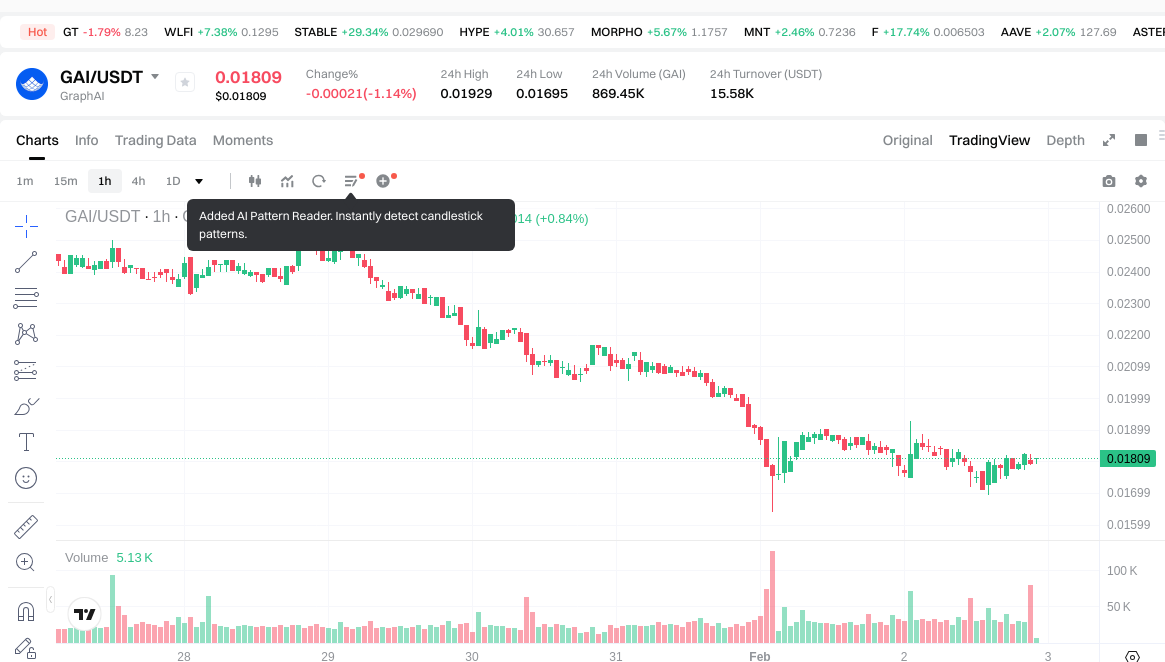
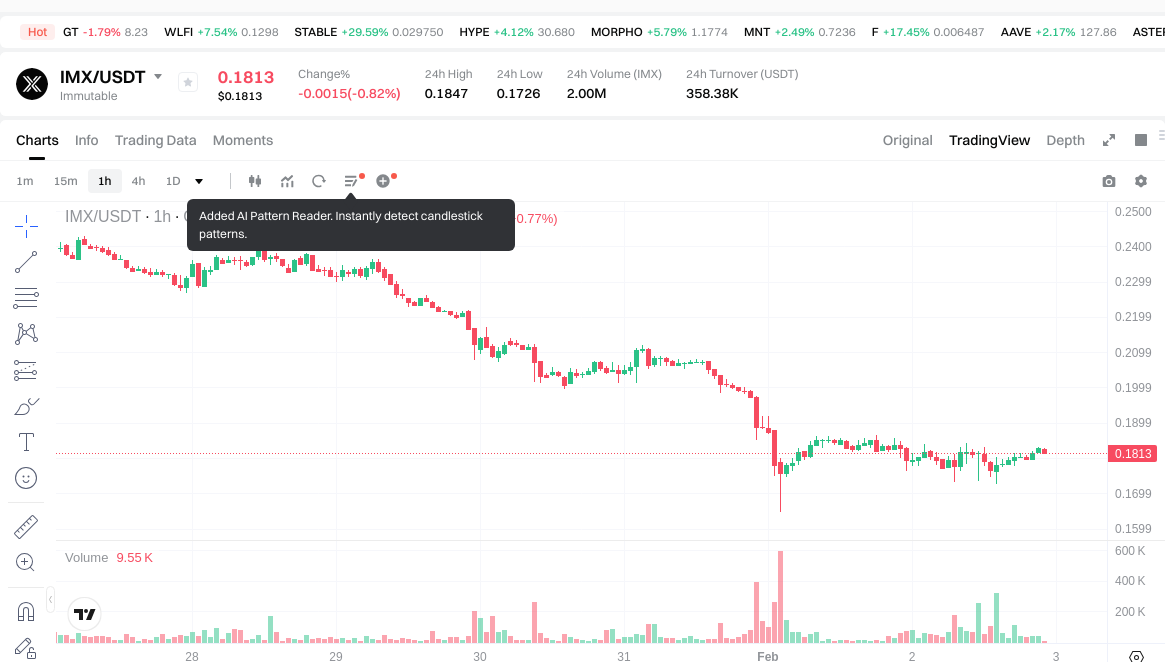
- Comparative Analysis: During the recent market cycle, GAI declined from its high of $0.5078 to a low of $0.0164 on January 31, 2026, representing a significant correction. In contrast, IMX dropped from its peak of $9.52 to $0.174285 on February 2, 2026, demonstrating a more pronounced decline over a longer timeframe.
Current Market Status (2026-02-02)
- GAI Current Price: $0.01809
- IMX Current Price: $0.1819
- 24-Hour Trading Volume: GAI $15,602.61269 vs IMX $357,469.567984
- Market Sentiment Index (Fear & Greed Index): 14 (Extreme Fear)
View real-time prices:
II. Core Factors Influencing GAI vs IMX Investment Value
Tokenomics Comparison
-
GAI: The reference materials do not provide specific information about GAI's supply mechanism or tokenomics design. Without verifiable data on total supply, distribution model, or emission schedule, a comprehensive assessment cannot be made.
-
IMX: According to market reference data, IMX operates as the native utility token for the Immutable X gaming chain. During the previous bull market peak, IMX reached an FDV (Fully Diluted Valuation) of approximately $18 billion. The token serves multiple functions within its gaming ecosystem, though specific supply parameters were not detailed in the materials.
-
📌 Historical Pattern: Token supply mechanisms significantly influence price cycles through inflationary or deflationary pressures. Gaming tokens with utility-driven demand and controlled emission schedules tend to exhibit different volatility patterns compared to fixed-supply assets.
Institutional Adoption and Market Application
-
Institutional Holdings: The reference materials indicate that blockchain gaming projects have attracted attention from institutional investors, particularly in regions with high crypto penetration rates combined with strong gaming consumption and development capabilities, such as Europe, North America, and South Korea.
-
Enterprise Adoption: GameFi projects have demonstrated applications in virtual economies, digital asset trading, and NFT-based gaming assets. The materials note that IMX has partnered with Starkware for infrastructure development, suggesting strategic positioning in the Layer 2 gaming ecosystem. However, specific enterprise adoption metrics for GAI were not available in the provided materials.
-
Regulatory Environment: The gaming and blockchain sectors face varying regulatory approaches across jurisdictions. The materials mention licensing requirements, tax considerations, and compliance challenges as factors affecting GameFi project operations, though specific policy stances toward GAI or IMX were not detailed.
Technology Development and Ecosystem Building
-
GAI Technology: The reference materials do not contain specific information about GAI's technological infrastructure, upgrade roadmap, or technical capabilities.
-
IMX Technology Development: IMX operates as a gaming-specific blockchain with partnerships in the Layer 2 space. The materials indicate ongoing infrastructure collaborations, though the platform faces challenges in attracting high-activity, large user-base gaming projects. The ecosystem includes specialized gaming chains like Immutable X, WAX, and Klaytn.
-
Ecosystem Comparison: The blockchain gaming sector encompasses various elements including game engines (Unity), development tools, cloud rendering, specialized gaming chains, guilds (such as YGG), and on/off-ramp services. The materials note that GameFi represents one of the most actively traded sectors with practical applications. However, direct ecosystem comparisons between GAI and IMX in areas such as DeFi integration, NFT functionality, payment systems, and smart contract deployment were not available in the reference materials.
Macroeconomic Environment and Market Cycles
-
Inflationary Environment Performance: The materials do not provide specific data comparing how GAI and IMX perform under inflationary conditions. Gaming tokens generally exhibit characteristics influenced by community engagement and technological innovation rather than traditional inflation hedges.
-
Monetary Policy Impact: Interest rate policies and dollar index movements affect crypto asset valuations broadly. The materials indicate that market trends and regulatory environments play significant roles in determining investment value for blockchain gaming projects, though specific correlations for GAI and IMX were not quantified.
-
Geopolitical Factors: The reference materials note that regions with high crypto penetration, strong gaming consumption, and developed gaming industries tend to lead GameFi investment and development. Southeast Asia, Latin America, and Africa are identified as early adopters, while Europe, North America, and South Korea are positioned as potential long-term leaders in capturing GameFi demand evolution and possessing development capabilities. However, specific geopolitical impacts on GAI versus IMX were not addressed in the available materials.
III. 2026-2031 Price Prediction: GAI vs IMX
Short-term Forecast (2026)
- GAI: Conservative $0.0110-$0.0181 | Optimistic $0.0181-$0.0212
- IMX: Conservative $0.159-$0.183 | Optimistic $0.183-$0.248
Medium-term Forecast (2028-2029)
- GAI may enter a gradual growth phase, with projected price range of $0.0173-$0.0395
- IMX may enter a moderate expansion stage, with projected price range of $0.119-$0.310
- Key drivers: institutional capital inflows, ETF developments, ecosystem expansion
Long-term Forecast (2031)
- GAI: Base scenario $0.0198-$0.0359 | Optimistic scenario $0.0359-$0.0514
- IMX: Base scenario $0.178-$0.301 | Optimistic scenario $0.301-$0.409
View detailed price predictions for GAI and IMX
Disclaimer
GAI:
| Year |
Predicted High Price |
Predicted Average Price |
Predicted Low Price |
Price Change |
| 2026 |
0.0211653 |
0.01809 |
0.0110349 |
0 |
| 2027 |
0.0253196685 |
0.01962765 |
0.011384037 |
8 |
| 2028 |
0.03236206932 |
0.02247365925 |
0.0173047176225 |
24 |
| 2029 |
0.0394817245704 |
0.027417864285 |
0.02385354192795 |
51 |
| 2030 |
0.038467263591855 |
0.0334497944277 |
0.028432325263545 |
84 |
| 2031 |
0.051420696483981 |
0.035958529009777 |
0.019777190955377 |
98 |
IMX:
| Year |
Predicted High Price |
Predicted Average Price |
Predicted Low Price |
Price Change |
| 2026 |
0.248336 |
0.1826 |
0.158862 |
0 |
| 2027 |
0.25209756 |
0.215468 |
0.15944632 |
18 |
| 2028 |
0.2548232302 |
0.23378278 |
0.1192292178 |
28 |
| 2029 |
0.310264816477 |
0.2443030051 |
0.124594532601 |
34 |
| 2030 |
0.324422175622545 |
0.2772839107885 |
0.2218271286308 |
52 |
| 2031 |
0.40916013875951 |
0.300853043205522 |
0.177503295491258 |
65 |
IV. Investment Strategy Comparison: GAI vs IMX
Long-term vs Short-term Investment Strategies
-
GAI: May suit investors focused on emerging AI-data infrastructure narratives within Web3, with tolerance for higher volatility and earlier-stage project risks. The asset's relatively recent launch and smaller market presence suggest positioning for speculative growth potential rather than established stability.
-
IMX: May appeal to investors seeking exposure to the NFT and blockchain gaming infrastructure sector, with interest in Layer 2 scaling solutions on Ethereum. The project's longer operational history and established partnerships provide a different risk-return profile compared to newer entrants.
Risk Management and Asset Allocation
-
Conservative Investors: GAI 10-15% vs IMX 20-30%, with remainder allocated to established assets and stablecoins. Conservative portfolios typically emphasize projects with longer track records and clearer utility.
-
Aggressive Investors: GAI 25-35% vs IMX 30-40%, allowing higher exposure to growth-oriented assets while maintaining diversification across different blockchain sectors.
-
Hedging Tools: Stablecoin reserves for volatility management, options strategies where available, cross-asset portfolio construction incorporating assets with low correlation to reduce overall portfolio risk.
V. Potential Risk Comparison
Market Risk
-
GAI: Exposure to liquidity constraints given lower trading volumes ($15,602 daily), potential for elevated price volatility, correlation with broader AI and Web3 sentiment cycles, and sensitivity to market conditions during the current Extreme Fear environment (Fear & Greed Index: 14).
-
IMX: Subject to NFT market cyclicality, dependency on gaming sector adoption trends, competition from alternative Layer 2 solutions, and broader cryptocurrency market movements. Historical price decline from $9.52 to current levels demonstrates significant drawdown risk during adverse market conditions.
Technology Risk
-
GAI: Limited publicly available information regarding technical infrastructure, scalability parameters, and network stability metrics creates uncertainty for technical due diligence. The nascent stage of development may present both opportunity and technical implementation challenges.
-
IMX: Faces ecosystem development challenges, particularly in attracting high-activity gaming projects with substantial user bases. Dependency on Layer 2 partnerships (such as Starkware collaboration) introduces counterparty and integration risks. Gaming blockchain competition from specialized chains (WAX, Klaytn) may impact market positioning.
Regulatory Risk
- Jurisdictional variations in crypto asset treatment, gaming token classifications, and NFT regulatory frameworks may affect both projects differently. GameFi projects face licensing requirements, tax considerations, and compliance obligations that vary by region. Regions with established crypto and gaming industries (Europe, North America, South Korea) may implement different regulatory approaches compared to emerging markets (Southeast Asia, Latin America, Africa), potentially creating geographical performance disparities.
VI. Conclusion: Which Is the Better Buy?
📌 Investment Value Summary:
-
GAI Characteristics: Represents exposure to AI-native data infrastructure narrative within Web3, with positioning in the emerging knowledge graph sector. The project's early stage offers speculative growth potential accompanied by correspondingly higher risk factors including limited liquidity and unproven long-term viability.
-
IMX Characteristics: Provides access to established NFT and gaming infrastructure on Ethereum Layer 2, with operational history and strategic partnerships supporting its market position. The asset offers exposure to blockchain gaming trends while facing sector-specific challenges including adoption hurdles and ecosystem competition.
✅ Investment Considerations:
-
Newer Investors: May consider starting with smaller allocations to either asset within a diversified portfolio, prioritizing education about each project's fundamentals, ecosystem positioning, and risk factors. Emphasis should be placed on understanding volatility characteristics and avoiding concentration in single assets.
-
Experienced Investors: Could evaluate portfolio allocation based on sector preferences (AI-data infrastructure vs gaming-NFT infrastructure), risk tolerance, and investment timeline. Consideration of correlation with existing holdings and strategic rebalancing during market cycles may enhance risk-adjusted returns.
-
Institutional Investors: May assess both assets within broader crypto exposure strategies, evaluating liquidity profiles, custody solutions, regulatory compliance frameworks, and alignment with investment mandates. Due diligence on governance structures, token economics, and long-term sustainability factors remains essential.
⚠️ Risk Disclosure: Cryptocurrency markets demonstrate substantial volatility and uncertainty. This content does not constitute investment advice, financial guidance, or recommendations to purchase, hold, or dispose of any assets. Investment decisions should be made following comprehensive research and consultation with qualified financial professionals.
VII. FAQ
Q1: Which project has better liquidity - GAI or IMX?
IMX demonstrates significantly superior liquidity compared to GAI. As of February 2, 2026, IMX records a 24-hour trading volume of $357,469.57, while GAI shows only $15,602.61 in daily volume - representing a 23-fold difference. This substantial liquidity gap affects execution risk, price slippage, and the ability to enter or exit positions efficiently. For investors prioritizing trade execution quality and reduced market impact costs, IMX offers a considerably more liquid market environment.
Q2: What are the primary risks facing each investment?
GAI faces early-stage project risks including limited liquidity, uncertain technological validation, and minimal publicly available infrastructure information. Its position in the emerging AI-native data layer sector presents both speculative opportunity and heightened uncertainty. IMX confronts sector-specific challenges including NFT market cyclicality, dependency on gaming adoption rates, competition from alternative Layer 2 solutions, and the ongoing difficulty attracting high-activity gaming projects with substantial user bases. Both assets remain subject to broader cryptocurrency market volatility and regulatory uncertainty.
Q3: How do the price predictions compare between GAI and IMX through 2031?
IMX maintains consistently higher absolute price projections across all timeframes. By 2031, IMX's optimistic scenario forecasts $0.301-$0.409, while GAI projects $0.0359-$0.0514. However, percentage growth potential differs: GAI shows projected growth of approximately 98% from current levels to 2031, compared to IMX's 65% growth projection. This reflects GAI's earlier development stage and higher risk-reward profile, whereas IMX represents a more established asset with moderate growth expectations within the gaming infrastructure sector.
Q4: What investor profiles suit each cryptocurrency?
GAI may appeal to aggressive investors comfortable with speculative positions in emerging AI-Web3 infrastructure narratives, higher volatility tolerance, and acceptance of early-stage project risks. Recommended allocation ranges from 10-15% for conservative portfolios to 25-35% for aggressive strategies. IMX suits investors seeking exposure to established NFT and blockchain gaming infrastructure, with interest in Ethereum Layer 2 scaling solutions. Conservative investors might allocate 20-30%, while aggressive portfolios could hold 30-40%. Both require diversification within broader cryptocurrency portfolios rather than concentrated positions.
Q5: How does the current market sentiment affect these investments?
The current Fear & Greed Index of 14 (Extreme Fear) creates challenging conditions for both assets, though with different implications. GAI, with its lower liquidity and earlier stage, faces heightened volatility risk during fear-driven market environments, potentially experiencing sharper price movements on lower volume. IMX, despite better liquidity, remains vulnerable to sector-specific sentiment regarding NFT and gaming adoption trends. Historically, extreme fear conditions present both risk and opportunity - increased downside volatility for existing positions but potentially attractive entry points for long-term investors with appropriate risk management strategies.
Q6: What technological advantages differentiate these projects?
GAI positions itself as an AI-native data layer for Web3, focusing on transforming blockchain events into structured knowledge graphs - representing participation in the intersection of artificial intelligence and decentralized infrastructure. IMX operates as a specialized Layer 2 scaling solution for NFTs on Ethereum, with established partnerships including Starkware collaboration, targeting gaming-specific blockchain applications. The fundamental difference lies in sector focus: GAI addresses data infrastructure and AI integration, while IMX concentrates on gaming and NFT scalability. However, limited publicly available technical specifications for GAI create information asymmetry compared to IMX's more established technical documentation.
Q7: Which asset performed better during previous market cycles?
Historical performance shows distinct patterns. IMX reached its all-time high of $9.52 in November 2021 during the NFT market boom, but has since declined to $0.1819 - representing an approximately 98% drawdown from peak levels. GAI, launched in 2025, peaked at $0.5078 in September 2025 and declined to $0.0164 by January 2026 - a significant correction within a shorter operational timeframe. IMX demonstrates a longer track record through complete market cycles, while GAI's limited history provides insufficient data for comprehensive cycle analysis. Neither asset has proven resilience through extended bear markets followed by recovery periods.
Q8: How do regional factors affect investment prospects for these assets?
Geographic considerations differ between the projects. IMX, as a gaming-focused blockchain, benefits from regions with strong gaming consumption and development capabilities - particularly Europe, North America, and South Korea for long-term ecosystem development, while Southeast Asia, Latin America, and Africa show early adoption patterns. GAI's AI-native data infrastructure positioning may correlate with regions emphasizing Web3 development and artificial intelligence integration, though specific geographic adoption patterns remain unclear given its recent launch. Regulatory environments vary significantly across jurisdictions, affecting both assets through differing approaches to gaming tokens, NFT classifications, and data infrastructure frameworks.
* The information is not intended to be and does not constitute financial advice or any other recommendation of any sort offered or endorsed by Gate.