IRIS vs RUNE: A Comprehensive Comparison of Two Leading Blockchain Ecosystems

Introduction: Investment Comparison Between IRIS and RUNE
In the cryptocurrency market, the comparison between IRIS vs RUNE has been a topic of ongoing interest among investors. Both assets demonstrate distinct differences in market cap ranking, application scenarios, and price performance, representing different positioning within the crypto asset landscape.
IRIS (IRIS): Launched in 2019, IRISnet positions itself as a self-evolving BPoS cross-chain service hub, aiming to serve as a trusted bridge connecting the digital economy and the real economy. It provides next-generation public chain infrastructure for building complex distributed business applications.
RUNE (RUNE): Introduced in 2019, THORChain operates as a highly optimized multi-chain protocol utilizing pBFT consensus mechanism. RUNE serves as the ecosystem token for transaction fees, liquidity provision, and block rewards within the THORChain network.
This article will comprehensively analyze the investment value comparison between IRIS vs RUNE, focusing on historical price trends, supply mechanisms, technical ecosystems, and future outlook. We aim to address the key question that concerns investors most:
"Which is the better buy right now?"
I. Historical Price Comparison and Current Market Status
IRIS (Coin A) and RUNE (Coin B) Historical Price Trends
-
2021: IRIS experienced notable price activity, with its all-time high (ATH) recorded at $0.299467 on April 12, 2021. During this period, the broader cryptocurrency market witnessed increased interest in cross-chain infrastructure projects.
-
2021: RUNE reached its ATH at $20.87 on May 19, 2021, reflecting strong market momentum for decentralized cross-chain liquidity protocols during the 2021 bull market cycle.
-
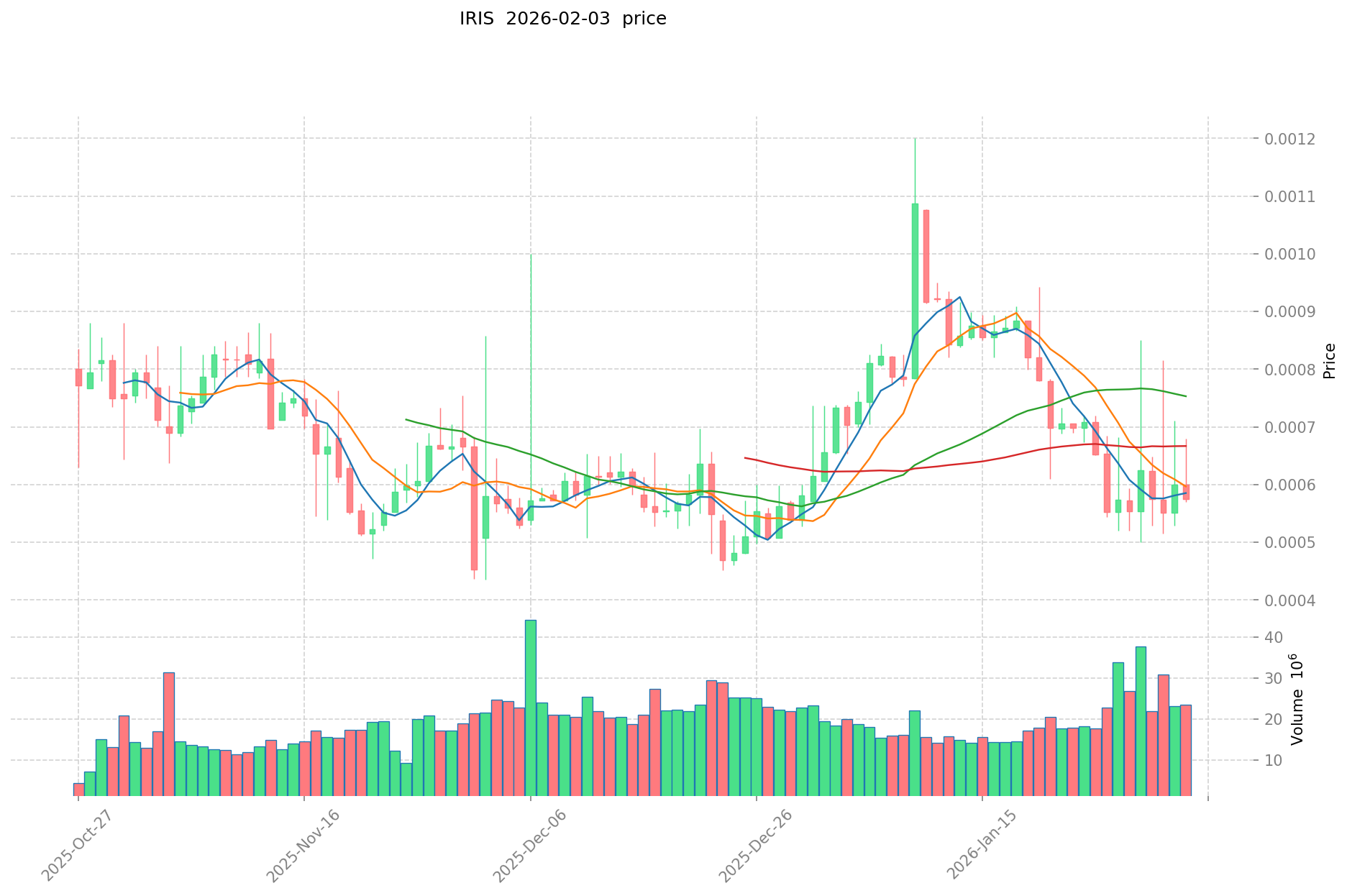
2025: IRIS recorded its all-time low (ATL) at $0.00044927 on December 2, 2025, representing a period of significant downward pressure. RUNE's ATL was established earlier at $0.00851264 on September 28, 2019.
-
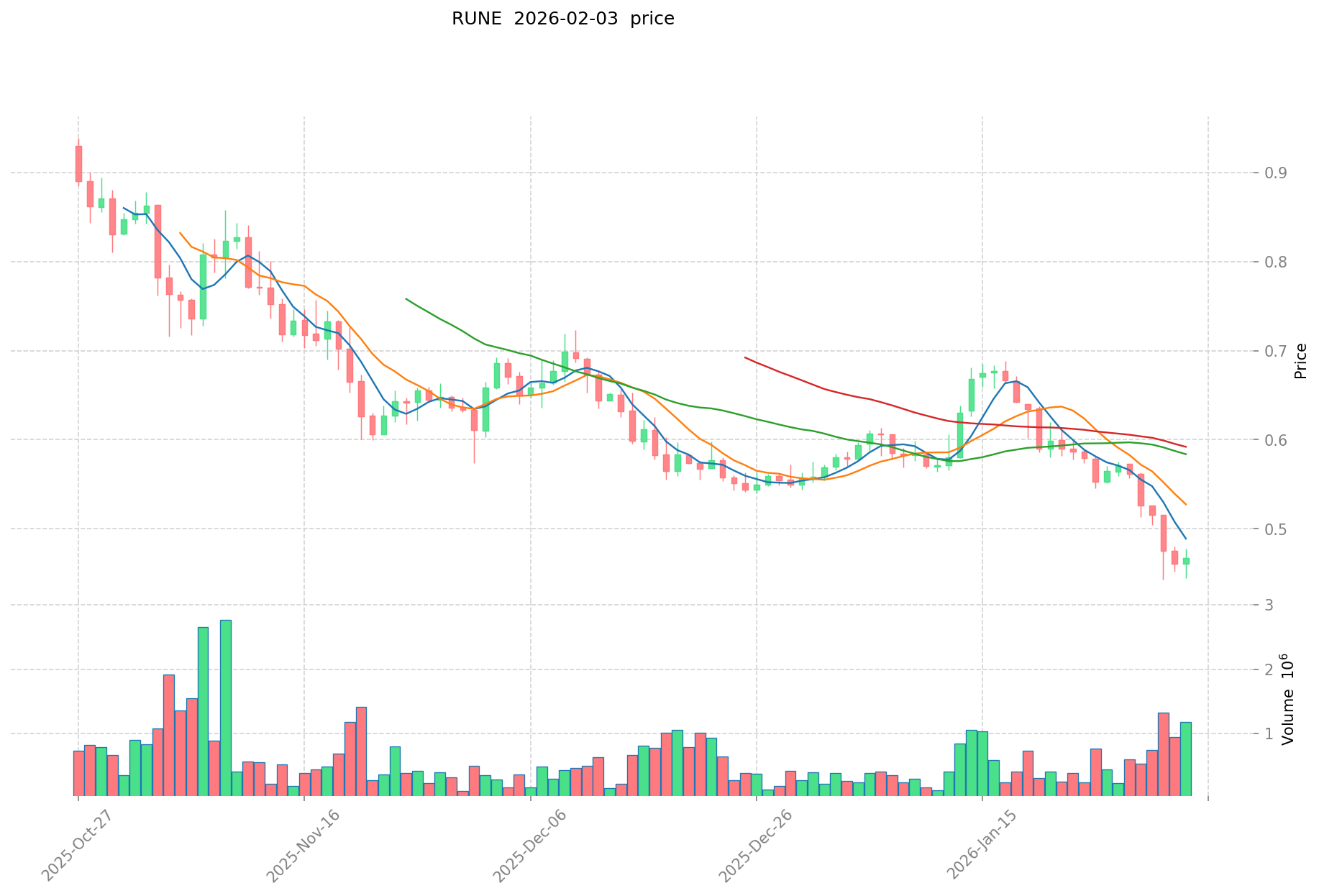
Comparative Analysis: Throughout the market cycle from 2021 peaks to recent levels, IRIS declined from its ATH of $0.299467 to current trading ranges near $0.0005772, demonstrating substantial depreciation. RUNE similarly declined from $20.87 to approximately $0.4666, though maintaining a relatively higher absolute price level despite comparable percentage drawdowns.
Current Market Status (February 3, 2026)
- IRIS Current Price: $0.0005772
- RUNE Current Price: $0.4666
- 24-Hour Trading Volume: IRIS recorded $13,875.75 compared to RUNE's $283,539.90, indicating notably lower liquidity for IRIS
- Market Sentiment Index (Fear & Greed Index): 17 (Extreme Fear)
View real-time pricing:
- Check current IRIS price Market Price
- Check current RUNE price Market Price
II. Core Factors Affecting IRIS vs RUNE Investment Value
Tokenomics Comparison
- IRIS: Cross-chain technology-focused supply mechanism supporting inter-blockchain service infrastructure
- RUNE: Native token of THORChain designed to facilitate decentralized cross-chain liquidity
- 📌 Historical Pattern: Supply mechanisms and ecosystem dynamics influence price cycles through network adoption and liquidity provision incentives.
Institutional Adoption and Market Application
- Institutional Holdings: Both assets remain predominantly community-driven with limited institutional exposure compared to larger-cap cryptocurrencies
- Enterprise Adoption: IRIS focuses on cross-chain service architecture for decentralized applications, while RUNE powers liquidity pools in decentralized exchange ecosystems
- Regulatory Landscape: Both projects operate within evolving regulatory frameworks that vary significantly across jurisdictions
Technical Development and Ecosystem Building
- IRIS Technical Upgrades: IRIS Network planned mainnet 4.0 upgrade introducing enhanced cross-chain capabilities
- RUNE Technical Development: THORChain continues developing its cross-chain liquidity protocol infrastructure
- Ecosystem Comparison: IRIS emphasizes inter-blockchain service models, while RUNE concentrates on decentralized exchange liquidity and cross-chain swaps
Macroeconomic Environment and Market Cycles
- Inflation Context: Both assets exhibit volatility characteristics typical of crypto markets, with investment appeal dependent on risk tolerance and technological understanding
- Macroeconomic Policy: Interest rate fluctuations and broader market sentiment impact both assets through investor confidence and capital allocation patterns
- Market Dynamics: Cryptocurrency market conditions and investor sentiment significantly influence valuation trajectories for both projects
III. 2026-2031 Price Projection: IRIS vs RUNE
Short-term Outlook (2026)
- IRIS: Conservative $0.000312 - $0.000577 | Optimistic $0.000577 - $0.000739
- RUNE: Conservative $0.238 - $0.468 | Optimistic $0.468 - $0.556
Mid-term Outlook (2028-2029)
- IRIS may enter a gradual growth phase, with projected range of $0.000590 - $0.000951 by 2028, potentially reaching $0.000751 - $0.000903 by 2029
- RUNE may enter a moderate expansion phase, with projected range of $0.308 - $0.741 by 2028, potentially reaching $0.423 - $0.809 by 2029
- Key drivers: institutional capital flow, ETF developments, ecosystem advancement
Long-term Outlook (2030-2031)
- IRIS: Baseline scenario $0.000755 - $0.000921 | Optimistic scenario $0.000921 - $0.001004
- RUNE: Baseline scenario $0.445 - $0.839 | Optimistic scenario $0.839 - $0.881
Disclaimer
The price projections presented are for informational purposes only and should not be construed as financial advice. Cryptocurrency markets remain subject to volatility and numerous unpredictable factors. Past performance does not indicate future results.
IRIS:
| Year | Predicted High Price | Predicted Average Price | Predicted Low Price | Price Change |
|---|---|---|---|---|
| 2026 | 0.000738816 | 0.0005772 | 0.000311688 | 0 |
| 2027 | 0.00081592992 | 0.000658008 | 0.00035532432 | 14 |
| 2028 | 0.0009506899584 | 0.00073696896 | 0.000589575168 | 27 |
| 2029 | 0.000902897521344 | 0.0008438294592 | 0.000751008218688 | 46 |
| 2030 | 0.000969433474201 | 0.000873363490272 | 0.00080349441105 | 51 |
| 2031 | 0.001004324345638 | 0.000921398482237 | 0.000755546755434 | 59 |
RUNE:
| Year | Predicted High Price | Predicted Average Price | Predicted Low Price | Price Change |
|---|---|---|---|---|
| 2026 | 0.556325 | 0.4675 | 0.238425 | 0 |
| 2027 | 0.532389 | 0.5119125 | 0.261075375 | 9 |
| 2028 | 0.741454065 | 0.52215075 | 0.3080689425 | 11 |
| 2029 | 0.8087070816 | 0.6318024075 | 0.423307613025 | 35 |
| 2030 | 0.9579388102515 | 0.72025474455 | 0.662634364986 | 54 |
| 2031 | 0.881051616270787 | 0.83909677740075 | 0.444721292022397 | 79 |
IV. Investment Strategy Comparison: IRIS vs RUNE
Long-term vs Short-term Investment Strategies
- IRIS: May appeal to investors focused on cross-chain service infrastructure and early-stage protocol development with higher risk tolerance for speculative positions in emerging blockchain interoperability solutions
- RUNE: May appeal to investors seeking exposure to decentralized exchange liquidity protocols with established cross-chain swap functionality and relatively higher trading volumes
Risk Management and Asset Allocation
- Conservative Investors: IRIS: 10-15% vs RUNE: 20-25% (within a broader diversified cryptocurrency portfolio)
- Aggressive Investors: IRIS: 25-30% vs RUNE: 35-40% (accepting higher volatility and potential drawdown risks)
- Hedging Tools: Stablecoin allocation for liquidity management, options strategies where available, cross-asset portfolio diversification across multiple blockchain ecosystems
V. Potential Risk Comparison
Market Risks
- IRIS: Lower liquidity levels with 24-hour trading volume of $13,875.75 may result in higher price volatility and potential execution challenges during market stress periods
- RUNE: Relatively higher liquidity with $283,539.90 in 24-hour volume, though still subject to broader cryptocurrency market cycles and sentiment shifts
Technical Risks
- IRIS: Cross-chain service architecture development dependencies, network adoption challenges, and scalability considerations as the ecosystem expands
- RUNE: Protocol security considerations inherent to decentralized cross-chain liquidity provision, potential smart contract vulnerabilities, and network stability during high-volume periods
Regulatory Risks
- Both assets operate within evolving global regulatory frameworks that vary significantly across jurisdictions. Cross-chain protocols may face additional scrutiny regarding interoperability standards and decentralized exchange functionality as regulatory clarity develops
VI. Conclusion: Which Is the Better Buy?
📌 Investment Value Summary:
- IRIS Characteristics: Cross-chain service infrastructure positioning, lower absolute price point, planned mainnet 4.0 upgrade introducing enhanced capabilities
- RUNE Characteristics: Established decentralized liquidity protocol, relatively higher trading volume indicating improved market liquidity, focused cross-chain swap ecosystem
✅ Investment Considerations:
- Novice Investors: Consider starting with smaller allocations in either asset within a diversified portfolio, prioritizing established cryptocurrencies while gaining market experience
- Experienced Investors: May evaluate both assets based on risk tolerance, cross-chain technology understanding, and portfolio diversification objectives across different blockchain infrastructure categories
- Institutional Investors: Both assets remain predominantly community-driven with limited institutional adoption data; thorough due diligence regarding liquidity, custody solutions, and regulatory compliance is recommended
⚠️ Risk Disclosure: Cryptocurrency markets exhibit extreme volatility. This analysis does not constitute investment advice. Conduct independent research and consult qualified financial advisors before making investment decisions.
VII. FAQ
Q1: What is the primary difference between IRIS and RUNE in terms of their blockchain technology focus?
IRIS focuses on cross-chain service infrastructure as a self-evolving BPoS hub connecting digital and real economies, while RUNE powers THORChain's decentralized cross-chain liquidity protocol. IRIS positions itself as a next-generation public chain infrastructure for building complex distributed business applications with inter-blockchain service capabilities, whereas RUNE specifically facilitates decentralized cross-chain swaps and liquidity provision through its optimized multi-chain protocol utilizing pBFT consensus mechanism.
Q2: Which cryptocurrency has demonstrated better liquidity performance based on current market data?
RUNE demonstrates significantly better liquidity with 24-hour trading volume of $283,539.90 compared to IRIS's $13,875.75 as of February 3, 2026. This approximately 20x difference in trading volume suggests RUNE offers improved execution capabilities and potentially lower slippage during transactions. Higher liquidity generally reduces volatility risks and provides better price discovery mechanisms, making RUNE more accessible for investors requiring entry and exit flexibility.
Q3: How have IRIS and RUNE performed since their all-time highs in 2021?
Both assets experienced substantial depreciation from their 2021 peaks. IRIS declined from its ATH of $0.299467 (April 12, 2021) to current levels around $0.0005772, representing approximately 99.8% drawdown. RUNE fell from its ATH of $20.87 (May 19, 2021) to approximately $0.4666, representing roughly 97.8% decline. While both suffered significant corrections typical of the 2021-2025 cryptocurrency market cycle, RUNE maintained a relatively higher absolute price level despite comparable percentage drawdowns.
Q4: What are the projected price ranges for IRIS and RUNE by 2030?
According to baseline projections, IRIS may range between $0.000755 - $0.000921 by 2030, with optimistic scenarios potentially reaching $0.000921 - $0.001004. RUNE baseline projections estimate $0.445 - $0.839 by 2030, with optimistic scenarios extending to $0.839 - $0.881. These projections represent potential growth of approximately 51% for IRIS and 54% for RUNE from 2026 levels, though cryptocurrency price predictions remain highly speculative and subject to numerous unpredictable market factors.
Q5: Which asset is more suitable for conservative versus aggressive investors?
For conservative investors within a diversified cryptocurrency portfolio, the recommended allocation would be 10-15% for IRIS versus 20-25% for RUNE, reflecting RUNE's relatively higher liquidity and established protocol status. Aggressive investors with higher risk tolerance might consider 25-30% allocation to IRIS versus 35-40% to RUNE. RUNE's higher recommended allocation reflects its comparatively better market liquidity, trading volume, and established position in decentralized exchange ecosystems, while IRIS represents a more speculative position in emerging cross-chain service infrastructure.
Q6: What are the main technical development focuses for IRIS and RUNE going forward?
IRIS is developing its mainnet 4.0 upgrade that will introduce enhanced cross-chain capabilities and improved inter-blockchain service architecture for decentralized applications. RUNE continues advancing its cross-chain liquidity protocol infrastructure, focusing on decentralized exchange liquidity provision and cross-chain swap functionality. The technical development trajectories reflect their distinct positioning: IRIS emphasizes comprehensive cross-chain service models for broader blockchain interoperability, while RUNE concentrates specifically on optimizing decentralized liquidity mechanisms across multiple blockchain networks.
Q7: What specific risks should investors consider when comparing IRIS and RUNE?
IRIS presents higher liquidity risk due to significantly lower trading volume ($13,875.75 daily), which may result in increased price volatility and execution challenges. RUNE, while more liquid, faces protocol security considerations inherent to decentralized cross-chain liquidity provision and potential smart contract vulnerabilities. Both assets are subject to regulatory uncertainties as cross-chain protocols may face additional scrutiny regarding interoperability standards. Market risks include extreme cryptocurrency volatility, with the current Fear & Greed Index at 17 (Extreme Fear) indicating prevailing negative sentiment that affects both assets.
Q8: How does institutional adoption compare between IRIS and RUNE?
Both IRIS and RUNE remain predominantly community-driven projects with limited institutional exposure compared to larger-cap cryptocurrencies. Neither asset has demonstrated significant institutional holdings or enterprise adoption at levels comparable to established digital assets. IRIS targets enterprise adoption through its cross-chain service architecture for decentralized applications, while RUNE focuses on institutional participation through its liquidity pool ecosystem. Institutional investors evaluating either asset should conduct thorough due diligence regarding liquidity depth, custody solution availability, and regulatory compliance frameworks across relevant jurisdictions.
Share
Content
Introduction: Investment Comparison Between IRIS and RUNE
I. Historical Price Comparison and Current Market Status
II. Core Factors Affecting IRIS vs RUNE Investment Value
III. 2026-2031 Price Projection: IRIS vs RUNE
IV. Investment Strategy Comparison: IRIS vs RUNE
V. Potential Risk Comparison
VI. Conclusion: Which Is the Better Buy?
VII. FAQ
How to Buy Cryptocurrency


Trending Cryptocurrencies



What will be the market capitalization of USDC in 2025? Analysis of the stablecoin market landscape.

How is DeFi different from Bitcoin?
What is DeFi: Understanding Decentralized Finance in 2025

USDC stablecoin 2025 Latest Analysis: Principles, Advantages, and Web3 Eco-Applications
Development of Decentralized Finance Ecosystem in 2025: Integration of Decentralized Finance Applications with Web3

2025 USDT USD Complete Guide: A Must-Read for Newbie Investors

What Are Nodes? Types of Nodes and How They Work in Blockchain

Comprehensive Guide to NFT Minting on Popular Platforms

What is NBLU: A Comprehensive Guide to Understanding Next-Generation Business Logic Units

What is MTRG: A Comprehensive Guide to Multi-Token Retrieval Generation in Modern AI Systems

What is KYO: A Comprehensive Guide to Understanding the Kyoto Protocol and Its Global Impact on Climate Change