This comprehensive analysis evaluates AIRian (AIR), an ERC-20 token launched in July 2024 that combines Decentralized Physical Infrastructure Networks (DePIN) with Sport AI technology for Web3 health community engagement. Currently trading at $0.008968 with a market cap of $1.41 million, AIR addresses emerging opportunities in health data monetization and user engagement through decentralized infrastructure. The article examines AIR's price performance, supply mechanics, ecosystem development potential, and market positioning across multiple timeframes. Key considerations include substantial price volatility, limited institutional adoption with only 557 token holders, and regulatory uncertainties in health data tokenization. Comprehensive price forecasts, investment strategies for different investor profiles, and detailed risk management protocols are provided to guide investment decisions. The analysis concludes that while AIR represents innovative sector positioning, investors must carefully assess individu
Introduction: AIRian (AIR) Investment Position and Market Outlook
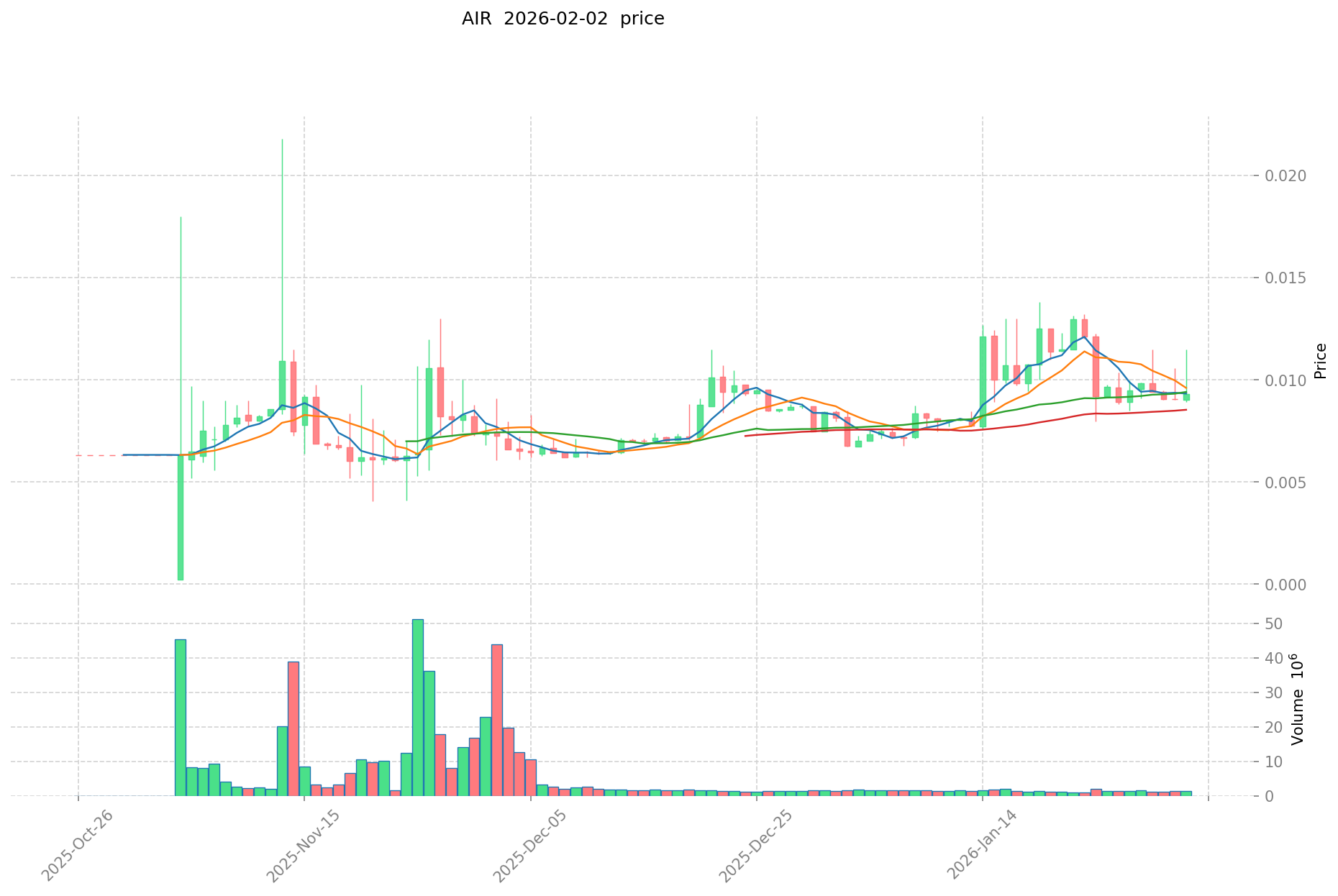
AIR is a digital asset in the cryptocurrency sector. Launched in July 2024, this project focuses on web3 community development, integrating DePIN (Decentralized Physical Infrastructure Networks) and Sport AI technologies to promote user health engagement. As of February 2026, AIR holds a market capitalization of approximately $1.41 million, with a circulating supply of around 157.33 million tokens. The current price is approximately $0.008968. With its positioning in the health and fitness ecosystem within the web3 space, AIR has attracted attention from investors exploring opportunities in decentralized health data and community-driven platforms. This article provides a comprehensive analysis of AIR's investment characteristics, historical price movements, future price considerations, and associated investment risks to serve as a reference for investors.
I. AIRian (AIR) Price History Review and Investment Value Status
- July 2024: AIR recorded a price of $0.15 during this period → This represented a significant valuation level for early participants
- November 2025: AIR experienced substantial price contraction → The token traded at $0.00022 during this phase
- Recent 30-day period: AIR demonstrated price appreciation → The token showed a 27.91% increase in value
Current AIR Investment Market Status (February 2026)
- AIR current price: $0.008968
- 24-hour trading volume: $13,563.503316
- Circulating supply: 157,326,692 AIR tokens
- Market capitalization: $1,410,905.773856
Click to view real-time AIR market price
II. Core Factors Affecting Whether AIR is a Good Investment (Is AIRian(AIR) a Good Investment)
Supply Mechanism and Scarcity (AIR investment scarcity)
- Supply Structure → Influences price and investment value
- AIRian operates with a maximum supply of 1,000,000,000 AIR tokens and a total supply of 1,000,000,000 AIR. As of February 2, 2026, the circulating supply stands at 157,326,692 AIR, representing approximately 15.73% of the total supply. This relatively low circulation ratio may suggest potential for supply expansion, which could impact long-term scarcity dynamics.
- The current market capitalization is $1,410,905.77, while the fully diluted market cap reaches $8,968,000.00. The market cap to fully diluted valuation ratio of 15.73% indicates a significant portion of the token supply remains non-circulating, which may influence future price movements as tokens enter circulation.
- Investment Significance: Understanding the supply release schedule and circulation dynamics is relevant for assessing long-term investment considerations, as gradual token unlocks may affect price stability.
Institutional Investment and Mainstream Adoption (Institutional investment in AIR)
- As of February 2, 2026, AIRian has 557 token holders, indicating a relatively limited holder base. The token is listed on 2 exchanges, with Gate.com being one of the confirmed trading platforms.
- Market share stands at 0.00033%, reflecting a nascent market position with limited mainstream recognition. No specific data regarding institutional holdings or enterprise adoption is available in the reference materials.
- The project positions itself as a Web3 community initiative focused on DePIN and Sport AI ecosystems, aiming to improve user health through data sharing and community engagement. However, evidence of significant institutional participation or mainstream corporate adoption has not been documented in available sources.
Macroeconomic Environment's Impact on AIR Investment
- As a relatively small-cap digital asset with a market capitalization under $1.5 million, AIRian may exhibit heightened sensitivity to broader cryptocurrency market conditions and macroeconomic factors.
- The token experienced a 71.07% decline over the one-year period ending February 2, 2026, suggesting vulnerability to market downturns. However, the 30-day performance showed a 27.91% increase, indicating some recent positive momentum.
- General cryptocurrency market dynamics, including regulatory developments, interest rate environments, and overall risk sentiment, may disproportionately affect smaller projects like AIRian. Investors should consider how broader economic conditions and cryptocurrency sector trends might influence the project's investment outlook.
Technology and Ecosystem Development (Technology & Ecosystem for AIR investment)
- AIRian utilizes the ERC-20 token standard and is deployed on the Ethereum blockchain, with the contract address 0x294b9da569c0d694870239813bbe7b5824fd2339. This infrastructure provides compatibility with Ethereum's established ecosystem.
- The project focuses on integrating DePIN (Decentralized Physical Infrastructure Networks) and Sport AI technologies to create a health-focused Web3 community. Users are intended to share health data and participate in competitive activities within the AIRian ecosystem.
- According to the project's whitepaper available at https://airian.gitbook.io/airian-whitepaper, the platform aims to build real-world assets and ecosystems that improve user health through engaging mechanisms. The success of this vision depends on continued ecosystem development, user adoption, and the practical implementation of its DePIN and Sport AI components.
- The project maintains an active social presence through its Twitter account (https://x.com/air_airofficial) and official website (https://airian.io/), which may provide updates on technological progress and ecosystem expansion.
III. AIR Future Investment Forecast and Price Outlook (Is AIRian(AIR) worth investing in 2026-2031)
Short-term Investment Forecast (2026, short-term AIR investment outlook)
- Conservative forecast: $0.0052 - $0.0090
- Neutral forecast: $0.0087 - $0.0097
- Optimistic forecast: $0.0097 - $0.0109
Mid-term Investment Outlook (2027-2029, mid-term AIRian(AIR) investment forecast)
-
Market stage expectation: AIRian may experience gradual growth as the project develops its DePIN and Sport AI ecosystem. The circulating supply remains at approximately 15.73% of total supply, which could provide room for token utility expansion.
-
Investment return forecast:
- 2027: $0.0094 - $0.0144
- 2028: $0.0072 - $0.0180
- 2029: $0.0080 - $0.0167
-
Key catalysts: Ecosystem development progress, user adoption rate in the web3 health community, partnership expansion, and overall DePIN sector performance.
Long-term Investment Outlook (Is AIRian a good long-term investment?)
- Base scenario: $0.0146 - $0.0173 (assuming steady ecosystem development and maintained community engagement)
- Optimistic scenario: $0.0158 - $0.0231 (assuming accelerated adoption, successful product launches, and favorable market conditions for health-focused DePIN projects)
- Risk scenario: Below $0.0052 (in case of major setbacks in ecosystem development, reduced market interest in DePIN, or broader crypto market downturn)
Click to view AIR long-term investment and price forecast: Price Prediction
2026-02-02 - 2031 Long-term Outlook
- Base scenario: $0.0146 - $0.0173 (corresponding to steady progress and gradual mainstream application adoption)
- Optimistic scenario: $0.0158 - $0.0231 (corresponding to large-scale adoption and favorable market environment)
- Transformative scenario: Above $0.0231 (in case of breakthrough ecosystem progress and mainstream popularization)
- 2031-12-31 predicted high: $0.0231 (based on optimistic development assumptions)
Disclaimer: The above forecasts are based on historical data analysis and current market conditions. Cryptocurrency investments carry significant risks, and actual prices may differ substantially from predictions due to market volatility, regulatory changes, technological developments, and other unforeseen factors. This analysis does not constitute investment advice, and investors should conduct their own research and risk assessment before making any investment decisions.
| Year |
Predicted High Price |
Predicted Average Price |
Predicted Low Price |
Price Change |
| 2026 |
0.01085128 |
0.008968 |
0.00520144 |
0 |
| 2027 |
0.014368978 |
0.00990964 |
0.009414158 |
10 |
| 2028 |
0.01796617732 |
0.012139309 |
0.00716219231 |
35 |
| 2029 |
0.0167085449076 |
0.01505274316 |
0.0079779538748 |
67 |
| 2030 |
0.017309901996842 |
0.0158806440338 |
0.014610192511096 |
77 |
| 2031 |
0.023067429491296 |
0.016595273015321 |
0.015765509364554 |
85 |
IV. AIRian Investment Strategy and Risk Management (How to invest in DePIN and Health Data tokens)
Investment Methodology (AIRian investment strategy)
-
Long-term Holding (HODL AIRian): Suitable for conservative investors who believe in the long-term potential of decentralized physical infrastructure networks (DePIN) and health data monetization. Given AIRian's focus on building a Web3 community ecosystem with real assets based on Sport AI, investors may consider accumulating positions during market corrections.
-
Active Trading: Relies on technical analysis and swing trading strategies. With AIR demonstrating notable price volatility (24-hour range between $0.00887-$0.0115), experienced traders may identify opportunities through short-term price movements. Historical data shows significant fluctuations, with the token ranging from an all-time low of $0.00022 to an all-time high of $0.15.
Risk Management (Risk management for AIRian investment)
-
Asset Allocation Ratios:
- Conservative investors: Allocate no more than 1-3% of crypto portfolio to AIRian
- Aggressive investors: May consider 5-10% allocation while maintaining diversification
- Professional investors: Can employ dynamic allocation based on market conditions and project development milestones
-
Risk Hedging Solutions: Implement multi-asset portfolio strategies combining established cryptocurrencies with emerging DePIN projects. Consider maintaining positions in stablecoins or other defensive assets to balance exposure to high-volatility tokens like AIRian.
-
Secure Storage: Utilize cold wallet solutions for long-term holdings and hot wallets for active trading portions. Hardware wallets from reputable manufacturers are recommended for storing AIR tokens (ERC-20 standard on Ethereum network).
V. AIRian Investment Risks and Challenges (Risks of investing in DePIN and Health Data tokens)
-
Market Risk: AIRian exhibits substantial price volatility, with recent performance showing -4.24% in 24 hours, -10.28% over 7 days, and -71.07% over one year. The relatively low market capitalization of approximately $1.41 million and trading volume of $13,563.50 may result in price manipulation risks and liquidity challenges.
-
Regulatory Risk: Health data tokenization and DePIN projects face evolving regulatory frameworks across different jurisdictions. Uncertainties regarding data privacy regulations, healthcare compliance requirements, and cryptocurrency classification may impact the project's operational capacity and token utility.
-
Technical Risk: As an ERC-20 token on Ethereum, AIRian is subject to network congestion and gas fee fluctuations. The project's reliance on Sport AI technology and health data sharing mechanisms introduces potential vulnerabilities related to data security, smart contract exploits, and ecosystem integration challenges. With only 557 token holders and availability on 2 exchanges, liquidity and adoption risks remain considerations.
VI. Conclusion: Is DePIN and Health Data tokenization a Good Investment?
-
Investment Value Summary: AIRian presents an innovative approach to combining decentralized physical infrastructure with health data monetization through its Web3 community ecosystem. While the project addresses emerging sectors with potential long-term relevance, the token has experienced considerable price fluctuations and currently trades significantly below its historical peak.
-
Investor Recommendations:
✅ Beginners: Consider dollar-cost averaging (DCA) strategy with small allocations, and prioritize secure wallet storage. Thoroughly research the DePIN and health data sectors before investing.
✅ Experienced Investors: May explore swing trading opportunities given volatility patterns, while maintaining diversified portfolio allocation across multiple crypto categories.
✅ Institutional Investors: Evaluate strategic positioning in the DePIN sector, considering AIRian as part of a broader thematic investment approach with appropriate risk assessment.
⚠️ Disclaimer: Cryptocurrency investments carry substantial risk. This content is for informational purposes only and does not constitute investment advice. Always conduct independent research and consult with financial professionals before making investment decisions.
VII. FAQ
Q1: What is AIRian (AIR) and what makes it different from other cryptocurrency investments?
AIRian (AIR) is an ERC-20 token launched in July 2024 that combines Decentralized Physical Infrastructure Networks (DePIN) with Sport AI technology to create a Web3 health community ecosystem. Unlike traditional cryptocurrencies, AIR focuses specifically on health data monetization and user engagement through competitive health activities. The project aims to build real-world assets by enabling users to share health data within a decentralized infrastructure. With a current market capitalization of approximately $1.41 million and only 557 token holders, AIR represents an early-stage project in the emerging intersection of blockchain technology, physical infrastructure networks, and health data management.
Q2: Is AIRian (AIR) a good short-term or long-term investment?
The investment suitability of AIR depends on your risk tolerance and investment horizon. For short-term investors (2026), conservative forecasts suggest a price range of $0.0052 - $0.0090, while optimistic scenarios project $0.0097 - $0.0109. For long-term holders (2031), base case projections estimate $0.0146 - $0.0173, with optimistic scenarios reaching $0.0158 - $0.0231. However, AIR has demonstrated significant volatility, experiencing a -71.07% decline over the past year despite a recent 27.91% increase in the last 30 days. Conservative investors should allocate only 1-3% of their crypto portfolio to AIR, while aggressive investors might consider 5-10% allocation. The token's limited liquidity, small holder base, and early-stage development make it a higher-risk investment requiring careful position sizing and risk management.
Q3: What are the main risks associated with investing in AIRian (AIR)?
AIRian carries three primary risk categories. First, market risk: the token exhibits substantial volatility with low market capitalization ($1.41 million) and limited trading volume ($13,563.50 in 24 hours), making it susceptible to price manipulation and liquidity challenges. Second, regulatory risk: as a health data tokenization project, AIR faces uncertain regulatory frameworks regarding data privacy, healthcare compliance, and cryptocurrency classification across different jurisdictions. Third, technical risk: with only 557 token holders and availability on just 2 exchanges, adoption remains limited. The project's reliance on Sport AI technology and health data sharing mechanisms introduces potential vulnerabilities related to data security and smart contract exploits. Additionally, only 15.73% of the total token supply is currently circulating, meaning future token unlocks could create downward price pressure.
Q4: How should beginners approach investing in AIRian (AIR)?
Beginners should adopt a cautious and methodical approach when considering AIR investment. Start with dollar-cost averaging (DCA) strategy, investing small amounts regularly rather than a lump sum to mitigate volatility risk. Prioritize secure storage by using hardware wallets for long-term holdings since AIR is an ERC-20 token on Ethereum. Before investing, thoroughly research both the DePIN sector and health data tokenization landscape to understand the project's context and competitive positioning. Given AIR's high volatility (trading between an all-time low of $0.00022 and all-time high of $0.15), beginners should only allocate funds they can afford to lose completely. Consider starting with educational resources about Web3 health ecosystems and monitor the project's development milestones through its official channels (website: https://airian.io/ and Twitter: https://x.com/air_airofficial) before making investment decisions.
Q5: What factors could drive AIRian (AIR) price appreciation in the future?
Several catalysts could positively impact AIR's price trajectory. First, ecosystem development progress: successful implementation of DePIN infrastructure and Sport AI technology integration could attract more users and increase token utility. Second, user adoption rate: expansion beyond the current 557 token holders into mainstream health-conscious communities would drive demand. Third, partnership expansion: collaborations with healthcare platforms, fitness applications, or Web3 infrastructure providers could enhance credibility and use cases. Fourth, broader DePIN sector performance: as decentralized physical infrastructure gains traction, AIR could benefit from sector-wide momentum. Fifth, token circulation dynamics: with only 15.73% of total supply currently circulating, strategic token release schedules combined with demand growth could create favorable supply-demand dynamics. Finally, overall cryptocurrency market conditions and increased institutional interest in health data monetization projects could provide tailwinds for AIR's valuation.
Q6: How does AIRian's tokenomics structure affect its investment potential?
AIRian's tokenomics present both opportunities and considerations for investors. The project has a maximum and total supply of 1,000,000,000 AIR tokens, with only 157,326,692 AIR (15.73%) currently in circulation as of February 2, 2026. This creates a significant gap between current market capitalization ($1,410,905.77) and fully diluted valuation ($8,968,000.00), representing approximately 6.36x potential dilution. This structure means that as additional tokens enter circulation through unlocking schedules, selling pressure could impact price stability unless matched by corresponding demand growth. However, the low current circulation also provides room for token utility expansion within the ecosystem. Investors should monitor the project's token release schedule and vesting mechanisms to understand future supply dynamics. The relatively concentrated supply could offer scarcity benefits if ecosystem adoption accelerates before significant additional tokens unlock, but it also introduces uncertainty regarding long-term token value stability.
Q7: What storage and security measures should AIRian (AIR) investors implement?
Proper security protocols are essential for AIR token holders. Since AIR is an ERC-20 token on the Ethereum blockchain (contract address: 0x294b9da569c0d694870239813bbe7b5824fd2339), investors should use Ethereum-compatible wallets. For long-term holdings, hardware wallets from reputable manufacturers (such as Ledger or Trezor) provide the highest security by keeping private keys offline. For active trading, use hot wallets with strong security features, but maintain only the portion needed for trading activities. Enable two-factor authentication (2FA) on all exchange accounts where AIR is held or traded. Verify contract addresses carefully before any transactions to avoid phishing scams targeting smaller cryptocurrency projects. Keep backup seed phrases in secure, offline locations—never store them digitally or share them with anyone. Consider multi-signature wallet setups for larger holdings. Regularly review connected applications and revoke permissions for unused decentralized applications (dApps) to minimize smart contract interaction risks.
Q8: How does AIRian compare to other DePIN and health data tokenization projects?
AIRian occupies a niche position within the emerging DePIN and health data tokenization sectors. With a market share of 0.00033% and market capitalization under $1.5 million, AIR represents an early-stage project compared to more established players in the space. The project's unique approach combines Sport AI with decentralized infrastructure specifically for health community engagement, differentiating it from broader DePIN projects focused on other infrastructure types or pure health data platforms without physical infrastructure components. However, the limited holder base (557 holders), availability on only 2 exchanges, and absence of documented institutional partnerships suggest AIR is in its nascent development phase compared to competitors with wider adoption and recognition. Investors evaluating AIR should compare its technological approach, team execution capability, community engagement metrics, and partnership development against similar projects in both the DePIN sector and health-tech cryptocurrency space to assess relative positioning and competitive advantages or disadvantages within this specialized market segment.
* The information is not intended to be and does not constitute financial advice or any other recommendation of any sort offered or endorsed by Gate.