HashPack (PACK) is the native utility token for Hedera Hashgraph's leading non-custodial wallet, currently trading at $0.005915 with a market cap of $1.38 million. This comprehensive analysis examines PACK's investment fundamentals, including its 83.23% year-over-year decline from a peak of $0.08778, supply mechanism with only 23.27% circulating, and deep ecosystem integration with DeFi and dApps. The article projects conservative to optimistic price scenarios through 2031, ranging from $0.006 to $0.015, while emphasizing substantial volatility risks and limited trading liquidity. Key investment considerations include market volatility, regulatory uncertainty, and technical dependencies on Hedera's network performance. Strategic recommendations vary by investor profile, from conservative 1-2% allocation with dollar-cost averaging to active trading approaches, all requiring careful risk management and diversification strategies.
Introduction: HashPack (PACK)'s Investment Position and Market Prospects
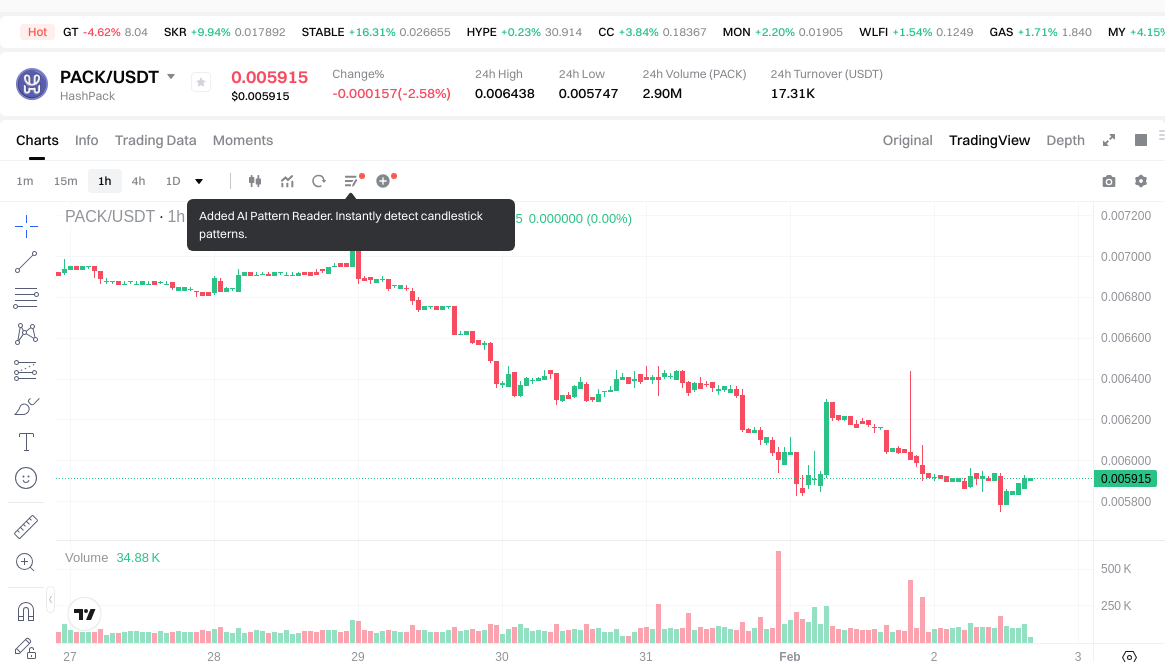
HashPack (PACK) is a notable digital asset in the cryptocurrency sector, serving as the native token of the leading retail wallet on Hedera Hashgraph. As of February 2, 2026, PACK holds a market capitalization of approximately $1.38 million, with a circulating supply of 232.68 million tokens and a current trading price around $0.005915. With its positioning as a non-custodial wallet solution integrated with DeFi, NFTs, and dApps within the Hedera ecosystem, PACK has attracted attention from investors evaluating "Is HashPack (PACK) a good investment?" The token ranks 2,295 in the overall cryptocurrency market, representing a 0.00021% market dominance, while maintaining integration with major decentralized applications in its ecosystem. This article provides a comprehensive analysis of PACK's investment value, historical price movements, future price projections, and associated investment risks to serve as a reference for potential investors.
I. HashPack (PACK) Price History Review and Current Investment Value
- 2024: HashPack launched on Gate.com in May 2024 with an initial price of $0.015 → early investors experienced significant volatility as the token established market presence
- November 2024: PACK reached a notable price level of $0.08778 → representing a substantial increase from launch levels, reflecting growing ecosystem adoption
- 2025-2026: Market correction phase → price declined from elevated levels to $0.005915, influenced by broader market conditions
Current PACK Investment Market Status (February 2026)
- PACK current price: $0.005915
- 24-hour trading volume: $17,412.93
- Market capitalization: $1,376,319.67
- Circulating supply: 232,682,953 PACK (23.27% of total supply)
- Price performance: -3.46% (24H), -13.46% (7D), -19.86% (30D), -83.23% (1Y)
Click to view real-time PACK market price
II. Core Factors Influencing Whether PACK is a Good Investment
Supply Mechanism and Scarcity (PACK Investment Scarcity)
- Total Supply: 1,000,000,000 PACK with a maximum supply cap → Fixed supply model influences long-term value proposition
- Circulating Supply: 232,682,953 PACK (23.27% of total supply) → Current circulation ratio indicates substantial unreleased tokens
- Market Cap to FDV Ratio: 23.27% → Reflects the proportion of circulating supply relative to fully diluted valuation, suggesting potential dilution risks as more tokens enter circulation
- Investment Significance: The fixed maximum supply establishes theoretical scarcity, though the low circulation ratio may affect near-term price dynamics as token distribution continues
Institutional Investment and Mainstream Adoption (Institutional Investment in PACK)
- Integration Status: HashPack is integrated with major dApps in the Hedera Hashgraph ecosystem → Demonstrates ecosystem-level adoption and utility
- Platform Positioning: Serves as the leading retail wallet on Hedera Hashgraph for DeFi, NFTs, and dApps → Establishes foundational infrastructure role within its native ecosystem
- Ecosystem Role: Deep involvement in retail and developer communities → Indicates grassroots adoption alongside technical integration
Macroeconomic Environment's Impact on PACK Investment
- Price Performance Context: 1-year decline of 83.23% and 30-day decline of 19.86% → Reflects broader market conditions affecting digital asset valuations
- Trading Volume: 24-hour trading volume of $17,412.93 with market cap of $1,376,319.67 → Indicates current liquidity levels and market participation
- Market Position: Ranked #2,295 with 0.00021% market dominance → Represents a smaller-cap asset subject to market volatility
Technology and Ecosystem Development (Technology & Ecosystem for PACK Investment)
- Non-Custodial Architecture: Audited wallet with self-custody features → Security-focused design supports user control of assets
- Account Creation Options: Free email-based account creation and seed phrase-based options → Reduces onboarding friction for new users
- Hedera Integration: Built on Hedera Hashgraph technology → Leverages the underlying network's capabilities for wallet functionality
- Ecosystem Applications: Supports DeFi, NFT, and dApp interactions → Provides utility across multiple use cases within the Hedera ecosystem
III. PACK Future Investment Forecast and Price Outlook (Is HashPack(PACK) worth investing in 2026-2031)
Short-term Investment Forecast (2026, short-term PACK investment outlook)
- Conservative Forecast: $0.00479115 - $0.005915
- Neutral Forecast: $0.005915 - $0.0071
- Optimistic Forecast: $0.0071 - $0.0083993
Mid-term Investment Outlook (2027-2029, mid-term HashPack(PACK) investment forecast)
-
Market Stage Expectation: During the 2027-2029 period, PACK may experience gradual growth as the Hedera ecosystem continues to develop and wallet adoption potentially increases among retail users and developers.
-
Investment Return Forecast:
- 2027: $0.0036501465 - $0.010306296
- 2028: $0.00716001286 - $0.01100197098
- 2029: $0.0058214397241 - $0.0120375533278
-
Key Catalysts: Expansion of DeFi, NFT, and dApp integrations within the Hedera ecosystem; broader adoption of non-custodial wallet solutions; growth in the Hedera developer and retail communities.
Long-term Investment Outlook (Is PACK a good long-term investment?)
- Base Scenario: $0.006133232088984 - $0.012923596187502 (assuming steady ecosystem development and moderate user growth)
- Optimistic Scenario: $0.012923596187502 - $0.014894992216104 (assuming accelerated adoption of Hedera-based applications and increased wallet usage)
- Risk Scenario: Below $0.005915 (under conditions of reduced market interest or competitive pressures from alternative wallet solutions)
View PACK long-term investment and price forecast: Price Prediction
2026-2031 Long-term Outlook
- Base Scenario: $0.005915 - $0.012923596187502 (corresponding to steady progress and gradual mainstream application growth)
- Optimistic Scenario: $0.012923596187502 - $0.014894992216104 (corresponding to large-scale adoption and favorable market conditions)
- Transformative Scenario: Above $0.014894992216104 (in case of breakthrough ecosystem developments and mainstream adoption)
- 2031-12-31 Projected High: $0.014894992216104 (based on optimistic development assumptions)
Disclaimer: The above forecasts are based on historical data and market analysis models and do not constitute investment advice. Cryptocurrency markets are highly volatile and subject to various risks. Investors should conduct independent research and assess their own risk tolerance before making any investment decisions.
| Year |
Predicted High Price |
Predicted Average Price |
Predicted Low Price |
Price Change |
| 2026 |
0.0083993 |
0.005915 |
0.00479115 |
0 |
| 2027 |
0.010306296 |
0.00715715 |
0.0036501465 |
21 |
| 2028 |
0.01100197098 |
0.008731723 |
0.00716001286 |
47 |
| 2029 |
0.0120375533278 |
0.00986684699 |
0.0058214397241 |
66 |
| 2030 |
0.014894992216104 |
0.0109522001589 |
0.006133232088984 |
85 |
| 2031 |
0.014345191768127 |
0.012923596187502 |
0.009821933102501 |
118 |
IV. HashPack (PACK) Investment Strategy and Risk Management (How to invest in cryptocurrency wallets)
Investment Methodology (PACK investment strategy)
Long-term Holding (HODL PACK): Suitable for conservative investors
For investors seeking exposure to the Hedera ecosystem infrastructure, PACK tokens may be considered as part of a long-term portfolio strategy. The token's integration with the Hedera Hashgraph ecosystem and its role in a non-custodial wallet platform could provide potential value appreciation as ecosystem adoption grows. However, investors should note the significant price volatility, with the token experiencing an 83.23% decline over the past year as of February 2, 2026.
Active Trading: Relying on technical analysis and swing trading
Active traders may consider PACK's price movements, noting recent volatility with a 24-hour range between $0.005747 and $0.006438. The token's relatively low market capitalization of approximately $1.38 million and 24-hour trading volume of around $17,413 suggest limited liquidity, which may create both opportunities and challenges for short-term trading strategies. Technical traders should exercise caution due to potential slippage and price impact in less liquid markets.
Risk Management (Risk management for PACK investment)
Asset Allocation Ratio: Conservative / Aggressive / Professional investors
- Conservative investors: Consider limiting exposure to PACK to no more than 1-2% of total crypto portfolio due to its small market cap and high volatility characteristics
- Aggressive investors: May allocate 3-5% of crypto holdings, while maintaining awareness of liquidity constraints
- Professional investors: Could implement position sizing strategies based on risk tolerance and portfolio diversification requirements
Risk Hedging Solutions: Multi-asset portfolio + hedging instruments
Investors may consider diversifying across multiple Hedera ecosystem tokens and established cryptocurrencies to mitigate concentration risk. Given PACK's correlation with the broader Hedera network performance, monitoring ecosystem developments and network activity metrics may provide additional risk management insights.
Secure Storage: Hot and cold wallets + hardware wallet recommendations
As PACK operates on the Hedera network (contract address: 0.0.4794920), investors should utilize wallets that support Hedera tokens. The HashPack wallet itself, being non-custodial and audited, provides native storage for PACK tokens. For enhanced security, investors holding significant amounts may consider:
- Hardware wallets compatible with Hedera tokens
- Multi-signature wallet solutions
- Regular security audits of storage solutions
V. Risks of Investing in HashPack (PACK) (Risks of investing in cryptocurrency wallet tokens)
Market Risk: High volatility and price manipulation concerns
PACK has demonstrated substantial price volatility, with its current price of $0.005915 representing approximately 93.26% below its all-time high of $0.08778 recorded on November 17, 2024. Recent performance shows declines across multiple timeframes: -3.46% (24h), -13.46% (7d), -19.86% (30d), and -83.23% (1y). The token's relatively low trading volume and market capitalization may increase susceptibility to price swings and potential market manipulation.
Regulatory Risk: Policy uncertainty across different jurisdictions
As a utility token associated with a cryptocurrency wallet service, PACK may face evolving regulatory frameworks regarding digital asset custody, financial services licensing, and securities classification in various jurisdictions. Changes in regulatory approaches to crypto wallets and DeFi services could impact the token's utility and value proposition.
Technical Risk: Network security vulnerabilities and upgrade failures
While HashPack wallet has undergone security audits, investors should remain aware of potential risks including:
- Smart contract vulnerabilities in the Hedera ecosystem
- Integration risks with dApps and DeFi protocols
- Potential technical issues during network upgrades or protocol changes
- Dependencies on Hedera Hashgraph network performance and stability
The token's circulating supply of approximately 232.68 million represents 23.27% of the maximum supply of 1 billion tokens, indicating potential future supply increases that could affect price dynamics.
VI. Conclusion: Is HashPack (PACK) a Good Investment?
Investment Value Summary: PACK presents opportunities within the Hedera ecosystem infrastructure, but faces substantial price volatility and market uncertainties.
As a utility token for a leading Hedera wallet platform, PACK may offer exposure to ecosystem growth. However, the significant price decline of over 83% year-over-year and relatively small market presence (market cap of ~$1.38 million, ranking #2295) indicate considerable investment risks. The token's integration with Hedera dApps and DeFi protocols provides potential utility value, though market adoption remains a key factor for future performance.
Investor Recommendations:
✅ Beginners: Consider dollar-cost averaging with minimal allocation (less than 1-2% of crypto portfolio) + secure wallet storage using audited solutions
✅ Experienced investors: May employ swing trading strategies while maintaining strict risk controls + diversified portfolio allocation across multiple ecosystem tokens
✅ Institutional investors: Could evaluate strategic positioning based on Hedera ecosystem thesis and comprehensive due diligence on wallet platform adoption metrics
⚠️ Important Notice: Cryptocurrency investments carry high risks. This analysis is for informational purposes only and does not constitute investment advice. Investors should conduct independent research and consider their risk tolerance before making investment decisions.
VII. FAQ
Q1: Is HashPack (PACK) a good investment for beginners in 2026?
PACK may be suitable for beginners only as a minimal portfolio allocation (1-2% maximum) due to its high volatility and limited liquidity. As a smaller-cap token ranked #2,295 with a market capitalization of approximately $1.38 million, PACK has experienced significant price fluctuations, including an 83.23% decline over the past year. Beginners should implement dollar-cost averaging strategies, utilize secure storage solutions like the audited HashPack wallet, and thoroughly understand the Hedera ecosystem before investing. The token's role as a utility token for a non-custodial wallet provides real-world use cases, but market uncertainties and limited trading volume create substantial risks for inexperienced investors.
Q2: What is the long-term price prediction for PACK through 2031?
Based on technical analysis and ecosystem development projections, PACK's long-term outlook ranges from conservative to optimistic scenarios. The base scenario estimates prices between $0.006133 to $0.012924 by 2031, assuming steady Hedera ecosystem growth and moderate wallet adoption. The optimistic scenario projects potential highs of $0.014895 by 2031, contingent on accelerated dApp integration and increased mainstream adoption of Hedera-based applications. However, these forecasts carry significant uncertainty given the token's current volatility patterns and the fact that only 23.27% of total supply is currently circulating, which may impact future price dynamics as additional tokens enter the market.
Q3: How does PACK's supply mechanism affect its investment value?
PACK has a fixed maximum supply of 1 billion tokens, with approximately 232.68 million currently in circulation (23.27% of total supply). This supply structure presents both opportunities and risks for investors. While the fixed maximum supply theoretically establishes scarcity, the low circulation ratio indicates substantial unreleased tokens that could enter the market over time, potentially creating dilution pressure. The market cap to fully diluted valuation (FDV) ratio of 23.27% suggests investors should monitor token release schedules and vesting patterns. As more tokens become circulating, supply dynamics may influence price performance, particularly given the token's relatively small current market capitalization.
Q4: What are the primary risks associated with investing in PACK?
PACK investment carries multiple risk categories that investors must evaluate. Market risk includes extreme volatility, with the token currently trading 93.26% below its all-time high and showing consistent declines across recent timeframes. The low trading volume of approximately $17,413 in 24 hours increases susceptibility to price manipulation and slippage. Regulatory risk stems from evolving frameworks regarding digital asset custody and DeFi services across jurisdictions. Technical risk includes potential smart contract vulnerabilities, integration challenges with Hedera dApps, and dependencies on Hedera network performance. Additionally, the token's small market presence and limited liquidity pose concentration risks for portfolio diversification strategies.
Q5: How does HashPack's integration with the Hedera ecosystem impact PACK's investment potential?
HashPack's position as the leading retail wallet on Hedera Hashgraph provides fundamental utility that influences PACK's investment thesis. The wallet's integration with major dApps, DeFi protocols, and NFT platforms within the Hedera ecosystem creates practical use cases for the token. As Hedera's developer and retail communities expand, increased wallet adoption could drive demand for PACK. The non-custodial architecture and security audits enhance the platform's credibility, potentially supporting long-term value appreciation. However, PACK's performance remains closely tied to Hedera's overall ecosystem growth, meaning investors should monitor network activity metrics, developer engagement, and adoption rates as indicators of potential value drivers.
Q6: What investment strategies are recommended for different investor profiles interested in PACK?
Investment strategies for PACK should align with individual risk tolerance and experience levels. Conservative investors should limit exposure to 1-2% of total crypto portfolio and employ dollar-cost averaging to mitigate timing risk, while utilizing secure storage solutions like hardware wallets compatible with Hedera tokens. Aggressive investors may allocate 3-5% of holdings and engage in active trading strategies, though they must account for liquidity constraints and potential slippage given the token's limited trading volume. Professional investors could implement position sizing based on comprehensive Hedera ecosystem analysis, incorporating hedging instruments and multi-asset diversification across established cryptocurrencies. All investors should establish clear stop-loss parameters and regular portfolio rebalancing protocols.
Q7: How does PACK's current market performance compare to its historical price levels?
PACK's current price of $0.005915 represents a significant decline from its historical peak performance. The token launched on Gate.com in May 2024 at approximately $0.015 and reached its all-time high of $0.08778 in November 2024, reflecting initial ecosystem enthusiasm and adoption. From that peak, PACK has declined approximately 93.26%, currently showing negative performance across multiple timeframes: -3.46% (24 hours), -13.46% (7 days), -19.86% (30 days), and -83.23% (1 year). This sustained downward trajectory reflects broader market corrections and potential challenges in maintaining momentum. Historical volatility patterns suggest investors should anticipate continued price fluctuations and assess whether current levels represent potential accumulation opportunities or indicate fundamental valuation concerns.
Q8: What factors should investors monitor when evaluating PACK's future prospects?
Investors evaluating PACK should track several key metrics and developments. First, monitor Hedera ecosystem growth indicators including dApp deployment rates, network transaction volumes, and developer activity, as these directly impact wallet utility demand. Second, track PACK's token distribution schedule and circulating supply changes, given that only 23.27% of total supply is currently in circulation. Third, assess trading volume trends and liquidity metrics to understand market participation and potential price stability. Fourth, observe integration announcements with new DeFi protocols, NFT platforms, or enterprise applications on Hedera. Fifth, monitor regulatory developments affecting crypto wallets and custody services across major jurisdictions. Finally, compare HashPack's competitive position against alternative Hedera wallets and cross-chain wallet solutions to gauge market share sustainability.
* The information is not intended to be and does not constitute financial advice or any other recommendation of any sort offered or endorsed by Gate.