This comprehensive guide evaluates whether DappRadar (RADAR) represents a viable investment opportunity by analyzing token fundamentals, market performance, and future potential. RADAR, the governance and utility token of DappRadar's decentralized application analytics platform, currently trades at $0.0003045 with a market cap of approximately $464,608 (as of February 2026). The article examines RADAR's price history showing significant decline from $0.057067 (2021 peak) to current levels, explores core investment factors including tokenomics with only 15.26% of maximum supply circulating, and provides detailed price forecasts ranging from conservative to optimistic scenarios through 2031. Key sections address investment strategies for different investor types, comprehensive risk management approaches, and critical challenges including market volatility, liquidity constraints, and regulatory uncertainties. The analysis concludes that RADAR suits experienced investors with limited portfolio allocation (1-10%)
Introduction: DappRadar (RADAR) Investment Position and Market Outlook
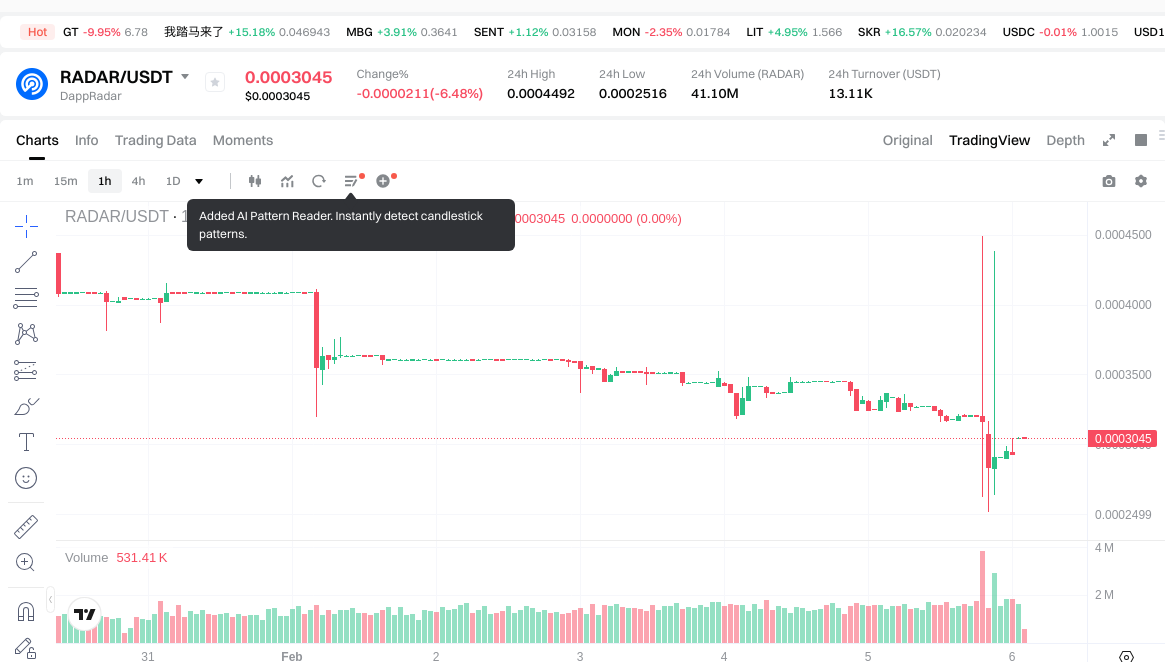
RADAR is a notable asset in the cryptocurrency sector, serving as the native token of the DappRadar ecosystem. As of February 6, 2026, RADAR maintains a market capitalization of approximately $464,608.64, with a circulating supply of around 1,525,808,338.02 tokens and a current price near $0.0003045. With its positioning as a governance and utility token for what is described as the world's Dapp store, RADAR has attracted attention among investors exploring "Is DappRadar (RADAR) a good investment?" The token is held by approximately 13,623 holders and trades on multiple platforms. This article provides a comprehensive analysis of RADAR's investment value, historical performance, future price projections, and associated investment risks to serve as a reference for investors.
I. RADAR Price History Review and Investment Value Status
- 2021: Token launch and initial market entry → Early investors experienced significant volatility with price reaching $0.057067 in December
- 2022-2025: Extended market adjustment period → RADAR price underwent sustained correction from previous levels
- 2026: Continued market pressure → Price declined to $0.00025308 in early February
Current RADAR Investment Market Status (February 2026)
- RADAR current price: $0.0003045
- Market sentiment (Fear & Greed Index): Data not available in provided materials
- 24-hour trading volume: $13,122.03
- Institutional investor holdings: Data not available in provided materials
Click to view real-time RADAR market price
II. Core Factors Affecting Whether RADAR is a Good Investment (Is DappRadar(RADAR) a Good Investment)
Supply Mechanism and Scarcity (RADAR investment scarcity)
- Total supply capped at 10,000,000,000 tokens with circulating supply of approximately 1,525,808,338 tokens → influences price dynamics and investment considerations
- Market capitalization to fully diluted valuation ratio stands at 15.26%, indicating substantial supply yet to enter circulation
- Investment consideration: The token's scarcity profile reflects significant future supply release potential, which may impact long-term value assessment
Institutional Investment and Mainstream Adoption (Institutional investment in RADAR)
- Current holder count: 13,623 addresses
- Trading availability: Listed on 1 exchange with 24-hour trading volume of $13,122.03
- Market share: 0.00012% of total cryptocurrency market capitalization
Macroeconomic Environment's Impact on RADAR Investment
- Monetary policy and interest rate changes → alter investment attractiveness across digital asset markets
- During inflationary environments, alternative digital assets face varied performance outcomes
- Geopolitical uncertainty → may influence demand patterns for smaller-cap digital assets
Technology and Ecosystem Development (Technology & Ecosystem for RADAR investment)
- Platform functionality: DappRadar serves as a global Dapp tracking and ranking platform across multiple protocols and verticals
- Token utility: RADAR holders access enhanced insights, early industry reports, and reward mechanisms through contribution and curation activities
- Ecosystem application: The platform's role in decentralized application analytics provides foundational utility for token value proposition
III. RADAR Future Investment Forecast and Price Outlook (Is DappRadar(RADAR) worth investing in 2026-2031)
Short-term Investment Forecast (2026, short-term RADAR investment outlook)
- Conservative Forecast: $0.000204015 - $0.0003045
- Neutral Forecast: $0.0003045 - $0.00035148
- Optimistic Forecast: $0.00035148 - $0.00042021
Mid-term Investment Outlook (2027-2029, mid-term DappRadar(RADAR) investment forecast)
- Market Stage Expectation: RADAR is projected to experience gradual price adjustments during the mid-term period, with potential recovery depending on broader market dynamics and ecosystem development.
- Investment Return Forecast:
- 2027: $0.000351484 - $0.0003840963
- 2028: $0.0002799192 - $0.000492658
- 2029: $0.000372330 - $0.000450259
- Key Catalysts: Ecosystem expansion, platform utility enhancements, broader DApp adoption trends, and market sentiment shifts.
Long-term Investment Outlook (Is DappRadar a good long-term investment?)
- Base Scenario: $0.000239900 - $0.000470746 (assuming steady ecosystem growth and maintained market presence)
- Optimistic Scenario: $0.000452641 - $0.000470746 (assuming increased platform utility, expanded partnerships, and favorable market conditions)
- Risk Scenario: $0.000239900 - $0.000331200 (under adverse market conditions or reduced platform adoption)
Click to view RADAR long-term investment and price forecast: Price Prediction
2026-02-06 - 2031 Long-term Outlook
- Base Scenario: $0.000239900 - $0.000470746 (corresponding to steady progress and gradual mainstream application improvement)
- Optimistic Scenario: $0.000452641 - $0.000470746 (corresponding to large-scale adoption and favorable market environment)
- Transformative Scenario: Above $0.000470746 (if the ecosystem achieves breakthrough developments and mainstream popularization)
- 2031-12-31 Predicted High: $0.000470746 (based on optimistic development assumptions)
Disclaimer: The forecasts presented are based on available market data and analytical models. Cryptocurrency investments carry inherent risks, and past performance does not guarantee future results. Investors should conduct independent research and consider their risk tolerance before making investment decisions.
| Year |
Predicted High Price |
Predicted Average Price |
Predicted Low Price |
Price Change |
| 2026 |
0.00042021 |
0.0003045 |
0.000204015 |
0 |
| 2027 |
0.0003840963 |
0.000362355 |
0.00035148435 |
19 |
| 2028 |
0.000492657858 |
0.00037322565 |
0.0002799192375 |
22 |
| 2029 |
0.00045025942416 |
0.000432941754 |
0.00037232990844 |
42 |
| 2030 |
0.000463680618534 |
0.00044160058908 |
0.00033120044181 |
45 |
| 2031 |
0.000470746227959 |
0.000452640603807 |
0.000239899520017 |
48 |
IV. RADAR Investment Strategy and Risk Management (How to invest in DappRadar)
Investment Methodology (RADAR investment strategy)
Long-term Holding (HODL RADAR)
For conservative investors seeking steady exposure to the decentralized application ecosystem, a long-term holding strategy may be considered. This approach involves purchasing RADAR tokens and maintaining positions through market cycles, potentially benefiting from the growth of the DappRadar platform and its ecosystem over time. Investors adopting this strategy typically focus on fundamental developments rather than short-term price movements.
Active Trading
Active trading strategies rely on technical analysis and swing trading techniques. Given RADAR's price volatility, with recent fluctuations showing a 24-hour range between $0.0002516 and $0.0004492, traders may identify opportunities through:
- Chart pattern recognition and trend analysis
- Volume-based trading signals (current 24H volume: $13,122.03)
- Support and resistance level identification
- Risk-reward ratio calculations for entry and exit points
Risk Management (Risk management for RADAR investment)
Asset Allocation Ratios
- Conservative investors: Consider limiting RADAR exposure to 1-3% of total crypto portfolio
- Aggressive investors: May allocate 5-10% depending on risk tolerance and conviction
- Professional investors: Could adjust allocation based on comprehensive due diligence and portfolio strategy
Risk Hedging Strategies
- Multi-asset portfolio construction: Diversify across different cryptocurrency categories
- Correlation analysis: Combine RADAR with assets showing low correlation
- Position sizing: Implement systematic position limits based on volatility metrics
- Stop-loss mechanisms: Set predetermined exit points to manage downside risk
Secure Storage Solutions
- Cold wallet storage: Hardware wallets (Ledger, Trezor) for long-term holdings
- Hot wallet allocation: Limited amounts for active trading on secure exchanges
- Multi-signature wallets: Enhanced security for larger holdings
- Regular security audits: Verify wallet integrity and backup procedures
V. RADAR Investment Risks and Challenges (Risks of investing in DappRadar)
Market Risks
RADAR exhibits significant price volatility, as evidenced by its historical price range from an all-time high of $0.057067 (December 23, 2021) to an all-time low of $0.00025308 (February 5, 2026). Recent performance shows substantial declines across multiple timeframes: -6.03% (24H), -30.07% (7D), -37.13% (30D), and -91.64% (1Y). The token's relatively low market capitalization of approximately $464,608 and limited exchange availability (listed on 1 exchange) may contribute to price susceptibility and liquidity concerns.
Regulatory Risks
The regulatory environment for utility tokens and DeFi-related projects varies significantly across jurisdictions. Changes in cryptocurrency regulations, securities classifications, or compliance requirements in different countries could impact RADAR's accessibility, trading venues, and overall market dynamics. Investors should monitor regulatory developments in their respective jurisdictions.
Technical Risks
- Smart contract vulnerabilities: As an Ethereum-based token (contract address: 0x44709a920fCcF795fbC57BAA433cc3dd53C44DbE), RADAR is subject to potential smart contract risks
- Network congestion: Ethereum network conditions may affect transaction speeds and costs
- Platform dependency: Token utility is closely tied to DappRadar platform adoption and development
- Tokenomics concerns: With only 15.26% of max supply currently circulating (1,525,808,338 out of 10,000,000,000 tokens), future token unlocks could create selling pressure
VI. Conclusion: Is DappRadar a Good Investment?
Investment Value Summary
RADAR represents exposure to the decentralized application tracking and analytics sector. The token's utility within the DappRadar ecosystem includes governance participation, enhanced platform features, early access to industry reports, and rewards for contributions. However, the token has experienced substantial price depreciation, with current trading at $0.0003045 representing a significant decline from historical peaks. The limited circulating supply ratio (15.26%) and concentration of holders (13,623) present both opportunities and risks for potential investors.
Investor Recommendations
✅ Beginners: Consider dollar-cost averaging strategies with small position sizes, combined with secure cold wallet storage. Prioritize understanding the DappRadar platform and token utility before investing.
✅ Experienced Investors: May explore swing trading opportunities based on technical analysis, while maintaining strict risk management protocols. Consider RADAR as a small portion of a diversified crypto portfolio focused on DeFi infrastructure projects.
✅ Institutional Investors: Conduct thorough due diligence on tokenomics, platform metrics, competitive positioning, and long-term sustainability before considering strategic allocation.
⚠️ Disclaimer: Cryptocurrency investments carry substantial risk and volatility. This content is provided for informational purposes only and does not constitute financial, investment, or trading advice. Investors should conduct independent research and consult qualified financial advisors before making investment decisions.
VII. FAQ
Q1: What is DappRadar (RADAR) and what makes it unique as an investment?
DappRadar (RADAR) is the native utility and governance token of DappRadar, described as the world's Dapp store and a global decentralized application tracking platform. RADAR provides token holders with enhanced insights, early access to industry reports, governance rights, and reward mechanisms through contribution and curation activities. What distinguishes RADAR as an investment is its role in the DApp analytics ecosystem, serving across multiple blockchain protocols and verticals. However, investors should note that RADAR currently has a relatively small market capitalization of approximately $464,608 and trades at $0.0003045 as of February 6, 2026, with only 15.26% of its maximum supply in circulation.
Q2: Is DappRadar (RADAR) a good investment for beginners?
RADAR may not be an ideal primary investment for beginners due to its high volatility and significant historical price declines. The token has dropped -91.64% over the past year and currently trades near its all-time low of $0.00025308. For beginners interested in RADAR despite these risks, a dollar-cost averaging strategy with small position sizes (1-3% of total crypto portfolio) is recommended, combined with secure cold wallet storage. It is crucial for new investors to thoroughly understand the DappRadar platform's utility and token economics before investing, and to never invest more than they can afford to lose. Given the token's limited exchange availability and low trading volume ($13,122.03 in 24 hours), liquidity concerns should also be carefully considered.
Q3: What are the price predictions for RADAR in 2026-2031?
Based on analytical models and current market data, RADAR price forecasts vary significantly depending on market scenarios. For 2026, conservative estimates range from $0.000204015 to $0.0003045, with optimistic scenarios reaching $0.00042021. Mid-term projections for 2027-2029 show potential prices between $0.000279919 and $0.000492658, depending on ecosystem development and market conditions. Long-term forecasts for 2031 suggest a predicted high of $0.000470746 under optimistic assumptions, with base scenarios ranging from $0.000239900 to $0.000470746. However, these projections carry substantial uncertainty given the token's volatility, limited circulating supply (only 15.26% of maximum), and dependence on platform adoption. Investors should treat these forecasts as reference points rather than guarantees, as cryptocurrency markets are inherently unpredictable.
Q4: What are the main risks of investing in DappRadar (RADAR)?
RADAR investment carries several significant risks that potential investors must carefully consider. Market risk is substantial, evidenced by extreme volatility ranging from an all-time high of $0.057067 to an all-time low of $0.00025308, with recent declines of -30.07% (7 days) and -91.64% (1 year). Liquidity risk exists due to limited exchange availability (only 1 exchange) and low daily trading volume ($13,122). Tokenomics risk is present as only 15.26% of the maximum 10 billion tokens are currently circulating, meaning future token unlocks could create significant selling pressure. Technical risks include smart contract vulnerabilities, Ethereum network dependencies, and platform-specific risks tied to DappRadar's adoption. Regulatory uncertainty surrounding utility tokens and DeFi projects could also impact accessibility and trading. The small market capitalization of approximately $464,608 increases susceptibility to price manipulation and extreme volatility.
Q5: How should I store RADAR tokens securely?
Secure storage of RADAR tokens depends on your investment timeline and trading frequency. For long-term holders, cold wallet storage using hardware wallets like Ledger or Trezor provides the highest security level, protecting tokens from online threats and hacking attempts. These devices should be purchased directly from official manufacturers and stored in secure physical locations with proper backup procedures. For active traders requiring frequent access, a limited allocation can be kept in hot wallets on reputable exchanges, though this amount should be minimized to reduce exposure to exchange-related risks. Larger holdings may benefit from multi-signature wallet configurations for enhanced security. Regular security audits of wallet integrity and maintaining secure backups of seed phrases in multiple physical locations are essential practices. Never share private keys or seed phrases, and be cautious of phishing attempts targeting cryptocurrency holders.
Q6: What is the best investment strategy for RADAR?
The optimal investment strategy for RADAR depends on your risk tolerance, investment timeline, and market expertise. For conservative investors seeking long-term exposure to the decentralized application ecosystem, a HODL (hold) strategy with allocation limited to 1-3% of total crypto portfolio may be appropriate, focusing on fundamental platform developments rather than short-term price movements. Active traders with technical analysis skills might explore swing trading opportunities based on RADAR's volatility, with recent 24-hour price ranges between $0.0002516 and $0.0004492 potentially offering trading opportunities. Key techniques include chart pattern recognition, volume analysis (monitoring 24H volume: $13,122.03), and support/resistance identification. Regardless of strategy, strict risk management is essential, including predetermined stop-loss levels, position sizing based on volatility metrics, and portfolio diversification across different cryptocurrency categories. Dollar-cost averaging can help mitigate timing risk for those building positions over time.
Q7: How does RADAR compare to other utility tokens in the DeFi ecosystem?
RADAR occupies a specialized niche within the DeFi ecosystem, focusing specifically on decentralized application tracking and analytics rather than broader DeFi functionalities like lending, trading, or yield farming. With a market capitalization of approximately $464,608 and market share of 0.00012%, RADAR is significantly smaller than major DeFi utility tokens. The platform's utility centers on providing enhanced insights, governance participation, early industry reports, and reward mechanisms for contribution activities. While this specialization differentiates RADAR from general-purpose DeFi tokens, it also creates dependency on the DappRadar platform's adoption and growth. The token's limited exchange availability (1 exchange) and low trading volume ($13,122.03 daily) contrast with more established utility tokens that typically feature higher liquidity and broader market accessibility. Investors comparing RADAR to other DeFi tokens should evaluate platform adoption metrics, competitive positioning, tokenomics transparency, and the sustainability of the underlying business model.
Q8: What catalysts could drive RADAR price appreciation in the future?
Several potential catalysts could influence RADAR's future price trajectory, though none are guaranteed. Platform-related catalysts include expanding DappRadar's user base, increasing adoption of the analytics platform across blockchain ecosystems, and launching new features that enhance token utility. Partnership announcements with major DApp projects or blockchain protocols could increase visibility and demand. Broader market catalysts include general cryptocurrency market bull cycles, increased institutional interest in DeFi infrastructure projects, and growing mainstream adoption of decentralized applications. Token-specific developments such as exchange listings on additional platforms, liquidity improvements, or beneficial changes to tokenomics could also impact price. However, investors should recognize that with 84.74% of maximum supply yet to enter circulation, token unlock schedules represent a significant counter-pressure. Additionally, RADAR's correlation with broader crypto market trends means Bitcoin and Ethereum performance, macroeconomic conditions, and regulatory developments will likely influence price movements regardless of project-specific developments.
* The information is not intended to be and does not constitute financial advice or any other recommendation of any sort offered or endorsed by Gate.