Is LABUBU (LABUBU) a good investment?: A Comprehensive Analysis of Risks, Returns, and Market Potential in 2024

Introduction: LABUBU (LABUBU) Investment Position and Market Prospects
LABUBU is a digital asset in the cryptocurrency field, representing a Nordic elf IP created by Long Jiasheng under Pop Mart. As of February 5, 2026, LABUBU has a market capitalization of approximately $591,388, with a circulating supply of about 999,980,482 tokens, and the current price is maintained around $0.0005914. With its unique positioning as a trendy toy culture-inspired token, LABUBU has gradually become a focal point for investors discussing "Is LABUBU (LABUBU) a good investment?" This article will comprehensively analyze LABUBU's investment value, historical trends, future price predictions, and investment risks to provide reference for investors.
I. LABUBU Price History and Investment Value Status
LABUBU Historical Price Trends and Investment Performance
- 2025: LABUBU launched in January 2025, entering the market as a Pop Mart-themed Nordic elf IP token → Initial market enthusiasm drove significant price volatility
- June 2025: Token reached a notable price level of $0.06178 on June 16 → Price experienced subsequent downward pressure amid broader market adjustments
- Late 2025 to Early 2026: Market correction phase → Price declined from higher levels to approximately $0.0005914, reflecting shifts in market sentiment and trading activity
Current LABUBU Investment Market Status (February 2026)
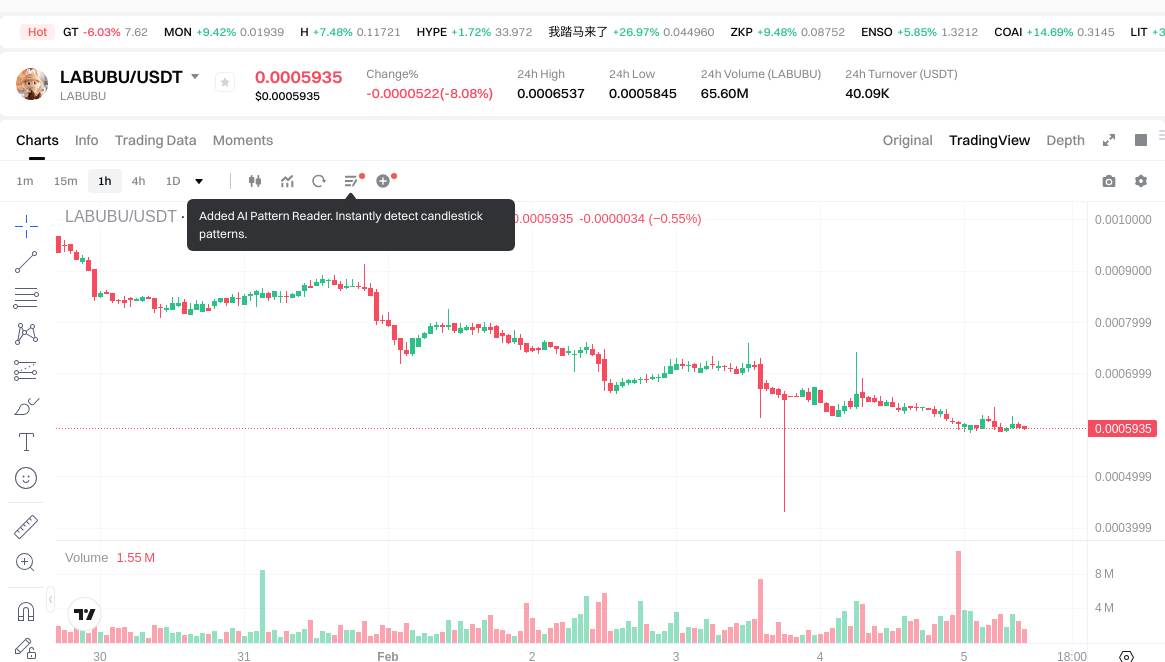
- Current LABUBU price: $0.0005914
- 24-hour trading volume: $39,473.37
- Market capitalization: $591,388.46
- Circulating supply: 999,980,482 LABUBU (100% of total supply)
- 24-hour price change: -7.75%
- 7-day price change: -40.06%
- 30-day price change: -59.94%
- Number of holders: 17,369
- Trading availability: Listed on 7 exchanges
Click to view real-time LABUBU market price
II. Core Factors Affecting Whether LABUBU is a Good Investment
Supply Mechanism and Scarcity (LABUBU investment scarcity)
- Fixed supply cap: LABUBU has a maximum supply of 999,980,482 tokens, with 100% already in circulation, establishing a fully deployed supply model that may influence scarcity dynamics.
- Complete circulation status: With the circulating supply matching the total and maximum supply, there is no future inflation risk from additional token releases, potentially supporting price stability considerations.
- Investment significance: The fixed supply framework, combined with limited availability, represents a fundamental characteristic that investors may consider when evaluating long-term holding strategies.
Institutional Investment and Mainstream Adoption (Institutional investment in LABUBU)
- Holder distribution: As of current data, LABUBU has 17,369 token holders, reflecting a certain level of community participation across the digital asset ecosystem.
- Brand association: LABUBU derives its concept from the Nordic elf IP created by Long Jiasheng under Pop Mart, linking the token to an established intellectual property in the collectibles market.
- Exchange presence: The token is listed on 7 exchanges, providing multiple access points for market participants seeking to acquire or trade the asset.
Macroeconomic Environment's Impact on LABUBU Investment
- Market volatility context: Recent price movements show a 7-day decline of 40.06% and a 30-day decrease of 59.94%, reflecting broader market conditions and sentiment shifts that may affect investment considerations.
- Risk perception factors: The token's price fluctuations align with patterns observed in emerging digital assets, where macroeconomic uncertainty and market sentiment can create significant short-term volatility.
- Portfolio diversification considerations: Investors examining LABUBU may consider its role within a broader digital asset allocation strategy, accounting for correlation with mainstream cryptocurrencies and traditional markets.
Technology and Ecosystem Development (Technology & Ecosystem for LABUBU investment)
- Blockchain infrastructure: LABUBU operates on the Solana network, utilizing its architecture for transaction processing and smart contract functionality.
- Ecosystem positioning: The token exists within the Solana ecosystem, benefiting from the network's technical characteristics while participating in a competitive environment of numerous tokens.
- Application context: While specific technical upgrades or ecosystem expansions are not detailed in available materials, the token's presence on Solana connects it to the broader developments and innovations occurring within that blockchain environment.
III. LABUBU Future Investment Forecast and Price Outlook (Is LABUBU(LABUBU) worth investing in 2026-2031)
Short-term Investment Forecast (2026, short-term LABUBU investment outlook)
- Conservative forecast: $0.00046 - $0.00053
- Neutral forecast: $0.00055 - $0.00062
- Optimistic forecast: $0.00063 - $0.00065
As of February 5, 2026, LABUBU trades at approximately $0.000591. Short-term projections for 2026 suggest the token may fluctuate within a narrow band reflecting current market sentiment and the completion of its inaugural launch phase. Under conservative assumptions, prices could remain near current levels or dip slightly toward $0.00046 if broader market conditions weaken. A neutral scenario positions the average around $0.00059, while an optimistic case could see LABUBU test resistance near $0.00065, contingent on sustained community engagement and increased platform listings.
Mid-term Investment Outlook (2027-2029, mid-term LABUBU(LABUBU) investment forecast)
- Market stage expectation: Transition from early adoption to broader recognition phase, with potential consolidation around key support and resistance levels.
- Investment return forecast:
- 2027: $0.00059 - $0.00069
- 2028: $0.00039 - $0.00070
- 2029: $0.00066 - $0.00073
- Key catalysts: Expansion of exchange listings, development of IP-related content (such as animations or collaborations), and organic community growth tied to the parent brand's global trendy toy market presence.
Between 2027 and 2029, LABUBU may enter a consolidation and gradual appreciation phase. Projections suggest a modest upward trajectory with intermittent volatility. If the project secures additional exchange integrations and leverages its IP brand recognition, mid-term targets could approach the upper end of the forecast range. However, the token's performance will likely remain sensitive to shifts in meme token sentiment and the broader cultural relevance of the Labubu character within the collectibles ecosystem.
Long-term Investment Outlook (Is LABUBU a good long-term investment?)
- Baseline scenario: $0.00064 - $0.00080 (assuming steady ecosystem development and moderate adoption growth)
- Optimistic scenario: $0.00080 - $0.00086 (assuming successful brand partnerships, mainstream exchange listings, and sustained community engagement)
- Risk scenario: $0.00039 - $0.00050 (under adverse market conditions, reduced community activity, or significant token dilution)
For detailed long-term LABUBU investment analysis and price forecasts, visit: Price Prediction
2026-02-05 to 2031 Long-term Outlook
- Base scenario: $0.00064 - $0.00075 USD (reflecting stable progress and gradual mainstream adoption)
- Optimistic scenario: $0.00080 - $0.00086 USD (reflecting large-scale adoption and favorable market conditions)
- Transformational scenario: Above $0.00090 USD (contingent on breakthrough ecosystem developments and widespread mainstream integration)
- December 31, 2031 forecast high: $0.00086 USD (based on optimistic development assumptions)
Looking toward 2031, LABUBU's long-term value proposition hinges on its ability to maintain cultural relevance and expand beyond its current niche. The base scenario assumes continued but moderate growth aligned with the broader meme and IP-driven token sector. An optimistic scenario factors in heightened brand collaborations, increased liquidity, and potential utility expansions that could drive the token toward the upper forecast band. Conversely, a risk scenario accounts for the possibility of waning interest, limited utility development, or adverse macroeconomic conditions that could suppress valuations. Investors should note that long-term forecasts remain highly speculative given the token's early stage and dependence on external brand momentum.
Disclaimer: The forecasts provided are for informational purposes only and do not constitute financial advice. Cryptocurrency investments carry substantial risk, and past performance does not guarantee future results. Always conduct independent research and consult with qualified financial advisors before making investment decisions.
| Year | Predicted High Price | Predicted Average Price | Predicted Low Price | Price Change |
|---|---|---|---|---|
| 2026 | 0.00065285 | 0.0005935 | 0.00046293 | 0 |
| 2027 | 0.00069172425 | 0.000623175 | 0.0005857845 | 5 |
| 2028 | 0.0006968966025 | 0.000657449625 | 0.000394469775 | 11 |
| 2029 | 0.00073134696285 | 0.00067717311375 | 0.000656857920337 | 14 |
| 2030 | 0.000802856443662 | 0.0007042600383 | 0.000640876634853 | 19 |
| 2031 | 0.000859056394718 | 0.000753558240981 | 0.000640524504833 | 27 |
IV. LABUBU Investment Strategy and Risk Management (How to invest in LABUBU)
Investment Methodology (LABUBU investment strategy)
Long-term Holding (HODL LABUBU)
For conservative investors seeking steady returns, long-term holding represents a foundational approach. This strategy involves acquiring LABUBU tokens and maintaining positions through market cycles, minimizing the impact of short-term price fluctuations. Given LABUBU's annual performance showing a 52.53% increase, patient investors may benefit from extended holding periods while the project develops its ecosystem and market presence.
Active Trading
Active trading strategies rely on technical analysis and swing trading techniques. Traders monitor key indicators including:
- Price action patterns within the 24-hour range ($0.0005845 - $0.0006557)
- Volume trends (current 24h volume: $39,473.37)
- Support and resistance levels derived from historical data
- Moving averages and momentum indicators
Traders should note recent volatility patterns, with 7-day decline of 40.06% and 30-day decline of 59.94%, requiring careful position sizing and stop-loss implementation.
Risk Management (Risk management for LABUBU investment)
Asset Allocation Ratios
Conservative Investors:
- Allocate no more than 1-2% of total portfolio to LABUBU
- Focus on established cryptocurrencies as core holdings
- Use LABUBU as a speculative position within broader crypto allocation
Aggressive Investors:
- May allocate 5-10% to emerging tokens like LABUBU
- Balance with stablecoin reserves for volatility management
- Maintain diversification across multiple blockchain ecosystems
Professional Investors:
- Employ dynamic allocation based on market conditions
- Utilize derivatives for enhanced risk-adjusted returns
- Implement systematic rebalancing protocols
Risk Hedging Solutions
- Multi-asset portfolio: Combine LABUBU with established cryptocurrencies, stablecoins, and traditional assets
- Hedging instruments: Consider utilizing options or futures contracts when available on supported platforms
- Position sizing: Never invest more than you can afford to lose, particularly given LABUBU's high volatility profile
Secure Storage
Cold Storage Solutions:
- Hardware wallets compatible with Solana blockchain
- Paper wallets for long-term holdings
- Multi-signature wallets for institutional holdings
Hot Wallet Recommendations:
- Use reputable Solana-compatible wallets for active trading
- Enable two-factor authentication
- Regularly update wallet software
- Never store large amounts in exchange wallets
V. LABUBU Investment Risks and Challenges (Risks of investing in LABUBU)
Market Risks
High Volatility: LABUBU exhibits significant price volatility, as evidenced by:
- 1-hour decline of 1.23%
- 24-hour decline of 7.75%
- 7-day decline of 40.06%
- 30-day decline of 59.94%
The token reached an all-time high of $0.06178 on June 16, 2025, but has since experienced substantial correction to current levels around $0.0005914, representing over 99% decline from peak. Such volatility can result in rapid capital loss.
Price Manipulation Concerns: With a relatively modest market capitalization of approximately $591,388 and daily trading volume of $39,473, LABUBU may be susceptible to price manipulation by large holders. The token is traded on 7 exchanges with 17,369 holders, indicating concentrated ownership patterns that could impact price stability.
Regulatory Risks
Policy Uncertainty: Cryptocurrency regulations vary significantly across jurisdictions. Potential regulatory developments include:
- Securities classification determinations
- Tax treatment changes
- Trading restrictions or platform delisting
- Cross-border transaction limitations
Investors should monitor regulatory developments in their respective jurisdictions and assess compliance requirements before investing.
Technical Risks
Network Security:
- Smart contract vulnerabilities on Solana blockchain
- Potential exploits in token contract (JB2wezZLdzWfnaCfHxLg193RS3Rh51ThiXxEDWQDpump)
- Risk of chain congestion affecting transaction execution
Upgrade Failures:
- Dependency on Solana network stability and upgrades
- Protocol changes that may impact token functionality
- Potential technical issues during network transitions
VI. Conclusion: Is LABUBU a Good Investment?
Investment Value Summary
LABUBU presents a high-risk, high-volatility investment opportunity within the cryptocurrency market. While the token has demonstrated annual growth of 52.53%, recent periods show significant downward pressure with declines exceeding 40% over 7 days and nearly 60% over 30 days. The project's association with Pop Mart's Nordic elf IP character provides cultural branding, though this does not guarantee financial performance.
Key considerations include:
- Limited market capitalization ($591,388) suggesting early-stage status
- Concentration risk with 17,369 holders and trading across only 7 exchanges
- Full circulation (100%) eliminating token unlock concerns
- Significant distance from all-time high indicating substantial downside realization
Investor Recommendations
✅ Beginners:
- Consider dollar-cost averaging if choosing to invest
- Limit exposure to no more than 1-2% of investment portfolio
- Prioritize secure wallet storage over exchange custody
- Educate yourself on Solana blockchain fundamentals
- Understand liquidity constraints before entering positions
✅ Experienced Investors:
- Employ swing trading strategies aligned with technical analysis
- Implement strict stop-loss protocols given volatility patterns
- Diversify across multiple cryptocurrency sectors
- Monitor on-chain metrics and holder distribution changes
- Consider tax implications of active trading strategies
✅ Institutional Investors:
- Conduct comprehensive due diligence on project fundamentals
- Assess liquidity depth for position sizing requirements
- Evaluate correlation with broader cryptocurrency markets
- Consider strategic allocation as satellite position within alternative assets
- Implement robust custody and operational risk frameworks
⚠️ Important Notice: Cryptocurrency investments carry substantial risk, including potential complete loss of capital. LABUBU's extreme volatility, limited market depth, and recent price performance warrant particular caution. This analysis is for informational purposes only and does not constitute investment advice. Investors should conduct independent research and consult qualified financial advisors before making investment decisions.
VII. FAQ
Q1: Is LABUBU a good investment for beginners in 2026?
LABUBU carries substantial risk and may not be suitable for most beginners. The token exhibits extreme volatility, with recent declines of 40.06% over 7 days and 59.94% over 30 days. Its modest market capitalization of $591,388 and limited exchange listings (7 platforms) indicate early-stage status with higher manipulation risk. Beginners should allocate no more than 1-2% of their portfolio if choosing to invest, prioritize secure wallet storage, and employ dollar-cost averaging strategies to mitigate timing risk. Understanding Solana blockchain fundamentals and accepting potential total capital loss are prerequisites before investing.
Q2: What is LABUBU's price prediction for 2027-2031?
Mid-term forecasts suggest LABUBU may trade between $0.00059-$0.00069 in 2027, potentially reaching $0.00066-$0.00073 by 2029. Long-term projections for 2031 estimate a high of $0.00086 under optimistic scenarios, with baseline expectations around $0.00064-$0.00075. These forecasts assume continued ecosystem development, increased exchange listings, and sustained community engagement tied to the Pop Mart IP brand. However, a risk scenario could see prices decline to $0.00039-$0.00050 under adverse market conditions. All projections remain highly speculative given the token's early stage and dependence on external brand momentum.
Q3: What are the main risks of investing in LABUBU?
Primary risks include extreme price volatility (99% decline from all-time high), limited liquidity with only $39,473 in 24-hour trading volume, and concentrated holder distribution (17,369 holders). Market manipulation concerns arise from the modest $591,388 market capitalization. Regulatory uncertainty regarding cryptocurrency classification and tax treatment poses compliance risks. Technical vulnerabilities include smart contract exploits on Solana blockchain and dependency on network stability. Additionally, LABUBU's performance heavily relies on maintaining cultural relevance of the Labubu character and Pop Mart brand recognition, creating brand-specific risk factors.
Q4: How should investors manage LABUBU holdings in their portfolio?
Conservative investors should limit LABUBU allocation to 1-2% of total portfolio, treating it as a speculative position within broader crypto holdings. Aggressive investors may allocate 5-10% while maintaining stablecoin reserves for volatility management. Implement strict position sizing—never invest more than you can afford to lose completely. Use cold storage solutions (hardware wallets compatible with Solana) for long-term holdings rather than exchange custody. Employ systematic rebalancing protocols and consider hedging instruments when available. Diversify across multiple cryptocurrency sectors and traditional assets to offset LABUBU's high volatility profile.
Q5: What makes LABUBU different from other meme tokens?
LABUBU distinguishes itself through association with Pop Mart's Nordic elf IP character created by Long Jiasheng, providing established brand recognition in the collectibles market. Unlike many meme tokens, it benefits from cultural connection to a physical merchandise ecosystem. The token operates on Solana blockchain, offering technical infrastructure advantages. With 100% of its 999,980,482 supply already in circulation, there is no future inflation risk from token unlocks. However, this IP association does not guarantee financial performance, and LABUBU faces similar challenges to other meme tokens including limited utility, high volatility, and dependence on community sentiment.
Q6: When is the best time to invest in LABUBU?
Timing LABUBU investment requires careful market analysis rather than a single optimal entry point. Current conditions show significant downward pressure with 59.94% decline over 30 days, potentially presenting lower entry prices but also reflecting bearish sentiment. Dollar-cost averaging mitigates timing risk by spreading purchases across multiple periods. Monitor key indicators including 24-hour trading volume trends, support levels around $0.00058, and broader Solana ecosystem developments. Wait for stabilization signals such as decreasing volatility and increasing holder count before committing significant capital. Avoid investing during euphoric price spikes and consider accumulating during consolidation phases when trading volume stabilizes.
Q7: What factors could drive LABUBU's price growth?
Potential growth catalysts include expansion to major cryptocurrency exchanges beyond current 7 platforms, increasing liquidity and accessibility. Development of IP-related content such as animations, games, or brand collaborations leveraging the Labubu character could enhance cultural relevance. Organic community growth tied to Pop Mart's global trendy toy market expansion may drive demand. Technical upgrades within the Solana ecosystem improving transaction efficiency could benefit LABUBU. Institutional adoption or strategic partnerships with established brands would provide legitimacy. Successful utility implementation beyond speculative trading, such as NFT integration or merchandise redemption mechanisms, could establish long-term value propositions.
Q8: How can investors safely store LABUBU tokens?
For long-term holdings, use cold storage solutions including hardware wallets compatible with Solana blockchain (such as Ledger or Trezor models supporting Solana). Paper wallets provide offline storage for investors comfortable with technical setup. Implement multi-signature wallets for institutional or large holdings requiring additional security layers. For active trading, use reputable Solana-compatible hot wallets (Phantom, Solflare) with two-factor authentication enabled. Never store significant amounts on exchange platforms—maintain only trading balances there. Regularly update wallet software to patch security vulnerabilities. Document and securely store recovery phrases separate from digital devices to prevent total loss from hardware failure.
Share
Content
Introduction: LABUBU (LABUBU) Investment Position and Market Prospects
I. LABUBU Price History and Investment Value Status
II. Core Factors Affecting Whether LABUBU is a Good Investment
III. LABUBU Future Investment Forecast and Price Outlook (Is LABUBU(LABUBU) worth investing in 2026-2031)
IV. LABUBU Investment Strategy and Risk Management (How to invest in LABUBU)
V. LABUBU Investment Risks and Challenges (Risks of investing in LABUBU)
VI. Conclusion: Is LABUBU a Good Investment?
VII. FAQ
How to Buy Cryptocurrency


Trending Cryptocurrencies



XZXX: A Comprehensive Guide to the BRC-20 Meme Token in 2025

Top 5 Meme Coins to Invest in 2025: Risks and Rewards

Solana (SOL) : Low Fees, Memecoins, and the way to moon

Meme Coin Price Predictions for 2025:Factors Influencing Meme Coin Prices

Pepe Unchained: Pepe Meme Coin evolves into a Layer-2 ecosystem

MemeBox Price and Airdrop Guide 2025: What You Need to Know

7 Steps to Take When Cryptocurrency Markets Crash

Stablecoins: Definition and Mechanism of Operation
Cryptocurrency Tax – How to File PIT-38 for Cryptocurrencies

Layer-1 vs Layer-2: What Sets Them Apart?
Smart Contracts: Definition and How They Work