Lnfi Network (LN) is an early-stage Lightning Network DeFi infrastructure token trading at $0.008134 with a market cap of $961,845.50 as of February 2026. This comprehensive analysis examines whether LN represents a viable investment by evaluating its multi-asset trading capabilities on Lightning Network, historical price volatility of -88.094% annually, and current market position across 4 exchanges including Gate. The article assesses core investment factors including supply mechanics with only 11.82% circulating, technology infrastructure supporting Bitcoin and RGB assets, and price scenarios ranging from $0.0044737 to $0.021353562541801 through 2031. Key investment strategies distinguish between conservative dollar-cost averaging approaches (1-3% allocation) and active trading methodologies, while comprehensive risk management addresses market volatility, limited liquidity of $12,358 daily volume, and technical integration challenges. The analysis concludes LN suits experienced investors understanding Lay
Introduction: Lnfi Network (LN) Investment Position and Market Prospects
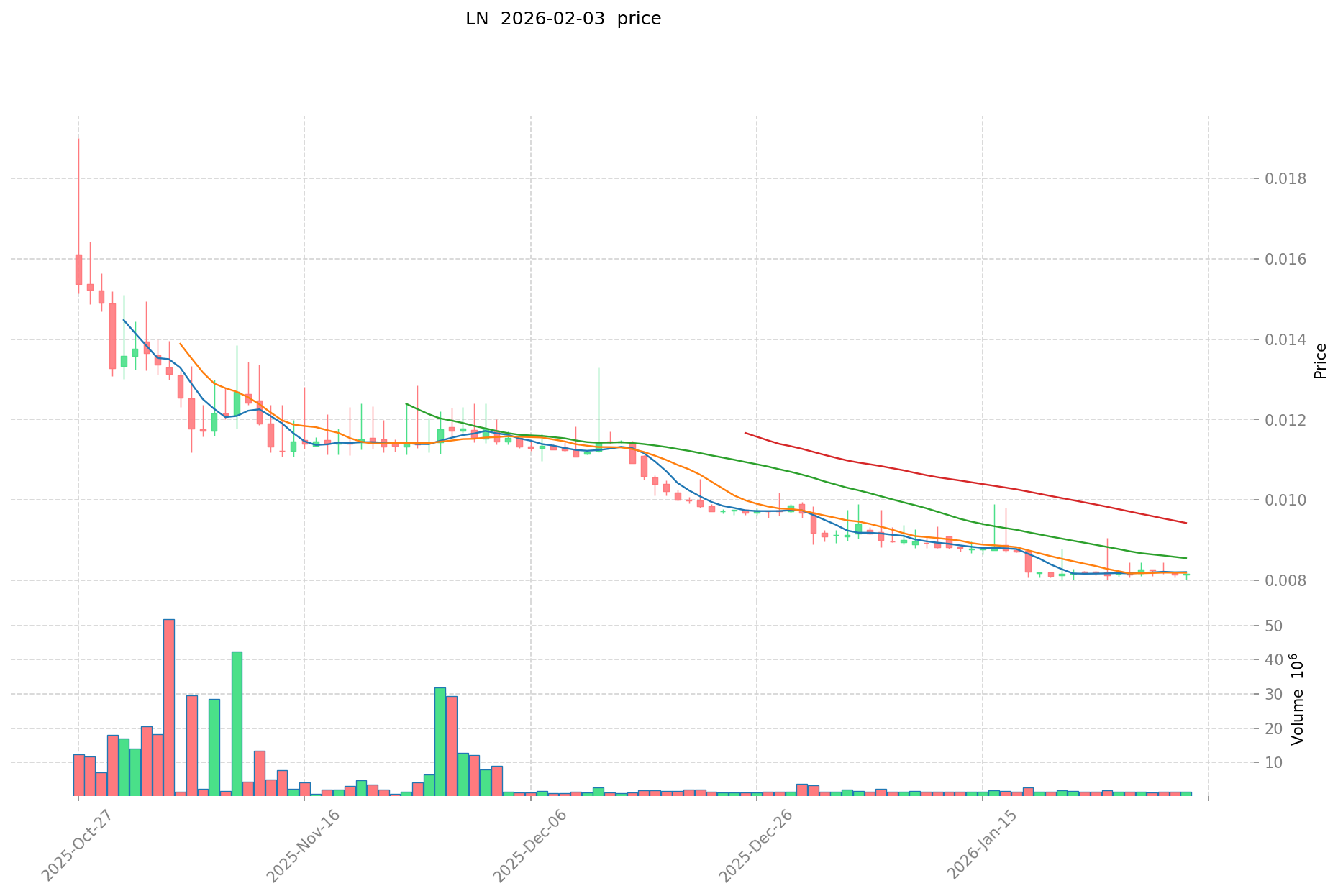
Lnfi Network (LN) represents a specialized asset within the cryptocurrency sector, focusing on multi-asset DeFi functionality on the Lightning Network. As of February 3, 2026, LN holds a market capitalization of approximately $961,845.50, with a circulating supply of 118.25 million tokens and a current price around $0.008134. The project aims to enable users to trade and manage Bitcoin, Taproot Assets, and RGB assets through its LightningFi infrastructure. With its BEP-20 token standard implementation and a ranking of 2537 in the crypto market, LN has attracted 1,152 holders and is available on 4 exchanges. The token has experienced notable price fluctuations since its deployment, showing a 24-hour change of -0.35% and a 30-day decline of -12.25%. This analysis examines LN's investment value, historical performance, future price projections, and associated risks to provide investors with comprehensive reference materials when considering "Is Lnfi Network (LN) a good investment?"
I. Lnfi Network (LN) Price History Review and Current Investment Value
- 2025: Token Launch and Initial Trading → LN launched at $0.05 on Gate.com and other platforms in July 2025, marking its entry into the cryptocurrency market
- 2025-2026: Price Volatility Period → LN experienced fluctuations from an earlier level to $0.008134, reflecting market adjustment dynamics
- 2026: Recent Market Performance → As of February 2026, LN showed -0.35% change in 24 hours and -12.25% over 30 days, indicating short-term price pressure
Current LN Investment Market Status (February 2026)
- LN Current Price: $0.008134
- 24-hour Trading Volume: $12,358.08
- Circulating Supply: 118.25 million LN (11.82% of total supply)
- Market Capitalization: $961,845.50
Click to view real-time LN market price
II. Core Factors Influencing Whether LN is a Good Investment (Is Lnfi Network(LN) a Good Investment)
Supply Mechanism and Scarcity (LN investment scarcity)
- Total supply of 1,000,000,000 LN tokens with a maximum supply cap → impacts price dynamics and investment considerations
- Current circulating supply of 118,250,000 tokens represents approximately 11.82% of total supply → indicates significant future supply potential
- Historical context: LN reached a notable price level of $0.043 in July 2025, while the current price as of February 3, 2026 stands at $0.008134 → reflects market volatility patterns
- Investment perspective: The supply structure and token distribution schedule may influence long-term valuation trajectories
- Market capitalization of approximately $961,845.50 with 1,152 token holders → indicates early-stage market participation
- Trading activity across 4 exchanges with 24-hour volume of $12,358.08 → suggests developing liquidity conditions
- Price movements: -0.35% (24H), -0.51% (7D), -12.25% (30D), -88.094% (1Y) → reflects recent market pressures and volatility
- Market dominance of 0.00029% → positions LN as an emerging asset within the broader cryptocurrency landscape
Technology and Ecosystem Development (Technology & Ecosystem for LN investment)
- Multi-asset DeFi functionality on Lightning Network infrastructure → enables trading and management of Bitcoin, Taproot Assets, and RGB assets through LightningFi platform
- BEP-20 standard implementation on BSC (Binance Smart Chain) → provides interoperability within existing blockchain ecosystems
- Next-generation financial infrastructure positioning → targets expansion of Bitcoin Layer 2 DeFi capabilities
- Ecosystem applications: Focus on trading, earning, and asset management features → may support long-term utility development
III. LN Future Investment Forecast and Price Outlook (Is Lnfi Network (LN) worth investing in 2026-2031)
Short-term Investment Forecast (2026, short-term LN investment outlook)
- Conservative forecast: $0.0044737 - $0.008134
- Neutral forecast: $0.008134 - $0.00902874
- Optimistic forecast: $0.00902874 or above
Mid-term Investment Outlook (2027-2028, mid-term Lnfi Network (LN) investment forecast)
- Market phase expectation: gradual expansion phase with moderate growth potential
- Investment return forecast:
- 2027: $0.0056637042 - $0.0106408988
- 2028: $0.005382235264 - $0.012782808752
- Key catalysts: Lightning Network adoption, DeFi functionality expansion, and multi-asset trading capabilities
Long-term Investment Outlook (Is LN a good long-term investment?)
- Base scenario: $0.005382235264 - $0.012782808752 (assuming steady ecosystem development)
- Optimistic scenario: $0.011314539777548 - $0.021353562541801 (assuming accelerated adoption and favorable market conditions)
- Risk scenario: below $0.005382235264 (under adverse market conditions or limited adoption)
Click to view LN long-term investment and price forecast: Price Prediction
2026-02-03 to 2031 Long-term Outlook
- Base scenario: $0.005382235264 - $0.012782808752 (corresponding to stable progress and steady mainstream application growth)
- Optimistic scenario: $0.011314539777548 - $0.021353562541801 (corresponding to large-scale adoption and favorable market environment)
- Transformative scenario: above $0.021353562541801 (if ecosystem achieves breakthrough progress and mainstream popularization)
- 2031-12-31 forecasted high: $0.021353562541801 (based on optimistic development assumptions)
Disclaimer: This forecast is based on historical data and market analysis. Cryptocurrency investments involve substantial risk, and past performance does not guarantee future results. Investors should conduct their own research and consider their risk tolerance before making investment decisions.
| Year |
Predicted High Price |
Predicted Average Price |
Predicted Low Price |
Price Change |
| 2026 |
0.00902874 |
0.008134 |
0.0044737 |
0 |
| 2027 |
0.0106408988 |
0.00858137 |
0.0056637042 |
5 |
| 2028 |
0.012782808752 |
0.0096111344 |
0.005382235264 |
18 |
| 2029 |
0.0151159116276 |
0.011196971576 |
0.00638227379832 |
37 |
| 2030 |
0.016708680834286 |
0.0131564416018 |
0.011314539777548 |
61 |
| 2031 |
0.021353562541801 |
0.014932561218043 |
0.01418593315714 |
83 |
IV. LN Investment Strategy and Risk Management (How to invest in Lnfi Network)
Investment Methodology (LN investment strategy)
Long-term Holding (HODL LN)
For conservative investors seeking stable exposure to Lightning Network DeFi infrastructure, long-term holding may be considered. This approach involves:
- Regular accumulation during market corrections
- Focus on fundamental development progress rather than short-term price movements
- Patience through market cycles as the Lightning Network ecosystem matures
Active Trading
For traders comfortable with higher risk profiles, active trading strategies may include:
- Technical analysis utilizing price trends, support/resistance levels, and volume indicators
- Swing trading based on market sentiment shifts
- Monitoring on-chain metrics and Lightning Network adoption trends
- Setting clear entry and exit points based on predefined criteria
Risk Management (Risk management for LN investment)
Asset Allocation Ratio
- Conservative investors: Allocate no more than 2-5% of crypto portfolio to LN
- Moderate investors: Consider 5-10% allocation with active monitoring
- Experienced investors: May allocate up to 10-15% with comprehensive risk hedging
Risk Hedging Solutions
- Diversified portfolio approach combining established cryptocurrencies with emerging DeFi assets
- Position sizing based on market capitalization and liquidity considerations
- Regular portfolio rebalancing to maintain target allocations
- Consideration of stablecoin holdings for liquidity management
Secure Storage
Given LN's BSC deployment (contract address: 0x6d2ebdf6d551d8408e7d896e9a1ec6f84806e193):
- Hot wallet: MetaMask or Trust Wallet for active trading
- Cold storage: Hardware wallets (Ledger, Trezor) for long-term holdings
- Security practices: Enable two-factor authentication, verify contract addresses, avoid sharing private keys
V. LN Investment Risks and Challenges (Risks of investing in Lnfi Network)
Market Risk
- High volatility: LN experienced significant price fluctuation with 88.094% decline over one year
- Limited liquidity: Trading volume of approximately $12,358 indicates relatively low market depth
- Price discovery challenges: Current market cap of $961,845 suggests early-stage valuation uncertainty
- Circulation dynamics: Only 11.82% of total supply currently circulating may create supply-side pressure
Regulatory Risk
- Uncertain regulatory framework for Lightning Network-based DeFi protocols across jurisdictions
- Potential classification changes affecting multi-asset DeFi platforms
- Compliance requirements for decentralized financial infrastructure may evolve
- Cross-border regulatory coordination challenges for global Lightning Network operations
Technical Risk
- Smart contract vulnerabilities on BSC platform
- Lightning Network integration complexity and potential channel management issues
- Multi-asset support (Bitcoin, Taproot Assets, RGB assets) introduces technical integration challenges
- Network upgrade dependencies and compatibility maintenance requirements
- Limited exchange listings (4 exchanges) may restrict liquidity and exit options
Project-Specific Risks
- Relatively low holder count (1,152) indicates limited adoption
- Early-stage project with launch in July 2025
- Competitive landscape with established Lightning Network solutions
- Dependence on broader Lightning Network adoption and development
VI. Conclusion: Is Lnfi Network a Good Investment?
Investment Value Summary
LN presents characteristics of an early-stage Lightning Network DeFi infrastructure project. While the technology addresses multi-asset management on Lightning Network, investors should note the significant price volatility evidenced by 88.094% decline over one year and limited current market capitalization of $961,845.
Investor Recommendations
✅ Beginners:
- Consider small position sizing (1-3% of portfolio) with dollar-cost averaging approach
- Prioritize secure storage using hardware wallets
- Focus on education about Lightning Network technology before investment
- Monitor project development progress and adoption metrics
✅ Experienced Investors:
- Implement swing trading strategies based on technical analysis
- Diversify across multiple DeFi protocols and Layer 2 solutions
- Set strict stop-loss levels given historical volatility
- Track Lightning Network ecosystem growth indicators
✅ Institutional Investors:
- Conduct comprehensive due diligence on technical architecture
- Consider strategic allocation within broader Lightning Network exposure
- Monitor regulatory developments affecting DeFi infrastructure
- Evaluate competitive positioning within Lightning Network DeFi landscape
⚠️ Disclaimer: Cryptocurrency investments carry substantial risk. This analysis is for informational purposes only and does not constitute investment advice. The significant price decline, limited liquidity, and early-stage nature of LN require careful consideration. Investors should conduct independent research and consult financial advisors before making investment decisions.
VII. FAQ
Q1: What is the current market position of Lnfi Network (LN) and is it suitable for investment?
As of February 3, 2026, LN ranks 2537 in the cryptocurrency market with a market capitalization of approximately $961,845.50 and a price of $0.008134. The token has experienced significant volatility, showing an 88.094% decline over one year, which indicates high-risk characteristics. LN is best suited for experienced investors who understand Lightning Network technology and can tolerate substantial price fluctuations. Beginners should consider minimal allocation (1-3% of portfolio) with comprehensive risk management, while the limited liquidity (24-hour volume of $12,358.08) and early-stage development status require careful evaluation before investment.
Q2: How does LN's supply mechanism affect its investment value?
LN has a total supply of 1,000,000,000 tokens with only 118,250,000 (11.82%) currently circulating. This supply structure creates potential downward pressure as future token releases could significantly increase market supply. The relatively low circulation percentage suggests that substantial supply expansion may occur, which historically correlates with price dilution risk. Investors should factor this supply dynamic into valuation models, as the gradual release of the remaining 88.18% of tokens may impact price performance over the mid-to-long term, particularly if demand growth does not keep pace with increasing circulation.
Q3: What are the primary technical features that distinguish LN from other DeFi projects?
LN operates as a multi-asset DeFi platform built on Lightning Network infrastructure, enabling users to trade and manage Bitcoin, Taproot Assets, and RGB assets through its LightningFi platform. Implemented as a BEP-20 token on Binance Smart Chain (contract address: 0x6d2ebdf6d551d8408e7d896e9a1ec6f84806e193), LN bridges Lightning Network functionality with BSC ecosystem interoperability. This dual-layer approach positions LN as Bitcoin Layer 2 DeFi infrastructure, though the technical complexity of integrating multiple asset types introduces both innovation potential and technical integration risks that investors should carefully assess.
Q4: What price forecasts exist for LN from 2026 to 2031?
Forecast models suggest LN may trade within $0.0044737 - $0.008134 in 2026 under conservative scenarios. By 2027-2028, neutral projections indicate potential ranges of $0.0056637042 - $0.0106408988 (2027) and $0.005382235264 - $0.012782808752 (2028). Long-term optimistic scenarios for 2031 project a high of approximately $0.021353562541801, representing potential 163% growth from current levels. However, these projections assume favorable Lightning Network adoption, ecosystem expansion, and market conditions. Investors must recognize that cryptocurrency forecasts carry substantial uncertainty, and past performance (including LN's 88% decline) demonstrates significant downside risk alongside speculative upside potential.
Q5: What are the main risks associated with investing in LN?
LN faces multiple risk categories including market risk (extreme volatility with 88% annual decline), liquidity risk (limited trading volume across only 4 exchanges), and circulation risk (only 11.82% of supply currently available). Technical risks include smart contract vulnerabilities on BSC, Lightning Network integration complexity, and multi-asset support challenges. Regulatory uncertainty surrounding DeFi protocols and Lightning Network applications adds compliance risk. Project-specific concerns include limited adoption (1,152 holders), early-stage development (launched July 2025), and competitive pressure from established Lightning Network solutions. These combined factors necessitate comprehensive risk management and conservative position sizing.
Q6: How should investors approach LN storage and security?
For active trading, investors should use reputable hot wallets such as MetaMask or Trust Wallet configured for BSC network (ensuring correct contract address 0x6d2ebdf6d551d8408e7d896e9a1ec6f84806e193). Long-term holdings require cold storage solutions including hardware wallets like Ledger or Trezor, which provide enhanced security against online threats. Essential security practices include enabling two-factor authentication, verifying contract addresses before transactions, maintaining private key confidentiality, and avoiding interaction with unverified platforms. Given LN's BEP-20 standard, investors must ensure wallet compatibility with Binance Smart Chain and should never share seed phrases or private keys with third parties.
Q7: What investment strategies are appropriate for different investor types considering LN?
Conservative beginners should implement dollar-cost averaging with 1-3% portfolio allocation, focusing on education about Lightning Network technology before significant commitment. Experienced traders may employ active strategies including technical analysis, swing trading based on volume indicators, and monitoring Lightning Network adoption metrics, with position sizes of 5-10% and strict stop-loss protocols. Institutional investors should conduct comprehensive due diligence on technical architecture, consider LN within broader Lightning Network exposure strategies, and evaluate competitive positioning while monitoring regulatory developments. All investor categories should maintain diversification across established cryptocurrencies and emerging DeFi assets to mitigate concentration risk.
Q8: What factors could drive LN's future price appreciation?
Potential positive catalysts include widespread Lightning Network adoption, successful expansion of multi-asset DeFi functionality, increased exchange listings beyond the current 4 platforms, and growth in holder base beyond 1,152 participants. Technical developments enabling seamless Bitcoin, Taproot Assets, and RGB assets integration could enhance utility and demand. Broader cryptocurrency market recovery and favorable regulatory frameworks for Lightning Network-based DeFi infrastructure may create supportive conditions. However, investors should recognize that these catalysts remain speculative, and LN's historical 88% decline demonstrates that negative factors (limited adoption, competitive pressure, market downturns) have significantly outweighed positive developments during its initial market phase.
* The information is not intended to be and does not constitute financial advice or any other recommendation of any sort offered or endorsed by Gate.