This comprehensive analysis evaluates Meter (MTRG), an EVM-compatible Layer-1 blockchain governance token currently trading at $0.02957 with a market cap of $954,410. The article examines MTRG's unique dual-token model—where MTRG secures the network through Proof-of-Stake while MTR functions as a semi-stable coin for gas payments—alongside its historical price performance, which has declined 76% year-over-year from peak levels. It addresses core investment factors including supply mechanics, institutional adoption potential, and technical architecture utilizing HotStuff2 consensus. The analysis provides price forecasts through 2031, ranging from conservative baseline scenarios to optimistic growth projections, while thoroughly evaluating market volatility, liquidity constraints, regulatory uncertainties, and competitive risks. Investment strategies differentiated by investor profiles—from beginners to institutional investors—include allocation guidelines and security protocols. The article concludes that MTRG
Introduction: Meter (MTRG)'s Investment Position and Market Prospects
MTRG is an important asset in the cryptocurrency field. As of February 2026, Meter (MTRG) maintains a market capitalization of approximately $954,410.49 with a circulating supply of about 32,276,310 tokens, and the current price is around $0.02957. As the governance token of Meter, an EVM-compatible high-performance public chain based on HotStuff2 consensus, MTRG has gradually become a focal point for investors discussing "Is Meter (MTRG) a good investment?" With its unique dual-token model - where MTRG secures network through POS mechanism while MTR serves as a semi-stable coin generated by Bitcoin miner POW to pay for network Gas - the project represents a distinctive approach in the blockchain infrastructure sector. This article will comprehensively analyze MTRG's investment value, historical trends, future price predictions, and investment risks to provide reference for investors.
I. Meter (MTRG) Price History Review and Current Investment Value
- 2020: MTRG launched at $0.5 in July 2020 → Early investors experienced significant initial volatility as the token established market presence
- 2021: Market expansion phase → MTRG reached $16.47 in November 2021, representing substantial appreciation from launch price
- 2022-2025: Market correction cycle → Price declined from peak levels to current trading range
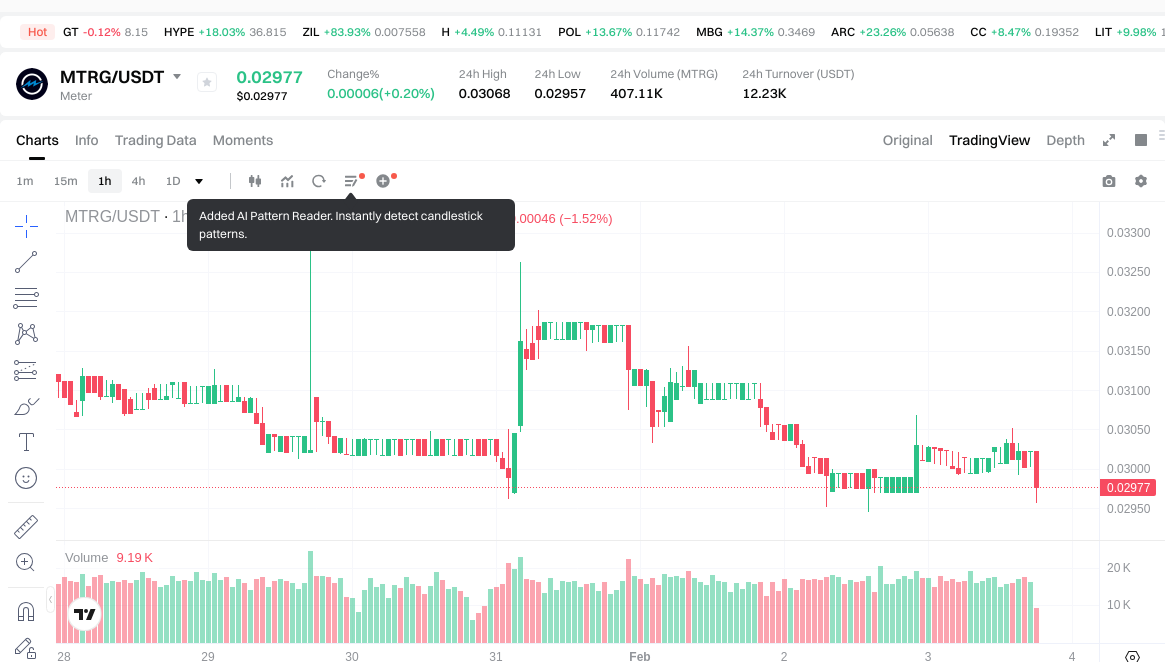
- 2026: Current consolidation phase → As of January 2, 2026, MTRG recorded its recent low at $0.029458
Current MTRG Investment Market Status (February 2026)
- MTRG current price: $0.02957
- 24-hour price change: -0.43%
- 24-hour trading volume: $12,258.77
- Market capitalization: $954,410.49
- Circulating supply: 32,276,310 MTRG (73.50% of total supply)
- Fully diluted market cap: $1,445,679.28
- Token holders: 1,785 addresses
- Listed exchanges: Available on 1 exchange platform
Click to view real-time MTRG market price
II. Core Factors Affecting Whether MTRG is a Good Investment
Supply Mechanism and Scarcity (MTRG Investment Scarcity)
- MTRG operates with a maximum supply of 43,913,268 tokens and a current circulating supply of 32,276,310 tokens, representing approximately 73.5% circulation ratio
- The dual-token model distinguishes MTRG as a governance token from MTR (the semi-stable coin used for gas payments), creating a unique supply structure
- Limited supply combined with ongoing network operations may influence long-term scarcity dynamics
- Investment consideration: The relationship between circulating supply and maximum supply provides insight into potential future dilution
Institutional Investment and Mainstream Adoption (Institutional Investment in MTRG)
- Current holder count stands at 1,785 addresses, indicating the scale of direct token ownership
- MTRG maintains presence across multiple chains including MTR native chain, BSC, and Ethereum, enabling cross-chain accessibility
- Network security utilizes POS mechanism through MTRG staking, creating utility beyond speculative trading
- The project's positioning as an EVM-compatible high-performance public chain based on HotStuff2 consensus provides technical infrastructure for ecosystem development
Macroeconomic Environment Impact on MTRG Investment
- As a governance token for a layer-1 blockchain infrastructure, MTRG performance correlates with overall blockchain adoption trends
- Market capitalization of approximately $954,410 represents a relatively small position within the broader crypto market (0.000052% market share)
- Price volatility remains significant, with 1-year performance showing -76.23% change, reflecting sensitivity to market conditions
- Lower liquidity (24-hour trading volume of $12,258.77) may amplify price movements during periods of market stress
Technology and Ecosystem Development (Technology & Ecosystem for MTRG Investment)
- HotStuff2 Consensus: The network employs HotStuff2 consensus mechanism designed for high-performance transaction processing on an EVM-compatible platform
- Hybrid Security Model: MTRG governance token secures the network through POS, while MTR generation through Bitcoin miner POW provides economic incentives
- Multi-chain deployment enables interoperability across MTR, BSC, and Ethereum ecosystems
- EVM compatibility allows developers to deploy existing Ethereum-based applications, potentially expanding the ecosystem utility
III. MTRG Future Investment Forecast and Price Outlook (Is Meter(MTRG) worth investing in 2026-2031)
Short-term Investment Forecast (2026, short-term MTRG investment outlook)
- Conservative forecast: $0.017 - $0.025
- Neutral forecast: $0.025 - $0.030
- Optimistic forecast: $0.030 - $0.033
Mid-term Investment Outlook (2027-2029, mid-term Meter(MTRG) investment forecast)
- Market phase expectation: The token may experience gradual recovery and stabilization as the broader crypto market evolves, with potential support from technological developments in the EVM high-performance public chain sector.
- Investment return forecast:
- 2027: $0.017 - $0.039
- 2028: $0.027 - $0.042
- 2029: $0.036 - $0.043
- Key catalysts: Network security enhancements through POS mechanisms, adoption of MTR for gas payments, and broader integration within the Meter ecosystem.
Long-term Investment Outlook (Is MTRG a good long-term investment?)
- Baseline scenario: $0.024 - $0.049 (assuming steady network development and moderate market conditions)
- Optimistic scenario: $0.041 - $0.066 (assuming increased ecosystem adoption and favorable regulatory environment)
- Risk scenario: Below $0.020 (in case of prolonged market downturn or technical challenges)
Click to view MTRG long-term investment and price forecast: Price Prediction
2026-02-03 - 2031 Long-term Outlook
- Baseline scenario: $0.024 - $0.049 (corresponding to steady progress and gradual mainstream application enhancement)
- Optimistic scenario: $0.041 - $0.066 (corresponding to large-scale adoption and favorable market environment)
- Transformative scenario: Above $0.066 (if the ecosystem achieves breakthrough progress and mainstream popularization)
- 2031-12-31 forecast high: $0.066 (based on optimistic development assumptions)
Disclaimer: These forecasts are based on available data and analytical models. Cryptocurrency markets are highly volatile and subject to numerous unpredictable factors. Past performance does not guarantee future results. This analysis should not be considered as investment advice. Investors should conduct their own research and consult with financial professionals before making investment decisions.
| Year |
Predicted High Price |
Predicted Average Price |
Predicted Low Price |
Price Change |
| 2026 |
0.0331184 |
0.02957 |
0.0165592 |
0 |
| 2027 |
0.038553366 |
0.0313442 |
0.01723931 |
6 |
| 2028 |
0.0419385396 |
0.034948783 |
0.02726005074 |
18 |
| 2029 |
0.043441337269 |
0.0384436613 |
0.035752605009 |
30 |
| 2030 |
0.057728923991145 |
0.0409424992845 |
0.024156074577855 |
38 |
| 2031 |
0.065616496478303 |
0.049335711637822 |
0.040948640659392 |
66 |
IV. Meter (MTRG) Investment Strategy and Risk Management (How to invest in Meter)
Investment Methodology (Meter investment strategy)
Long-term Holding (HODL Meter)
Long-term holding strategies may appeal to investors seeking exposure to high-performance blockchain infrastructure. Meter operates as an EVM-compatible public chain utilizing the HotStuff2 consensus mechanism, with MTRG serving as its governance token. The protocol employs a dual-token model where MTRG secures the network through Proof-of-Stake while MTR (a semi-stable coin generated through Bitcoin miner POW) covers network gas fees.
Investors considering this approach should note that MTRG has experienced considerable price fluctuation since its launch in July 2020. As of February 3, 2026, the token trades at $0.02957, representing a substantial decline from its all-time high of $16.47 recorded on November 3, 2021. The current price approaches its all-time low of $0.029458, established on January 2, 2026.
Active Trading
Active trading strategies rely on technical analysis and momentum-based approaches. Recent price movements show volatility across multiple timeframes: -2.18% (1H), -0.43% (24H), -4.77% (7D), -9.13% (30D), and -76.23% (1Y). The 24-hour trading range spans from $0.02957 to $0.03068, with trading volume recorded at $12,258.77.
Traders should consider the relatively limited liquidity profile, with MTRG listed on 1 exchange and maintaining a market capitalization of approximately $954,410. The circulating supply represents 73.5% of the maximum supply (32.28M out of 43.91M tokens), with a fully diluted market cap of $1.45M.
Risk Management (Risk management for Meter investment)
Asset Allocation Guidelines
Conservative Investors: Given the token's historical volatility and current market positioning (ranked #2542 by market cap with 0.000052% market dominance), conservative portfolios might limit MTRG allocation to under 1% of crypto holdings.
Aggressive Investors: Those with higher risk tolerance and belief in Layer-1 infrastructure projects may consider allocations of 3-5% within their cryptocurrency portfolio, balanced against more established assets.
Professional Investors: Institutional or experienced traders might evaluate MTRG within a broader blockchain infrastructure thesis, potentially allocating 5-10% to emerging Layer-1 projects while maintaining diversification across multiple protocols.
Risk Hedging Strategies
Investors may consider diversifying across multiple blockchain infrastructure projects rather than concentrating exposure in a single asset. Portfolio construction could incorporate established Layer-1 protocols alongside emerging alternatives to balance potential upside with downside protection.
Given MTRG's limited exchange availability and modest trading volume, position sizing should account for potential liquidity constraints during market stress periods.
Secure Storage Solutions
Cold Storage Options: MTRG can be stored in hardware wallets supporting EVM-compatible tokens, providing offline security for long-term holdings.
Hot Wallet Considerations: For active traders, exchange wallets or software wallets offer convenience but require careful security practices including two-factor authentication and withdrawal whitelisting.
Multi-Chain Storage: Since MTRG exists across multiple networks (MTR native chain, BSC, and Ethereum), investors should verify proper network selection when transferring tokens and maintain separate wallet addresses for each chain to prevent loss of funds.
V. Meter (MTRG) Investment Risks and Challenges (Risks of investing in Meter)
Market Risks
High Volatility: MTRG demonstrates substantial price fluctuations, with the token declining over 76% year-over-year and approaching historical lows. The 24-hour price range of 3.75% (from $0.02957 to $0.03068) illustrates ongoing volatility even at depressed price levels.
Limited Liquidity: With trading volume of approximately $12,259 over 24 hours and presence on only 1 exchange, MTRG faces liquidity constraints that could amplify price movements during periods of buying or selling pressure. The token holds 1,785 holders, suggesting a relatively small community base.
Market Capitalization Concerns: Ranking at #2542 with a market cap under $1 million and market dominance of 0.000052%, MTRG operates in a highly competitive Layer-1 landscape where larger protocols command significantly greater resources and network effects.
Regulatory Risks
Jurisdictional Uncertainty: Cryptocurrency regulations continue evolving across different jurisdictions. Layer-1 protocols like Meter may face varying regulatory treatment depending on whether authorities classify MTRG as a utility token, security, or other asset category.
Cross-Chain Compliance: MTRG's deployment across multiple networks (MTR, BSC, Ethereum) introduces complexity regarding regulatory oversight, as different blockchain ecosystems may face distinct regulatory approaches in various countries.
DeFi Infrastructure Scrutiny: As blockchain infrastructure supporting decentralized applications, Meter-based protocols could face regulatory examination regarding activities conducted on the network, even if the base layer protocol itself remains neutral.
Technical Risks
Network Security Considerations: While Meter employs the HotStuff2 consensus mechanism and Proof-of-Stake security through MTRG, any blockchain network faces potential vulnerabilities including consensus bugs, validator centralization, or smart contract exploits affecting network stability.
Protocol Development Risks: Blockchain protocols require continuous development and maintenance. Technical roadmap execution risks, potential delays in planned upgrades, or inability to attract developer resources could impact long-term viability.
Competitive Landscape: The EVM-compatible Layer-1 space includes numerous established and emerging protocols. Meter competes for developer attention, user adoption, and liquidity against well-funded alternatives with larger ecosystems and network effects.
Bridge and Cross-Chain Risks: MTRG's presence on multiple chains implies reliance on bridging mechanisms, which have historically represented attack vectors in the cryptocurrency space. Users transferring assets between chains face technical risks associated with bridge protocols.
VI. Conclusion: Is Meter (MTRG) a Good Investment?
Investment Value Summary
Meter (MTRG) represents a Layer-1 blockchain infrastructure project utilizing innovative consensus mechanisms (HotStuff2) and a dual-token economic model. The protocol's technical architecture combines EVM compatibility with a unique approach to network security (PoS via MTRG) and transaction costs (semi-stable MTR generated through PoW).
However, the investment profile reflects significant challenges. MTRG has declined over 76% year-over-year, currently trading near its all-time low at $0.02957 with a market capitalization under $1 million. Limited exchange availability, modest trading volume, and a ranking outside the top 2,500 cryptocurrencies indicate constrained market adoption and liquidity.
The token's price history shows substantial volatility, with short-term fluctuations ranging from -2.18% (1H) to -9.13% (30D), while the long-term trend has been predominantly negative. The circulating supply of 73.5% suggests limited additional token inflation risk, though the maximum supply represents only 89.8% of total supply.
Investor Recommendations
✅ Beginners: New cryptocurrency investors might prioritize more established assets with greater liquidity, larger communities, and proven track records. If pursuing exposure to emerging Layer-1 protocols, consider dollar-cost averaging in minimal amounts while maintaining secure storage through hardware wallets or reputable software wallets with strong security practices.
✅ Experienced Investors: Those with knowledge of blockchain infrastructure and risk tolerance for speculative positions might evaluate MTRG within a diversified portfolio of Layer-1 protocols. Active traders could explore short-term momentum strategies while remaining cognizant of liquidity constraints. Position sizing should reflect the elevated risk profile relative to more established crypto assets.
✅ Institutional Investors: Professional investors and institutions might assess Meter's technology and team within broader blockchain infrastructure research, potentially taking exploratory positions sized appropriately for venture-stage exposure. Due diligence should encompass technical architecture review, competitive analysis, and long-term sustainability evaluation.
⚠️ Disclaimer: Cryptocurrency investments carry substantial risk including potential loss of principal. Market volatility, regulatory uncertainty, technological challenges, and liquidity constraints affect all digital assets, particularly those with smaller market capitalizations. This content provides informational analysis only and does not constitute financial advice, investment recommendations, or solicitation to purchase or sell any asset. Investors should conduct independent research, consider their financial circumstances and risk tolerance, and consult qualified financial advisors before making investment decisions.
VII. FAQ
Q1: What is Meter (MTRG) and what makes it unique in the blockchain space?
Meter (MTRG) is the governance token for an EVM-compatible Layer-1 blockchain that employs the HotStuff2 consensus mechanism. Its uniqueness lies in a dual-token model: MTRG secures the network through Proof-of-Stake while MTR, a semi-stable coin generated by Bitcoin miner Proof-of-Work, covers network gas fees. This architecture distinguishes Meter from conventional single-token blockchain protocols by separating governance and security functions (MTRG) from transaction cost payment (MTR). The protocol supports multi-chain deployment across MTR native chain, BSC, and Ethereum, enabling cross-chain interoperability.
Q2: What is the current price and market performance of MTRG in February 2026?
As of February 3, 2026, MTRG trades at $0.02957 with a market capitalization of approximately $954,410. The token ranks #2542 by market cap with 0.000052% market dominance. Recent performance shows negative momentum across multiple timeframes: -0.43% (24H), -4.77% (7D), -9.13% (30D), and -76.23% (1Y). The 24-hour trading volume stands at $12,258.77, with MTRG available on 1 exchange. The current price approaches the all-time low of $0.029458 recorded on January 2, 2026, representing a substantial decline from the all-time high of $16.47 reached on November 3, 2021.
Q3: What are the main risks associated with investing in MTRG?
MTRG presents several significant investment risks. Market risks include extreme volatility (76% decline year-over-year), limited liquidity with only $12,259 in 24-hour trading volume, and restricted exchange availability on just 1 platform. The small market capitalization under $1 million and ranking outside the top 2,500 cryptocurrencies indicate challenges in achieving widespread adoption. Technical risks encompass network security considerations, protocol development execution, and intense competition within the crowded EVM-compatible Layer-1 space. Regulatory uncertainty affects the classification and treatment of both MTRG as a governance token and the broader cross-chain infrastructure. Bridge and cross-chain risks emerge from MTRG's multi-network presence.
Q4: What investment allocation is appropriate for MTRG in different portfolio types?
Investment allocation recommendations vary by investor profile and risk tolerance. Conservative investors might limit MTRG exposure to under 1% of crypto holdings given historical volatility and current market positioning. Aggressive investors with higher risk tolerance and conviction in Layer-1 infrastructure projects may consider allocations of 3-5% within cryptocurrency portfolios, balanced against more established assets. Professional investors or institutions might evaluate MTRG within a broader blockchain infrastructure thesis, potentially allocating 5-10% to emerging Layer-1 projects while maintaining diversification across multiple protocols. All allocations should account for the token's liquidity constraints and elevated risk profile relative to mainstream cryptocurrencies.
Q5: What are the price forecasts for MTRG through 2031?
Short-term forecasts for 2026 range from conservative estimates of $0.017-$0.025, neutral projections of $0.025-$0.030, to optimistic scenarios of $0.030-$0.033. Mid-term outlook (2027-2029) suggests gradual recovery potential: 2027 ($0.017-$0.039), 2028 ($0.027-$0.042), and 2029 ($0.036-$0.043). Long-term projections through 2031 encompass baseline scenarios of $0.024-$0.049, optimistic scenarios of $0.041-$0.066, and risk scenarios below $0.020. The 2031 forecast high reaches $0.066 under favorable development assumptions. These projections assume network adoption growth, technological advancement, and stable market conditions, though actual outcomes may vary significantly due to market volatility and unpredictable factors.
Q6: How does MTRG's tokenomics and supply structure affect its investment potential?
MTRG operates with a maximum supply of 43,913,268 tokens, of which 32,276,310 tokens (73.5%) currently circulate, held across 1,785 addresses. This high circulation ratio indicates limited future dilution risk from token unlocks. The dual-token architecture separates economic functions: MTRG provides governance and network security through staking, while MTR serves as the transactional currency for gas payments. The circulating supply represents approximately 73.5% of maximum supply, with fully diluted market cap at $1.45 million. This structure creates distinct utility for MTRG beyond speculative trading, though the relatively small holder base and market capitalization suggest limited current network effects compared to established Layer-1 protocols.
Q7: What are the key factors that could influence MTRG's future price movement?
Several factors may impact MTRG's price trajectory. Technology development including successful implementation of HotStuff2 consensus enhancements and EVM compatibility improvements could attract developers and users. Ecosystem expansion through increased adoption of MTR for gas payments and growth in applications built on Meter infrastructure would enhance utility value. Broader market conditions affecting Layer-1 protocols and cryptocurrency sentiment significantly influence price movements given MTRG's correlation with overall blockchain adoption trends. Regulatory clarity regarding token classification and cross-chain operations may reduce uncertainty. Exchange listings and liquidity improvements could reduce price volatility. Competition from other EVM-compatible chains and their respective ecosystems represents downside risk to market share and adoption.
Q8: What security measures should investors implement when holding MTRG?
Investors should implement multi-layered security practices when holding MTRG. Cold storage through hardware wallets supporting EVM-compatible tokens provides offline security for long-term holdings, minimizing exposure to online threats. Hot wallet users should employ software wallets with robust security features including two-factor authentication, withdrawal whitelisting, and regular software updates. Given MTRG's multi-chain presence across MTR native chain, BSC, and Ethereum, investors must verify proper network selection during transfers to prevent loss of funds. Maintaining separate wallet addresses for each supported chain reduces cross-chain confusion. Exchange users should enable all available security features and consider moving assets to personal wallets for amounts exceeding short-term trading needs. Regular backup of wallet recovery phrases to secure offline locations protects against device failure or loss.
* The information is not intended to be and does not constitute financial advice or any other recommendation of any sort offered or endorsed by Gate.