This comprehensive guide evaluates whether NESS Lab (NESS) is a worthwhile investment, providing detailed analysis of technology fundamentals, market dynamics, and risk factors through 2031. As of February 2026, NESS trades at $0.005794 with a $1.18 million market cap on the Polygon network, serving as the core utility token for Ness Lab's knowledge-sharing ecosystem. The article examines NESS's volatile price history—declining 82% over one year from a $0.036 peak—alongside its scarcity mechanics with 204 million circulating tokens from a 500 million total supply. Key analysis covers institutional adoption barriers, macroeconomic headwinds, and the platform's community governance features. Price forecasts range conservatively from $0.00296-$0.00610 through 2026, with long-term projections reaching $0.01088 by 2031 under optimistic scenarios. Investment strategies address beginner dollar-cost averaging, active trading, and risk management approaches. Critical risk factors include market volatility, regulatory
Introduction: Ness LAB (NESS) Investment Position and Market Outlook
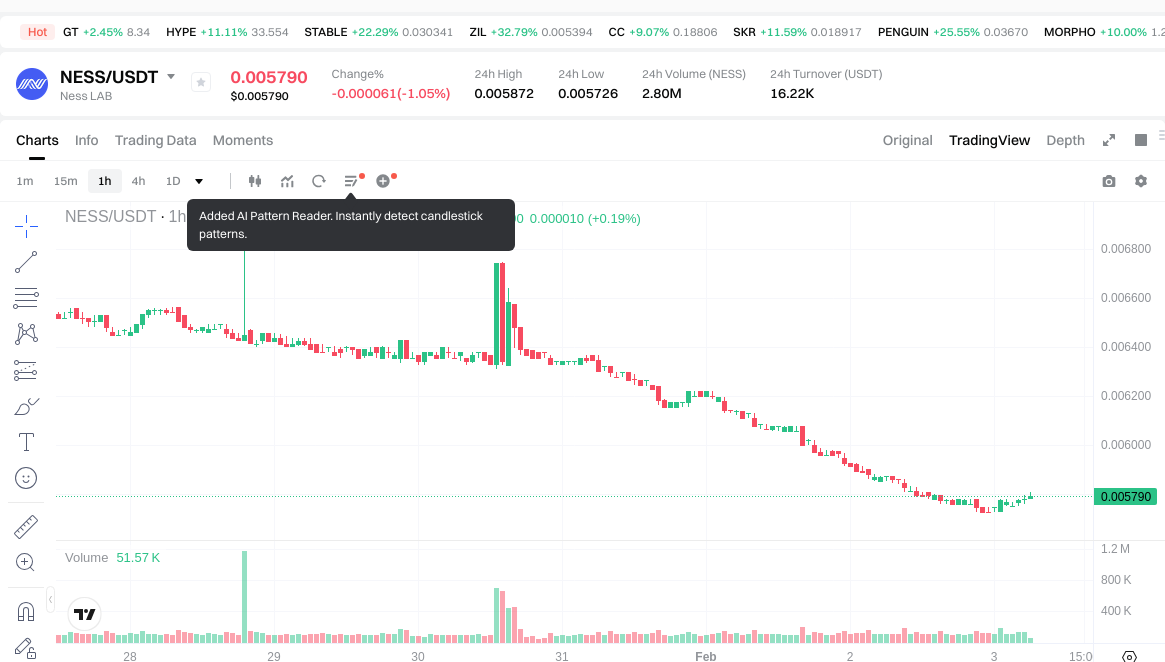
NESS is a digital asset in the cryptocurrency sector that has developed within the information economy space. As of February 3, 2026, NESS maintains a market capitalization of approximately $1.18 million, with a circulating supply of around 204.24 million tokens, and a current price hovering around $0.005794. The token operates on the Polygon network and serves as the core utility asset for the Ness Lab platform, which facilitates connections, collaboration, and knowledge sharing among users. With a ranking of 2405 in the cryptocurrency market and a market dominance of 0.00010%, NESS has drawn attention from investors examining "Is Ness LAB (NESS) a good investment?" This article provides a comprehensive analysis of NESS's investment value, historical price movements, future price projections, and associated investment risks to serve as reference for investors.
I. Ness LAB (NESS) Price History Review and Investment Value Status
- December 2025: NESS reached a notable price level of $0.036 → representing a significant milestone in the token's early trading history
- February 2026: Market adjustment phase → NESS price experienced downward movement to $0.005726
- Recent Period: Market volatility observed → price fluctuated between $0.005726 and $0.036 during the tracked period
Current NESS Investment Market Status (February 2026)
- NESS current price: $0.005794
- Market sentiment: Market cap stands at approximately $1.18 million with a fully diluted valuation of $2.90 million
- 24-hour trading volume: $16,153.26
- Token circulation: 204,236,070 NESS (approximately 40.85% of total supply)
Click to view real-time NESS market price
II. Core Factors Influencing Whether NESS is a Good Investment (Is Ness LAB(NESS) a Good Investment)
Supply Mechanism and Scarcity (NESS investment scarcity)
- Total Supply and Circulating Supply → Influencing Price and Investment Value
- NESS has a maximum supply of 500,000,000 tokens, with a circulating supply of 204,236,070 tokens as of February 2026, representing approximately 40.85% of the total supply.
- The fixed supply model may contribute to potential scarcity dynamics as adoption increases, though the majority of tokens remain uncirculated.
- Historical data shows NESS reached a notable price level of $0.036 in December 2025, before declining to lower levels, demonstrating significant volatility in its price trajectory.
- Investment Significance: Scarcity considerations remain relevant for long-term investment evaluation, particularly as the circulating supply represents less than half of the total token allocation.
Institutional Investment and Mainstream Adoption (Institutional investment in NESS)
- Exchange Availability and Market Access:
- NESS is listed on 3 exchanges as of February 2026, providing limited but growing market access for investors.
- The token has approximately 4,957 holders, indicating an emerging but relatively small community base.
- Ecosystem Participation and Community Governance:
- Ness Lab employs a community-driven governance model that emphasizes inclusivity and shared decision-making, which may influence long-term sustainability and adoption.
- The platform incorporates mechanisms such as expert networks, mentorship programs, and crowdfunding features, potentially supporting broader ecosystem development.
Macroeconomic Environment's Impact on NESS Investment
- Market Volatility and Risk Factors:
- NESS has demonstrated considerable price volatility, with a 24-hour trading range between $0.005726 and $0.005872 as of February 2026.
- The token has experienced notable declines across multiple timeframes: -1.53% over 24 hours, -9.56% over 7 days, -28.91% over 30 days, and -82.19% over 1 year.
- Technical indicators suggest a bearish outlook for 2026 based on multiple quantitative measures, which may reflect broader market sentiment and macroeconomic conditions.
- Market Capitalization and Liquidity:
- The fully diluted market capitalization stands at approximately $2,897,000, with a circulating market cap of approximately $1,183,343 as of February 2026.
- The 24-hour trading volume of $16,153.26 indicates moderate liquidity levels, which may impact price stability and investment execution.
Technology and Ecosystem Development (Technology & Ecosystem for NESS investment)
- Blockchain Infrastructure:
- NESS operates as a digital asset within the Ness Lab ecosystem, with contract deployment on Polygon (contract address: 0x6eaea1ed457e06f8cf6ee7adf34e621844c3b0fc).
- The platform is designed to facilitate knowledge sharing, collaboration, and value exchange through blockchain technology.
- Ecosystem Features and Utility:
- Dynamic Rewards System: The platform incentivizes community contributions including content creation, insights, and support through a recognition and compensation mechanism.
- Value Exchange Framework: NESS serves as the core digital asset powering participation and transactions within the Ness Lab ecosystem.
- Community Tools: The platform provides tools such as expert networks, mentorship programs, and crowdfunding mechanisms to support project development and individual growth.
- Governance Participation: Community-driven governance features aim to ensure inclusive decision-making processes for platform development.
- Investment Considerations:
- The technology and ecosystem features may provide foundational support for long-term value, though adoption rates and competitive positioning remain key factors.
- The platform's focus on knowledge economy and community engagement represents a specific use case within the broader blockchain ecosystem.
III. NESS Future Investment Forecast and Price Outlook (Is Ness LAB(NESS) worth investing in 2026-2031)
Short-term Investment Forecast (2026, short-term NESS investment outlook)
- Conservative forecast: $0.00296 - $0.00459
- Neutral forecast: $0.00459 - $0.00581
- Optimistic forecast: $0.00581 - $0.00610
Mid-term Investment Outlook (2027-2029, mid-term Ness LAB(NESS) investment forecast)
-
Market phase expectations: During this period, NESS may experience gradual development as the platform continues to build its ecosystem and user base. Price movements could reflect broader market trends alongside project-specific developments in community engagement and platform features.
-
Investment return forecast:
- 2027: $0.00566 - $0.00697
- 2028: $0.00329 - $0.00691
- 2029: $0.00395 - $0.00702
-
Key catalysts: Platform adoption rates, expansion of expert networks and mentorship programs, implementation of community governance mechanisms, overall crypto market conditions, and execution of the project's roadmap.
Long-term Investment Outlook (Is NESS a good long-term investment?)
- Base scenario: $0.00596 - $0.00816 (assuming steady platform growth and consistent community participation)
- Optimistic scenario: $0.00816 - $0.01088 (assuming accelerated adoption and favorable market environment)
- Risk scenario: Below $0.00330 (under conditions of reduced market interest or project execution challenges)
Click to view NESS long-term investment and price forecast: Price Prediction
2026-2031 Long-term Outlook
- Base scenario: $0.00596 - $0.00816 (corresponding to steady progress and gradual mainstream application growth)
- Optimistic scenario: $0.00816 - $0.01088 (corresponding to large-scale adoption and favorable market conditions)
- Transformative scenario: Above $0.01088 (subject to breakthrough ecosystem developments and mainstream penetration)
- 2031-12-31 predicted high: $0.01088 (based on optimistic development assumptions)
Disclaimer: The above predictions are based on historical data and market analysis models. Cryptocurrency markets are highly volatile and subject to numerous unpredictable factors. These forecasts should not be construed as financial advice, and investors should conduct their own research and risk assessment before making any investment decisions.
| Year |
Predicted High Price |
Predicted Average Price |
Predicted Low Price |
Price Change |
| 2026 |
0.00609945 |
0.005809 |
0.00296259 |
0 |
| 2027 |
0.00696644325 |
0.005954225 |
0.00565651375 |
2 |
| 2028 |
0.00691255751375 |
0.006460334125 |
0.00329477040375 |
11 |
| 2029 |
0.007020768110343 |
0.006686445819375 |
0.003945003033431 |
15 |
| 2030 |
0.008155792288182 |
0.006853606964859 |
0.005962638059427 |
18 |
| 2031 |
0.010881814458455 |
0.007504699626521 |
0.006529088675073 |
29 |
IV. NESS Investment Strategy and Risk Management (How to invest in NESS)
Investment Methodology (NESS investment strategy)
Long-term Holding (HODL NESS): This approach may suit investors with a steady risk tolerance who believe in the platform's long-term vision of advancing the information economy through community-driven collaboration and knowledge sharing. Given NESS Lab's focus on incentivizing user contributions via a dynamic rewards system and fostering project growth through expert networks and mentorship programs, long-term holders may benefit from the platform's sustainable development model and community-driven governance.
Active Trading: Traders relying on technical analysis and swing trading strategies should note NESS's recent price movements. Over the past 24 hours, NESS experienced a decline of approximately 1.53%, with a 7-day decrease of around 9.56% and a 30-day drop of roughly 28.91%. The token's 24-hour trading range was between $0.005726 and $0.005872. Active traders may seek to capitalize on short-term price fluctuations, though they should remain aware of the token's volatility patterns.
Risk Management (Risk management for NESS investment)
Asset Allocation Ratio:
- Conservative investors: Consider limiting NESS exposure to a small portion of a diversified portfolio (e.g., 2-5%), given the token's price volatility and relatively lower market ranking.
- Aggressive investors: May allocate a moderate portion (e.g., 5-10%) while maintaining exposure to other digital assets for balance.
- Professional investors: Could implement strategic allocations based on technical indicators, market sentiment analysis, and platform development milestones.
Risk Hedging Solutions: Investors may consider constructing a multi-asset portfolio that includes established cryptocurrencies alongside NESS to balance risk exposure. Hedging instruments such as stablecoins or traditional assets may help offset potential downside volatility.
Secure Storage:
- Cold wallets: Hardware wallets or offline storage solutions are recommended for long-term holdings to minimize exposure to online security threats.
- Hot wallets: For active traders requiring frequent access, reputable exchange wallets or mobile wallets with strong security features may be suitable, though users should enable two-factor authentication and other security measures.
V. NESS Investment Risks and Challenges (Risks of investing in NESS)
Market Risk: NESS has demonstrated notable price volatility. The token recorded a decline of over 82% over a one-year period, with its price falling from a high of $0.036 in December 2025 to a low of $0.005726 in February 2026. The current circulating market cap stands at approximately $1.18 million, with a market dominance of around 0.00010%. Such metrics suggest potential for price fluctuations and liquidity considerations.
Regulatory Risk: Digital assets face varying degrees of regulatory scrutiny across different jurisdictions. Changes in regulatory frameworks or enforcement actions in key markets could impact NESS's accessibility, trading volume, and overall adoption. Investors should monitor regulatory developments that may affect blockchain-based platforms and token economics.
Technical Risk: As a blockchain-based digital asset operating within the Ness Lab ecosystem, NESS may face technical challenges including potential smart contract vulnerabilities, network congestion, or integration issues. Platform upgrades, changes to the rewards system, or governance protocol modifications could introduce unforeseen technical risks. The token's contract address is available on Polygon (0x6eaea1ed457e06f8cf6ee7adf34e621844c3b0fc), and users should exercise due diligence when interacting with smart contracts.
VI. Conclusion: Is NESS a Good Investment?
Investment Value Summary: NESS represents a digital asset within an innovation-focused platform aimed at advancing the information economy through community engagement, knowledge sharing, and collaborative tools. While the platform's features—including dynamic rewards, expert networks, and community-driven governance—present a structured approach to fostering user participation, the token has experienced considerable price volatility and a decline over recent periods. The current market metrics indicate a relatively smaller market presence with a circulating supply of approximately 204 million tokens out of a maximum supply of 500 million.
Investor Recommendations:
✅ Beginners: Consider employing a dollar-cost averaging strategy combined with secure wallet storage. New investors should prioritize understanding the platform's fundamentals and risk profile before committing capital.
✅ Experienced Investors: May explore swing trading opportunities while maintaining a diversified portfolio allocation. Technical analysis and monitoring of platform developments can inform entry and exit strategies.
✅ Institutional Investors: Could evaluate NESS for strategic long-term positioning within a broader digital asset portfolio, contingent on thorough due diligence of the platform's governance model, tokenomics, and growth trajectory.
⚠️ Disclaimer: Cryptocurrency investment involves substantial risk and price volatility. This content is for informational purposes only and does not constitute financial, investment, or trading advice. Investors should conduct independent research and consult with qualified financial advisors before making investment decisions.
VII. FAQ
Q1: What is the current market position of NESS and is it a good investment for 2026?
As of February 2026, NESS holds a market capitalization of approximately $1.18 million with a current price around $0.005794, ranking 2405 in the cryptocurrency market with a market dominance of 0.00010%. The token has experienced significant volatility, declining approximately 82% over the past year from a high of $0.036 in December 2025. Investment suitability depends on individual risk tolerance—conservative investors may consider limiting NESS exposure to 2-5% of a diversified portfolio, while aggressive investors might allocate 5-10%. The platform's community-driven governance model and knowledge-sharing features provide foundational utility, though price projections remain modest with conservative 2026 forecasts ranging between $0.00296-$0.00459.
Q2: How does NESS's tokenomics and scarcity affect its investment potential?
NESS has a maximum supply of 500,000,000 tokens, with approximately 204,236,070 tokens (40.85%) currently in circulation as of February 2026. The fixed supply model may contribute to potential scarcity dynamics as adoption increases, though the majority of tokens remain uncirculated. This partial circulation represents both an opportunity and a consideration—future token releases could dilute existing holdings, while controlled distribution may support price stability. The relatively small holder base of approximately 4,957 participants suggests an emerging community with room for growth, though limited liquidity (24-hour trading volume of $16,153.26) may impact price execution for larger transactions.
Q3: What are the primary risks associated with investing in NESS?
NESS presents three principal risk categories: market risk, evidenced by an 82% price decline over one year and high volatility with recent 30-day losses of 28.91%; regulatory risk, as digital assets face evolving regulatory frameworks across jurisdictions that could impact accessibility and trading volumes; and technical risk, including potential smart contract vulnerabilities, network congestion on Polygon, or platform upgrade complications. The token's relatively small market capitalization ($1.18 million) and low market dominance (0.00010%) indicate heightened vulnerability to market sentiment shifts. Investors should implement appropriate risk management strategies including portfolio diversification, secure storage solutions, and position sizing aligned with their risk tolerance.
Q4: What investment strategy is most appropriate for NESS holders?
Investment strategies should align with individual objectives and risk profiles. Long-term holding (HODL) may suit investors with steady risk tolerance who believe in the platform's vision of community-driven knowledge sharing and its dynamic rewards system, though such positions should be limited to a small portfolio percentage given current volatility. Active trading opportunities exist for experienced traders utilizing technical analysis, particularly given NESS's recent price movements ($0.005726-$0.005872 range in 24 hours), though traders must remain cognizant of liquidity constraints and price volatility. Dollar-cost averaging may benefit beginners seeking gradual exposure while mitigating timing risk. All strategies should incorporate secure storage—cold wallets for long-term holdings and secure hot wallets with two-factor authentication for active trading positions.
Q5: What is the long-term price forecast for NESS through 2031?
Price projections for NESS through 2031 vary based on adoption scenarios and market conditions. The base scenario forecasts a range of $0.00596-$0.00816, assuming steady platform growth and consistent community participation. An optimistic scenario projects $0.00816-$0.01088, contingent upon accelerated adoption and favorable market environments. By 2031, the predicted high reaches $0.01088 under optimistic development assumptions, representing potential growth from current levels. However, risk scenarios exist where prices could fall below $0.00330 under conditions of reduced market interest or project execution challenges. Key catalysts include platform adoption rates, expansion of expert networks and mentorship programs, implementation of community governance mechanisms, and overall cryptocurrency market conditions. These forecasts should not be construed as financial advice—investors must conduct independent research given the inherent uncertainty in cryptocurrency markets.
Q6: How does NESS's ecosystem and technology support its investment value?
NESS operates on the Polygon network (contract address: 0x6eaea1ed457e06f8cf6ee7adf34e621844c3b0fc) and serves as the core digital asset within the Ness Lab ecosystem, which facilitates knowledge sharing, collaboration, and value exchange. The platform features a dynamic rewards system that incentivizes content creation, insights, and community support, potentially driving sustainable engagement. Additional ecosystem tools include expert networks, mentorship programs, and crowdfunding mechanisms designed to support project development and individual growth. Community-driven governance features aim to ensure inclusive decision-making processes for platform evolution. While these technological and ecosystem features provide foundational support for potential long-term value, actual investment returns will depend significantly on adoption rates, competitive positioning within the blockchain space, and the successful execution of the project's roadmap. The platform's focus on the knowledge economy represents a specific use case that may appeal to users seeking collaborative and educational blockchain applications.
Q7: What are the key differences between NESS and other cryptocurrency investments?
NESS differentiates itself through its specific focus on the information economy and knowledge-sharing platforms, contrasting with cryptocurrencies centered on financial transactions, decentralized finance, or general-purpose smart contracts. With a market capitalization of approximately $1.18 million and ranking of 2405, NESS occupies a smaller niche compared to established cryptocurrencies, resulting in higher volatility and lower liquidity (24-hour trading volume of $16,153.26 versus larger assets). The platform's community-driven governance model and incentive mechanisms for content creation and expertise-sharing represent a distinct value proposition within the blockchain ecosystem. However, this specialization also presents concentration risk—NESS's value depends heavily on adoption within its specific use case rather than broader market utility. Investors comparing NESS to diversified cryptocurrency holdings should weigh the platform's unique positioning against its smaller market presence, limited exchange availability (3 exchanges), and relatively nascent community base (approximately 4,957 holders).
Q8: Is NESS suitable for institutional investors or primarily retail investors?
NESS currently exhibits characteristics more commonly associated with retail investment opportunities, though institutional investors may consider strategic positioning with appropriate due diligence. The token's relatively small market capitalization ($1.18 million), limited exchange availability (3 platforms), and modest liquidity levels suggest institutional participation remains limited as of February 2026. Retail investors may find NESS accessible through smaller position sizes aligned with higher-risk portfolio allocations, while institutional investors would need to evaluate factors including governance transparency, tokenomics sustainability, regulatory compliance frameworks, and scalability potential before committing significant capital. The platform's community-driven governance model may appeal to institutional investors focused on decentralized ecosystem development, though concerns regarding token concentration (only 40.85% of total supply circulating) and price stability would require careful assessment. Both retail and institutional participants should implement rigorous risk management protocols given the token's demonstrated volatility and relatively early stage of market development.
* The information is not intended to be and does not constitute financial advice or any other recommendation of any sort offered or endorsed by Gate.