This comprehensive guide examines Phil (PHIL), a community-driven memecoin launched in August 2024, currently trading at $0.000391 with a $391,000 market cap. The article analyzes PHIL's investment characteristics through multiple dimensions: historical price trends showing a 93.23% annual decline, current market status with 11,361 holders, and tokenomics featuring a fixed supply of 1 billion tokens. It provides detailed price forecasts across timeframes, ranging from conservative to optimistic scenarios through 2031, while emphasizing the speculative nature of memecoin investments. The guide outlines both long-term HODL strategies and active trading approaches, alongside essential risk management frameworks including asset allocation, portfolio diversification, and secure storage solutions on Gate and other exchanges. Critical risk assessments address market volatility, regulatory uncertainty, and technical vulnerabilities inherent to ERC-20 tokens on Ethereum. Ultimately, PHIL represents a high-risk specula
Introduction: Phil (PHIL) Investment Position and Market Outlook
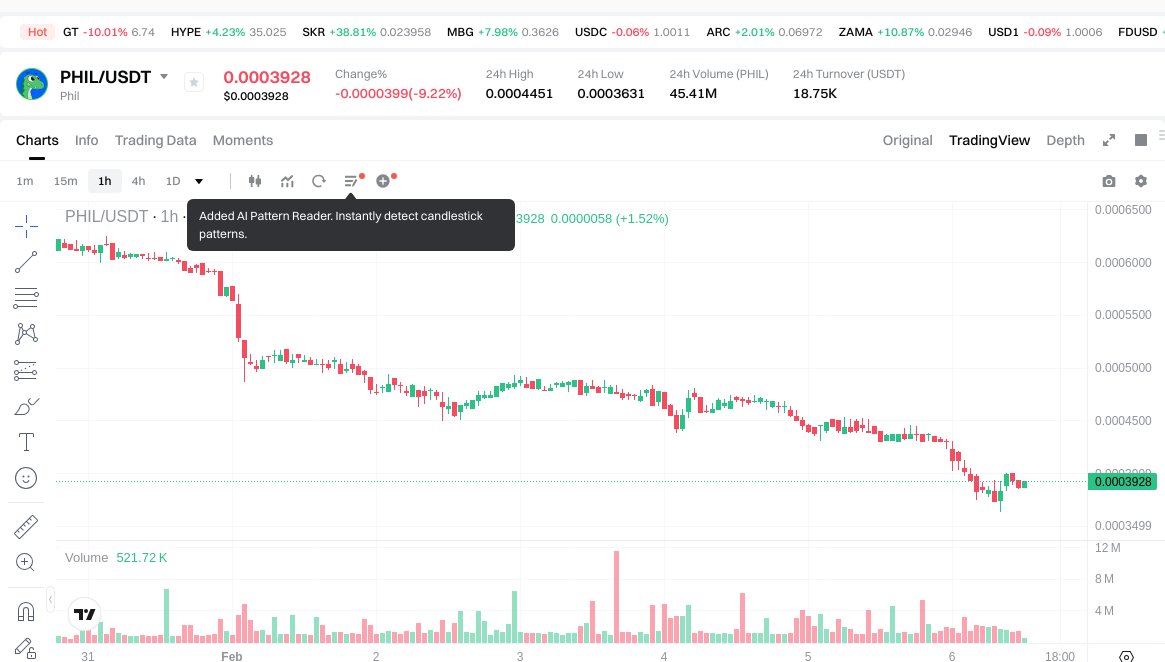
PHIL is a community-driven memecoin in the cryptocurrency space, launched in August 2024. As of February 6, 2026, PHIL has a market capitalization of approximately $391,000, with a circulating supply of 1,000,000,000 tokens, and the current price stands at around $0.000391. Positioned as a project focused on transparency, trust, and meaningful partnerships within the memecoin sector, PHIL has gradually become a subject of discussion among investors exploring "Is Phil (PHIL) a good investment?" With a mission to unite leading memecoins and foster a more secure and interconnected crypto ecosystem, PHIL represents both a cultural movement and a tradable digital asset. This article comprehensively analyzes PHIL's investment characteristics, historical performance, future price projections, and associated risks to provide reference for potential investors.
I. Phil (PHIL) Price History Review and Current Investment Value
- 2024: PHIL experienced significant volatility following its launch → Early investors who entered near the August peak faced considerable price corrections
- August 2024: Token reached a notable price level of $0.0735 → PHIL price demonstrated substantial fluctuation during this period
- 2025-2026: Market underwent correction phase → Price declined from elevated levels to $0.0003631 as of February 2026
Current PHIL Investment Market Status (February 2026)
- PHIL current price: $0.000391
- Market sentiment (Fear & Greed Index): Data not available in reference materials
- 24-hour trading volume: $18,784.72
- Institutional investor holdings: Holder count stands at 11,361 addresses
Click to view real-time PHIL market price
II. Core Factors Influencing Whether PHIL is a Good Investment
Supply Mechanism and Scarcity (PHIL Investment Scarcity)
- Fixed supply mechanism → impacts price and investment value
- With a maximum supply of 1,000,000,000 tokens and 100% circulation ratio, PHIL operates under a fully circulating supply model, which affects its scarcity dynamics
- The token has experienced significant price fluctuations, with data showing a decline from higher levels in August 2024 to current levels in February 2026
- Investment significance: the fixed supply cap may contribute to scarcity considerations in long-term investment analysis
Institutional Investment and Mainstream Adoption (Institutional Investment in PHIL)
- Market positioning: PHIL positions itself as a community-driven memecoin with a mission focused on transparency, trust, and partnerships within the memecoin sector
- The project aims to unite top memecoins, which could influence its adoption trajectory within the memecoin community
- With 11,361 holders as of February 2026, the token demonstrates some level of community participation
- Trading availability: PHIL is listed on 10 exchanges, including Gate.com, providing accessibility for investors
Macroeconomic Environment's Impact on PHIL Investment
- As a memecoin in the cryptocurrency market, PHIL's investment characteristics may be influenced by broader market conditions and risk appetite
- The token operates within the ERC20 standard on the Ethereum network, connecting it to the broader Ethereum ecosystem dynamics
- Market volatility considerations: recent data shows significant price movements, with a 24-hour change of -9.55% and 7-day change of -36.22%, reflecting sensitivity to market conditions
Technology and Ecosystem Development (Technology & Ecosystem for PHIL Investment)
- ERC20 standard implementation: PHIL is deployed on the Ethereum blockchain using the ERC20 token standard, providing compatibility with existing Ethereum infrastructure
- Community-driven approach: the project emphasizes transparency and collaboration as core values, which may influence its ecosystem development trajectory
- The token's stated mission involves fostering partnerships within the memecoin space, potentially contributing to broader ecosystem connections
III. PHIL Future Investment Forecast and Price Outlook (Is Phil(PHIL) worth investing in 2026-2031)
Short-term Investment Forecast (2026, short-term PHIL investment outlook)
- Conservative forecast: $0.000318087 - $0.0003927
- Neutral forecast: $0.0003927 - $0.000451605
- Optimistic forecast: $0.000451605 and above
Mid-term Investment Outlook (2027-2029, mid-term Phil(PHIL) investment forecast)
- Market stage expectation: PHIL may experience gradual growth as the memecoin sector evolves and community engagement continues
- Investment return forecast:
- 2027: $0.000215297775 - $0.000595235025
- 2028: $0.000442563573375 - $0.00060025863975
- 2029: $0.000332685720675 - $0.000742998109507
- Key catalysts: Community-driven initiatives, transparency measures, and potential partnerships within the memecoin ecosystem
Long-term Investment Outlook (Is PHIL a good long-term investment?)
- Base scenario: $0.000506014981146 - $0.001057571310596 (assuming steady community support and gradual ecosystem development)
- Optimistic scenario: $0.000702582339207 - $0.001057571310596 (assuming enhanced collaboration among memecoins and increased market adoption)
- Risk scenario: Below $0.000318087 (under adverse market conditions or reduced community engagement)
Check PHIL long-term investment and price forecast: Price Prediction
2026-02-06 - 2031 Long-term Outlook
- Base scenario: $0.000506014981146 - $0.00073956035706 USD (corresponding to steady progress and gradual mainstream application)
- Optimistic scenario: $0.000702582339207 - $0.001057571310596 USD (corresponding to large-scale adoption and favorable market environment)
- Transformative scenario: Above $0.001057571310596 USD (if ecosystem achieves breakthrough progress and mainstream adoption)
- 2031-12-31 forecast high: $0.001057571310596 USD (based on optimistic development assumptions)
Disclaimer: The above forecasts are based on available data and market analysis models. Cryptocurrency investments carry substantial risk, and actual performance may differ materially from projections. This information does not constitute investment advice.
| Year |
Predicted High Price |
Predicted Average Price |
Predicted Low Price |
Price Change |
| 2026 |
0.000451605 |
0.0003927 |
0.000318087 |
0 |
| 2027 |
0.000595235025 |
0.0004221525 |
0.000215297775 |
7 |
| 2028 |
0.00060025863975 |
0.0005086937625 |
0.000442563573375 |
30 |
| 2029 |
0.000742998109507 |
0.000554476201125 |
0.000332685720675 |
41 |
| 2030 |
0.000830383558804 |
0.000648737155316 |
0.000506014981146 |
65 |
| 2031 |
0.001057571310596 |
0.00073956035706 |
0.000702582339207 |
89 |
IV. Phil Investment Strategy and Risk Management (How to invest in Memecoins)
Investment Methodology (Phil investment strategy)
Long-term Holding (HODL Phil)
For conservative investors seeking stable exposure to community-driven memecoins, a long-term holding strategy may be considered. This approach involves acquiring PHIL tokens and maintaining positions through market cycles, banking on the project's stated mission to unite top memecoins and build a more interconnected crypto ecosystem. Given Phil Token's focus on transparency and trust-building within the memecoin sector, long-term holders would be betting on the gradual realization of these collaborative initiatives and potential network effects as partnerships develop.
Active Trading
Active traders may employ technical analysis and swing trading strategies to capitalize on PHIL's price movements. With 24-hour trading volume around $18,784 and notable volatility (24-hour change of -9.55%, 7-day change of -36.22%), the token presents opportunities for traders comfortable with memecoin price dynamics. Technical indicators, chart patterns, and volume analysis can inform entry and exit points, though traders should remain cognizant of the inherent volatility characteristic of community-driven memecoins.
Risk Management (Risk management for Phil investment)
Asset Allocation Ratios
- Conservative investors: Limit memecoin exposure to 1-3% of total crypto portfolio, with PHIL representing a small fraction of that allocation
- Aggressive investors: May allocate 5-10% to speculative assets including memecoins, with position sizing based on risk tolerance
- Professional investors: Employ dynamic allocation strategies with strict stop-loss mechanisms and regular rebalancing protocols
Risk Hedging Approaches
Diversification remains essential when investing in memecoins like Phil. Consider:
- Multi-asset portfolio construction combining established cryptocurrencies with speculative positions
- Hedging instruments such as stablecoins for preserving capital during volatile periods
- Position sizing relative to overall portfolio risk parameters
Secure Storage
As an ERC-20 token on Ethereum, PHIL can be stored in various wallet solutions:
- Cold wallets: Hardware wallets like Ledger or Trezor for long-term holdings
- Hot wallets: MetaMask or other Ethereum-compatible wallets for active trading, maintaining only necessary amounts
- Hardware wallet recommendations: Devices supporting ERC-20 tokens with proven security track records
V. Phil Investment Risks and Challenges (Risks of investing in Memecoins)
Market Risks
Phil Token exhibits significant volatility characteristic of the memecoin sector. The token has experienced substantial price fluctuations, with a current price of $0.000391 representing considerable distance from its peak. The 30-day decline of -49.23% and 1-year decline of -93.23% illustrate the intense price swings inherent to this asset class. Trading volume of approximately $18,784 over 24 hours suggests relatively limited liquidity compared to major cryptocurrencies, potentially exposing investors to slippage and price manipulation risks in thin market conditions.
Regulatory Risks
Memecoin investments face evolving regulatory landscapes across jurisdictions. Different countries maintain varying stances on cryptocurrency classification and trading, with potential implications for:
- Trading platform availability and compliance requirements
- Tax treatment of memecoin transactions
- Restrictions on promotional activities for community-driven tokens
- Potential classification changes affecting legal status
Investors should monitor regulatory developments in their jurisdictions and understand compliance obligations related to memecoin holdings.
Technical Risks
As an ERC-20 token deployed on Ethereum (contract address: 0xc328a59e7321747aebbc49fd28d1b32c1af8d3b2), Phil inherits both the security benefits and potential vulnerabilities of the Ethereum network. Technical considerations include:
- Smart contract risks: Potential bugs or vulnerabilities in token implementation
- Network congestion: Ethereum gas fee fluctuations affecting transaction costs
- Wallet security: Risks associated with private key management and phishing attacks
- Exchange risks: Dependency on trading platform security and operational integrity
With 11,361 holders and availability on 10 exchanges, the token demonstrates some level of adoption, though concentrated holder distribution could present centralization concerns.
VI. Conclusion: Is Memecoin a Good Investment?
Investment Value Summary
Phil Token represents a community-driven memecoin project emphasizing transparency and collaboration within the crypto space. While the project articulates a mission to unite leading memecoins and build a more secure ecosystem, potential investors should recognize the speculative nature of such assets. The token's substantial price decline from peak levels and high volatility underscore the challenges inherent to memecoin investments. Long-term potential depends heavily on the project's ability to execute its collaborative vision and maintain community engagement in a competitive memecoin landscape.
Investor Recommendations
✅ Beginners: If choosing to participate, consider dollar-cost averaging with very small position sizes, and prioritize secure wallet storage using hardware solutions. Focus on understanding blockchain fundamentals before engaging with speculative assets.
✅ Experienced investors: May explore swing trading opportunities based on technical analysis while maintaining strict risk management protocols. Consider memecoin positions as tactical allocations within a diversified portfolio framework.
✅ Institutional investors: Approach memecoin exposure with caution, employing rigorous due diligence processes and treating such positions as high-risk, speculative allocations if included at all in portfolio strategies.
⚠️ Important Notice: Cryptocurrency investments, particularly memecoins, carry substantial risk including potential total loss of capital. This content is for informational purposes only and does not constitute investment advice. Conduct thorough research and consider consulting financial professionals before making investment decisions.
VII. FAQ
Q1: Is PHIL a good investment for beginners in 2026?
PHIL is a high-risk speculative asset not recommended as a primary investment for beginners. As a memecoin with extreme volatility (-93.23% decline over one year and -49.23% over 30 days), PHIL presents significant challenges for novice investors. The current market capitalization of approximately $391,000 and limited trading volume of $18,784 (24-hour) indicate thin liquidity, which can lead to substantial slippage and price manipulation risks. Beginners considering PHIL should limit exposure to 1-3% of their total crypto portfolio, employ dollar-cost averaging strategies, and prioritize learning blockchain fundamentals and secure wallet storage practices before engaging with such speculative assets.
Q2: What is PHIL's long-term price potential by 2031?
Based on available market analysis, PHIL's 2031 price forecast ranges from $0.000702582339207 to $0.001057571310596 under optimistic scenarios, representing potential gains of approximately 80-170% from current levels ($0.000391). However, these projections assume successful execution of PHIL's mission to unite top memecoins, sustained community engagement, and favorable market conditions. Conservative scenarios estimate prices between $0.000506014981146 and $0.00073956035706. Given PHIL's historical volatility and speculative nature as a community-driven memecoin, actual performance may differ materially from forecasts, and investors should treat these projections as speculative estimates rather than guaranteed outcomes.
Q3: How does PHIL's fixed supply affect its investment value?
PHIL operates with a fixed maximum supply of 1,000,000,000 tokens at 100% circulation, meaning all tokens are currently in circulation with no additional minting planned. This fixed supply mechanism theoretically creates scarcity dynamics that could support price appreciation if demand increases. However, scarcity alone does not guarantee investment value—the token's utility, community adoption, and ecosystem development remain critical factors. Unlike Bitcoin's deflationary model with halving events, PHIL's fully circulated supply means price movements depend primarily on demand fluctuations rather than supply constraints. The current holder count of 11,361 addresses suggests moderate distribution, though concentrated holdings could impact price stability.
Q4: What are the main risks of investing in PHIL?
PHIL investment carries multiple significant risks: (1) Market risk—extreme volatility with 93.23% annual decline and substantial daily price swings, (2) Liquidity risk—limited trading volume ($18,784 24-hour) may cause difficulty executing large orders without price impact, (3) Regulatory risk—evolving global regulations on memecoins could affect trading availability or legal status, (4) Technical risk—smart contract vulnerabilities and Ethereum network dependencies (gas fees, congestion), and (5) Execution risk—the project's success depends on delivering its mission to unite memecoins and build partnerships, which remains uncertain. Additionally, as an ERC-20 token, PHIL inherits Ethereum ecosystem risks and requires proper wallet security practices.
Q5: Where can I buy and store PHIL tokens securely?
PHIL is available on 10 cryptocurrency exchanges, with Gate.com being among the trading platforms mentioned in reference materials. As an ERC-20 token on Ethereum (contract address: 0xc328a59e7321747aebbc49fd28d1b32c1af8d3b2), PHIL can be purchased through exchanges supporting Ethereum-based tokens. For secure storage, investors should consider: Cold storage—hardware wallets like Ledger or Trezor for long-term holdings offering maximum security; Hot wallets—MetaMask or other Ethereum-compatible wallets for active trading, maintaining only amounts needed for transactions. Always verify contract addresses, enable two-factor authentication on exchanges, and never share private keys. Store recovery phrases in secure offline locations separate from digital devices.
Q6: How does PHIL compare to other memecoins as an investment?
PHIL differentiates itself through its stated mission of uniting top memecoins and emphasizing transparency and trust within the memecoin sector, positioning it as a collaborative rather than purely speculative project. However, with a market cap of approximately $391,000 and limited trading volume compared to established memecoins, PHIL remains a micro-cap asset with higher volatility and liquidity constraints. Unlike memecoins driven solely by viral marketing, PHIL's community-driven approach focuses on building partnerships and ecosystem connections. That said, the token's 93.23% annual decline and current price significantly below its August 2024 peak ($0.0735) indicate it has underperformed during the broader memecoin market cycle. Investors should compare PHIL's community engagement metrics, holder distribution, and partnership developments against other memecoins when evaluating relative investment merit.
Q7: What investment strategy works best for PHIL?
The optimal PHIL investment strategy depends on investor risk tolerance and objectives. For long-term holders (HODL strategy), the approach involves acquiring tokens and maintaining positions through market cycles, betting on PHIL's mission execution and gradual ecosystem development—suitable for investors with 1-3% portfolio allocation to speculative assets and tolerance for significant volatility. For active traders, technical analysis and swing trading strategies may capitalize on PHIL's price movements (24-hour volatility of -9.55%, 7-day volatility of -36.22%), though this requires constant monitoring and strict stop-loss discipline. Risk management essentials include: position sizing appropriate to risk tolerance, diversification across multiple assets, using hardware wallets for secure storage, and never investing more than you can afford to lose. Dollar-cost averaging may help mitigate timing risk for gradual position building.
Q8: What factors could drive PHIL's price higher in the future?
Several catalysts could potentially support PHIL price appreciation: (1) Partnership developments—successful collaborations with leading memecoins as outlined in the project's mission could increase utility and adoption, (2) Community growth—expansion beyond the current 11,361 holders through effective engagement initiatives, (3) Exchange listings—additional trading platform availability could improve liquidity and accessibility, (4) Broader memecoin sector growth—favorable market conditions lifting speculative assets generally, (5) Transparency initiatives—demonstrated progress on trust-building measures differentiating PHIL from purely speculative memecoins, and (6) Ethereum ecosystem developments—improvements to network efficiency reducing gas fees could benefit ERC-20 tokens. However, these potential catalysts remain speculative, and investors should monitor actual project developments rather than rely on anticipated future events when making investment decisions.
* The information is not intended to be and does not constitute financial advice or any other recommendation of any sort offered or endorsed by Gate.