Polkamarkets (POLK) is a DeFi-powered prediction market platform built on cross-chain infrastructure, currently trading at $0.003852 with a market cap of $385,200 as of February 2026. This comprehensive analysis examines whether POLK represents a viable investment opportunity by evaluating its price history (declining from $4.18 peak in 2021), tokenomics with 100 million tokens fully circulated, and market position within the emerging prediction market sector. The article provides short-term, mid-term, and long-term price forecasts through 2031, alongside tailored investment strategies for conservative, aggressive, and professional investors. Key considerations include significant market volatility, limited liquidity ($12,719.71 daily volume), regulatory uncertainty, and technical infrastructure risks. The analysis concludes that POLK presents potential opportunities within DeFi prediction markets for risk-aware investors using proper position sizing and diversification, though substantial risks warrant caref
Introduction: Polkamarkets (POLK) Investment Position and Market Outlook
POLK is a notable asset in the cryptocurrency field. Since its launch in 2021, it has been developing within the decentralized prediction market sector. As of 2026, Polkamarkets holds a market capitalization of approximately $385,200, with a circulating supply of 100,000,000 tokens, and the current price is around $0.003852. Positioned as a DeFi-powered prediction market platform built on cross-chain infrastructure, POLK has become a subject of discussion among investors considering "Is Polkamarkets (POLK) a good investment?" This article provides a comprehensive analysis of POLK's investment characteristics, historical price movements, future price perspectives, and associated risks to serve as a reference for investors.
I. POLK Price History Review and Current Investment Value Status
- 2021: Token launch → Price reached $4.18 on March 16, representing the peak valuation during the initial market cycle
- 2021-2025: Multi-year decline → Price decreased from $4.18 to current levels around $0.003852
- 2026: Price volatility continues → Recent 24-hour decline of 6.27%, with 7-day decline of 41.37%
Current POLK Investment Market Status (February 2026)
- POLK current price: $0.003852
- Market sentiment (Fear & Greed Index): Data indicates cautious market positioning
- 24-hour trading volume: $12,719.71
- Token circulation: 100,000,000 POLK (100% of total supply)
Click to view real-time POLK market price
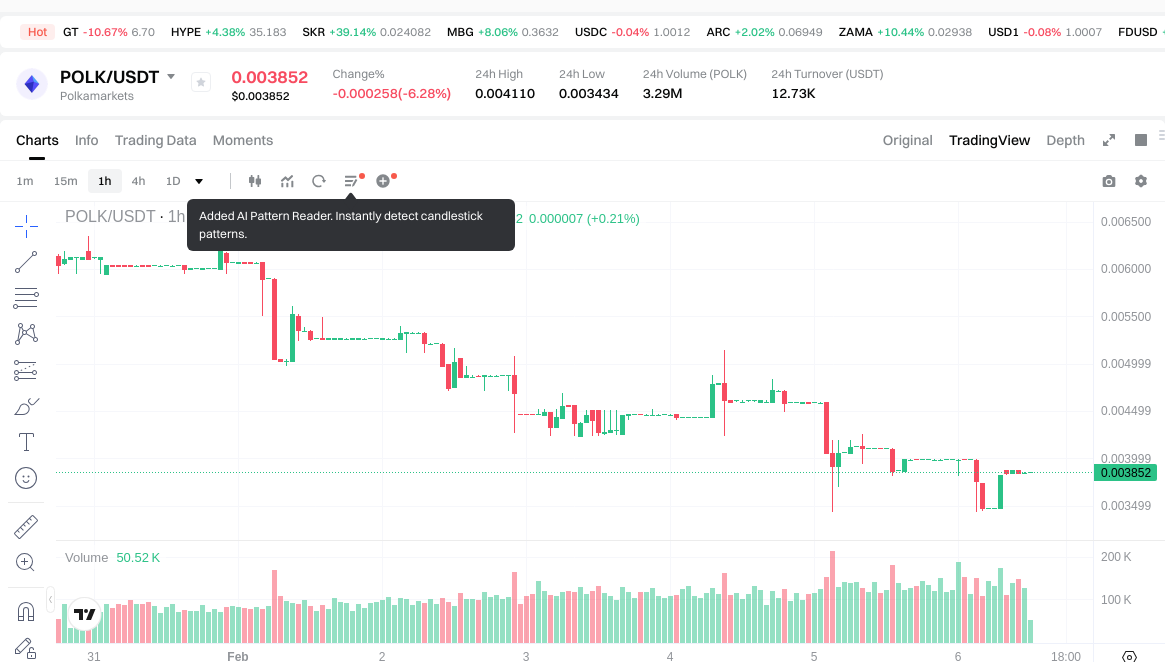
II. Core Factors Affecting Whether POLK is a Good Investment (Is Polkamarkets(POLK) a Good Investment)
Supply Mechanism and Scarcity (POLK investment scarcity)
- Fixed Maximum Supply → Impacts price and investment value
- Maximum supply: 100,000,000 POLK tokens with 100% already in circulation
- Investment significance: Complete circulation may limit scarcity-driven price appreciation
Institutional Investment and Mainstream Adoption (Institutional investment in POLK)
- Current holder base: 8,814 holders as of February 2026
- Market presence: Listed on 1 exchange, indicating limited mainstream adoption
- Investment consideration: Relatively small holder base and exchange availability may affect liquidity and institutional interest
Macroeconomic Environment's Impact on POLK Investment
- Monetary policy and interest rate changes → Alter investment attractiveness for crypto assets
- Market volatility: POLK experienced -6.27% change in 24 hours, -41.37% over 7 days, and -66.53% over 1 year
- Economic uncertainty → May influence risk appetite for smaller-cap prediction market tokens
Technology and Ecosystem Development (Technology & Ecosystem for POLK investment)
- DeFi-powered prediction market platform: Built for cross-chain information exchange and trading
- Polkadot-based infrastructure: Decentralized and interoperable platform for real-world event prediction
- Prediction market applications: Users can take positions on real-world event outcomes, expanding use cases within the DeFi ecosystem
III. POLK Future Investment Forecast and Price Outlook (Is Polkamarkets(POLK) worth investing in 2026-2031)
Short-term Investment Forecast (2026, short-term POLK investment outlook)
- Conservative Forecast: $0.00215264 - $0.003844
- Neutral Forecast: $0.003844 - $0.00443982
- Optimistic Forecast: $0.00443982 - $0.00503564
Mid-term Investment Outlook (2027-2029, mid-term Polkamarkets(POLK) investment forecast)
- Market Stage Expectation: POLK may experience gradual recovery and development during the mid-term period, with price fluctuations reflecting market sentiment and adoption trends in the prediction market sector.
- Investment Return Forecast:
- 2027: $0.0040846344 - $0.0050613948
- 2028: $0.003657967698 - $0.005605716732
- 2029: $0.00331402372224 - $0.00766367985768
- Key Catalysts: Platform development progress, user adoption rates, DeFi market conditions, and broader cryptocurrency market trends may influence price movements.
Long-term Investment Outlook (Is POLK a good long-term investment?)
- Baseline Scenario: $0.003454776523518 - $0.006774071614741 (assuming steady platform development and moderate market conditions)
- Optimistic Scenario: $0.006774071614741 - $0.007127222267642 (assuming increased adoption and favorable market environment)
- Risk Scenario: Below $0.003454776523518 (under adverse market conditions or decreased platform activity)
View POLK long-term investment and price forecast: Price Prediction
2026-02-06 - 2031 Long-term Outlook
- Baseline Scenario: $0.003454776523518 - $0.006774071614741 (corresponding to steady progress and gradual mainstream application growth)
- Optimistic Scenario: $0.006774071614741 - $0.007127222267642 (corresponding to large-scale adoption and favorable market environment)
- Transformative Scenario: Above $0.007127222267642 (if ecosystem achieves breakthrough progress and mainstream popularization)
- 2031-12-31 Predicted High: $0.00731599734392 (based on optimistic development assumptions)
Disclaimer: The above forecasts are based on algorithmic models and historical data analysis. Cryptocurrency markets are highly volatile and unpredictable. These projections should not be considered as investment advice. Investors should conduct their own research and consider their risk tolerance before making any investment decisions.
| Year |
Predicted High Price |
Predicted Average Price |
Predicted Low Price |
Price Change |
| 2026 |
0.00503564 |
0.003844 |
0.00215264 |
0 |
| 2027 |
0.0050613948 |
0.00443982 |
0.0040846344 |
15 |
| 2028 |
0.005605716732 |
0.0047506074 |
0.003657967698 |
23 |
| 2029 |
0.00766367985768 |
0.005178162066 |
0.00331402372224 |
34 |
| 2030 |
0.007127222267642 |
0.00642092096184 |
0.004558853882906 |
66 |
| 2031 |
0.00731599734392 |
0.006774071614741 |
0.003454776523518 |
75 |
IV. POLK Investment Strategy and Risk Management (How to invest in Polkamarkets)
Investment Methodology (POLK investment strategy)
-
Long-term Holding (HODL POLK): Suitable for conservative investors
Long-term holding strategy involves purchasing POLK tokens and maintaining positions over extended periods, focusing on the fundamental value and development potential of the Polkamarkets prediction market platform. This approach may be appropriate for investors who believe in the long-term growth prospects of decentralized prediction markets and DeFi-powered platforms built on interoperable blockchain infrastructure.
-
Active Trading: Relies on technical analysis and swing trading operations
Active trading strategies involve leveraging price fluctuations through technical analysis tools and chart patterns. Given POLK's recent price movements showing significant volatility (24-hour change of -6.27%, 7-day change of -41.37%, and 30-day change of -48.37%), traders may identify potential entry and exit points based on support and resistance levels, volume indicators, and momentum signals.
Risk Management (Risk management for POLK investment)
-
Asset Allocation Ratio: Conservative / Aggressive / Professional investors
- Conservative investors: May consider allocating 1-3% of their cryptocurrency portfolio to POLK, maintaining majority positions in established digital assets
- Aggressive investors: Could allocate 5-10% to POLK as part of a higher-risk, higher-reward strategy within their crypto holdings
- Professional investors: May implement dynamic allocation strategies based on market conditions, technical indicators, and fundamental developments
-
Risk Hedging Solutions: Multi-asset portfolio + hedging instruments
Investors may consider diversifying across different cryptocurrency categories, including established tokens, DeFi protocols, and prediction market platforms. Hedging strategies could involve maintaining positions in stablecoins or implementing stop-loss orders to limit downside exposure during periods of heightened volatility.
-
Secure Storage: Hot and cold wallets + hardware wallet recommendations
Given that POLK operates as an ERC-20 token on the Ethereum network (contract address: 0xd478161c952357f05f0292b56012cd8457f1cfbf), investors should utilize secure storage solutions. Hardware wallets supporting Ethereum-based tokens provide enhanced security for long-term holdings, while reputable software wallets may be suitable for smaller amounts intended for active trading.
V. POLK Investment Risks and Challenges (Risks of investing in Polkamarkets)
-
Market Risk: High volatility, price manipulation
POLK has demonstrated substantial price volatility, with the token experiencing significant drawdowns from its historical high. The 24-hour trading volume of approximately $12,719.71 and relatively modest market capitalization of $385,200 suggest limited liquidity, which may amplify price swings and increase susceptibility to large order impacts. The circulating supply represents 100% of the maximum supply (100,000,000 POLK), eliminating future supply inflation but not mitigating inherent market volatility risks.
-
Regulatory Risk: Policy uncertainty across different jurisdictions
Prediction market platforms and DeFi protocols face evolving regulatory frameworks across various jurisdictions. Changes in cryptocurrency regulations, securities laws, or specific restrictions on prediction markets could impact the platform's operations, token utility, and accessibility in certain regions. Investors should remain aware of regulatory developments that may affect the project's long-term viability.
-
Technical Risk: Network security vulnerabilities, upgrade failures
As a platform built for cross-chain information exchange and operating on Ethereum infrastructure, POLK faces potential technical risks including smart contract vulnerabilities, blockchain network congestion, and interoperability challenges. The success of the platform depends on continuous technical development and the ability to maintain security standards while scaling operations.
VI. Conclusion: Is Polkamarkets a Good Investment?
-
Investment Value Summary: POLK presents potential opportunities within the prediction market and DeFi sectors, though accompanied by considerable short-term price fluctuations and market risks.
-
Investor Recommendations:
✅ Beginners: Consider dollar-cost averaging strategies combined with secure wallet storage solutions to mitigate timing risks
✅ Experienced Investors: May explore swing trading opportunities while maintaining diversified portfolio allocations
✅ Institutional Investors: Could evaluate strategic long-term positioning as part of broader DeFi and prediction market exposure
⚠️ Disclaimer: Cryptocurrency investments carry substantial risks. This content is provided for informational purposes only and does not constitute investment advice. Investors should conduct thorough due diligence and consider their individual financial circumstances before making investment decisions.
VII. FAQ
Q1: What is the current market position of Polkamarkets (POLK) in the prediction market sector?
As of February 2026, POLK maintains a relatively modest market position with a market capitalization of approximately $385,200 and a current price around $0.003852. The token has experienced significant decline from its historical high of $4.18 in March 2021, representing over 99% depreciation. With 8,814 holders and listing on only 1 exchange, POLK demonstrates limited mainstream adoption compared to major DeFi protocols. The 24-hour trading volume of $12,719.71 indicates relatively low liquidity, which may impact price stability and execution for larger trades. The platform operates as a DeFi-powered prediction market built on cross-chain infrastructure, positioning itself within the emerging decentralized prediction market niche, though it faces competition from more established platforms in the sector.
Q2: How does POLK's tokenomics structure affect its investment potential?
POLK features a fixed maximum supply of 100,000,000 tokens with 100% already in circulation, eliminating future inflationary pressure from new token releases. This complete circulation means there are no additional tokens to be unlocked or distributed, which removes the dilution risk commonly seen in projects with vesting schedules. However, the full circulation also limits scarcity-driven price appreciation mechanisms that benefit from gradual supply release. The token operates on Ethereum as an ERC-20 token (contract address: 0xd478161c952357f05f0292b56012cd8457f1cfbf), providing compatibility with the extensive Ethereum ecosystem. From an investment perspective, the tokenomics structure suggests that future price movements will primarily depend on demand factors such as platform adoption, user activity, and overall market sentiment rather than supply dynamics.
Q3: What are the key risks associated with investing in POLK?
POLK investment carries multiple significant risks that investors should carefully evaluate. Market risk is substantial, evidenced by recent volatility showing -6.27% decline in 24 hours, -41.37% over 7 days, and -66.53% over 1 year. The limited liquidity with approximately $12,719.71 in 24-hour trading volume increases susceptibility to price manipulation and large order impacts. Regulatory risk stems from evolving frameworks governing prediction markets and DeFi protocols across different jurisdictions, which could restrict platform operations or token utility. Technical risks include smart contract vulnerabilities, potential network security breaches, and challenges in maintaining cross-chain interoperability. The project's limited exchange presence (only 1 listing) creates concentration risk and restricts accessibility for potential investors. Additionally, the prediction market sector remains relatively nascent, facing adoption challenges and competition from both centralized and decentralized alternatives.
Q4: What investment strategies are recommended for different types of POLK investors?
Investment strategies for POLK should align with individual risk tolerance and experience levels. Conservative investors should consider allocating only 1-3% of their cryptocurrency portfolio to POLK, implementing dollar-cost averaging to mitigate timing risks, and utilizing secure hardware wallets for token storage. Aggressive investors might allocate 5-10% of their crypto holdings to POLK as part of a higher-risk strategy, potentially combining long-term positions with tactical trading based on technical indicators and market momentum. Professional investors could implement dynamic allocation strategies, adjusting exposure based on platform development milestones, trading volume trends, and broader DeFi market conditions. Regardless of approach, diversification across multiple cryptocurrency categories is essential, and investors should maintain stop-loss orders to limit downside exposure during periods of heightened volatility. Due to POLK's significant price fluctuations and limited liquidity, position sizing should remain conservative relative to overall portfolio value.
Q5: How do price forecasts for POLK compare across different timeframes?
Short-term forecasts (2026) indicate POLK could trade between $0.00215264 and $0.00503564, with the neutral scenario centered around $0.003844, close to current price levels. Mid-term projections (2027-2029) suggest gradual recovery potential, with 2027 estimates ranging from $0.0040846344 to $0.0050613948, 2028 between $0.003657967698 and $0.005605716732, and 2029 spanning $0.00331402372224 to $0.00766367985768. Long-term outlook through 2031 presents baseline scenarios of $0.003454776523518 to $0.006774071614741, with optimistic projections reaching $0.007127222267642 to $0.00731599734392 by December 2031. These forecasts are based on algorithmic models and historical data, assuming various adoption rates and market conditions. However, investors should recognize that prediction market tokens face substantial uncertainty, and actual outcomes may differ significantly from projections due to platform development progress, competitive dynamics, regulatory changes, and overall cryptocurrency market trends.
Q6: What role does the prediction market sector play in POLK's investment thesis?
The prediction market sector represents both an opportunity and risk factor for POLK's investment thesis. Polkamarkets operates as a DeFi-powered prediction market platform built on cross-chain infrastructure, allowing users to take positions on real-world event outcomes through decentralized mechanisms. This positioning taps into growing interest in decentralized alternatives to traditional betting and forecasting platforms. The platform's Polkadot-based infrastructure provides potential advantages in interoperability and scalability compared to single-chain solutions. However, the prediction market sector remains relatively underdeveloped compared to other DeFi categories such as decentralized exchanges, lending protocols, and yield farming platforms. Mainstream adoption faces challenges including regulatory uncertainty, user experience complexity, and competition from established centralized prediction markets. The sector's success depends on demonstrating clear utility advantages over traditional alternatives, building sufficient liquidity to support meaningful market activity, and navigating varying regulatory landscapes across jurisdictions. For POLK investors, the platform's ability to capture market share within this emerging sector will be critical to long-term value appreciation.
Q7: How does POLK's technical infrastructure impact its investment value?
POLK's technical foundation as an Ethereum-based ERC-20 token with cross-chain prediction market functionality significantly influences its investment profile. The platform leverages Polkadot's interoperability features to enable decentralized information exchange and trading across multiple blockchain networks, potentially providing competitive advantages in user accessibility and market efficiency. Operating on Ethereum infrastructure offers benefits including established security standards, extensive developer tooling, and integration with the broader DeFi ecosystem, though it also subjects the platform to Ethereum network congestion and gas fee volatility. The cross-chain architecture introduces additional complexity requiring robust smart contract security and reliable oracle systems for real-world event data verification. From an investment perspective, the technical infrastructure's strength will determine the platform's ability to scale operations, maintain security standards, and deliver user experiences competitive with both centralized and decentralized alternatives. Technical development progress, successful infrastructure upgrades, and demonstrated resilience against security vulnerabilities will be key factors influencing investor confidence and long-term token value appreciation.
Q8: What are the key milestones investors should monitor when evaluating POLK?
Investors should track several critical indicators when assessing POLK's investment trajectory. Platform metrics including daily active users, prediction market creation volume, and total value locked in active markets provide direct measures of adoption and utility. Trading volume trends across both POLK token markets and prediction markets hosted on the platform indicate liquidity health and user engagement. Exchange listing expansion beyond the current single listing would signal increased mainstream acceptance and improved accessibility for potential investors. Partnership announcements with data providers, oracle networks, and other DeFi protocols could strengthen the platform's infrastructure and expand use cases. Regulatory developments affecting prediction markets in major jurisdictions may significantly impact the platform's addressable market and operational flexibility. Technical milestones such as successful cross-chain integration implementations, security audit completions, and platform upgrade deployments demonstrate development team execution capability. Holder base growth beyond the current 8,814 addresses and institutional investment announcements would indicate broadening confidence in the project's long-term viability. Monitoring these factors provides insight into whether POLK is progressing toward forecasted price targets or facing headwinds that may necessitate reassessing investment positions.
* The information is not intended to be and does not constitute financial advice or any other recommendation of any sort offered or endorsed by Gate.