This comprehensive analysis evaluates whether Singularity Finance (SFI) represents a viable investment opportunity. Trading at $0.007556 with a market cap of $1.07 million, SFI is an AI-centric EVM-compatible Layer 2 blockchain emerging from the SingularityNET ecosystem. The article examines SFI's price history showing a 94.4% decline from its February 2025 peak, analyzes key investment factors including tokenomics with 71.69% unreleased supply, and evaluates institutional adoption potential among 9,512 current holders. Price forecasts range from $0.00612-$0.01612 through 2031 across conservative to optimistic scenarios. The analysis addresses critical risks including market volatility, liquidity constraints, and regulatory uncertainties while providing tailored investment strategies for different investor types through Gate exchange.
Introduction: Singularity Finance (SFI)'s Investment Position and Market Outlook
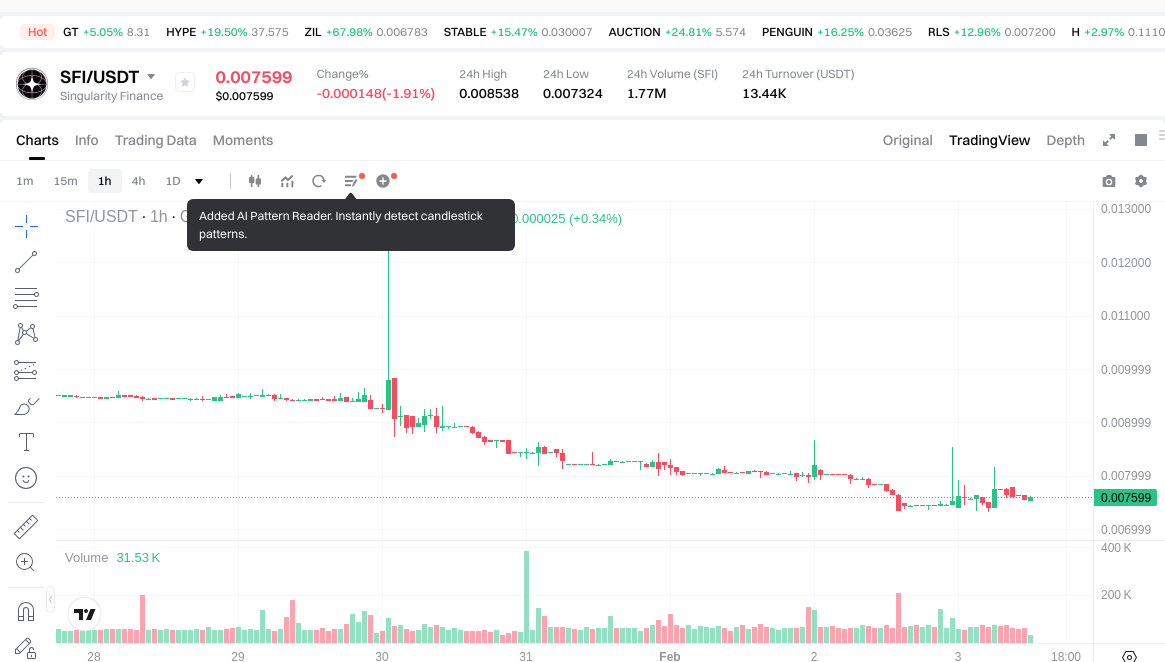
Singularity Finance (SFI) represents an emerging asset in the cryptocurrency sector, positioning itself as an AI-centric EVM-compatible Layer 2 blockchain solution. As of February 3, 2026, SFI maintains a market capitalization of approximately $1.07 million with a circulating supply of 141.53 million tokens, trading at around $0.007556. The token has experienced notable volatility since its launch in early 2025, with price fluctuations ranging from an earlier price point of $0.135 in February 2025 to recent levels near $0.007324. Currently ranked #2463 by market capitalization with a dominance of 0.00013%, SFI holds a market cap to fully diluted valuation ratio of 28.31%, indicating significant unreleased supply. Originating from the SingularityNET ecosystem and connected to the Artificial Superintelligence Alliance, the platform aims to provide a compliant RWA tokenization framework for the AI value chain. With approximately 9,512 holders and availability on 3 exchanges, SFI continues to generate discussion among investors evaluating "Is Singularity Finance (SFI) a good investment?" This analysis examines SFI's investment characteristics, historical performance patterns, future outlook considerations, and associated risks to provide reference information for market participants.
I. Price History Review and Current Investment Value of SFI
- 2025: Singularity Finance (SFI) was launched on the market → Price stabilized around $0.024
- February 2025: SFI reached a price peak during early trading → Price touched approximately $0.135
- 2025-2026: Market adjustment phase → Price declined from approximately $0.135 to around $0.0076
Current Investment Market Status of SFI (February 2026)
- Current SFI price: $0.007556
- Market sentiment (Fear & Greed Index): Data not available in reference materials
- 24-hour trading volume: $13,476.29
- Institutional investor holdings: Approximately 9,512 holders
Click to view real-time SFI market price
II. Core Factors Affecting Whether SFI is a Good Investment
Supply Mechanism and Scarcity (SFI investment scarcity)
- Total Supply and Circulation: SFI has a maximum supply of 500,000,000 tokens, with a current circulating supply of 141,532,390 tokens (approximately 28.31% of total supply)
- Supply Distribution Impact: The relatively low circulating ratio indicates a significant portion of tokens remains unlocked, which may influence future price dynamics as supply gradually enters the market
- Investment Implications: With 71.69% of tokens yet to circulate, investors should consider potential dilution effects on long-term value preservation
Institutional Investment and Mainstream Adoption (Institutional investment in SFI)
- Ecosystem Connection: SFI stems from the SingularityNET ecosystem and maintains close ties with the Artificial Superintelligence Alliance, potentially providing institutional backing and credibility
- Holder Base: The token currently has 9,512 holders, representing a developing community base
- Strategic Positioning: Singularity Finance's focus on AI-centric financial infrastructure may attract institutional interest in the intersection of AI and blockchain sectors
Macroeconomic Environment's Impact on SFI Investment
- Market Performance Context: SFI demonstrated notable volatility, with a 1-year decline of 95.50% from historical levels, reflecting broader market conditions affecting emerging crypto assets
- Sector Trends: The AI-focused positioning may provide differentiation in market downturns, though correlation with general crypto market sentiment remains significant
- Risk Considerations: Current trading activity shows 24-hour volume of $13,476.29, indicating relatively limited liquidity compared to major cryptocurrencies
Technology and Ecosystem Development (Technology & Ecosystem for SFI investment)
- Layer 2 Infrastructure: SFI operates as an EVM-compatible L2 blockchain designed to bring the AI economy on-chain, potentially addressing scalability and cost concerns
- RWA Tokenization Framework: The platform offers a compliance-focused Real-World Asset tokenization framework aimed at monetizing the AI value chain
- Strategic Pivot: Recent announcements indicate a shift from asset listings toward developing financial infrastructure tailored for the AI economy, suggesting long-term strategic evolution
- Ecosystem Positioning: As the self-described "financial chain for everything AI," the platform targets integration of AI-related financial services and tokenization
III. SFI Future Investment Forecast and Price Outlook (Is Singularity Finance(SFI) worth investing in 2026-2031)
Short-term Investment Forecast (2026, short-term SFI investment outlook)
- Conservative forecast: US$0.00612 - US$0.00756
- Neutral forecast: US$0.00756 - US$0.00816
- Optimistic forecast: US$0.00816 - US$0.00998
Mid-term Investment Outlook (2027-2029, mid-term Singularity Finance(SFI) investment forecast)
-
Market stage expectation: The mid-term outlook suggests a potential recovery phase, with SFI attempting to regain momentum following its recent decline. The token may exhibit gradual appreciation as the AI-centric L2 blockchain ecosystem matures and adoption potentially increases.
-
Investment return forecast:
- 2027: US$0.00739 - US$0.00998
- 2028: US$0.00660 - US$0.01088
- 2029: US$0.00752 - US$0.01277
-
Key catalysts: Potential drivers include developments within the SingularityNET ecosystem, advancements in the Artificial Superintelligence Alliance, expansion of RWA tokenization framework adoption, and broader market sentiment toward AI-related blockchain projects.
Long-term Investment Outlook (Is SFI a good long-term investment?)
- Base scenario: US$0.00734 - US$0.01330 (assuming steady ecosystem development and moderate market conditions through 2031)
- Optimistic scenario: US$0.01277 - US$0.01611 (assuming accelerated adoption of AI tokenization solutions and favorable regulatory environment)
- Risk scenario: US$0.00612 - US$0.00752 (under adverse market conditions or slower-than-expected ecosystem growth)
View SFI long-term investment and price forecast: Price Prediction
2026-02-03 - 2031 Long-term Outlook
- Base scenario: US$0.0073 - US$0.0133 (corresponding to steady progress and gradual mainstream application growth)
- Optimistic scenario: US$0.0128 - US$0.0161 (corresponding to large-scale adoption and favorable market environment)
- Transformative scenario: Above US$0.0161 (if the ecosystem achieves breakthrough developments and mainstream adoption)
- 2031-12-31 projected high: US$0.0161 (based on optimistic development assumptions)
Disclaimer: The above forecasts are based on historical data and market analysis models. Cryptocurrency investments carry substantial risk, and actual prices may vary significantly from predictions due to market volatility, regulatory changes, technological developments, and other unforeseen factors. This content does not constitute investment advice, and investors should conduct their own research and consult financial professionals before making investment decisions.
| Year |
Predicted High Price |
Predicted Average Price |
Predicted Low Price |
Price Change |
| 2026 |
0.00816048 |
0.007556 |
0.00612036 |
0 |
| 2027 |
0.0099799648 |
0.00785824 |
0.0073867456 |
4 |
| 2028 |
0.010881304928 |
0.0089191024 |
0.006600135776 |
18 |
| 2029 |
0.01277126272656 |
0.009900203664 |
0.00752415478464 |
31 |
| 2030 |
0.015303239813628 |
0.01133573319528 |
0.006234653257404 |
50 |
| 2031 |
0.016116578670389 |
0.013319486504454 |
0.007325717577449 |
76 |
IV. SFI Investment Strategy and Risk Management (How to invest in AI-centric blockchain tokens)
Investment Methodology (SFI investment strategy)
Long-term Holding (HODL SFI): This approach may suit investors who believe in the long-term development potential of AI-blockchain integration. Given that Singularity Finance positions itself as an AI-centric EVM-compatible L2 blockchain, investors considering this strategy would focus on the project's technological roadmap and ecosystem growth rather than short-term price movements.
Active Trading: Traders employing this method typically rely on technical analysis and price momentum strategies. With SFI showing considerable price volatility (24-hour range between $0.007324 and $0.008538, with a 24-hour decline of 2.05%), active traders may seek opportunities in price fluctuations. However, the relatively low 24-hour trading volume of approximately $13,476 suggests limited liquidity, which could impact execution quality.
Risk Management (Risk management for SFI investment)
Asset Allocation Ratio:
- Conservative investors: May limit exposure to speculative assets like SFI to a small percentage of their overall portfolio
- Aggressive investors: Might allocate a moderate portion to emerging blockchain projects with AI integration themes
- Professional investors: Could consider SFI as part of a diversified crypto portfolio with appropriate position sizing
Risk Hedging Solutions: Investors may consider maintaining a diversified portfolio across multiple asset classes and blockchain projects. Given SFI's market dominance of only 0.00013%, concentration risk should be carefully managed through portfolio diversification.
Secure Storage:
- Cold wallets: Recommended for long-term holdings to minimize exposure to online security risks
- Hot wallets: May be suitable for active traders requiring frequent access
- Hardware wallets: Provide enhanced security for significant holdings
V. SFI Investment Risks and Challenges (Risks of investing in AI-centric blockchain tokens)
Market Risk: SFI has demonstrated substantial price volatility, with a 7-day decline of 21.43% and a 30-day decline of 18.6%. The token's historical performance shows a significant drawdown, with the current price of $0.007556 representing a substantial decrease from its all-time high of $0.135 recorded on February 19, 2025. The market capitalization of approximately $1.07 million and limited exchange availability (listed on 3 exchanges) indicate relatively low market depth, which could amplify price volatility.
Regulatory Risk: As a blockchain project involving RWA (Real World Asset) tokenization and AI integration, Singularity Finance may face evolving regulatory requirements across different jurisdictions. The project's compliance framework and regulatory approach could be subject to policy changes that may impact its operations and token economics.
Technical Risk: The project's infrastructure relies on EVM compatibility and L2 architecture. Potential technical challenges include smart contract vulnerabilities, network security considerations, and successful implementation of planned technological upgrades. With 9,512 token holders, the project has a relatively modest user base, which may reflect early-stage adoption risks.
Liquidity Risk: The circulating supply represents approximately 28.31% of the maximum supply of 500 million tokens, with a fully diluted market cap of $3.78 million. The relatively low trading volume and limited exchange listings may present challenges for investors seeking to enter or exit positions at desired price levels.
VI. Conclusion: Is AI-centric blockchain token a Good Investment?
Investment Value Summary: SFI represents an early-stage project at the intersection of artificial intelligence and blockchain technology. The token has experienced considerable price volatility since its listing in February 2025, with current pricing significantly below historical peaks. The project's connection to the SingularityNET ecosystem and the Artificial Superintelligence Alliance provides technological context, though market adoption metrics suggest the project remains in early development stages.
Investor Recommendations:
✅ Beginners: Consider dollar-cost averaging strategies if interested in AI-blockchain exposure, combined with secure wallet storage practices. Start with limited position sizes to understand market dynamics.
✅ Experienced Investors: May evaluate SFI as part of a broader thematic allocation to AI-blockchain convergence projects, employing active portfolio management and regular rebalancing based on technical indicators and project developments.
✅ Institutional Investors: Should conduct comprehensive due diligence on the project's technology stack, team credentials, ecosystem partnerships, and regulatory compliance framework before considering any strategic allocation.
⚠️ Notice: Cryptocurrency investments carry substantial risk due to market volatility, regulatory uncertainties, and technological complexities. This content is provided for informational purposes only and does not constitute investment advice. Investors should conduct independent research and consult with qualified financial advisors before making investment decisions.
VII. FAQ
Q1: What is Singularity Finance (SFI) and what makes it different from other blockchain projects?
Singularity Finance (SFI) is an AI-centric EVM-compatible Layer 2 blockchain solution that focuses on bringing the AI economy on-chain through RWA tokenization framework. The project originated from the SingularityNET ecosystem and maintains connections with the Artificial Superintelligence Alliance. What distinguishes SFI is its strategic focus on creating compliant financial infrastructure specifically designed for monetizing the AI value chain, positioning itself as the "financial chain for everything AI" rather than a general-purpose blockchain platform.
Q2: Why has SFI's price declined significantly since its launch?
SFI has experienced a substantial price decline of approximately 94.4% from its historical peak of $0.135 in February 2025 to its current level around $0.007556 as of February 2026. This decline reflects several factors: the token's early-stage development status with only 28.31% of total supply in circulation, relatively limited liquidity with a 24-hour trading volume of approximately $13,476, and exposure to broader cryptocurrency market volatility. The project's modest holder base of 9,512 and availability on only 3 exchanges suggest limited market depth, which amplifies price movements.
Q3: What are the key risks associated with investing in SFI?
The primary risks include: market volatility (demonstrated by a 21.43% decline over 7 days), low liquidity risk due to limited trading volume and exchange listings, significant supply dilution potential with 71.69% of tokens yet to enter circulation, and early-stage adoption uncertainty with a market cap dominance of only 0.00013%. Additionally, regulatory uncertainties surrounding RWA tokenization and AI-blockchain integration, combined with technical implementation risks for the L2 infrastructure, present considerable challenges for investors to evaluate.
Q4: What is the projected price range for SFI through 2031?
Based on market analysis models, the projected ranges are: 2026 ($0.00612 - $0.00816), 2027 ($0.00739 - $0.00998), 2028 ($0.00660 - $0.01088), 2029 ($0.00752 - $0.01277), 2030 ($0.00623 - $0.01530), and 2031 ($0.00733 - $0.01612). The base scenario suggests gradual recovery through steady ecosystem development, while the optimistic scenario assumes accelerated adoption of AI tokenization solutions. However, these forecasts carry substantial uncertainty due to cryptocurrency market volatility, regulatory changes, and technological developments.
Q5: How should different types of investors approach SFI?
For beginners, consider starting with limited position sizes using dollar-cost averaging strategies combined with secure wallet storage to understand market dynamics without overexposure. Experienced investors may evaluate SFI as part of a broader thematic allocation to AI-blockchain convergence projects, employing active portfolio management and regular rebalancing based on technical indicators. Institutional investors should conduct comprehensive due diligence on the project's technology stack, team credentials, ecosystem partnerships, and regulatory compliance framework before considering strategic allocation. All investor types should maintain appropriate diversification given SFI's early-stage status and volatility characteristics.
Q6: What factors could potentially drive SFI's price appreciation?
Key potential catalysts include: developments within the SingularityNET ecosystem and Artificial Superintelligence Alliance, successful expansion of the RWA tokenization framework adoption, growth in AI-related blockchain project sentiment, technological advancements in the L2 infrastructure, increased exchange listings improving liquidity, expansion of the holder base beyond the current 9,512 participants, and favorable regulatory clarity for AI tokenization and RWA frameworks. The project's strategic pivot toward developing financial infrastructure for the AI economy could also attract institutional interest if executed successfully.
Q7: How does SFI's tokenomics structure affect its investment potential?
SFI's tokenomics show a maximum supply of 500 million tokens with only 141.53 million currently in circulation (28.31%). This creates a market cap to fully diluted valuation ratio of 28.31%, indicating that 71.69% of tokens remain unlocked. This structure presents both opportunities and risks: potential for supply-driven price pressure as tokens gradually enter circulation, but also possibilities for controlled distribution that supports ecosystem development. Investors should consider that future unlocks may create dilution effects, though strategic distribution could support long-term value if tied to milestone achievements and ecosystem growth.
Q8: What security measures should investors implement when holding SFI?
For security, investors should adopt storage solutions appropriate to their investment timeframe and activity level. Long-term holders should prioritize cold wallet storage or hardware wallets to minimize online security risks, particularly for significant holdings. Active traders requiring frequent access may use hot wallets but should maintain only necessary amounts for trading purposes. Regardless of storage method, investors should implement strong security practices including: secure backup of private keys, multi-factor authentication where applicable, verification of wallet addresses before transactions, and awareness of phishing attempts targeting cryptocurrency holders. Given SFI's relatively modest market presence, extra caution is warranted when selecting exchanges and wallet providers with proven security track records.
* The information is not intended to be and does not constitute financial advice or any other recommendation of any sort offered or endorsed by Gate.