TerraUSD Classic (USTC) is an algorithmic stablecoin that originally maintained a $1 peg through a burn-mint mechanism with LUNA reserves, but has suffered significant depegging since May 2022, currently trading at approximately $0.004339 as of February 2026. This comprehensive analysis evaluates USTC's investment viability by examining its historical price collapse from $1.091 in 2021 to current levels representing over 99% loss, alongside factors including limited market capitalization of $385,930.79, relative illiquidity with $288,857.89 daily volume, and extreme volatility with 24-hour swings of -15.8%. The article presents layered price predictions through 2031 spanning conservative ($0.002537-$0.005774 for 2026) to optimistic scenarios ($0.011626 potential high by 2031), while emphasizing substantial risks including technological vulnerabilities, regulatory uncertainty for algorithmic stablecoins, and unresolved mechanism failures. Investment strategies range from active trading approaches for experienc
Introduction: TerraUSD Classic (USTC) Investment Position and Market Prospects
TerraUSD Classic (USTC) represents a notable algorithmic stablecoin asset in the cryptocurrency sector. Launched in April 2019, USTC was designed as a scalable, cross-chain decentralized stablecoin within the DeFi ecosystem. As of February 6, 2026, USTC holds a market capitalization of approximately $385,930.79, with a circulating supply of around 88,944,638.52 tokens, and a current trading price near $0.004339. The token is available on 15 exchanges and maintains 49,505 holders. With its positioning as an algorithmic stablecoin mechanism originally designed to maintain value through burning reserve assets, USTC has become a subject of discussion among investors considering "Is TerraUSD Classic (USTC) a good investment?" This article provides a comprehensive analysis of USTC's investment characteristics, historical price movements, future price projections, and associated risks to serve as a reference for investors.
I. TerraUSD Classic (USTC) Price History Review and Current Investment Status
- 2021: USTC demonstrated notable performance during this period, with the token recording a price level of $1.091 in May → Investors experienced substantial gains during the upward trajectory phase
- 2022: The algorithmic stablecoin mechanism encountered significant challenges, leading to a de-pegging event in May → USTC price experienced considerable volatility, departing from its intended $1 parity
- 2025: Market conditions remained challenging, with the token trading at lower price levels → The price declined to $0.0057459 in November
Current USTC Investment Market Status (February 2026)
- USTC current price: $0.004339
- Market emotion indicator: Bearish sentiment persists in the trading environment
- 24-hour trading volume: $288,857.89
- Circulating supply: 88,944,638.52 USTC tokens
Click to view real-time USTC market price
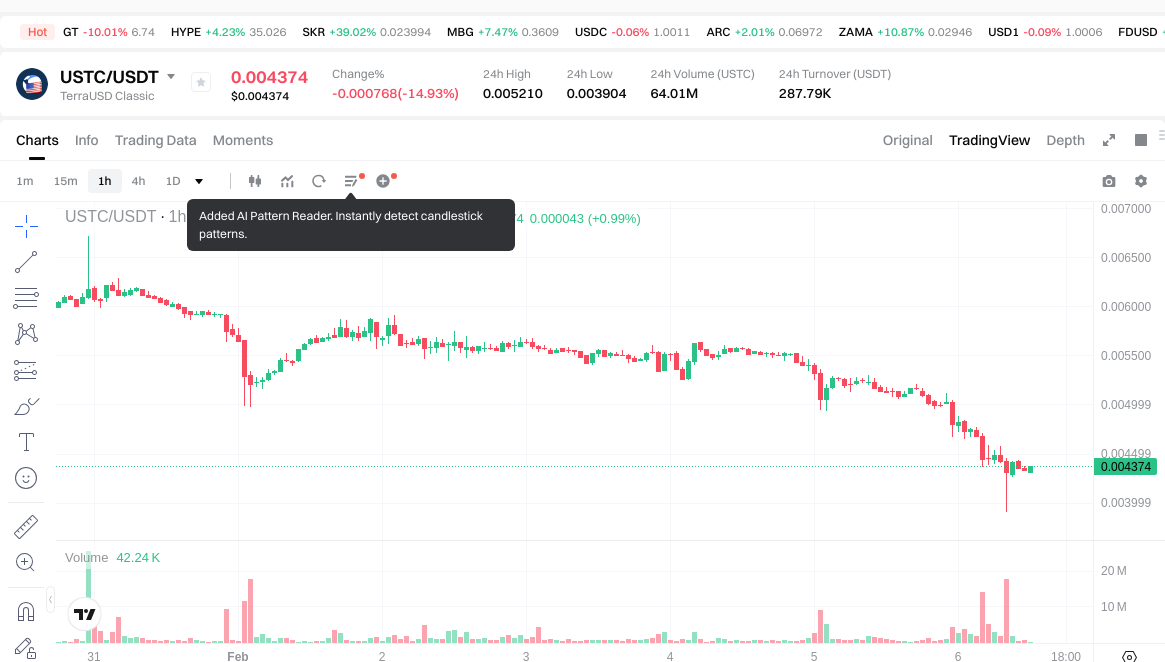
II. Core Factors Affecting Whether USTC is a Good Investment
Supply Mechanism and Scarcity (USTC investment scarcity)
- Algorithmic supply mechanism → impacts price and investment value
- Historical context: USTC's minting cost equals the face value of the stablecoin, requiring burning $1 worth of reserve assets ($LUNA) to mint 1 USTC
- Investment significance: unlimited supply expansion policy presents unique challenges to traditional scarcity-based investment logic
Institutional Investment and Mainstream Adoption (Institutional investment in USTC)
- Current market position: USTC holds a market share of 0.000016% with a market capitalization of approximately $385,930
- Exchange availability: listed on 15 exchanges with 49,505 holders
- Network presence: deployed on multiple chains including LUNC and ETH networks
Macroeconomic Environment's Impact on USTC Investment
- Market volatility considerations → USTC experienced significant price fluctuations with a 24-hour decline of 15.8%
- Historical price range: peaked around $1.091 in May 2021, reaching a low near $0.0057459 in November 2025
- Current market conditions: trading at $0.004339 as of February 6, 2026, representing substantial decline from historical levels
Technology and Ecosystem Development (Technology & Ecosystem for USTC investment)
- Cross-chain capabilities: designed as a scalable, yield-generating, cross-chain decentralized stablecoin
- DeFi integration: positioned to support DeFi applications and protocols without restrictions through its expandable monetary policy
- Network infrastructure: operates on Terra Classic ecosystem with contract addresses on LUNC and ETH chains
III. USTC Future Investment Prediction and Price Outlook (Is TerraUSD Classic(USTC) worth investing in 2026-2031)
Short-term Investment Prediction (2026, short-term USTC investment outlook)
- Conservative prediction: $0.002537 - $0.003170
- Neutral prediction: $0.004374 - $0.004800
- Optimistic prediction: $0.005200 - $0.005774
Mid-term Investment Outlook (2027-2029, mid-term TerraUSD Classic(USTC) investment forecast)
- Market stage expectation: The token may experience gradual recovery patterns as reflected in projected price movements, though uncertainty remains regarding algorithmic stablecoin mechanisms and market acceptance following historical volatility.
- Investment return prediction:
- 2027: $0.003146 - $0.006748
- 2028: $0.003369 - $0.006443
- 2029: $0.004015 - $0.007412
- Key catalysts: Market sentiment recovery, developments in algorithmic stablecoin sector, potential ecosystem rebuilding initiatives, and broader cryptocurrency market trends.
Long-term Investment Outlook (Is USTC a good long-term investment?)
- Base scenario: $0.005436 - $0.009241 (assuming moderate market recovery and continued trading activity)
- Optimistic scenario: $0.007617 - $0.011626 (assuming favorable market conditions and potential restoration of confidence in algorithmic mechanisms)
- Risk scenario: Below $0.002500 (under adverse market conditions or further loss of market confidence)
View USTC long-term investment and price prediction: Price Prediction
2026-2031 Long-term Outlook
- Base scenario: $0.004374 - $0.008018 (corresponding to steady progress and gradual application development)
- Optimistic scenario: $0.006177 - $0.011626 (corresponding to improved adoption and favorable market environment)
- Transformative scenario: Above $0.012000 (if ecosystem achieves breakthrough developments and mainstream adoption)
- 2031-12-31 predicted high: $0.011626 (based on optimistic development assumptions)
Disclaimer: Price predictions are speculative and based on historical data analysis and various market models. Cryptocurrency investments carry significant risk, and past performance does not guarantee future results. Investors should conduct thorough research and consider their risk tolerance before making investment decisions.
| Year |
Predicted High Price |
Predicted Average Price |
Predicted Low Price |
Price Change |
| 2026 |
0.00577368 |
0.004374 |
0.00253692 |
0 |
| 2027 |
0.0067482072 |
0.00507384 |
0.0031457808 |
16 |
| 2028 |
0.006443015724 |
0.0059110236 |
0.003369283452 |
36 |
| 2029 |
0.0074124235944 |
0.006177019662 |
0.0040150627803 |
42 |
| 2030 |
0.009240821414352 |
0.0067947216282 |
0.00543577730256 |
56 |
| 2031 |
0.01162576870585 |
0.008017771521276 |
0.007616882945212 |
84 |
IV. USTC Investment Strategy and Risk Management (How to invest in stablecoins)
Investment Methodology (USTC investment strategy)
-
Long-term Holding (HODL USTC): Given USTC's algorithmic stablecoin mechanism and historical volatility, long-term holding presents significant challenges. The asset has experienced substantial depegging from its $1 target, currently trading at $0.004339, representing a decline of over 99% from its intended parity. Traditional HODL strategies may not be suitable for USTC due to its unstable value retention.
-
Active Trading: USTC exhibits high volatility with 24-hour fluctuations of -15.8% and 7-day changes of -27.79%. Active traders may find opportunities in price swings, though this requires sophisticated technical analysis capabilities and risk tolerance. The 24-hour trading range between $0.003904 and $0.00521 demonstrates significant intraday volatility that experienced traders might leverage through short-term positions.
Risk Management (Risk management for USTC investment)
-
Asset Allocation Ratio:
- Conservative investors: USTC should represent minimal portfolio allocation given its high-risk profile and historical instability
- Aggressive investors: Limited speculative allocation with strict stop-loss parameters
- Professional investors: Only suitable for those with deep understanding of algorithmic stablecoin mechanics and risk mitigation strategies
-
Risk Hedging Solutions: Diversification across multiple asset classes is essential when holding USTC. Consider combining with established cryptocurrencies and traditional hedging instruments. Given USTC's correlation with broader crypto market movements, portfolio hedging through uncorrelated assets becomes critical.
-
Secure Storage: USTC is available on LUNC and ETH chains with contract addresses verifiable through blockchain explorers. For security:
- Hot wallets: Suitable only for active trading amounts
- Cold storage: Recommended for any holdings intended for longer periods
- Hardware wallets: Provide enhanced security for private key management
V. USTC Investment Risks and Challenges (Risks of investing in stablecoins)
-
Market Risk: USTC demonstrates extreme price volatility, with a 1-year decline of -61.52% and 30-day decrease of -40.47%. The asset has lost approximately 99.6% of its value from its algorithmic peg target of $1. Trading volume of $288,857.89 within 24 hours indicates relatively limited liquidity, which can amplify price manipulation risks and slippage during trades.
-
Regulatory Risk: As an algorithmic stablecoin, USTC faces uncertain regulatory treatment across jurisdictions. Various countries are developing frameworks specifically addressing algorithmic stablecoins following sector-wide instabilities. Regulatory actions could impact USTC's accessibility, trading venues, and overall viability.
-
Technical Risk: The algorithmic mechanism linking USTC to LUNA reserves presents inherent technical vulnerabilities. Historical events have demonstrated risks associated with the burn-mint mechanism when market dynamics create adverse feedback loops. Smart contract security across both LUNC and ETH implementations requires ongoing vigilance. Network upgrades or protocol changes could introduce additional technical uncertainties.
VI. Conclusion: Is stablecoins a Good Investment?
-
Investment Value Summary: USTC presents a highly speculative investment profile with substantial historical losses and ongoing volatility. While algorithmic stablecoins offer theoretical scalability benefits for DeFi applications, USTC's track record demonstrates significant depegging risk. The current market capitalization of $385,930.79 and trading activity across 15 exchanges indicate continued market interest, though at significantly reduced levels from historical peaks.
-
Investor Recommendations:
✅ Beginners: USTC is not recommended for new investors due to its complex mechanics, high volatility, and substantial historical losses. Those entering cryptocurrency markets should prioritize established assets with proven stability.
✅ Experienced Investors: Only those with comprehensive understanding of algorithmic stablecoin risks and active trading capabilities should consider USTC. Position sizing should remain minimal within overall portfolio allocation, with strict risk management protocols including stop-loss orders.
✅ Institutional Investors: USTC does not currently present characteristics suitable for strategic long-term institutional allocation given its instability and depegging history.
⚠️ Disclaimer: Cryptocurrency investments carry substantial risk. This content is for informational purposes only and does not constitute investment advice. USTC's historical performance indicates significant challenges in maintaining its algorithmic peg, and investors should conduct thorough due diligence before any investment decisions.
VII. FAQ
Q1: What is TerraUSD Classic (USTC) and how does it differ from traditional stablecoins?
TerraUSD Classic (USTC) is an algorithmic stablecoin that was originally designed to maintain a $1 peg through a burn-mint mechanism with LUNA reserves, rather than being backed by fiat currency reserves like traditional stablecoins such as USDT or USDC. Launched in April 2019, USTC was developed as a scalable, cross-chain decentralized stablecoin for the DeFi ecosystem. Unlike collateral-backed stablecoins that maintain reserves in banks, USTC's value stabilization relied on an algorithmic relationship with LUNA tokens—users could burn $1 worth of LUNA to mint 1 USTC and vice versa. However, this mechanism proved vulnerable during market stress, leading to a significant depegging event in May 2022. As of February 2026, USTC trades at approximately $0.004339, representing a departure of over 99% from its intended $1 parity, highlighting the risks inherent in algorithmic stablecoin designs compared to reserve-backed alternatives.
Q2: Why did USTC lose its $1 peg and what are the current risks?
USTC lost its $1 peg primarily due to a breakdown in its algorithmic stabilization mechanism during May 2022, when adverse market conditions created a negative feedback loop between USTC and LUNA that the system could not recover from. The algorithmic design depended on market confidence and arbitrage opportunities to maintain parity—when large-scale redemptions occurred simultaneously, the system's ability to absorb selling pressure collapsed, leading to rapid devaluation of both USTC and its backing asset LUNA. Current risks include extreme price volatility (24-hour decline of -15.8%, 1-year decline of -61.52%), limited liquidity with only $288,857.89 in 24-hour trading volume, regulatory uncertainty surrounding algorithmic stablecoins, and the unresolved technical vulnerabilities in the burn-mint mechanism. The market capitalization has declined to approximately $385,930.79, reflecting diminished confidence in the asset's ability to regain stability.
Q3: Is USTC suitable for long-term investment or HODL strategy?
No, USTC is generally not suitable for traditional long-term holding (HODL) strategies due to its failure to maintain value stability and substantial historical losses. Unlike Bitcoin or established cryptocurrencies where HODL strategies have proven effective, USTC's core value proposition as a stablecoin—maintaining $1 parity—has been compromised since May 2022. The asset currently trades at $0.004339, representing over 99% decline from its intended value, and price predictions suggest continued uncertainty with 2026 projections ranging from $0.002537 to $0.005774. Long-term holders have experienced catastrophic losses, and the asset lacks the fundamental characteristics that typically support buy-and-hold strategies such as growing adoption, technological advancement driving value appreciation, or deflationary tokenomics. USTC may only be appropriate for experienced traders seeking short-term speculative opportunities within strict risk management frameworks, rather than as a long-term store of value.
Q4: What is the price outlook for USTC through 2026-2031?
Price predictions for USTC indicate modest potential recovery scenarios with significant uncertainty. For 2026, projections range from a low of $0.002537 to an optimistic high of $0.005774, with a neutral average around $0.004374. Mid-term forecasts suggest gradual potential appreciation: 2027 ($0.003146-$0.006748), 2028 ($0.003369-$0.006443), and 2029 ($0.004015-$0.007412). Long-term projections through 2031 estimate a potential high of $0.011626 under optimistic scenarios assuming favorable market conditions and ecosystem restoration. However, these predictions carry substantial uncertainty and depend on multiple factors including broader cryptocurrency market trends, potential rebuilding of the Terra Classic ecosystem, restoration of market confidence in algorithmic mechanisms, and regulatory developments. Investors should note that historical performance shows USTC peaked at $1.091 in May 2021 before declining over 99%, and there is risk of further depreciation below $0.002500 under adverse conditions. These projections are speculative and do not guarantee future performance.
Q5: How should investors approach risk management when considering USTC?
Risk management for USTC requires stringent protocols given its high-risk profile and historical instability. Conservative investors should avoid USTC entirely or limit exposure to minimal portfolio allocation (under 1-2%) that can be completely lost without material financial impact. For aggressive investors willing to accept substantial risk, position sizing should remain limited with mandatory stop-loss orders to prevent catastrophic losses—given the 24-hour volatility of -15.8% and intraday ranges of approximately 25%, strict exit strategies are essential. Active traders should only use hot wallets for trading amounts, moving any holdings intended for longer periods to cold storage or hardware wallets for security. Diversification becomes critical when holding USTC—combining it with uncorrelated assets including established cryptocurrencies, traditional hedging instruments, and stable reserve currencies can mitigate portfolio-wide exposure. Investors should continuously monitor the 24-hour trading volume ($288,857.89), liquidity conditions across 15 exchanges, and broader market sentiment indicators, prepared to exit positions rapidly if adverse conditions emerge.
Q6: What distinguishes USTC from other algorithmic stablecoins currently in the market?
USTC is distinguished primarily by its historical collapse and current status as a "classic" or legacy algorithmic stablecoin that failed to maintain its peg. Unlike newer algorithmic stablecoins that have incorporated lessons from USTC's depegging event—such as overcollateralization mechanisms, circuit breakers, or hybrid collateral models—USTC continues operating under its original burn-mint design without the backing mechanisms that newer projects implement. Its market capitalization of $385,930.79 and 49,505 holders represent a significantly reduced scale compared to operational algorithmic stablecoins. USTC's cross-chain deployment on both LUNC and ETH networks provides technical infrastructure, but this does not address the fundamental mechanism vulnerabilities that caused its original failure. The token essentially serves as a cautionary example within the algorithmic stablecoin sector, demonstrating the risks of pure algorithmic designs without sufficient collateral backing or stability mechanisms during extreme market stress.
Q7: Are there any legitimate use cases for USTC in 2026 and beyond?
Current legitimate use cases for USTC are extremely limited compared to its original DeFi integration intentions. While USTC was designed as a scalable, yield-generating stablecoin for DeFi protocols without restrictions, its loss of the $1 peg severely compromises these applications—DeFi protocols require stable value units for lending, borrowing, and liquidity provision, functions that USTC can no longer reliably serve. Potential current use cases are primarily speculative: short-term trading opportunities based on volatility patterns, potential recovery speculation for risk-tolerant investors who believe in long-term ecosystem restoration, and academic or research purposes examining algorithmic stablecoin mechanics and failure modes. Some holders may maintain positions hoping for potential community-driven revival efforts or technological improvements to the Terra Classic ecosystem. However, none of these represent the stable value transfer, cross-chain settlement, or DeFi collateral functions that USTC was originally designed to fulfill, and investors should not expect USTC to function as a true stablecoin for practical transaction or storage purposes.
Q8: What regulatory considerations should investors be aware of regarding USTC?
Regulatory considerations for USTC involve significant uncertainty as global authorities develop frameworks specifically addressing algorithmic stablecoins following sector instabilities. Various jurisdictions are implementing or proposing regulations that may classify algorithmic stablecoins differently from fiat-backed alternatives, potentially subjecting them to enhanced disclosure requirements, capital adequacy standards, or operational restrictions. Some regulatory bodies may categorize USTC as a high-risk crypto asset rather than a stablecoin given its substantial depegging, affecting its treatment under securities laws, consumer protection regulations, and anti-money laundering frameworks. Investors should be aware that regulatory actions could impact USTC's availability on exchanges—platforms may delist or restrict trading in response to compliance requirements. Cross-border regulatory divergence creates additional complexity since USTC operates across multiple blockchain networks (LUNC and ETH) and is traded on 15 exchanges potentially subject to different jurisdictional rules. Tax treatment varies by country, with some treating stablecoin transactions as taxable events while others provide exemptions—though USTC's volatility complicates standard stablecoin tax approaches. Investors should consult local regulations and tax professionals before engaging with USTC.
* The information is not intended to be and does not constitute financial advice or any other recommendation of any sort offered or endorsed by Gate.