This comprehensive analysis examines WLTH, a community-driven investment protocol democratizing early-stage venture capital access through Web3 technology. As of February 2026, WLTH trades at $0.002292 with a market cap of $458,400, representing significant decline from its May 2024 launch price of $0.06. The article evaluates WLTH's investment potential across multiple dimensions: historical price performance showing 74.87% annual decline, core supply mechanics with 200,000,000 circulating tokens (20% of maximum supply), and institutional adoption through its Oracle validation system. Future price forecasts range from $0.00119756 to $0.005379324545407 through 2031, contingent upon ecosystem development and market conditions. Investment strategies accommodate conservative, aggressive, and professional investors with recommended allocation ratios and risk management protocols. Critical risk factors include market volatility, regulatory uncertainty, and technical vulnerabilities. The analysis concludes that WLT
Introduction: Common Wealth (WLTH) Investment Position and Market Outlook
WLTH represents a community-driven investment protocol in the cryptocurrency sector, launched in May 2024 with an initial focus on democratizing early-stage investment opportunities. As of February 2026, WLTH maintains a market capitalization of approximately $458,400, with a circulating supply of 200,000,000 tokens and a current trading price around $0.002292. Positioned as a funds-based community investment protocol that aims to extend venture capital participation beyond traditional institutional investors, WLTH has become a subject of discussion among those exploring "Is WLTH (WLTH) a good investment?" This article provides a comprehensive analysis of WLTH's investment characteristics, historical price movements, future price considerations, and associated risks to serve as a reference for market participants.
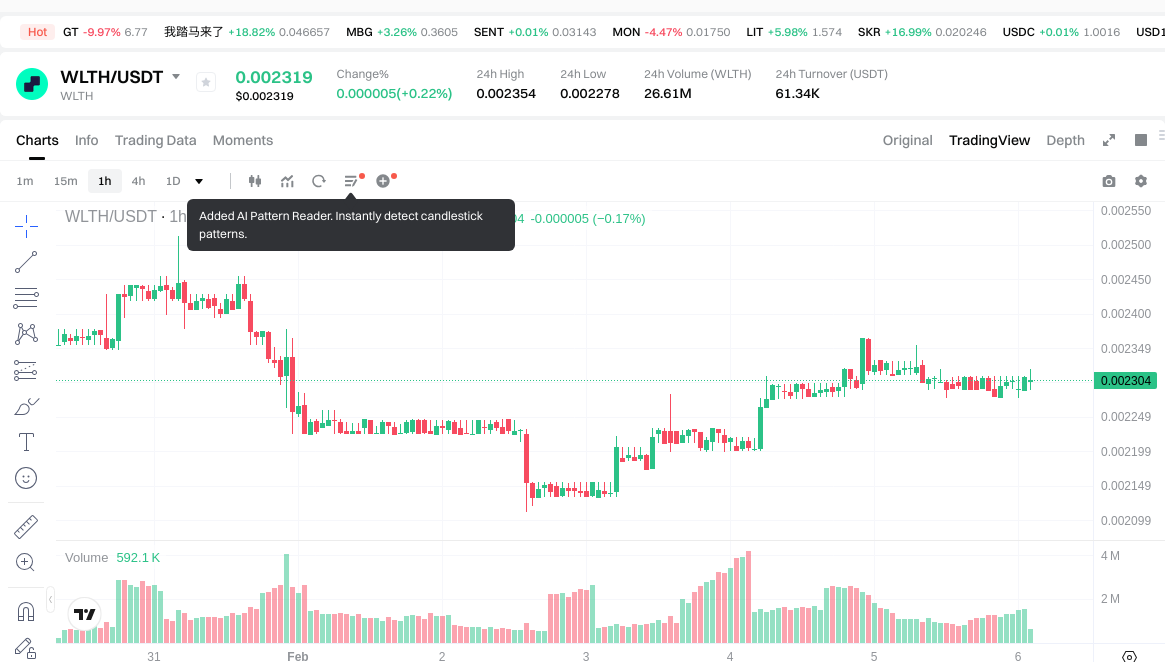
The protocol operates through a distinctive model where All Street Oracles refer vetted early-stage projects to various investment funds, with community members voting on investment decisions proportional to their fund participation. With a total supply of 977,227,466 tokens and a maximum supply cap of 1,000,000,000 tokens, WLTH currently represents a 20% circulating supply ratio. The token experienced price fluctuations since its launch, recording a peak of $0.2945 in May 2024 and a lower point of $0.002111 in April 2025. Recent price trends show a decline of 0.38% over one hour, 0.08% over 24 hours, 9.73% over seven days, 30.99% over 30 days, and 74.87% over one year as of February 6, 2026.
I. WLTH Price Historical Review and Current Investment Value Status
- 2024: WLTH token was launched in May, with the token reaching a price level of $0.2945 on May 30, 2024. Early-stage investors who participated during this period experienced significant market activity.
- 2025: The token entered a correction phase, with price movements reflecting broader market dynamics. By April 18, 2025, the price adjusted to $0.002111, representing a substantial decline from earlier levels.
- Market Cycle Impact: Price fluctuations reflected shifts in investor sentiment and market conditions, with the token experiencing notable volatility throughout 2024-2025.
Current WLTH Investment Market Status (February 2026)
- WLTH Current Price: $0.002292
- 24-hour Trading Volume: $61,447.41
- Market Capitalization: $458,400
- Circulating Supply: 200,000,000 WLTH
- Total Supply: 977,227,466 WLTH
- Maximum Supply: 1,000,000,000 WLTH
- Circulation Ratio: 20.0%
- Number of Holders: 57,421
- Exchange Listings: 1 exchange
Click to view real-time WLTH market price
II. Core Factors Influencing Whether WLTH is a Good Investment
Supply Mechanism and Scarcity (WLTH Investment Scarcity)
- Maximum supply is capped at 1,000,000,000 WLTH, with current circulating supply at 200,000,000 tokens (20% of maximum supply)
- Total supply stands at 977,227,466 WLTH, indicating controlled token release
- The circulating supply ratio of 20% suggests significant token reserves remain unlocked, which may influence future price dynamics
- Investment significance: The defined supply ceiling establishes a framework for potential scarcity, though actual market impact depends on token release schedules and adoption rates
Institutional Investment and Mainstream Adoption (Institutional Investment in WLTH)
- WLTH operates as a community investment protocol utilizing an "All Street" Oracles system, where industry figures refer and vet early-stage projects
- The platform has 57,421 holders as of February 2026, indicating retail participation levels
- Each fund investment requires backing from at least one Oracle member, establishing a due diligence framework
- Trading availability on one exchange with 24-hour trading volume of approximately $61,447
Macroeconomic Environment Impact on WLTH Investment
- WLTH functions within the Web3 investment ecosystem, positioning it within the broader digital asset market subject to macroeconomic conditions
- The project's focus on democratizing early-stage investment access may appeal during periods when traditional venture capital access remains limited
- Market capitalization of approximately $458,400 places WLTH among smaller-cap digital assets, potentially subject to higher volatility during macroeconomic shifts
Technology and Ecosystem Development (Technology & Ecosystem for WLTH Investment)
- Deployed on Base blockchain (contract address: 0x99b2B1A2aDB02B38222ADcD057783D7e5D1FCC7D)
- The protocol features a fund-based structure where community investors vote on project investments proportionate to their fund participation
- Platform incorporates Oracle AMAs, proposal workshops, analysis and reports as part of its due diligence framework
- Minimum investment threshold set at $20, accepting both fiat and cryptocurrency payments
- The project launched in May 2024 with initial pricing at $0.06, compared to current pricing at $0.002292 as of February 2026
III. WLTH Future Investment Forecast and Price Outlook (Is WLTH worth investing in 2026-2031)
Short-term Investment Forecast (2026, short-term WLTH investment outlook)
- Conservative forecast: $0.00119756 - $0.002303
- Neutral forecast: $0.002303 - $0.00317814
- Optimistic forecast: $0.00317814 and above
Mid-term Investment Outlook (2027-2029, mid-term WLTH investment forecast)
- Market stage expectation: Based on available data, WLTH may experience gradual growth phases with increasing price ranges across 2027-2029, subject to market conditions and ecosystem development.
- Investment return forecast:
- 2027: $0.0017265591 - $0.0038093923
- 2028: $0.0029147332235 - $0.0044212245525
- 2029: $0.003270887423562 - $0.004078989022325
- Key catalysts: Broader adoption of the Common Wealth protocol, expansion of fund-based community investment features, oracle network development, and enhanced due diligence framework implementation.
Long-term Investment Outlook (Is WLTH a good long-term investment?)
- Base scenario: $0.003567191343108 - $0.004597713286673 (assuming steady ecosystem growth and maintained market conditions)
- Optimistic scenario: $0.005231880636559 - $0.005379324545407 (assuming accelerated adoption and favorable market environment)
- Risk scenario: Below $0.002111 (under adverse market conditions or significant regulatory challenges)
Click to view WLTH long-term investment and price forecast: Price Prediction
2026-02-06 - 2031 Long-term Outlook
- Base scenario: $0.003567191343108 - $0.004597713286673 (corresponding to steady progress and gradual mainstream application growth)
- Optimistic scenario: $0.005231880636559 - $0.005379324545407 (corresponding to large-scale adoption and favorable market environment)
- Transformative scenario: Above $0.005379324545407 (if ecosystem achieves breakthrough progress and mainstream popularization)
- 2031-12-31 forecast high: $0.005379324545407 (based on optimistic development assumptions)
Disclaimer: This forecast is based on historical data analysis and market trend modeling. Cryptocurrency markets involve substantial risks, and actual prices may differ significantly from predictions. Investors should conduct independent research and consider their risk tolerance before making investment decisions.
| Year |
Predicted High Price |
Predicted Average Price |
Predicted Low Price |
Price Change |
| 2026 |
0.00317814 |
0.002303 |
0.00119756 |
0 |
| 2027 |
0.0038093923 |
0.00274057 |
0.0017265591 |
19 |
| 2028 |
0.0044212245525 |
0.00327498115 |
0.0029147332235 |
42 |
| 2029 |
0.004078989022325 |
0.00384810285125 |
0.003270887423562 |
67 |
| 2030 |
0.005231880636559 |
0.003963545936787 |
0.003567191343108 |
72 |
| 2031 |
0.005379324545407 |
0.004597713286673 |
0.003586216363605 |
100 |
IV. WLTH Investment Strategy and Risk Management (How to invest in WLTH)
Investment Methodology (WLTH investment strategy)
Long-term Holding (HODL WLTH): Suitable for Conservative Investors
A long-term holding strategy may be considered for investors who believe in the democratization of early-stage investment access. This approach involves acquiring WLTH tokens and holding them through market cycles, potentially benefiting from the platform's growth as it expands its funds-based community investment protocol. Given the project's focus on opening venture capital opportunities to retail investors through Web3 technology, long-term holders might position themselves to participate in the platform's evolving ecosystem. However, investors should note the significant price decline from the launch price of $0.06 to the current level of approximately $0.002292, representing a substantial decrease since the May 2024 launch.
Active Trading: Relying on Technical Analysis and Swing Operations
Active traders may explore opportunities through technical analysis and swing trading strategies, particularly given WLTH's price volatility. With 24-hour trading volume of approximately $61,447 and price fluctuations between $0.002278 and $0.002354 in recent sessions, short-term price movements may present trading opportunities. The token has demonstrated notable percentage changes across different timeframes, including a 9.73% decline over 7 days and a 30.99% decrease over 30 days. Traders should monitor volume patterns, support and resistance levels, and broader market sentiment when executing swing trading strategies.
Risk Management (Risk management for WLTH investment)
Asset Allocation Ratio: Conservative / Aggressive / Professional Investors
-
Conservative Investors: May consider allocating no more than 1-3% of their cryptocurrency portfolio to WLTH, given its relatively low market capitalization of approximately $458,400 and ranking of 3082 in the market. This limited exposure helps manage risk while maintaining potential upside participation.
-
Aggressive Investors: Those with higher risk tolerance might allocate 5-10% of their crypto portfolio to WLTH, accepting the higher volatility in exchange for potential returns if the platform gains traction in democratizing early-stage investment access.
-
Professional Investors: Institutional or experienced investors may conduct thorough due diligence on the platform's fund performance, Oracle validation processes, and community engagement metrics before determining appropriate allocation levels. Professional investors should evaluate the token's utility within the ecosystem and the platform's competitive positioning in the community investment space.
Risk Hedging Solutions: Multi-asset Portfolio + Risk Mitigation Tools
Investors may consider diversifying their exposure across multiple asset classes to mitigate WLTH-specific risks. A balanced portfolio might include established cryptocurrencies, stablecoins, and other DeFi protocol tokens. Given WLTH's circulating supply of 200,000,000 tokens (20% of max supply of 1,000,000,000), investors should monitor potential dilution risks as more tokens enter circulation. Risk mitigation strategies may include setting stop-loss orders, implementing dollar-cost averaging for entry positions, and maintaining liquidity reserves to respond to market volatility.
Secure Storage: Hot and Cold Wallets + Hardware Wallet Recommendations
WLTH tokens are deployed on the Base network as ERC20 tokens, with the contract address 0x99b2B1A2aDB02B38222ADcD057783D7e5D1FCC7D. For secure storage:
-
Hot Wallets: Web3 wallets compatible with Base network, such as MetaMask or Coinbase Wallet, may be used for active trading and platform interaction. Investors should ensure proper security measures including two-factor authentication and secure backup of seed phrases.
-
Cold Wallets: For long-term storage, hardware wallets that support Base network and ERC20 tokens, such as Ledger or Trezor devices, provide enhanced security by keeping private keys offline. This approach significantly reduces exposure to online threats and hacking attempts.
-
Best Practices: Investors should never store all holdings in a single location, maintain multiple backup copies of recovery phrases in secure physical locations, and regularly verify wallet compatibility with Base network updates.
V. WLTH Investment Risks and Challenges (Risks of investing in WLTH)
Market Risk: High Volatility and Price Manipulation
WLTH exhibits substantial price volatility, with a 74.87% decline over the past year from higher valuation levels. The token's market capitalization of approximately $458,400 and relatively low 24-hour trading volume of around $61,447 indicate limited liquidity, which can amplify price swings during periods of buying or selling pressure. The significant gap between the all-time high of $0.2945 (May 2024) and current price of $0.002292 demonstrates the potential for dramatic price fluctuations. Lower liquidity markets may be more susceptible to price impact from large transactions, and investors should be aware that executing significant buy or sell orders could result in unfavorable price slippage.
Regulatory Risk: Policy Uncertainty Across Different Countries
As a platform democratizing access to early-stage investments through Web3 technology, Common Wealth operates in a regulatory environment that varies significantly across jurisdictions. The intersection of securities law, cryptocurrency regulation, and crowdfunding rules creates complex compliance considerations. Different countries maintain varying approaches to tokenized investment platforms, community-driven fund management, and retail participation in early-stage venture opportunities. Regulatory developments in key markets could impact the platform's operational model, token utility, or accessibility to users in specific regions. Investors should monitor regulatory announcements from relevant authorities in their jurisdictions and understand how policy changes might affect WLTH token value and platform functionality.
Technical Risk: Network Security Vulnerabilities and Upgrade Failures
WLTH's infrastructure relies on the Base network, introducing dependency risks related to the underlying blockchain's security and performance. Smart contract vulnerabilities in the token contract (0x99b2B1A2aDB02B38222ADcD057783D7e5D1FCC7D) or platform protocols could potentially expose funds to exploitation. The platform's fund management system, Oracle validation processes, and community voting mechanisms involve complex smart contract interactions that require robust security audits and ongoing monitoring. Protocol upgrades, whether to the Common Wealth platform or the Base network itself, carry inherent risks of introducing bugs or compatibility issues. With approximately 57,421 holders, any security incident could affect a substantial user base. Investors should verify that appropriate security measures, audits, and bug bounty programs are in place before committing significant capital.
VI. Conclusion: Is WLTH a Good Investment?
Investment Value Summary
WLTH represents an approach to democratizing early-stage investment access through a funds-based community investment protocol. The project's vision of opening venture capital opportunities to retail investors addresses a genuine market need for broader participation in early-stage deal flow. However, the token's performance since launch shows significant price decline, with current valuation substantially below the initial offering price. The relatively low market capitalization and limited liquidity present both opportunities and challenges. Long-term potential depends on the platform's ability to deliver consistent fund performance, attract quality project referrals from Oracle network members, and grow its user base beyond the current holder count of approximately 57,421.
Investor Recommendations
✅ Beginners: Consider dollar-cost averaging with small position sizes ($20 minimum investment aligns with platform accessibility), store tokens in secure wallets compatible with Base network, and thoroughly research the platform's fund offerings and due diligence framework before participating. New investors should start with conservative allocation percentages and prioritize learning about the platform's Oracle validation system and community governance processes.
✅ Experienced Investors: May explore swing trading opportunities given price volatility, while maintaining diversified portfolio exposure across multiple crypto assets. Experienced participants should evaluate individual fund performance metrics, analyze project referral quality from Oracle members, and actively participate in proposal workshops and due diligence processes. Consider both token price appreciation potential and utility value from accessing curated early-stage investment opportunities.
✅ Institutional Investors: Should conduct comprehensive due diligence on platform governance, fund management track records, regulatory compliance framework, and competitive positioning within the tokenized investment space. Institutional participants may benefit from engaging directly with core contributors to understand protocol development roadmap, security audit results, and plans for expanding the Oracle network. Strategic long-term positioning requires careful assessment of the platform's sustainable competitive advantages in democratizing venture capital access.
⚠️ Disclaimer: Cryptocurrency investment carries substantial risk, including potential loss of principal. WLTH's significant price volatility, limited liquidity, and evolving regulatory environment create additional risk factors. This content provides informational analysis only and does not constitute financial advice, investment recommendations, or solicitation to buy or sell any asset. Investors should conduct independent research, consult with qualified financial advisors, and only invest capital they can afford to lose. Past performance does not indicate future results, and all investment decisions remain the sole responsibility of individual investors.
VII. FAQ
Q1: What is the current price and market capitalization of WLTH, and how has it performed since launch?
As of February 6, 2026, WLTH trades at approximately $0.002292 with a market capitalization of $458,400. The token has experienced significant price decline since its May 2024 launch, dropping from an all-time high of $0.2945 to current levels—representing a 74.87% decrease over one year. The 24-hour trading volume stands at $61,447.41, with 200,000,000 tokens in circulation (20% of the 1,000,000,000 maximum supply). This performance reflects substantial volatility and correction from initial valuation levels, indicating investors should carefully assess risk tolerance before considering positions in this asset.
Q2: How does Common Wealth's investment model work, and what makes WLTH different from traditional venture capital?
Common Wealth operates as a funds-based community investment protocol where "All Street Oracles"—vetted industry figures—refer and validate early-stage projects for community consideration. Token holders can participate in investment decisions through proportional voting based on their fund participation, with a minimum investment threshold of $20 accepting both fiat and cryptocurrency. This model democratizes access to early-stage deal flow traditionally reserved for institutional venture capital firms. The platform deployed on Base blockchain incorporates Oracle AMAs, proposal workshops, and analysis reports as part of its due diligence framework, distinguishing it from conventional VC structures through community governance and lower entry barriers.
Q3: What are the main risk factors associated with investing in WLTH?
WLTH presents multiple risk categories requiring careful evaluation. Market risk includes high volatility evidenced by 74.87% annual decline, limited liquidity with $61,447 daily volume, and potential price manipulation due to low market cap. Regulatory risk stems from uncertain policy frameworks across jurisdictions regarding tokenized investment platforms and retail participation in early-stage ventures. Technical risk involves smart contract vulnerabilities in the Base network deployment, potential security issues with the fund management system, and risks associated with protocol upgrades. The 20% circulating supply ratio also indicates potential dilution risk as more tokens enter circulation, which could impact price dynamics.
Q4: What is the long-term price forecast for WLTH through 2031?
Price projections suggest gradual recovery potential under favorable conditions. The 2026 conservative forecast ranges from $0.00119756 to $0.002303, with neutral scenarios reaching $0.00317814. By 2027-2029, mid-term forecasts indicate potential growth to $0.0017265591 - $0.0038093923 (2027), $0.0029147332235 - $0.0044212245525 (2028), and $0.003270887423562 - $0.004078989022325 (2029). Long-term 2031 projections range from base scenario $0.003567191343108 - $0.004597713286673 to optimistic scenario $0.005231880636559 - $0.005379324545407. However, these forecasts depend on ecosystem development, mainstream adoption, and favorable market conditions. Actual results may differ substantially due to cryptocurrency market volatility and unforeseen factors.
Q5: What investment strategies are recommended for different types of WLTH investors?
Conservative investors should limit WLTH allocation to 1-3% of crypto portfolio, utilizing dollar-cost averaging and secure cold wallet storage compatible with Base network. Aggressive investors may allocate 5-10% while accepting higher volatility, potentially exploring swing trading opportunities given price fluctuations between $0.002278-$0.002354 in recent sessions. Professional investors should conduct comprehensive due diligence on fund performance metrics, Oracle validation processes, and platform governance before determining allocation. All investor types should diversify across multiple assets, implement stop-loss orders, and maintain liquidity reserves. Hardware wallets like Ledger or Trezor provide enhanced security for long-term holdings, while MetaMask or Coinbase Wallet facilitate active platform interaction.
Q6: How does WLTH's tokenomics structure affect its investment potential?
WLTH features a capped maximum supply of 1,000,000,000 tokens with current circulation of 200,000,000 (20%), while total supply stands at 977,227,466 tokens. This 20% circulation ratio indicates significant token reserves remain unlocked, creating potential dilution concerns as additional tokens enter circulation through scheduled releases. The defined supply ceiling establishes a scarcity framework, though actual market impact depends heavily on token release schedules and adoption rates. With 57,421 current holders and availability on only one exchange, limited distribution and liquidity may constrain price discovery. Investors should monitor token unlock schedules and circulation expansion plans to assess potential supply-side pressure on valuations.
Q7: What are the key factors that could drive WLTH's future value appreciation?
Several catalysts could influence WLTH's trajectory: broader adoption of the Common Wealth protocol's community investment model, successful fund performance demonstrating the platform's value proposition, expansion of the Oracle network with influential industry participants, and enhanced due diligence framework implementation building user confidence. Technical developments on Base network, increased exchange listings improving liquidity, growing holder base beyond current 57,421 participants, and mainstream recognition of democratized venture capital access represent additional growth drivers. Macroeconomic conditions favoring alternative investment platforms, regulatory clarity supporting tokenized investment models, and successful exits from portfolio companies funded through the platform could also positively impact token valuation.
Q8: What security measures should investors implement when holding WLTH tokens?
WLTH tokens deployed on Base network (contract address: 0x99b2B1A2aDB02B38222ADcD057783D7e5D1FCC7D) require appropriate security protocols. For active trading, utilize Web3-compatible hot wallets like MetaMask or Coinbase Wallet with two-factor authentication and secure seed phrase backups. For long-term storage, hardware wallets supporting Base network and ERC20 tokens (Ledger, Trezor) provide enhanced security by maintaining offline private keys. Best practices include diversifying storage across multiple locations, never storing all holdings in single wallet, maintaining multiple physical backup copies of recovery phrases, and regularly verifying wallet compatibility with Base network updates. Investors should also verify smart contract addresses before transactions and remain vigilant against phishing attempts targeting Web3 wallet users.
* The information is not intended to be and does not constitute financial advice or any other recommendation of any sort offered or endorsed by Gate.