This comprehensive analysis compares OPTIMUS and FLOW, two cryptocurrency tokens representing distinctly different investment theses. OPTIMUS, launched in 2023, positions itself as a decentralized venture fund targeting AI and humanoid robotics projects, currently trading at $0.006538 with daily volume of $12,646. FLOW, established in September 2020, functions as a blockchain infrastructure platform for mainstream adoption, gaming, and digital assets, trading at $0.05213 with superior liquidity of $325,357 daily volume. The article examines historical price performance, technological ecosystems, institutional adoption patterns, and macroeconomic drivers affecting both tokens. While OPTIMUS offers emerging sector exposure with higher volatility and speculative potential, FLOW provides established market presence with better trading conditions. Investment recommendations vary by risk tolerance: conservative investors should favor FLOW's stability, while aggressive investors might allocate significantly toward O
Introduction: OPTIMUS vs FLOW Investment Comparison
In the cryptocurrency market, the comparison between OPTIMUS and FLOW has always been a topic that investors cannot avoid. The two tokens not only show significant differences in market cap ranking, application scenarios, and price performance, but also represent different crypto asset positioning.
OPTIMUS: Launched in 2023, it positions itself as a decentralized venture fund for AI projects, serving as a tribute to Elon Musk and Tesla's robotics innovation.
FLOW: Since its launch in September 2020, FLOW has been recognized as a next-generation blockchain platform designed for mainstream adoption, particularly focusing on games, applications, and digital assets.
This article will comprehensively analyze the investment value comparison between OPTIMUS and FLOW from the perspectives of historical price trends, supply mechanisms, institutional adoption, technical ecosystem, and future predictions, attempting to answer the question that investors care about most:
"Which is the better buy right now?"
I. Historical Price Comparison and Current Market Status
OPTIMUS (Coin A) and FLOW (Coin B) Historical Price Trends
- 2024: OPTIMUS experienced notable price movements, with its value reaching $0.617148 in March 2024. The token subsequently faced downward pressure throughout the year.
- 2021: FLOW was influenced by significant market interest in NFT platforms, with its price reaching $42.4 in April 2021. The token has since experienced considerable volatility.
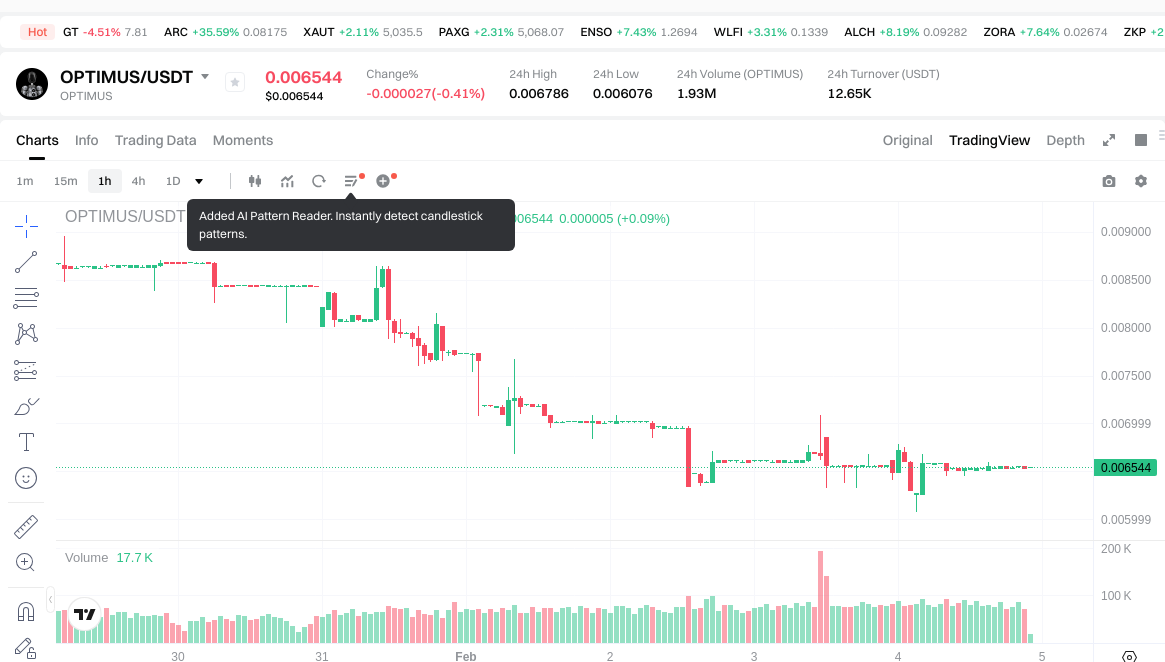
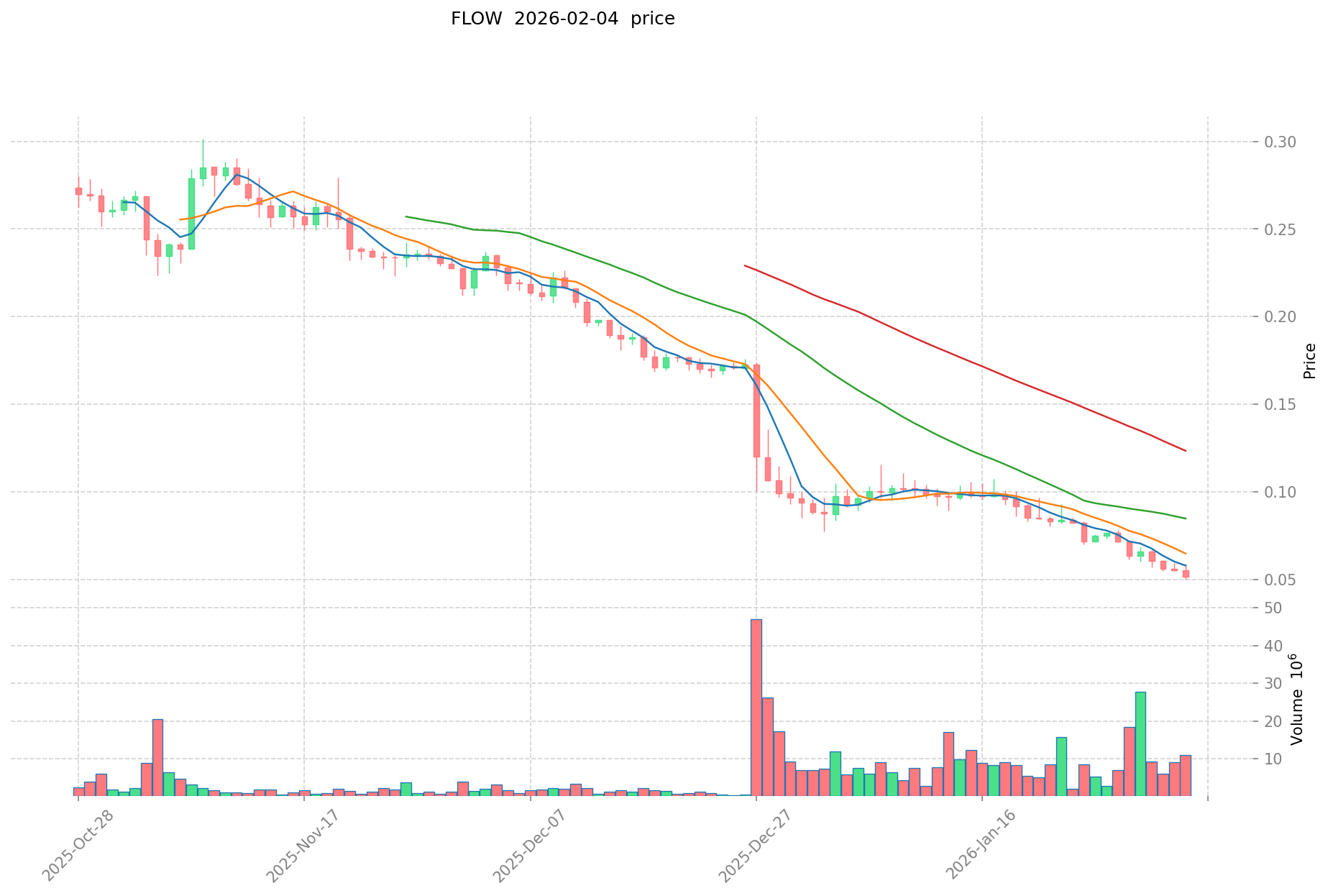
- Comparative Analysis: During recent market cycles, OPTIMUS declined from its high of $0.617148 to current levels near $0.006538, representing substantial depreciation. FLOW similarly declined from its peak of $42.4 to approximately $0.05213, reflecting broader market corrections.
Current Market Situation (2026-02-04)
- OPTIMUS Current Price: $0.006538
- FLOW Current Price: $0.05213
- 24-Hour Trading Volume: OPTIMUS $12,646.41 vs FLOW $325,357.22
- Market Sentiment Index (Fear & Greed Index): 14 (Extreme Fear)
View real-time prices:
II. Core Factors Influencing OPTIMUS vs FLOW Investment Value
Supply Mechanism Comparison (Tokenomics)
Note: The reference materials do not provide specific information on tokenomics or supply mechanisms for either OPTIMUS or FLOW tokens. Investment analysis should be conducted based on official project documentation and verified sources.
Institutional Adoption and Market Application
OPTIMUS (Humanoid Robotics)
-
Enterprise Adoption: Tesla's Optimus humanoid robot represents a significant industrial application case. According to industry reports, Tesla aims to produce 5,000-10,000 humanoid robots in 2026, with production capacity planned to scale 10x by 2027. Manufacturing enterprises in China, including BYD and Xiaopeng Motors, are leveraging automotive industry expertise to advance humanoid robot development.
-
Policy Support: Global governments have demonstrated strong support for humanoid robotics. In China, national-level policies since 2015 have supported computing power, embodied intelligence, and hardware development. Major cities have established multiple industrial alliances and funds, with industrial funds established in 2024 alone totaling hundreds of billions of yuan. In the United States, specialized R&D subsidies and tax incentives have attracted substantial capital into the humanoid robotics sector.
-
Market Positioning: Industry analysis suggests humanoid robotics represents a potential trillion-yuan market opportunity, with applications spanning manufacturing, logistics, and household services. The sector is currently in the transition phase from "0 to 1", with 2025 potentially marking the first year of mass production.
FLOW (Context Not Specified)
The reference materials do not provide sufficient information regarding FLOW's institutional adoption, enterprise application scenarios, or regulatory environment.
Technology Development and Ecosystem Building
OPTIMUS Technology Evolution
-
Technical Specifications: Based on Tesla data, Optimus Gen 3 features approximately 28 degrees of freedom in the body and limbs, with dexterous hands potentially reaching 34 degrees of freedom, totaling over 60 degrees of freedom. Core components include frameless/coreless motors, harmonic reducers, roller screws, one-dimensional/six-dimensional force/position sensors, and bearings.
-
AI Integration: ARK research indicates that the complexity of humanoid robots is approximately 200,000 times greater than autonomous vehicles. Through mapping the computational requirements and performance improvements of Tesla's Full Self-Driving (FSD), analysis suggests that with continued AI computational expansion and hardware advances, Optimus humanoid robots may reach human-level task execution capabilities around 2028.
-
Supply Chain Development: Chinese enterprises demonstrate advantages in hardware components. Domestic supply chains are developing rapidly, with certain areas such as harmonic reducers already at internationally leading levels. Industry reports identify approximately 100 domestic enterprises across various humanoid robotics segments.
FLOW Technology Development
Reference materials do not contain detailed information regarding FLOW's technical architecture, development roadmap, or ecosystem applications.
Ecosystem Comparison
-
OPTIMUS Ecosystem: The humanoid robotics industrial chain overlaps with traditional industries including industrial robotics and automotive manufacturing. Chinese manufacturing enterprises possess cost advantages and technical accumulation, positioning them to benefit from hardware component opportunities. Application scenarios span factory automation, logistics warehousing, and household services.
-
FLOW Ecosystem: Insufficient data available in reference materials for comparative analysis.
Macroeconomic Environment and Market Cycles
Economic Growth Drivers
ARK's research framework suggests that AI-driven technological convergence, including robotics, may contribute to structural changes in GDP growth rates. The analysis indicates that capital investment alone could contribute 1.9 percentage points to annualized real GDP growth within this decade, potentially pushing realized real growth 4 percentage points above consensus expectations annually.
Investment Cycle Characteristics
-
Infrastructure Investment: Global data center system investment in 2025 reached approximately $500 billion, nearly 2.5 times the average level from 2012-2023. This infrastructure expansion supports AI and robotics development.
-
Manufacturing Transformation: The humanoid robotics sector benefits from established supply chains in industrial automation and automotive manufacturing, potentially enabling faster cost reduction and quality improvement compared to new energy vehicles.
Market Maturity Assessment
-
Current Stage: Humanoid robotics remains in the embryonic "0 to 1" phase. Key tracking points include AI technology advancement enabling robotics capabilities, industrial progress from leading companies like Tesla, and domestic innovators including Unitree Technology, Zhiyuan Robotics, and UBTech.
-
Risk Factors: Commercial deployment timeline uncertainty, downstream demand realization, AI technology development pace, and domestic component manufacturer order fulfillment represent primary risk considerations.
Policy and Regulatory Environment
Multiple jurisdictions have established supportive regulatory frameworks. However, the materials note that technology commercialization requires addressing universality and cost challenges while managing ethical risk considerations. Cross-border technology transfer policies and international cooperation frameworks may influence development trajectories.
Note: Comparative analysis between OPTIMUS and FLOW investment value requires comprehensive evaluation across technology maturity, market application scale, regulatory support, and macroeconomic positioning. Investment decisions should incorporate verified project fundamentals, risk assessment, and professional financial guidance.
III. 2026-2031 Price Forecast: OPTIMUS vs FLOW
Short-term Forecast (2026)
- OPTIMUS: Conservative $0.004908 - $0.006544 | Optimistic $0.006544 - $0.00942336
- FLOW: Conservative $0.0400554 - $0.05202 | Optimistic $0.05202 - $0.062424
Mid-term Forecast (2028-2029)
- OPTIMUS may enter a gradual accumulation phase, with projected price range of $0.006270382272 - $0.0143126225648
- FLOW may enter a steady growth phase, with projected price range of $0.0460436823 - $0.0763338475845
- Key drivers: institutional capital inflows, ETF developments, ecosystem expansion
Long-term Forecast (2030-2031)
- OPTIMUS: Baseline scenario $0.010494080418507 - $0.0126191443224 | Optimistic scenario $0.0126191443224 - $0.015400403731056
- FLOW: Baseline scenario $0.042522999970522 - $0.071104032737595 | Optimistic scenario $0.071104032737595 - $0.10523396845164
View detailed price predictions for OPTIMUS and FLOW
Disclaimer
OPTIMUS:
| Year |
Predicted High Price |
Predicted Average Price |
Predicted Low Price |
Price Change |
| 2026 |
0.00942336 |
0.006544 |
0.004908 |
0 |
| 2027 |
0.0110174784 |
0.00798368 |
0.005189392 |
22 |
| 2028 |
0.01235075296 |
0.0095005792 |
0.006270382272 |
45 |
| 2029 |
0.0143126225648 |
0.01092566608 |
0.0100516127936 |
67 |
| 2030 |
0.014638207413984 |
0.0126191443224 |
0.010600081230816 |
93 |
| 2031 |
0.015400403731056 |
0.013628675868192 |
0.010494080418507 |
108 |
FLOW:
| Year |
Predicted High Price |
Predicted Average Price |
Predicted Low Price |
Price Change |
| 2026 |
0.062424 |
0.05202 |
0.0400554 |
0 |
| 2027 |
0.06237198 |
0.057222 |
0.0457776 |
9 |
| 2028 |
0.0663746589 |
0.05979699 |
0.0460436823 |
14 |
| 2029 |
0.0763338475845 |
0.06308582445 |
0.0510995178045 |
21 |
| 2030 |
0.07249822945794 |
0.06970983601725 |
0.042522999970522 |
33 |
| 2031 |
0.10523396845164 |
0.071104032737595 |
0.053328024553196 |
36 |
IV. Investment Strategy Comparison: OPTIMUS vs FLOW
Long-term vs Short-term Investment Strategies
-
OPTIMUS: May appeal to speculative investors focused on emerging AI and robotics sector exposure, with tolerance for elevated volatility and early-stage technology development risks. The token's connection to humanoid robotics represents a long-term thematic investment aligned with industrial automation trends.
-
FLOW: May suit investors seeking exposure to established blockchain infrastructure with historical market presence since 2020. The token's positioning in digital assets and applications provides potential diversification within blockchain platform investments.
Risk Management and Asset Allocation
-
Conservative Investors: OPTIMUS 20-30% vs FLOW 70-80% - Conservative allocation favors assets with longer operational history and established market presence, while maintaining limited exposure to emerging sector opportunities.
-
Aggressive Investors: OPTIMUS 60-70% vs FLOW 30-40% - Higher risk tolerance portfolios may weight toward early-stage technology exposure, accepting increased volatility for potential asymmetric returns.
-
Hedging Instruments: Stablecoin reserves for liquidity management, options strategies for downside protection, cross-asset portfolio construction including diversified cryptocurrency holdings and traditional asset classes.
V. Potential Risk Comparison
Market Risks
-
OPTIMUS: Trading volume of $12,646.41 indicates limited liquidity, creating execution risks and price slippage potential. The token has experienced substantial depreciation from $0.617148 to current levels near $0.006538, reflecting high volatility characteristics. Market sentiment index at 14 (Extreme Fear) suggests broader market stress conditions.
-
FLOW: Higher trading volume of $325,357.22 provides relatively improved liquidity compared to OPTIMUS. Historical price decline from $42.4 to approximately $0.05213 demonstrates significant downside volatility. The token remains subject to cryptocurrency market cycles and sentiment fluctuations.
Technical Risks
-
OPTIMUS: As an early-stage project launched in 2023, the token faces technology commercialization uncertainties. The underlying humanoid robotics sector remains in the embryonic "0 to 1" phase, with commercial deployment timelines uncertain. Integration complexity and AI technology development pace represent material technical risk factors.
-
FLOW: Reference materials do not provide detailed information regarding FLOW's technical architecture or specific scalability challenges. General blockchain platform risks include network stability considerations, upgrade implementation, and competitive positioning within the broader blockchain ecosystem.
Regulatory Risks
-
Global cryptocurrency regulatory frameworks continue evolving, with jurisdiction-specific approaches to digital asset classification, taxation, and operational requirements. Both tokens face regulatory uncertainty, though the specific impact may vary based on project structure, geographic operations, and use case positioning.
-
Cross-border technology transfer policies and international cooperation frameworks may influence development trajectories, particularly for OPTIMUS given its connection to robotics and AI sectors subject to technology export controls in certain jurisdictions.
VI. Conclusion: Which Is the Better Buy?
📌 Investment Value Summary:
-
OPTIMUS Advantages: Exposure to emerging humanoid robotics sector with substantial long-term market potential. Connection to Tesla innovation narrative and AI-driven technological convergence themes. Potential positioning within trillion-yuan market opportunity as industrial automation advances.
-
FLOW Advantages: Established market presence since September 2020 with operational track record. Higher daily trading volume of $325,357.22 provides improved liquidity characteristics. Positioning within blockchain infrastructure for mainstream adoption, games, applications, and digital assets.
✅ Investment Recommendations:
-
Novice Investors: Consider comprehensive education on cryptocurrency fundamentals, risk management principles, and portfolio construction before capital deployment. Both assets exhibit substantial volatility and require careful position sizing relative to overall financial circumstances.
-
Experienced Investors: Evaluate portfolio allocation based on risk tolerance, investment timeline, and conviction in underlying technology sectors. Consider FLOW for established blockchain platform exposure with operational history, and OPTIMUS for thematic allocation to AI and robotics convergence with appropriate risk management.
-
Institutional Investors: Conduct thorough due diligence including technology assessment, regulatory analysis, liquidity evaluation, and counterparty risk review. Consider both tokens within broader digital asset allocation strategies, with emphasis on risk-adjusted return profiles and correlation characteristics.
⚠️ Risk Disclosure: Cryptocurrency markets demonstrate extreme volatility with potential for substantial capital loss. This analysis does not constitute investment advice, financial guidance, or recommendations to buy, sell, or hold any digital assets. Investment decisions should incorporate professional financial consultation, comprehensive risk assessment, and alignment with individual financial objectives and risk tolerance.
VII. FAQ
Q1: What is the main difference between OPTIMUS and FLOW in terms of their core positioning?
OPTIMUS is a decentralized venture fund token focused on AI and robotics projects (launched 2023), while FLOW is an established blockchain platform infrastructure designed for mainstream adoption, games, and digital assets (launched September 2020). OPTIMUS represents exposure to emerging humanoid robotics and AI convergence themes, positioning itself as a tribute to Tesla's innovation in robotics. In contrast, FLOW provides infrastructure-layer blockchain technology that enables developers to build decentralized applications, NFT platforms, and digital asset ecosystems with a longer operational track record and established market presence.
Q2: Which token demonstrates better liquidity for trading purposes?
FLOW shows significantly superior liquidity with 24-hour trading volume of $325,357.22, compared to OPTIMUS's $12,646.41. This represents approximately 26 times higher trading volume for FLOW, which translates to reduced execution risk, tighter bid-ask spreads, and lower price slippage during transactions. For investors prioritizing ease of entry and exit, FLOW's enhanced liquidity characteristics provide more favorable trading conditions, particularly for larger position sizes or time-sensitive execution requirements.
Q3: How have the historical price performances of OPTIMUS and FLOW compared?
Both tokens have experienced substantial depreciation from their historical peaks. OPTIMUS declined from $0.617148 (March 2024) to current levels near $0.006538, representing approximately 98.9% decline. FLOW decreased from $42.4 (April 2021) to approximately $0.05213, reflecting roughly 99.9% decline. While both demonstrate significant downside volatility, FLOW's decline occurred over a longer timeframe (2021-present) compared to OPTIMUS's more recent peak (2024), suggesting different market cycle exposures and investor adoption phases.
Q4: What are the key technological risk factors for each token?
OPTIMUS faces early-stage technology commercialization risks, as the underlying humanoid robotics sector remains in the embryonic "0 to 1" phase with uncertain deployment timelines. ARK research indicates humanoid robots are approximately 200,000 times more complex than autonomous vehicles, requiring significant AI advancement to reach human-level task execution capabilities (projected around 2028). FLOW's technical risks are less documented in available materials but include standard blockchain platform considerations such as network stability, scalability challenges, and competitive positioning within the evolving blockchain infrastructure landscape.
Q5: How do price forecasts differ between OPTIMUS and FLOW through 2031?
Short-term (2026) optimistic scenarios project OPTIMUS reaching $0.00942336 versus FLOW at $0.062424, maintaining FLOW's higher absolute price point. Long-term (2031) baseline scenarios forecast OPTIMUS between $0.010494-$0.0126191 and FLOW between $0.042522-$0.071104. While both projections show potential appreciation from current levels, FLOW maintains consistently higher absolute price projections throughout the forecast period, though percentage gains from current prices may vary based on starting valuations and market cycle positioning.
Q6: What is the recommended portfolio allocation for conservative versus aggressive investors?
Conservative investors may consider 20-30% OPTIMUS and 70-80% FLOW allocation, favoring the established operational history and improved liquidity characteristics of FLOW while maintaining limited exposure to emerging robotics sector opportunities through OPTIMUS. Aggressive investors with higher risk tolerance might adopt 60-70% OPTIMUS and 30-40% FLOW positioning, weighting toward early-stage technology exposure for potential asymmetric returns while accepting elevated volatility. All allocations should incorporate comprehensive risk management including stablecoin reserves, hedging instruments, and diversification across asset classes.
Q7: What macroeconomic factors could influence the investment value of these tokens?
OPTIMUS benefits from industrial automation trends, with Tesla planning 5,000-10,000 humanoid robot production in 2026 and 10x scaling by 2027. Global data center investment reached approximately $500 billion in 2025, supporting AI infrastructure development. ARK research suggests AI-driven technological convergence could contribute 1.9 percentage points to annualized real GDP growth, potentially pushing realized growth 4 percentage points above consensus expectations. FLOW's value drivers are less specified in available materials but include broader cryptocurrency adoption trends, blockchain infrastructure demand, and digital asset ecosystem expansion across gaming and application sectors.
Q8: What regulatory considerations should investors evaluate for OPTIMUS and FLOW?
Both tokens face evolving cryptocurrency regulatory frameworks with jurisdiction-specific approaches to digital asset classification, taxation, and operational requirements. OPTIMUS carries additional considerations related to robotics and AI sectors potentially subject to technology export controls in certain jurisdictions. Cross-border technology transfer policies and international cooperation frameworks may influence development trajectories. Investors should monitor regulatory developments in their specific jurisdictions, assess compliance frameworks established by project teams, and evaluate potential impacts from changing policy environments on token utility, liquidity, and legal status.
* The information is not intended to be and does not constitute financial advice or any other recommendation of any sort offered or endorsed by Gate.