What is MDX: A Comprehensive Guide to Markdown with JSX Integration

Mdex's Positioning and Significance
In 2021, the Mdex team launched Mdex (MDX), aiming to address the challenges of high transaction fees and limited interoperability in decentralized exchanges. As a dual-chain DEX model combining liquidity and trading mining mechanisms, Mdex plays a key role in the DeFi and decentralized trading sectors.
As of 2026, Mdex has established itself as a decentralized exchange platform integrating DEX, IMO, and DAO functionalities, with an active presence in the DeFi ecosystem. This article will provide an in-depth analysis of its technical architecture, market performance, and future potential.
Origin and Development History
Background of Creation
Mdex was created by its development team in 2021, aiming to solve the issues of high transaction costs on Ethereum and the need for more efficient decentralized trading solutions. It emerged during the DeFi boom and the rise of alternative blockchain ecosystems, with the goal of providing users with secure, cost-effective, and diversified decentralized token exchange services to transform the current landscape. The launch of Mdex brought new possibilities to DeFi users and liquidity providers.
Key Milestones
- 2021: Mainnet launch, implementing a dual-chain DEX model supporting both Huobi ECO Chain and Ethereum.
- The platform introduced dual mining mechanisms for liquidity provision and trading, enhancing user incentives.
- Mdex evolved to integrate DEX, IMO, and DAO functionalities, expanding its DeFi ecosystem offerings.
With the support of its community and development team, Mdex continues to optimize its technology, security, and real-world applications.
How Does Mdex Work?
No Central Control
Mdex operates on a decentralized network of computers (nodes) distributed globally, free from the control of banks or governments. These nodes collaborate to verify transactions, ensuring the system remains transparent and resistant to attacks, granting users greater autonomy and enhancing network resilience.
Blockchain Foundation
Mdex's blockchain serves as a public, immutable digital ledger that records every transaction. Transactions are grouped into blocks and linked through cryptographic hashes to form a secure chain. Anyone can view the records, establishing trust without intermediaries. The platform's dual-chain architecture further enhances performance and reduces transaction costs.
Ensuring Fairness
Mdex employs automated market making (AMM) mechanisms to facilitate trades and prevent manipulation. Liquidity providers contribute assets to liquidity pools and earn rewards in MDX tokens through liquidity mining and trading mining programs. Its innovation includes supporting dual-chain operations to leverage the advantages of low fees and ecosystem diversity.
Secure Transactions
Mdex utilizes public-private key cryptography to protect transactions:
- Private keys (similar to secret passwords) are used to authorize transactions
- Public keys (similar to account numbers) are used to verify ownership
This mechanism ensures fund security while maintaining pseudonymous transactions. The platform's smart contract architecture provides additional security features for decentralized trading operations.
Mdex (MDX) Market Performance
Circulating Supply Overview
As of February 05, 2026, Mdex (MDX) has a circulating supply of 950,246,937.39 tokens, with a total supply of 1,060,000,000 tokens and an unlimited maximum supply, indicating an inflationary model.
New tokens enter the market through Mdex's dual mining mechanism that supports both liquidity and trading mining, influencing its supply and demand dynamics.
Price Volatility
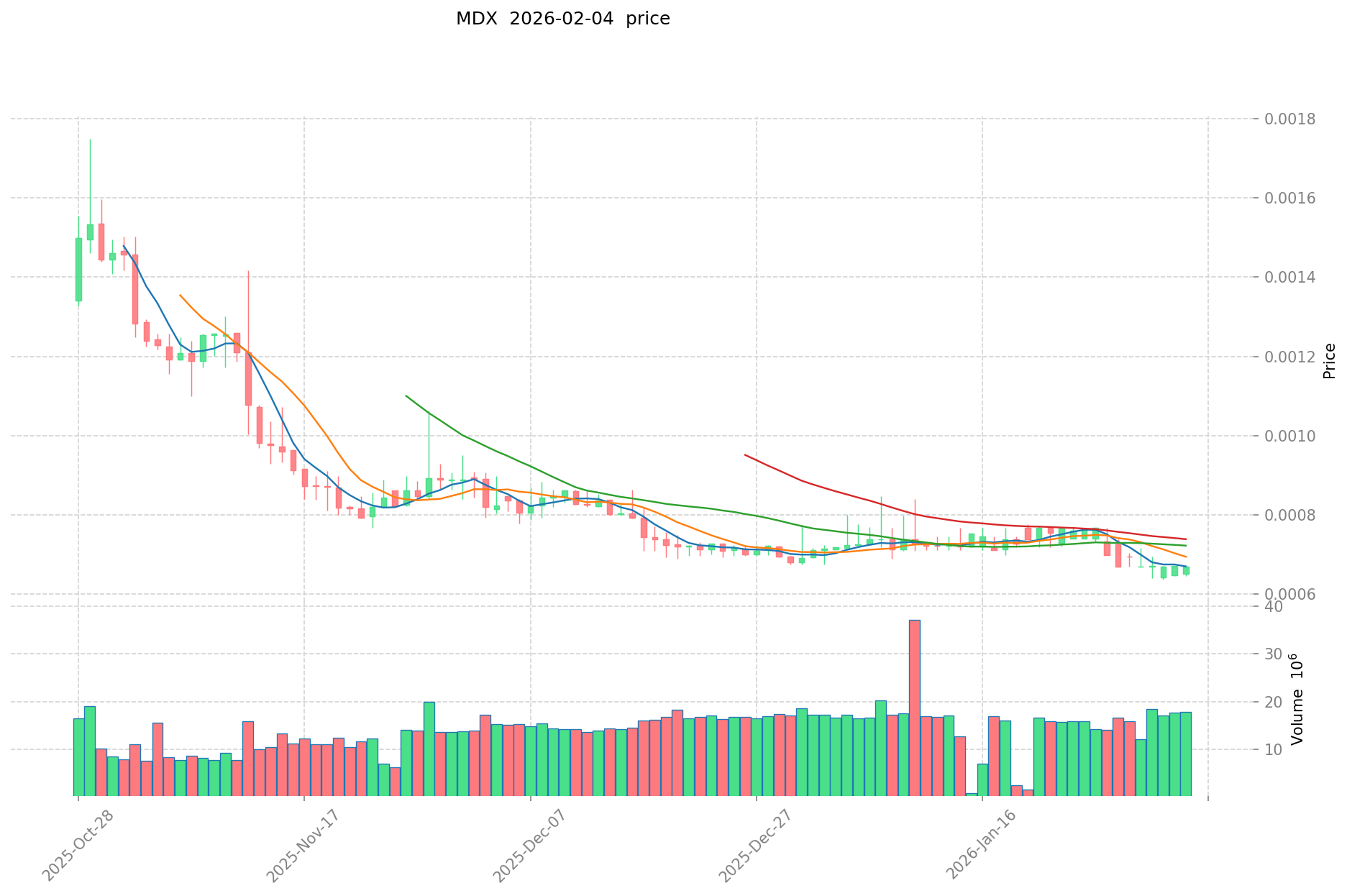
MDX reached its all-time high of $10.06 on February 22, 2021, during a period of heightened market activity in the decentralized finance sector.
Its all-time low of $0.000629 occurred on February 05, 2026, reflecting recent market conditions.
These fluctuations demonstrate market sentiment, adoption trends, and external factors affecting the token's valuation.
Click to view current MDX market price
On-Chain Metrics
- Holder Count: 984 addresses (indicating community participation level)
- 24-hour Trading Volume: $11,501.78 (showing current market activity)
- Market Cap to FDV Ratio: 89.65% (reflecting the proportion of circulating supply relative to total supply)
Mdex Ecosystem Applications and Partners
Core Use Cases
Mdex's ecosystem supports multiple applications:
- DeFi: As a decentralized exchange (DEX), Mdex provides automated market making and token swapping services.
- Liquidity Mining: The platform offers dual mining mechanisms for liquidity provision and trading, enabling users to earn rewards through participation.
Strategic Collaborations
Based on the available information, specific strategic partnerships are not detailed in the provided materials.
Controversies and Challenges
Mdex faces several challenges:
- Technical Hurdles: As a dual-chain DEX operating across multiple blockchain ecosystems, maintaining seamless cross-chain functionality presents ongoing technical demands.
- Market Competition: The DEX sector features intense competition from various decentralized trading platforms.
- Price Volatility: The token has experienced significant price fluctuations, with a 78.60% decline over the past year.
These factors have prompted discussions within the community and driven continuous platform evolution.
Mdex Community and Social Media Atmosphere
Community Engagement
Mdex maintains an active presence with 984 holders as of February 05, 2026. The platform's Twitter account serves as a primary channel for community updates and engagement. Recent trading activity shows a 24-hour volume of approximately $11,501.78.
Social Media Sentiment
Social media discussions present varied perspectives:
- Supporters highlight Mdex's low transaction fees and dual-chain architecture, viewing it as an innovative solution for decentralized trading.
- Critics focus on price performance concerns and competitive pressures within the DEX landscape.
Current market dynamics reflect a 24-hour price increase of 2.47% alongside longer-term volatility.
Trending Topics
Community discussions frequently address Mdex's dual-chain model, mining mechanisms, and market positioning, examining both its innovative features and competitive challenges.
Mdex Additional Information Sources
- Official Website: Visit Mdex Official Site for platform features, use cases, and latest developments.
- Whitepaper: Mdex Documentation details its technical architecture, objectives, and vision.
- Twitter Updates: Mdex maintains an active presence on Twitter via @MdexTech, sharing updates on platform developments and community activities.
Mdex Future Roadmap
Specific roadmap details are not provided in the available materials.
How to Participate in Mdex?
- Purchase Options: MDX tokens can be traded on Gate.com
- Storage Solutions: Tokens can be stored in compatible wallets supporting BSC and ETH networks
- Platform Participation: Users can engage with the platform by providing liquidity or trading to participate in the dual mining mechanism
- Ecosystem Development: Visit the official documentation to explore development opportunities
Summary
Mdex represents an innovative approach to decentralized exchange through its dual-chain architecture, offering low transaction costs, automated market making, and dual mining rewards. Its active community and multi-chain support position it within the competitive DEX landscape. Despite facing market volatility and competitive pressures, Mdex's technical innovation and DeFi integration demonstrate its commitment to providing diversified decentralized trading services. Whether you are new to DeFi or an experienced participant, Mdex offers opportunities for engagement in decentralized finance.
FAQ
What is MDX and how does it work in the crypto ecosystem?
MDX is a Modular Digital Exchange technology in decentralized finance enabling efficient trading and liquidity provision. It supports interactive content creation and enhances trading experiences within the crypto ecosystem through modular architecture.
What are the main use cases and features of MDX token?
MDX token enables trading, liquidity provision, and governance on the Mdex platform. It rewards holders, facilitates fundraising, and serves as the core utility asset for ecosystem participation and value distribution.
How do I buy and trade MDX tokens, and what are the associated risks?
You can buy and trade MDX tokens using decentralized swap features in crypto wallets. Risks include market volatility, smart contract vulnerabilities, and liquidity fluctuations. Always research thoroughly before trading.
What is the difference between MDX and other decentralized exchange tokens?
MDX is the native token of Mdex, a DEX on Heco blockchain, providing liquidity mining and governance rights. Unlike other DEX tokens on different chains, MDX offers unique Heco ecosystem integration and optimized trading efficiency.
What is the tokenomics and supply structure of MDX?
MDX has a total supply of 8 billion tokens with a release rate of 4 million tokens per month over 13 years and 4 months. Tokens are used for healthcare access, network governance, and validator staking rewards.
Share
Content
Mdex's Positioning and Significance
Origin and Development History
How Does Mdex Work?
Mdex (MDX) Market Performance
Mdex Ecosystem Applications and Partners
Controversies and Challenges
Mdex Community and Social Media Atmosphere
Mdex Additional Information Sources
Mdex Future Roadmap
How to Participate in Mdex?
Summary
FAQ
How to Buy Cryptocurrency


Trending Cryptocurrencies



XZXX: A Comprehensive Guide to the BRC-20 Meme Token in 2025

Survey Note: Detailed Analysis of the Best AI in 2025

Detailed Analysis of the Best 10 GameFi Projects to Play and Earn in 2025

Kaspa’s Journey: From BlockDAG Innovation to Market Buzz

Best Crypto Wallets 2025: How to Choose and Secure Your Digital Assets
Popular GameFi Games in 2025

Top 5 Tokens to Consider for DeFi Investment
Tax Planning for Bitcoin Investors Who Have Achieved Millionaire Status

FUD and FOMO in Crypto: Key Concepts Explained with Practical Examples
OpenSea NFT Exchange: Reviews, Advantages and Disadvantages

Top 10 Metaverse Platforms: An In-Depth Overview